A scientific notation calculator rewrites any number as a number from 1 to 10 times a power of ten, so 45,000 becomes 4.5 × 10⁴. Type a number in the scientific notation calculator above to get scientific notation, E notation and standard form with the steps, or switch modes to multiply, divide, add and subtract.
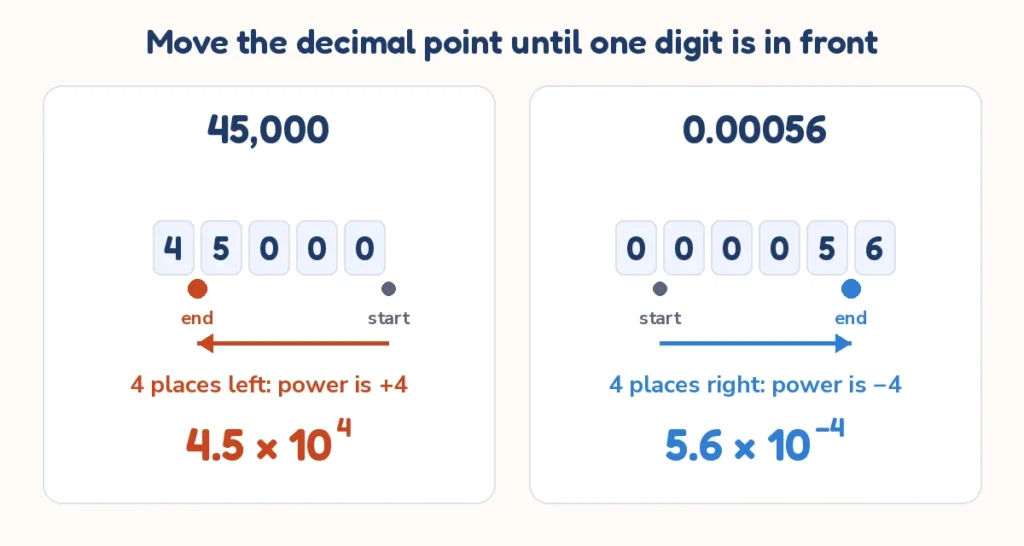
Quick answer: scientific notation is a × 10n, where a is at least 1 and less than 10 and n is a whole number. Move the decimal point until one non-zero digit is in front; the number of places you moved it is n (positive for big numbers, negative for numbers below 1). So 45,000 = 4.5 × 10⁴ and 0.00056 = 5.6 × 10⁻⁴.
How to use the scientific notation calculator
The scientific notation calculator has two modes. Convert a number turns one number into scientific notation. Calculate with two numbers multiplies, divides, adds or subtracts and gives the answer in scientific notation. Answers update as you type.
- Choose Convert a number or Calculate with two numbers.
- Type the number in ordinary form (45000 or 0.00056), in E notation (4.5e4) or as 4.5 x 10^4.
- In calculate mode, pick the operation and type the second number.
- Optionally limit the answer to 2 to 6 significant digits, then read the answer and the steps.
| Setting | What it does |
|---|---|
| Convert a number | Gives scientific notation, E notation, standard form (written out), engineering notation and the power of ten. |
| Calculate with two numbers | Multiplies, divides, adds or subtracts two numbers and shows the working in scientific notation. |
| Significant digits | Rounds the front number to 2 to 6 digits, or keeps all digits. |
Scientific notation formula and rules
A number N in scientific notation is N = a × 10n, with 1 ≤ |a| < 10 and n a whole number. The front number a is called the coefficient or mantissa, and n is the exponent or power of ten. To convert, follow these rules:
- Move the decimal point until exactly one non-zero digit is in front of it. That gives a.
- Count how many places you moved it. That count is n.
- If you moved the point left, the original number was large and n is positive. If you moved it right, the number was below 1 and n is negative.
- A number from 1 up to 10 needs no move, so n = 0.
Worked example 1: convert 0.00056
The digits are 56. Put the point after the first non-zero digit to get 5.6. To turn 5.6 back into 0.00056, the point must move 4 places to the left, so the original number is small and the power is −4. Therefore 0.00056 = 5.6 × 10⁻⁴, which is 5.6e-4 in E notation. This is the default example in the scientific notation calculator.
Worked example 2: multiply 4.5 × 104 by 4 × 10−2
Multiply the front numbers: 4.5 × 4 = 18. Add the powers: 4 + (−2) = 2. That gives 18 × 102, but the front number must be below 10, so move the point one place left and add 1 to the power: 1.8 × 10³, or 1,800.
Scientific notation examples and a printable chart
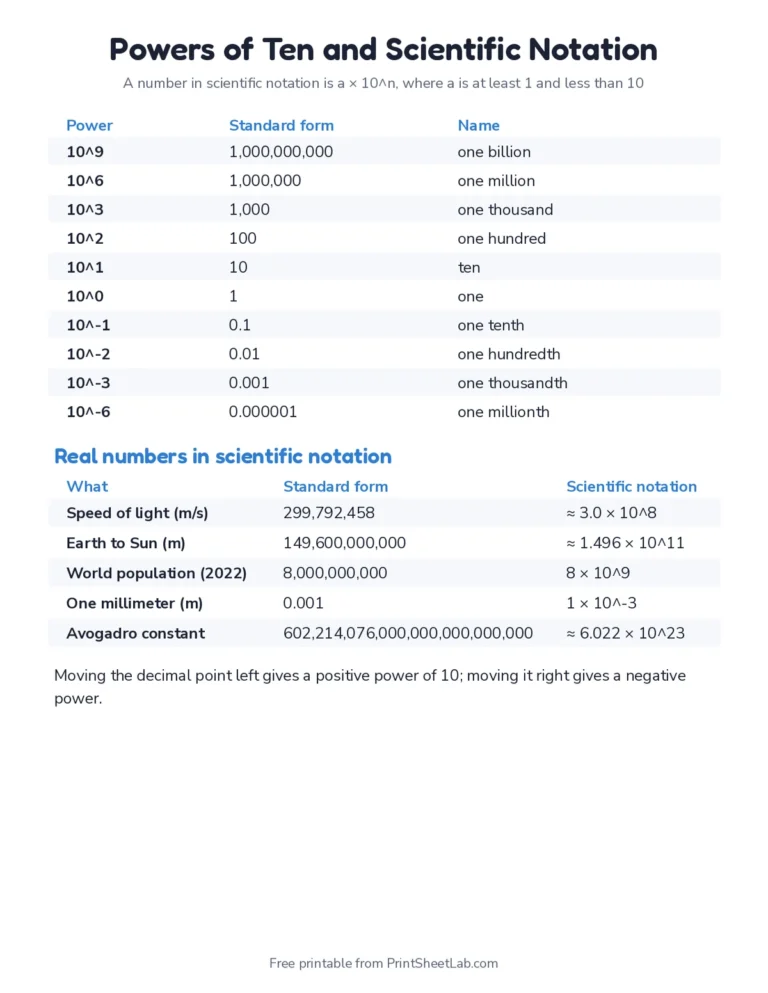
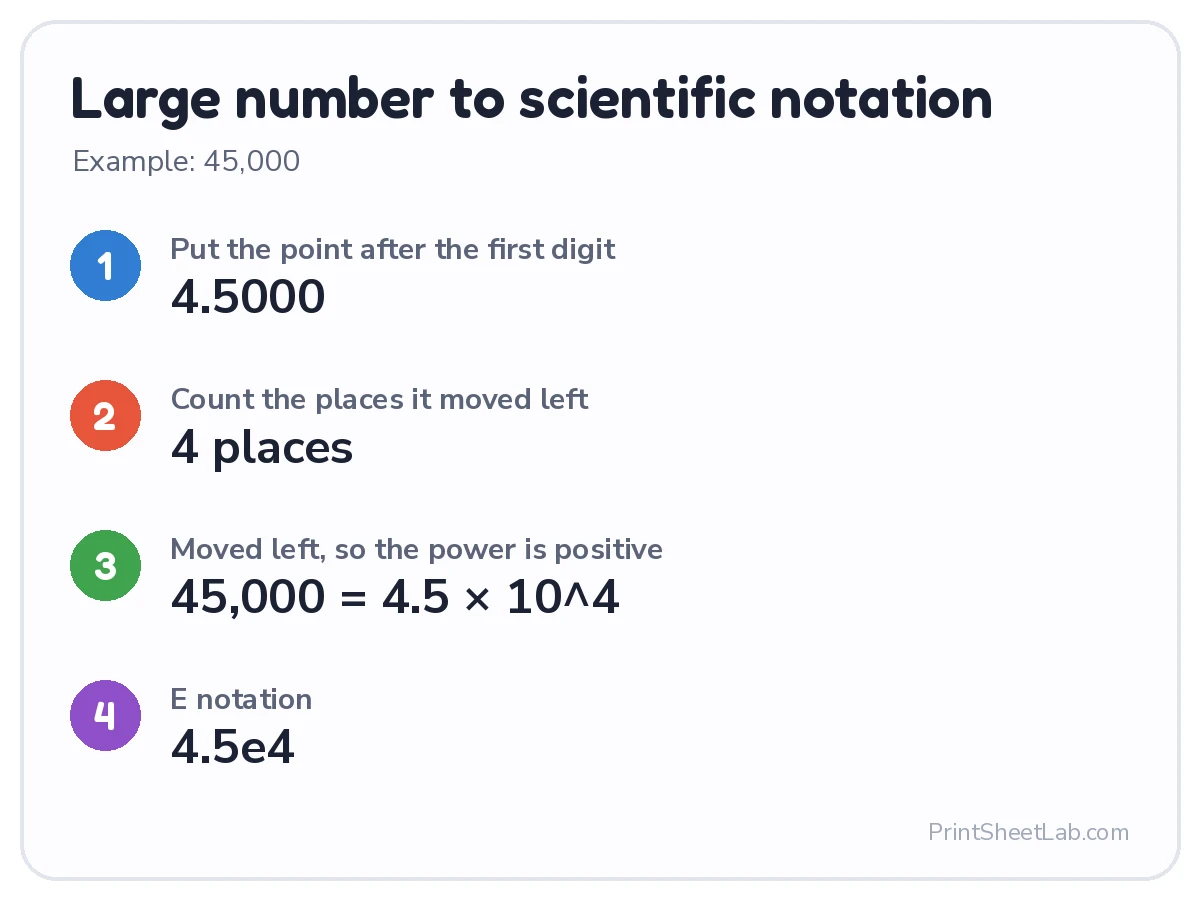
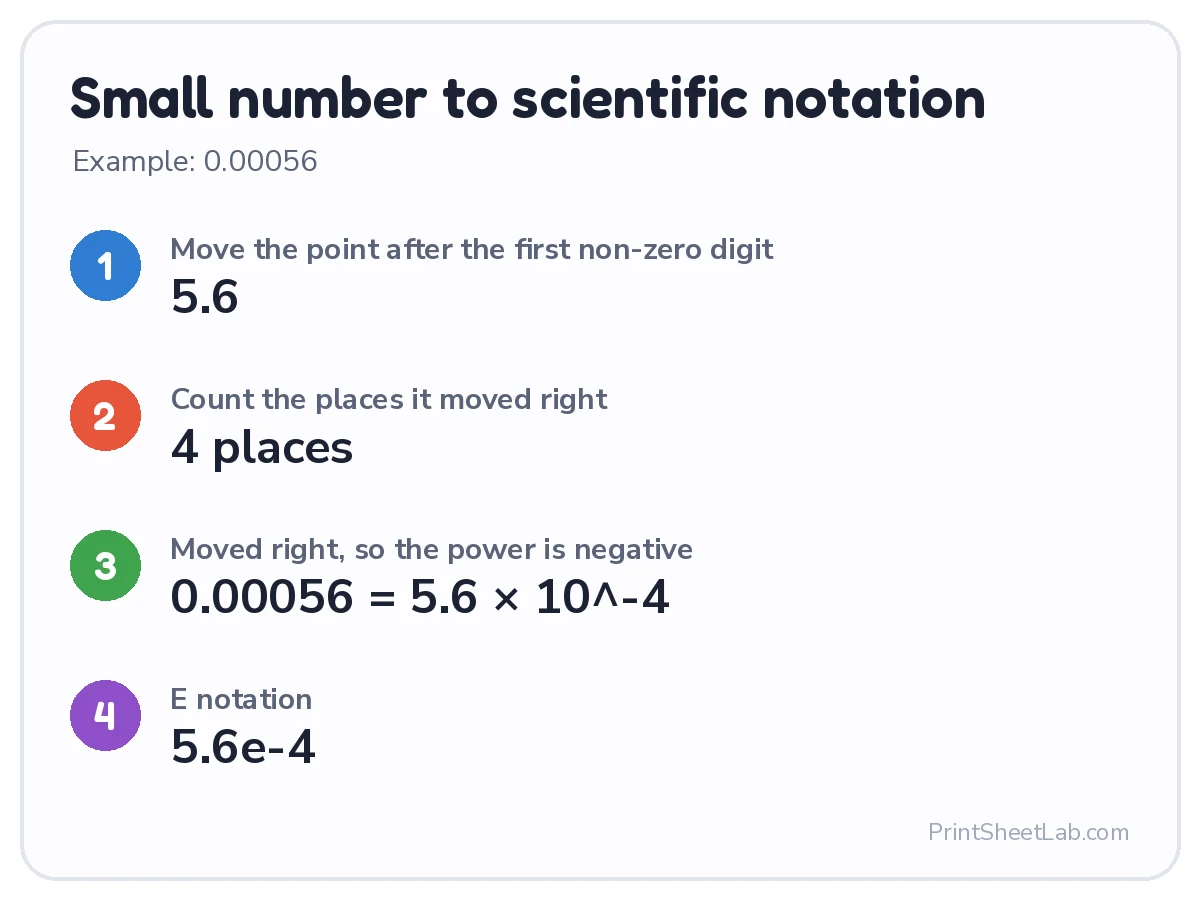
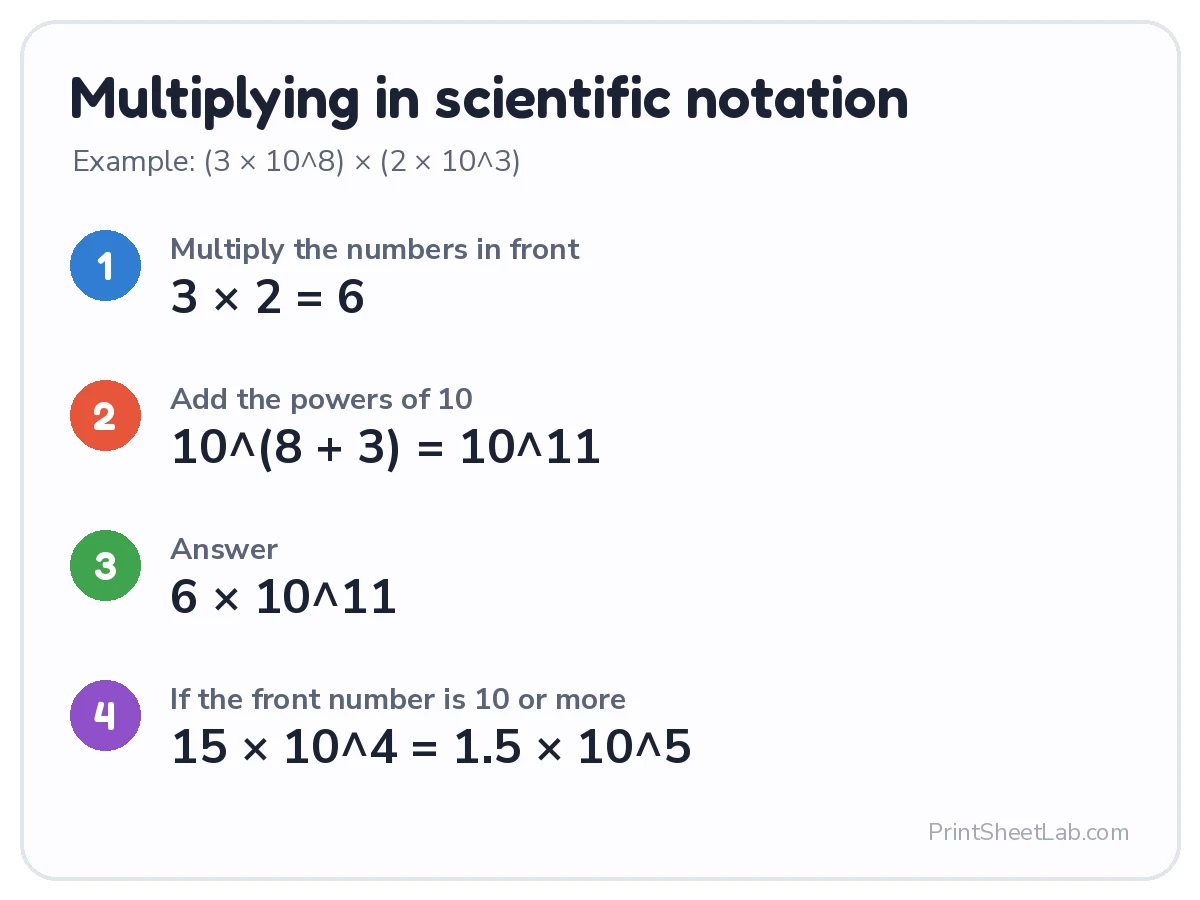
The cards convert a large number and a small number step by step, then multiply two numbers in scientific notation. The printable chart lists the powers of ten from a billion to a millionth with real-world numbers.
Converting large numbers to scientific notation
To write a large number in scientific notation, move the decimal point to the left until only one non-zero digit is in front of it. The number of places you moved it becomes a positive power of ten. For 45,000, moving the point 4 places left gives 4.5, so 45,000 = 4.5 × 10⁴. For 299,792,458, the speed of light in meters per second, moving it 8 places gives 2.99792458 × 10⁸, often rounded to 3.0 × 10⁸.
Converting small numbers to scientific notation
For a number smaller than 1, move the decimal point to the right until it sits just after the first non-zero digit. The power of ten is negative and equals the number of places you moved. For 0.00056, moving the point 4 places right gives 5.6, so 0.00056 = 5.6 × 10⁻⁴. One millimeter is 0.001 m, or 1 × 10⁻³ m. Big numbers have positive powers, numbers between 0 and 1 have negative powers, and numbers from 1 up to 10 have a power of 0.
Scientific notation converter: a quick lookup table
This table was made with the same rules as the scientific notation converter. Engineering notation is a variant that keeps the power a multiple of 3.
| Number | Scientific notation | E notation | Engineering notation |
|---|---|---|---|
| 45,000 | 4.5 × 10⁴ | 4.5e4 | 45 × 103 |
| 0.00056 | 5.6 × 10⁻⁴ | 5.6e-4 | 560 × 10−6 |
| 6,100,000 | 6.1 × 10⁶ | 6.1e6 | 6.1 × 10⁶ |
| 0.0000032 | 3.2 × 10⁻⁶ | 3.2e-6 | 3.2 × 10⁻⁶ |
| 1,250 | 1.25 × 10³ | 1.25e3 | 1.25 × 10³ |
| 0.5 | 5 × 10⁻¹ | 5e-1 | 500 × 10−3 |
| 93,000,000 | 9.3 × 10⁷ | 9.3e7 | 93 × 106 |
| 0.000000075 | 7.5 × 10⁻⁸ | 7.5e-8 | 75 × 10−9 |
Scientific notation to standard form
To go from scientific notation to standard form, move the decimal point the number of places shown by the power: right for a positive power, left for a negative one, adding zeros as needed. For 3.2 × 10⁵, move the point 5 places right: 320,000. For 7.1 × 10⁻³, move it 3 places left: 0.0071. Type either form into the calculator to check the answer.
| Scientific notation | Standard form | E notation |
|---|---|---|
| 1 × 10⁶ | 1,000,000 | 1e6 |
| 2.5 × 10⁴ | 25,000 | 2.5e4 |
| 3.2 × 10⁵ | 320,000 | 3.2e5 |
| 9.81 × 100 | 9.81 | 9.81e0 |
| 4 × 10⁻² | 0.04 | 4e-2 |
| 7.1 × 10⁻³ | 0.0071 | 7.1e-3 |
| 6.02 × 10⁸ | 602,000,000 | 6.02e8 |
| 8.5 × 10⁻⁶ | 0.0000085 | 8.5e-6 |
E notation and the standard form calculator
E notation is how calculators, spreadsheets and programming languages show scientific notation. The letter e (or E) means “times ten to the power of”, so 4.5e4 is 4.5 × 10⁴ and 5.6e-4 is 5.6 × 10⁻⁴. If a screen shows 6.02E23, it means 6.02 × 10²³. You can type E notation straight into the converter to get the number written out in full.
The phrase “standard form” means different things in different countries. In the United States it usually means the number written out normally, like 45,000. In the United Kingdom, standard form is another name for scientific notation, as Wikipedia’s scientific notation article explains. This standard form calculator gives both versions side by side, so it works whichever meaning your course uses.
How E notation looks in different tools
| Tool | What to do | Shows 45,000 as |
|---|---|---|
| Python | print(4.5e4) shows 45000.0; format(45000, ‘.2e’) gives | 4.50e+04 |
| Excel and Google Sheets | Format Cells, Number, Scientific with 2 decimals, or type 4.5E4 | 4.50E+04 |
| TI-84 graphing calculator | MODE, then choose Sci (or Eng for engineering notation) | 4.5E4 |
| Scientific calculators | Use the EE or EXP key to type the power of ten; SCI mode shows results this way | 4.5E4 |
Multiplying scientific notation, dividing, adding and subtracting
The scientific notation calculator handles all four operations in its calculate mode. Here are the rules it follows, with an example each:
- Multiplying scientific notation: multiply the front numbers and add the powers. (3 × 108) × (2 × 103) = 6 × 10¹¹.
- Dividing: divide the front numbers and subtract the powers. (8 × 10⁶) ÷ (2 × 10²) = 4 × 10⁴.
- Adding and subtracting: make the powers the same first, then add or subtract the front numbers. 3 × 10⁴ + 2 × 103 = 3 × 10⁴ + 0.2 × 104 = 3.2 × 10⁴.
- Tidying: if the front number ends up 10 or more (or below 1), move the point and change the power: 15 × 104 = 1.5 × 10⁵.
| Calculation | Answer in scientific notation | Standard form |
|---|---|---|
| 3 × 108 × 2 × 103 | 6 × 10¹¹ | 600,000,000,000 |
| 8 × 10⁶ ÷ 2 × 10² | 4 × 10⁴ | 40,000 |
| 4.5 × 104 × 4 × 10−2 | 1.8 × 10³ | 1,800 |
| 3 × 10⁴ + 2 × 10³ | 3.2 × 10⁴ | 32,000 |
| 3 × 10⁴ − 2 × 10³ | 2.8 × 10⁴ | 28,000 |
| 5 × 10−3 × 6 × 10−5 | 3 × 10⁻⁷ | 0.0000003 |
Scientific notation with negative exponents
A negative exponent means a number between 0 and 1, not a negative number. 10−3 is 0.001, and 4 × 10⁻³ is 0.004. A negative number has a minus sign on the front number instead: −4 × 10³ is −4,000. When you multiply, add the exponents even if one is negative: 105 × 10−2 = 103.
Scientific notation on a calculator: the EE key and SCI mode
Most scientific calculators have an EE or EXP key that types the “times ten to the power” part, so 4.5 × 10⁴ is entered as 4.5, EE, 4. SCI mode (on a TI-84, press MODE and choose Sci) makes every answer appear in scientific notation, and Eng mode shows engineering notation. If a calculator gives an error on a very large number, type it into this scientific notation calculator instead.
Powers of ten and SI prefixes
Scientific notation and metric prefixes are two ways of saying the same thing. The table follows the SI prefix list published by NIST, so 5 km is 5 × 10³ m and 3 nm is 3 × 10⁻⁹ m.
| Power of ten | Standard form | SI prefix | Symbol | Name |
|---|---|---|---|---|
| 1012 | 1,000,000,000,000 | tera | T | trillion |
| 109 | 1,000,000,000 | giga | G | billion |
| 106 | 1,000,000 | mega | M | million |
| 103 | 1,000 | kilo | k | thousand |
| 10−2 | 0.01 | centi | c | hundredth |
| 10−3 | 0.001 | milli | m | thousandth |
| 10−6 | 0.000001 | micro | μ | millionth |
| 10−9 | 0.000000001 | nano | n | billionth |
| 10−12 | 0.000000000001 | pico | p | trillionth |
Real numbers in scientific notation: the exact SI constants
Physics is full of numbers that only make sense in scientific notation. Since 2019 the SI units are defined by fixed values of seven constants, and NIST lists each of the five below as exact, with no uncertainty. Type any of them into the scientific notation calculator to see the full standard form.
| Constant | Symbol | Exact value in scientific notation |
|---|---|---|
| Speed of light in vacuum | c | 2.99792458 × 10⁸ m/s (299,792,458 m/s) |
| Planck constant | h | 6.62607015 × 10⁻³⁴ J s |
| Elementary charge | e | 1.602176634 × 10⁻¹⁹ C |
| Boltzmann constant | k | 1.380649 × 10⁻²³ J/K |
| Avogadro constant | NA | 6.02214076 × 10²³ per mole |
Scientific notation and significant figures
Scientific notation also shows how precise a measurement is. The front number holds the significant digits, so 3.00 × 10⁸ has three and 3 × 10⁸ has one. Plain 300,000,000 is ambiguous, because the zeros might or might not be significant. Use the significant digits setting to round a result to 2 to 6 digits, and see the significant figures calculator for the counting rules. For 299,792,458, three digits gives 3.00 × 10⁸.
Scientific notation calculator with steps: common mistakes
| Mistake | Why it is wrong | Correct form |
|---|---|---|
| 45 × 103 | Front number must be below 10 | 4.5 × 10⁴ |
| 0.3 × 10⁻² | Front number must be at least 1 | 3 × 10⁻³ |
| 10 × 106 | 10 is not below 10 | 1 × 10⁷ |
| 0.003 = 3 × 10³ | Numbers below 1 need a negative power | 3 × 10⁻³ |
| 0.00056 = 5.6 × 10⁻³ | Count places moved (4), not zeros (3) | 5.6 × 10⁻⁴ |
Scientific notation practice problems
Try these on paper first, then check each one in the scientific notation calculator (answers in brackets):
- Write 530,000 in scientific notation. (5.3 × 10⁵)
- Write 0.0000074 in scientific notation. (7.4 × 10⁻⁶)
- Write 8.1 × 10⁵ in standard form. (810,000)
- Multiply (2 × 103) by (7 × 105). (1.4 × 10⁹)
- Divide (9 × 108) by (3 × 10−2). (3 × 10¹⁰)
- Add 6.5 × 10⁴ and 3.5 × 10⁴. (1 × 10⁵)
Scientific notation in chemistry: counting atoms
One mole of anything contains 6.02214076 × 10²³ particles. So 2.5 moles contain 2.5 × 6.02214076 × 1023 = 1.50553519 × 1024 particles. Multiply the front numbers (2.5 × 6.02214076 = 15.0553519) and keep the power of ten; if the front number comes out as 10 or more, tidy it afterwards.
Where scientific notation is used
Science and engineering use scientific notation because it keeps very large and very small numbers readable and makes comparison quick: a number with a power of 9 is about a thousand times bigger than one with a power of 6.
Chemistry counts particles with the Avogadro constant, physics uses the speed of light and the Planck constant, and computing uses E notation for floating-point numbers. Students usually meet scientific notation in eighth grade in the United States. For related practice, see the place value worksheets, the place value chart and the number to words converter.
Scientific notation calculator: frequently asked questions
What is 0.00056 in scientific notation?
5.6 × 10⁻⁴. The decimal point moves 4 places to the right, so the power of ten is −4.
How do I convert scientific notation back to a normal number?
Move the decimal point the number of places shown by the power: right for a positive power, left for a negative one. Or type it in E notation (like 4.5e4) and the converter writes it out.
What does e mean on a calculator?
The letter e means “times ten to the power of”. 3.2e5 is 3.2 × 105 = 320,000.
How do I multiply numbers in scientific notation?
Multiply the front numbers, add the exponents, then tidy so the front number is between 1 and 10. (3 × 108) × (2 × 103) = 6 × 10¹¹.
How do I add numbers in scientific notation?
Rewrite them with the same power of ten, add the front numbers and tidy the result. 3 × 10⁴ + 2 × 103 = 3.2 × 10⁴.
Can the front number be 10?
No. It must be at least 1 and less than 10, so 10 × 103 is written 1 × 10⁴.
Does the scientific notation calculator handle negative numbers?
Yes. −45,000 becomes −4.5 × 10⁴; the sign stays on the front number.
Why can’t I enter zero?
No power of ten turns zero into a number from 1 to 10, so zero has no scientific notation form. Zero is simply written 0, and a calculation that ends in exactly zero shows 0 as the answer.
Is standard form the same as scientific notation?
In the United Kingdom, yes: standard form means scientific notation. In the United States, standard form usually means the ordinary written-out number.
What is engineering notation?
It is scientific notation with the power of ten kept to a multiple of 3, so 45,000 is 45 × 103. It lines up with SI prefixes such as kilo and mega.
Related calculators
- Significant figures calculator: count and round significant digits
- Rounding calculator and unit converter
- Number to words converter and square root calculator
- All calculators
Sources and further reading
Last updated: October 2026.