A number to words converter writes a number in English words, so 1,250.75 becomes one thousand two hundred fifty point seven five. This free number to words converter also writes check and cheque amounts for the US, Canada, the UK, Australia, New Zealand and India, gives ordinals such as twenty-first, and speaks lakh and crore.
Quick answer: To write a number in words, split it into groups of three digits from the right, say each group as a number under 1,000 and add its name: thousand, million, billion. So 1,234,567 is one million two hundred thirty-four thousand five hundred sixty-seven. On a US check, $1,250.75 is One thousand two hundred fifty and 75/100 dollars.
How to use the number to words converter
- Type a number. Commas, a minus sign and a decimal point are fine, and 1250.75 and 1,250.75 work the same.
- Choose Number to words, Check or cheque or Ordinal.
- Pick the spelling rule (American or British) or, for checks, the country. Choose capital letters and hyphens if you need them.
- Copy the result or share the exact settings with Copy link.
| Mode | You get | Example for 1,250.75 |
|---|---|---|
| Number to words | the number in words, with American, British and Indian wording listed | one thousand two hundred fifty point seven five |
| Check or cheque | the amount line for six countries | One thousand two hundred fifty and 75/100 dollars |
| Ordinal | first, second, third and so on (whole numbers only) | for 21: twenty-first |
Examples and a printable number words chart
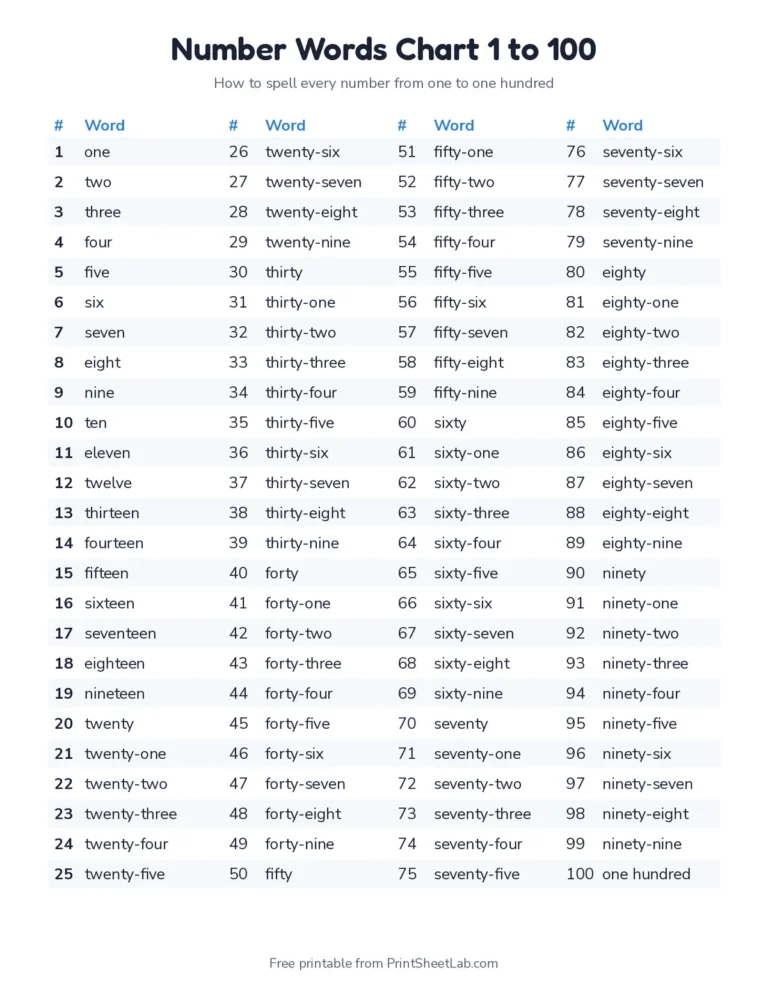
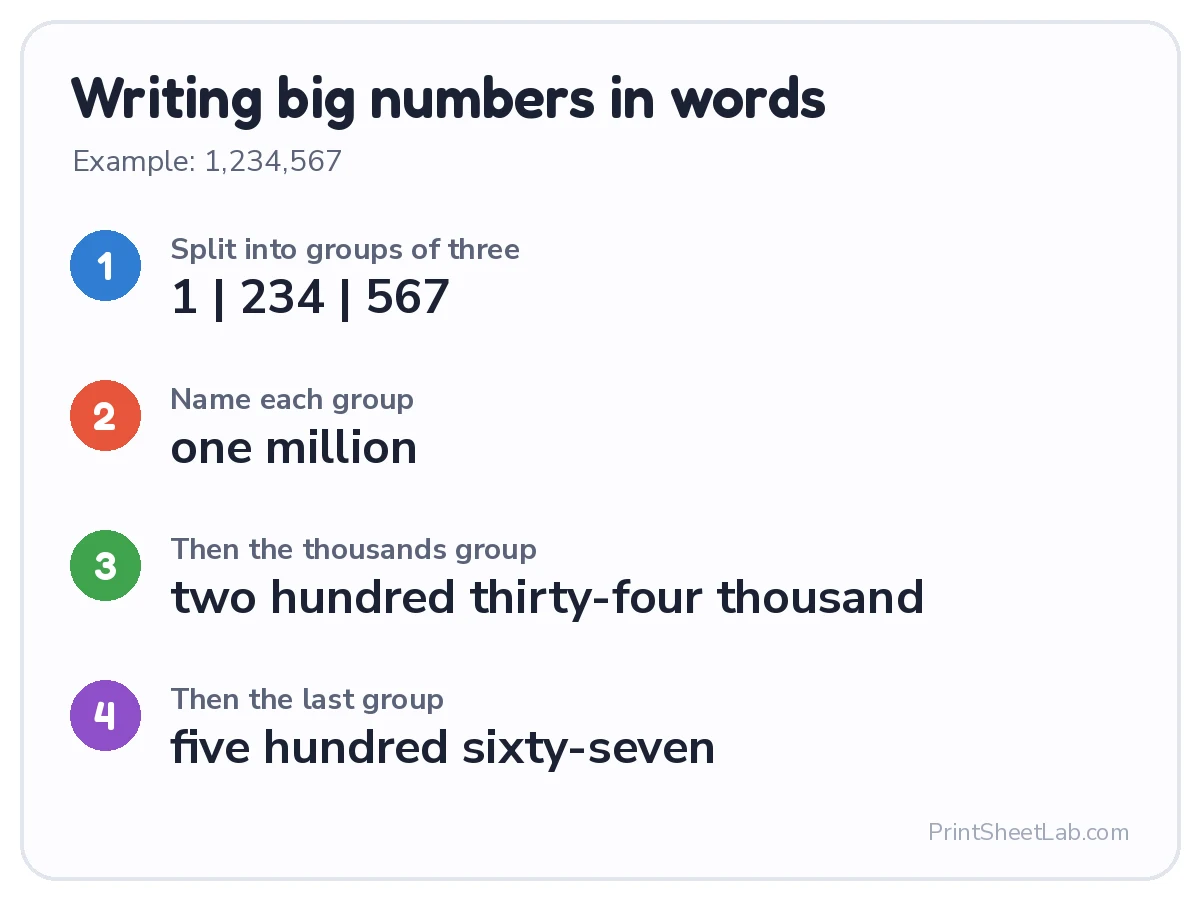
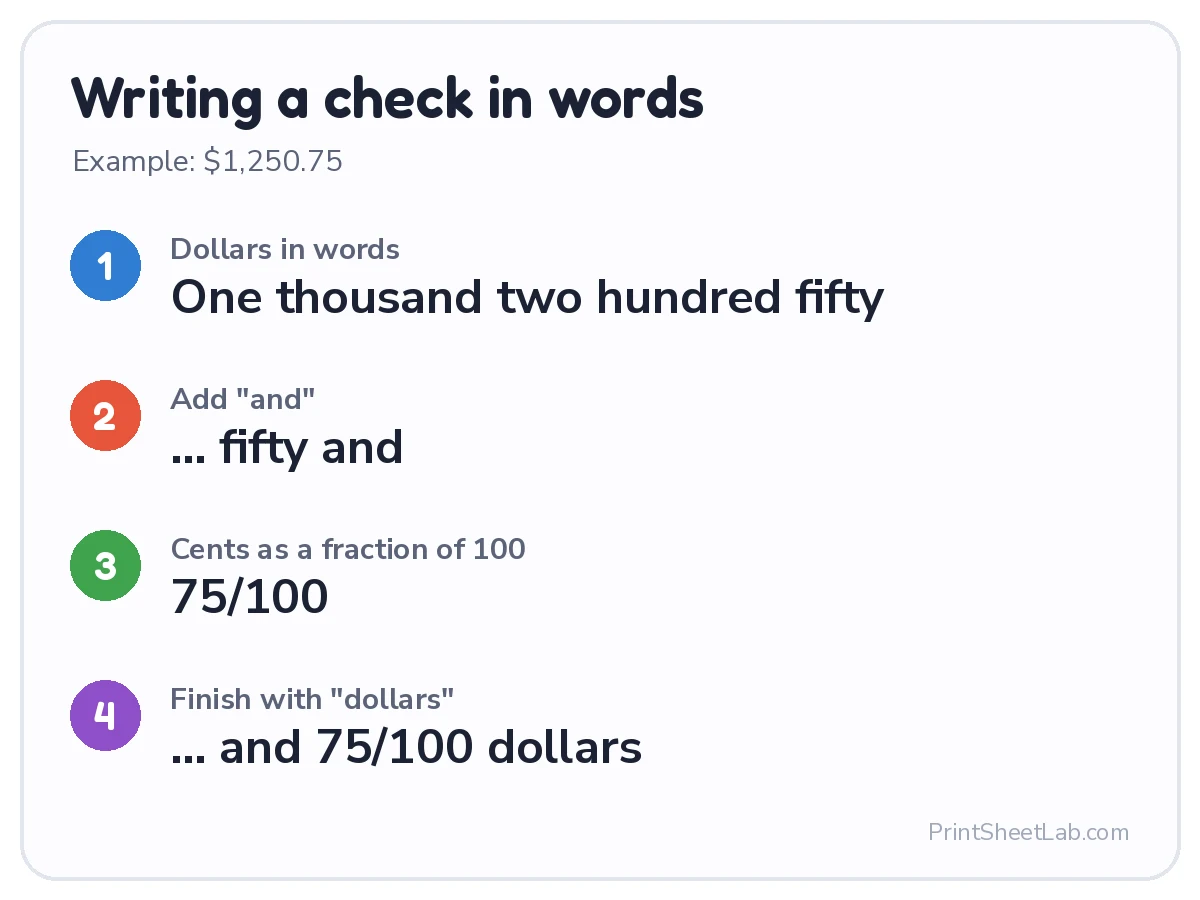
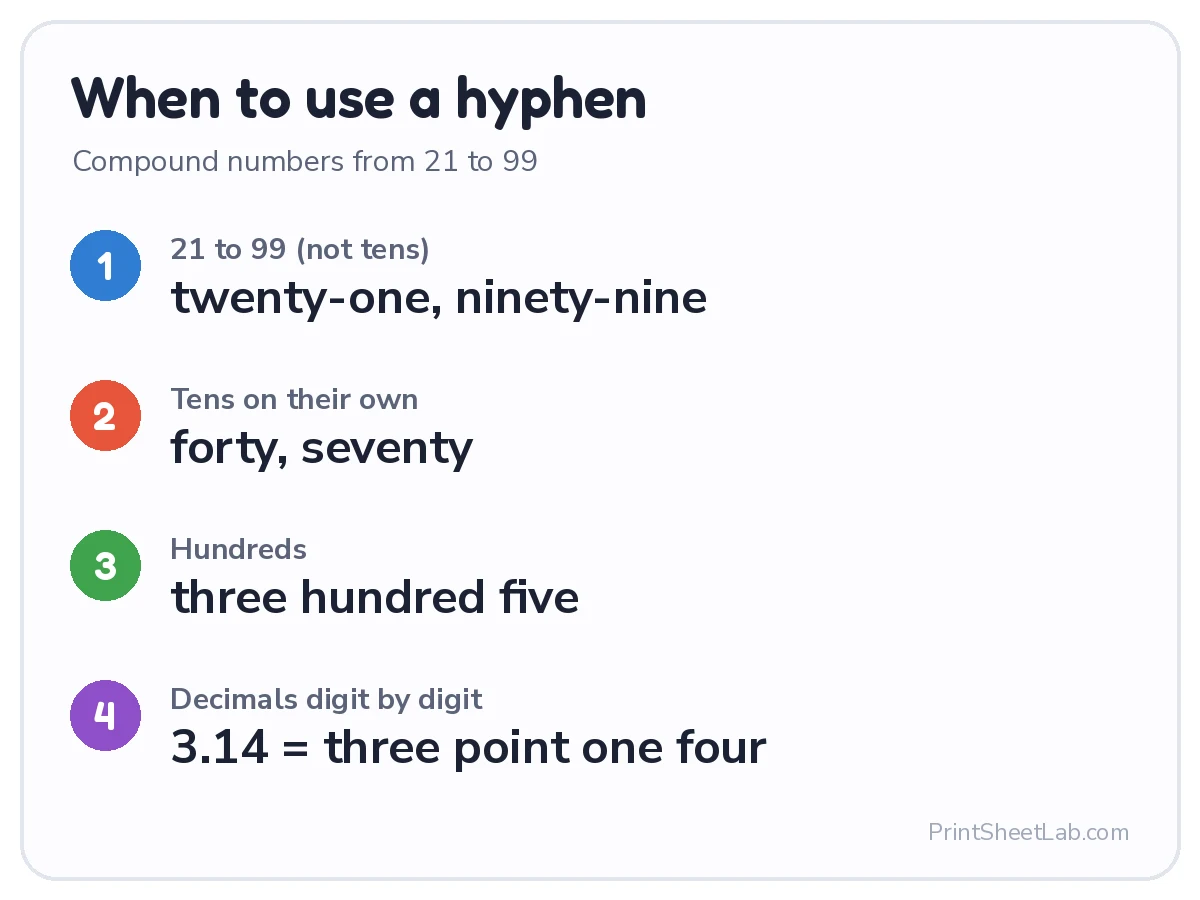
The cards show how to write big numbers in words using groups of three digits, how to write a check and when to use a hyphen. The printable chart spells every number from 1 to 100, a useful spelling reference for young writers.
How to write numbers in words
The trick for any large number is to split it into groups of three digits from the right, then name each group with its place: thousand, million, billion, trillion. A group of three zeros is skipped. Each group is read as a number from one to nine hundred ninety-nine, followed by its name.
Worked example 1. Write 1,234,567 in words. The groups are 1 (millions), 234 (thousands) and 567 (ones), which are read one million, two hundred thirty-four thousand and five hundred sixty-seven. Written without commas, that is one million two hundred thirty-four thousand five hundred sixty-seven.
Worked example 2. Write 5,000,019 in words. The groups are 5, 000 and 019. The thousands group is all zeros, so it disappears: five million nineteen. The place value chart shows the groups visually, and the place value worksheets give practice reading big numbers.
| Number | In words |
|---|---|
| 47 | forty-seven |
| 306 | three hundred six |
| 4,090 | four thousand ninety |
| 72,815 | seventy-two thousand eight hundred fifteen |
| 900,000 | nine hundred thousand |
| 1,000,001 | one million one |
Number to words rules: hyphens, and, commas and decimals
Four small rules cover almost every case. Hyphens join the tens and ones from twenty-one to ninety-nine, as in forty-two and seventy-eight, but not tens on their own (forty) or separate groups (three hundred five). Commas are not needed in the words. A decimal point is read as point, then each digit one at a time: 2.05 is two point zero five.
The fourth rule is the word and. In American English it stays out of whole numbers, so 105 is one hundred five. British, Australian, New Zealand and Indian English often put it after hundred and before a last number under 100. The number to words converter has a switch for each style, and Wikipedia’s English numerals article covers the details.
| Number | American | British |
|---|---|---|
| 105 | one hundred five | one hundred and five |
| 1,005 | one thousand five | one thousand and five |
| 2,026 | two thousand twenty-six | two thousand and twenty-six |
| 100,050 | one hundred thousand fifty | one hundred thousand and fifty |
| 1,200,000 | one million two hundred thousand | one million two hundred thousand |
| 1,000,050 | one million fifty | one million and fifty |
Number to words for check writing
A check shows the amount twice: in figures in the box and in words on the line below. The words are the legal amount, so write them clearly. The United States pattern is the dollars in words, the word and, the cents as a fraction of 100, then the word dollars. The converter’s check mode builds that line for you, including 00/100 for whole amounts, and you can add the word only or change the capital letters.
| Amount | Words on the check line (US) |
|---|---|
| $1,250.75 | One thousand two hundred fifty and 75/100 dollars |
| $89.00 | Eighty-nine and 00/100 dollars |
| $1,005.10 | One thousand five and 10/100 dollars |
| $1,500.00 | One thousand five hundred and 00/100 dollars |
| $0.50 | Zero and 50/100 dollars |
| $12,345.67 | Twelve thousand three hundred forty-five and 67/100 dollars |
Start at the far left of the line and draw a line through any empty space so nothing can be added. If the words and the figures disagree, the words win in the United States under Uniform Commercial Code section 3-114, and in the UK under section 9 of the Bills of Exchange Act 1882. A bank may still return a check that is unclear, so make them match.
How to write a check for $1,500
Write One thousand five hundred and 00/100 dollars on the line and 1,500.00 in the box. Choose Check or cheque in the converter, type 1500 and copy the result. For an amount with cents, such as $1,005.10, the line reads One thousand five and 10/100 dollars: write the cents as a fraction of 100, even when a digit is zero.
Cheque amount in words: UK, Canada, Australia and New Zealand
The same amount is worded differently by country. In the United Kingdom, Australia and New Zealand it is common to write the whole amount in words with the currency, then the pence or cents in words and the word only. Canadian checks are usually written like US ones. None of this is a single law, so follow any sample your bank prints. Here is $1,250.75 in each style:
| Country | Cheque amount in words |
|---|---|
| United States | One thousand two hundred fifty and 75/100 dollars |
| Canada | One thousand two hundred fifty and 75/100 dollars |
| United Kingdom (£1,250.75) | One thousand two hundred and fifty pounds and seventy-five pence only |
| Australia | One thousand two hundred and fifty dollars and seventy-five cents only |
| New Zealand | One thousand two hundred and fifty dollars and seventy-five cents only |
| India (₹1,250.75) | Rupees one thousand two hundred fifty and seventy-five paise only |
When the amount has no pence or cents, the UK style drops them: One thousand two hundred and fifty pounds only. Switch the cents setting to a fraction or the word only on or off if your bank prefers a different form. Wikipedia’s cheque article explains how cheques work and how practices differ.
Lakh and crore in words: the Indian numbering system
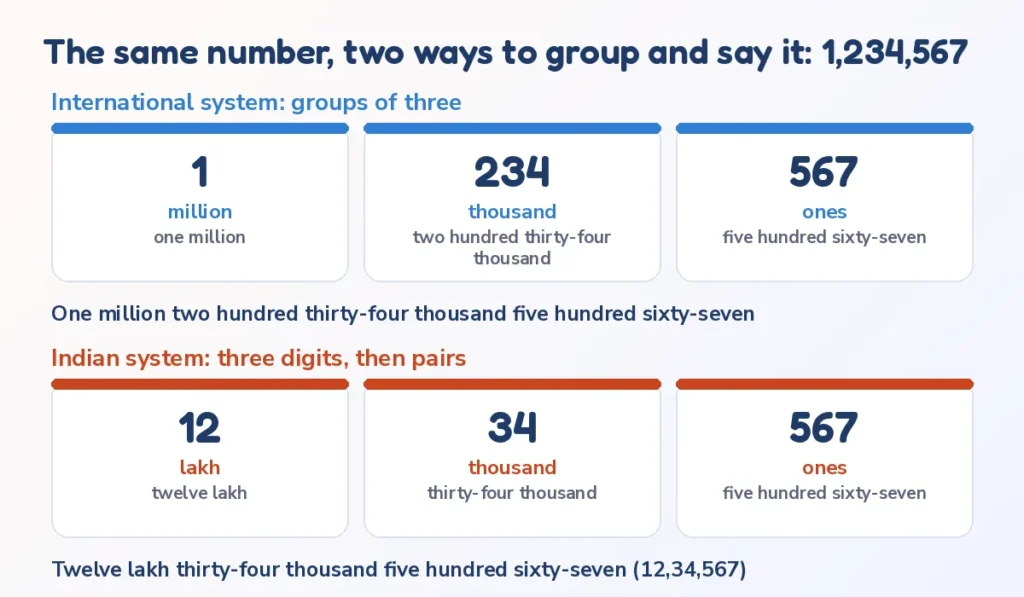
In India, Pakistan, Bangladesh, Nepal and Sri Lanka, large numbers are grouped differently: the last three digits, then pairs. One lakh is 1,00,000 (one hundred thousand) and one crore is 1,00,00,000 (ten million). Choose Indian (lakh, crore) in the numbering system setting, or pick India in check mode, and the converter groups and names the digits that way.
| Name | Value | Written in the Indian system |
|---|---|---|
| thousand | 1,000 | 1,000 |
| lakh | 100,000 | 1,00,000 |
| crore | 10,000,000 | 1,00,00,000 |
| arab (100 crore) | 1,000,000,000 | 1,00,00,00,000 |
| kharab (100 arab) | 100,000,000,000 | 1,00,00,00,00,000 |
| lakh crore | 1,000,000,000,000 | 10,00,00,00,00,000 |
The number to words converter speaks lakh and crore, including multiples such as lakh crore, for numbers up to 14 digits. Arab and kharab are listed above for reference, but everyday writing and most cheques use lakh and crore. The Indian cheque style is Rupees, the amount in words and the word Only, with paise after the word and when there are any.
| Number | International grouping | Indian grouping | In words (Indian system) |
|---|---|---|---|
| 150,000 | 150,000 | 1,50,000 | one lakh fifty thousand |
| 1,234,567 | 1,234,567 | 12,34,567 | twelve lakh thirty-four thousand five hundred sixty-seven |
| 30,000,000 | 30,000,000 | 3,00,00,000 | three crore |
| 250,000,000 | 250,000,000 | 25,00,00,000 | twenty-five crore |
| 1,000,000,000,000 | 1,000,000,000,000 | 10,00,00,00,00,000 | one lakh crore |
The Wikipedia article on the Indian numbering system gives the full list of names, including those above the crore.
Number to words for millions, billions and trillions
Each new name stands for another group of three zeros. English uses the short scale, in which a billion is a thousand million. Britain used a larger billion until the 1970s, and several European languages still use the long scale, so check the context for old texts. The number to words converter names numbers with up to 36 digits.
| Name | Zeros | Number |
|---|---|---|
| thousand | 3 | 1,000 |
| million | 6 | 1,000,000 |
| billion | 9 | 1,000,000,000 |
| trillion | 12 | 1,000,000,000,000 |
| quadrillion | 15 | 1,000,000,000,000,000 |
| quintillion | 18 | 1,000,000,000,000,000,000 |
| sextillion | 21 | 1,000,000,000,000,000,000,000 |
| septillion | 24 | 1,000,000,000,000,000,000,000,000 |
| octillion | 27 | 1,000,000,000,000,000,000,000,000,000 |
| nonillion | 30 | 1,000,000,000,000,000,000,000,000,000,000 |
| decillion | 33 | 1,000,000,000,000,000,000,000,000,000,000,000 |
The table follows the naming pattern in Wikipedia’s long and short scales article. A googol, 1 followed by 100 zeros, is a named number outside this range. For very big or very small numbers, see the scientific notation calculator.
Ordinal numbers in words: first, second, third
An ordinal names a position rather than an amount. To make one, change only the last word of the number: one becomes first, two second, three third, five fifth, eight eighth, nine ninth and twelve twelfth. Words ending in y change to ieth, so twenty becomes twentieth, and every other number just adds th. In figures, 11, 12 and 13 always take th, while 21, 22 and 23 take st, nd and rd.
| Number | Ordinal in words | In figures |
|---|---|---|
| 1 | first | 1st |
| 2 | second | 2nd |
| 3 | third | 3rd |
| 11 | eleventh | 11th |
| 21 | twenty-first | 21st |
| 40 | fortieth | 40th |
| 100 | one hundredth | 100th |
| 112 | one hundred twelfth | 112th |
| 1000 | one thousandth | 1,000th |
Choose Ordinal in the number to words converter to type any whole number and get both forms. For Roman numerals, try the Roman numeral converter.
Amount in words on invoices and legal documents
Contracts, invoices and bank forms often ask for an amount in words as well as figures, because words are harder to alter. The amount in words usually starts with a capital letter, avoids abbreviations and ends with a line or the word only. Check the document for its own style: some want all capitals, and some want the currency name before the number, as in Rupees.
The amount in words should match the figures exactly, including cents. If you round a total, round it first, then convert the rounded figure; the rounding calculator helps. For totals that include tax or a tip, work them out with the discount, tax and tip calculator before writing the words.
Years, phone numbers and other special cases
Some numbers are usually read in a special way. Years are often spoken in pairs: 1999 is nineteen ninety-nine, and 2026 can be twenty twenty-six or two thousand twenty-six. Phone numbers, zip codes and account numbers are read digit by digit, and a number that starts a sentence is spelled out. The number to words converter always gives the full counting form, which is the form used on checks, contracts and formal documents.
Style guides differ on when to spell out numbers in running text. Many school and news styles spell out one to nine and use figures for 10 and up. When a sentence mixes numbers, be consistent: write three apples and 12 pears, or write three apples and twelve pears, but avoid mixing styles in one list.
Numbers to words for students and teachers
Writing numbers in words is a standard place value skill in second to fourth grade, and it helps with reading word problems and checks later on. Students can try the numbers below, then check them with the number to words converter: 47, 306, 4,090 and 72,815. The place value worksheets have printed practice, and the money worksheets cover writing amounts.
- Number of the day: write a number in words, expanded form and figures.
- Check challenge: give a price list and have students write a check for one item, then mark it with check mode.
- Say it, write it: read a big number aloud and have students write it in figures, then in words.
Number to words questions people ask
How do you write a number in words in English?
Split it into groups of three digits from the right, say each group as a number under 1,000 and add its name. Hyphenate 21 to 99. In American English leave out and, so 2,305 is two thousand three hundred five.
How do you convert a number to words for a check?
Write the dollars in words, then and, then the cents over 100, then dollars. So $89.00 is Eighty-nine and 00/100 dollars. Use the number to words converter’s check mode to build the line for the US, Canada, UK, Australia, New Zealand or India.
How do you write 105 in words?
In American English it is one hundred five. In British English it is one hundred and five. Both are correct for their region; use the setting that matches your reader.
Number to words: frequently asked questions
How do you write 100 in words?
One hundred. And 1,000 is one thousand, 1,000,000 is one million. No and or comma is needed in whole American numbers.
How do I write a check for $1,500?
One thousand five hundred and 00/100 dollars. Choose check mode, type 1500 and copy the line.
Should I write one hundred and five or one hundred five?
In US English, one hundred five. British, Australian, New Zealand and Indian English usually say one hundred and five. In US check writing, and only joins the dollars and the cents.
Which numbers need a hyphen?
Two-word numbers from twenty-one to ninety-nine, such as thirty-three and eighty-one. Larger numbers are written as separate words.
How big a number can the converter spell out?
Up to 36 digits, which reaches decillions. In the Indian lakh and crore system the limit is 14 digits.
How are negative numbers and decimals written?
A minus sign becomes the word minus, so -12 is minus twelve. Digits after a decimal point are read one at a time: 3.14 is three point one four.
What is one lakh and one crore in words?
One lakh is one hundred thousand (1,00,000) and one crore is ten million (1,00,00,000). One lakh crore is one trillion in the international system.
What do I write on a check when there are no cents?
Write 00/100 in the US style, as in Eighty-nine and 00/100 dollars. UK, Australian, New Zealand and Indian styles just stop after the pounds, dollars or rupees.
Do the words or the figures count if they differ?
In the US and the UK, the words control. That is why the amount in words should always match the figures.
Can I use the converter for ordinals like twenty-first?
Yes. Choose Ordinal, type a whole number such as 21, and it gives twenty-first and 21st.
Related calculators
- Roman numeral converter
- Rounding calculator
- Scientific notation calculator
- Discount, tax and tip calculator
- Word counter
- Place value chart
- All calculators
Sources and further reading
- English numerals (Wikipedia)
- Indian numbering system (Wikipedia)
- UCC section 3-114: contradictory terms (Cornell LII)
- Bills of Exchange Act 1882, section 9 (legislation.gov.uk)
Last updated: October 2026.