A volume calculator finds how much space a 3D shape fills, or how much it can hold, in cubic units. This free volume calculator handles ten shapes, including the box, cylinder, cone, sphere and pyramid, and shows the formula with your numbers, the surface area and the answer in gallons, liters and cubic feet.
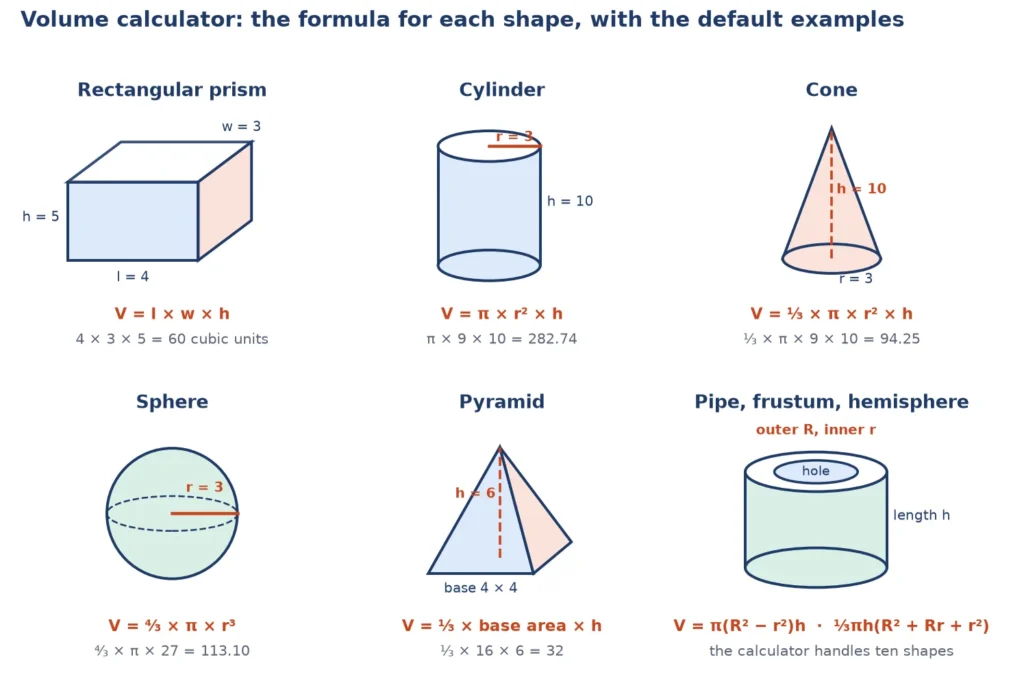
Quick answer: Volume is the space inside a 3D shape, in cubic units. For a box it is length × width × height, so 4 × 3 × 5 = 60 cubic feet. For a cylinder it is π × r² × h, for a cone ⅓ × π × r² × h and for a sphere ⁴⁄₃ × π × r³. One cubic foot holds 7.48 US gallons, so that 60 cubic foot box holds about 449 gallons.
How to use the volume calculator
- Choose the shape from the list: cube, rectangular prism, cylinder, hollow cylinder, cone, truncated cone, sphere, hemisphere, pyramid or triangular prism.
- Choose the unit of length: feet, inches, yards, miles, meters, centimeters, millimeters or kilometers. Use the same unit for every measurement.
- Type the measurements. For round shapes, say whether the number you know is the radius or the diameter, and the volume calculator converts it for you.
- Optional: pick a material such as water, concrete or steel to see the weight, or type your own density.
- Read the volume, the capacity in liters, the surface area and the table of the same volume in other units, then open How it works for the formula.
| Shape | What you enter | What you get |
|---|---|---|
| Cube | side length | volume and surface area |
| Rectangular prism | length, width, height | volume and surface area |
| Cylinder | radius or diameter, height | volume and surface area |
| Hollow cylinder (pipe) | outer size, inner size, length | volume of the material, space inside, surface area |
| Cone | radius or diameter, height | volume and surface area |
| Truncated cone (frustum) | bottom size, top size, height | volume and surface area |
| Sphere | radius or diameter | volume and surface area |
| Hemisphere | radius or diameter | volume and surface area |
| Pyramid | base length, base width, height | volume and surface area |
| Triangular prism | triangle base, triangle height, length | volume |
Whatever you choose, the volume calculator also gives the capacity in liters, because 1,000 cubic centimeters is exactly 1 liter. It works in any unit you like, so a 4 by 3 by 5 foot tank gives 60 ft³, which is 1,699 liters or 449 US gallons.
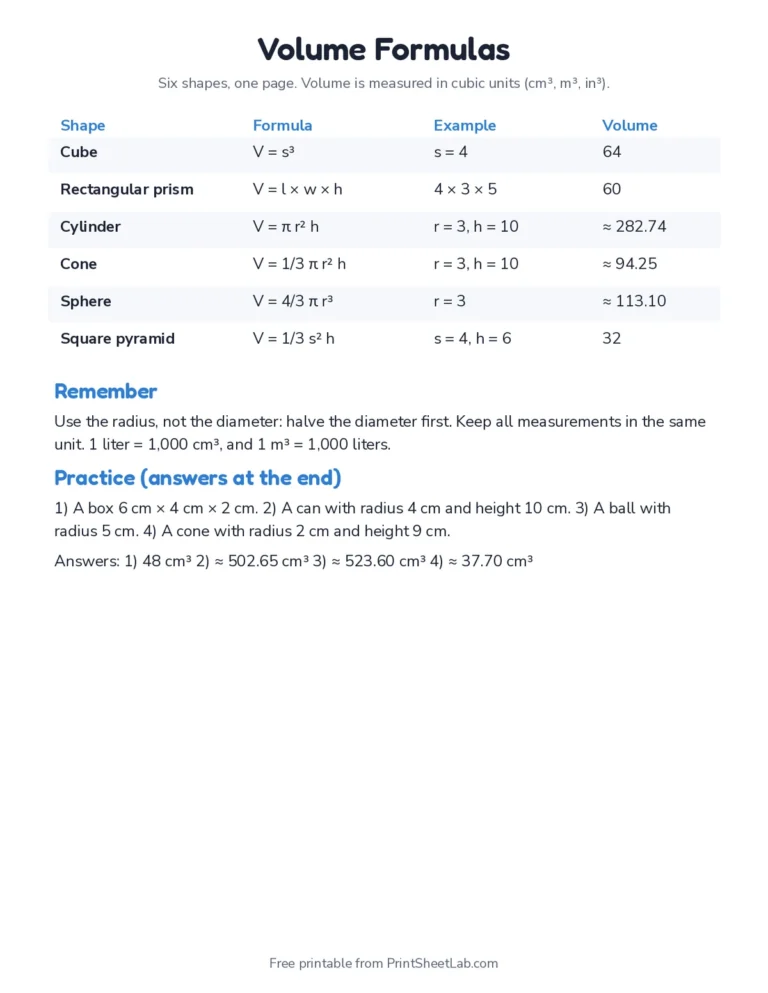
Volume formulas and a printable formulas sheet
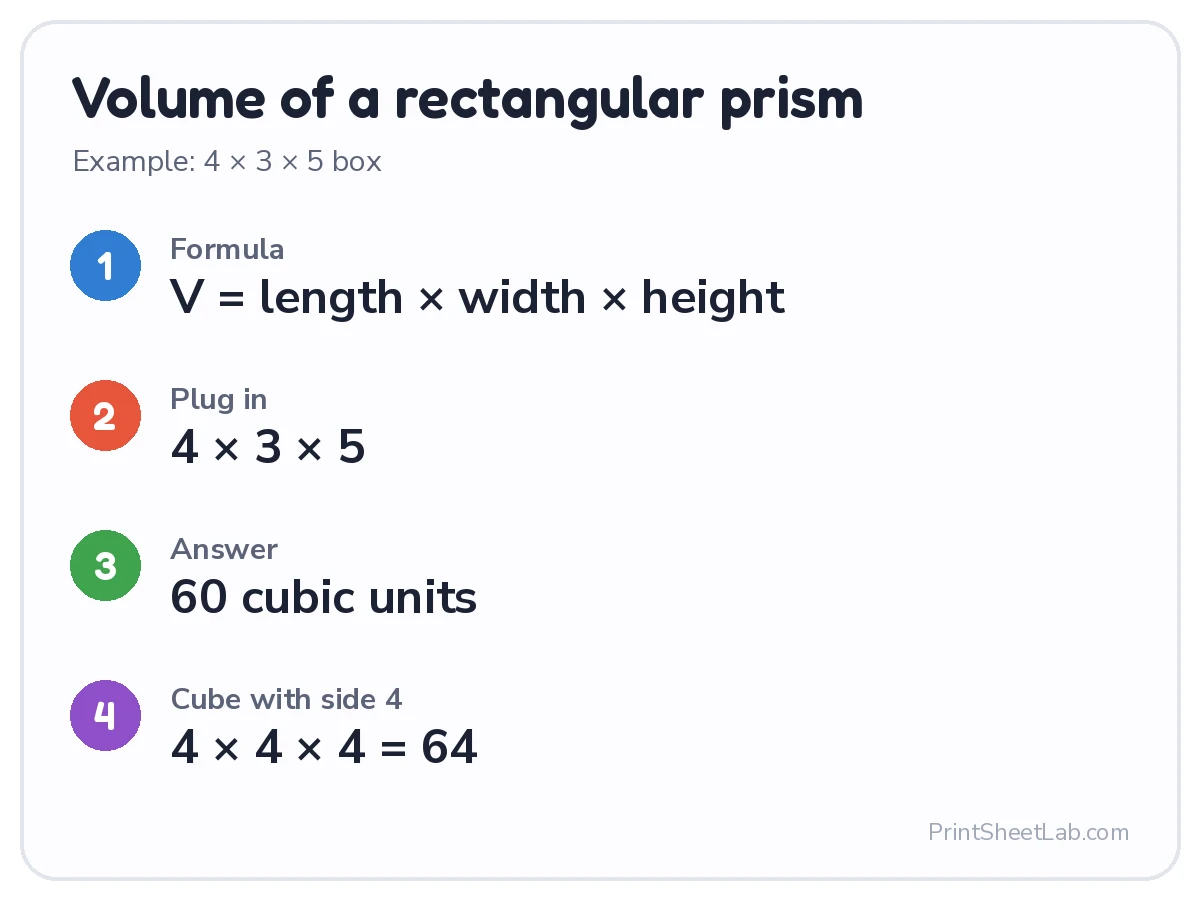
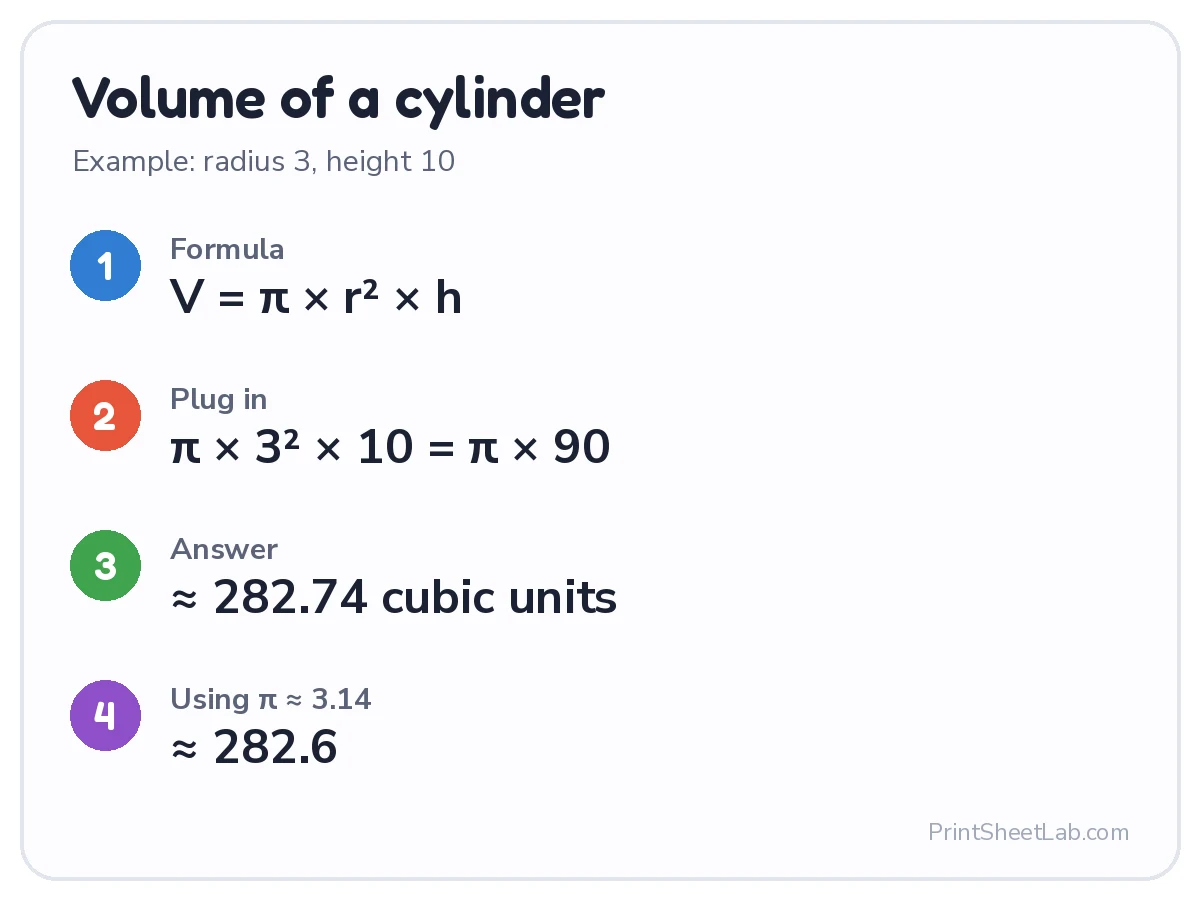
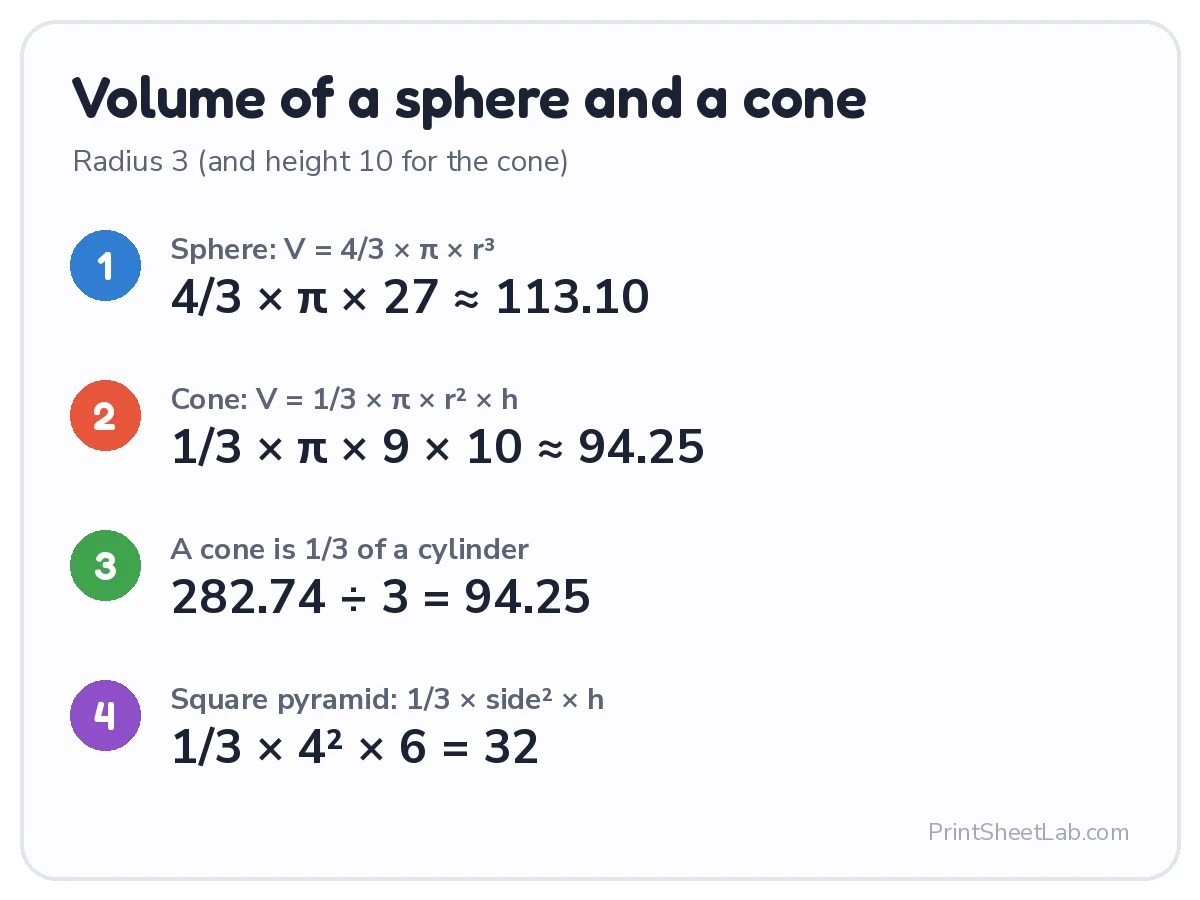
The cards below work through a rectangular prism, a cylinder, and a sphere and cone with the same radius. The printable volume formulas sheet has all six basic shapes on one page with worked examples and four practice problems with answers. The table after the cards adds the surface area formula for each shape.
| Shape | Volume formula | Surface area formula |
|---|---|---|
| Cube | s³ | 6 × s² |
| Rectangular prism | l × w × h | 2 × (lw + lh + wh) |
| Cylinder | π × r² × h | 2 × π × r × (r + h) |
| Hollow cylinder | π × (R² − r²) × h | 2 × π × (R + r) × h + 2 × π × (R² − r²) |
| Cone | ⅓ × π × r² × h | π × r × (r + √(r² + h²)) |
| Truncated cone | ⅓ × π × h × (R² + R×r + r²) | π × (R² + r² + (R + r) × slant height) |
| Sphere | ⁴⁄₃ × π × r³ | 4 × π × r² |
| Hemisphere | ⅔ × π × r³ | 3 × π × r² |
| Pyramid (rectangular base) | ⅓ × l × w × h | base + four triangular faces |
| Triangular prism | ½ × base × height × length | not shown (needs all three triangle sides) |
Volume of a rectangular prism and a cube
The volume of a rectangular prism is length × width × height. A box 4 cm long, 3 cm wide and 5 cm tall holds 4 × 3 × 5 = 60 cm³: you could fill it with 60 one-centimeter cubes, in 5 layers of 12. This is the shape behind most everyday volume questions: a fish tank, a shipping box, a raised garden bed, a room or a swimming pool.
What is the volume of a cube?
The volume of a cube is its side cubed, because all three edges are equal. A cube with 4 cm sides holds 4 × 4 × 4 = 64 cm³, and its surface area is 6 × 4² = 96 cm². Doubling the side of a cube multiplies its volume by 8, not by 2.
This table gives the volume of a rectangular prism in cubic feet, US gallons and liters for common tank and bin sizes.
| Size (ft) | Cubic feet | US gallons | Liters |
|---|---|---|---|
| 2 × 2 × 2 | 8 | 59.8 | 227 |
| 3 × 2 × 2 | 12 | 89.8 | 340 |
| 6 × 3 × 3 | 54 | 403.9 | 1,529 |
| 8 × 4 × 3 | 96 | 718.1 | 2,718 |
| 4 × 3 × 5 | 60 | 448.8 | 1,699 |
| 10 × 5 × 4 | 200 | 1,496.1 | 5,663 |
Pools work the same way. A pool 24 ft long and 12 ft wide with an average depth of 4.5 ft holds 24 × 12 × 4.5 = 1,296 ft³, or about 9,695 US gallons. For a pool that is deeper at one end, add the shallow and deep depths and halve the total to get the average depth. A fish tank 60 cm long, 30 cm wide and 40 cm tall holds 72,000 cm³, which is 72 liters.
Volume of a cylinder
The volume of a cylinder is the area of the circular base times the height: V = π × r² × h. For a cylinder with a radius of 3 and a height of 10, V = π × 9 × 10 = π × 90 ≈ 282.74 cubic units. With π ≈ 3.14 you get 282.6, which is why textbook answers can differ in the last digit.
Always use the radius, which is half the diameter. A can 8 cm across has a radius of 4 cm; if it is 10 cm tall, its volume is π × 16 × 10 ≈ 502.65 cm³, a little over half a liter. In the volume calculator, choose Diameter in the round-measurements box and type 8 instead, and you get the same answer without halving.
| Tank (diameter × height, ft) | Cubic feet | US gallons | Liters |
|---|---|---|---|
| 2 × 3 | 9.42 | 70.5 | 267 |
| 3 × 4 | 28.27 | 211.5 | 801 |
| 4 × 6 | 75.4 | 564 | 2,135 |
| 5 × 8 | 157.08 | 1,175 | 4,448 |
| 6 × 10 | 282.74 | 2,115.1 | 8,006 |
A hollow cylinder, such as a pipe or a tube, is a big cylinder with a smaller one removed: V = π × (R² − r²) × h, where R is the outer radius and r the inner radius. A 100 ft run of pipe with an inside diameter of 1 inch holds π × (1/24 ft)² × 100 = 0.545 ft³, or about 4.1 US gallons of water. The volume calculator gives both the volume of the pipe material and the space inside.
Volume of a cone and a truncated cone
A cone holds exactly one third of a cylinder with the same base and height, so the volume of a cone is ⅓ × π × r² × h. A cone with a radius of 3 and a height of 10 holds 282.74 ÷ 3 ≈ 94.25 cubic units. An ice cream cone 4 cm across and 9 cm tall (radius 2) holds about ⅓ × π × 4 × 9 ≈ 37.70 cm³. The height is the straight-up height from the base to the tip, not the length of the sloping side.
A pile of sand, gravel or soil is roughly a cone. A pile 6 ft across and 2.5 ft high holds ⅓ × π × 3² × 2.5 = 23.56 ft³, which is 0.87 cubic yards. A truncated cone, or frustum, is a cone with its tip cut off, like a bucket or a flower pot.
With a bottom radius of 4 in, a top radius of 6 in and a height of 10 in, the volume is ⅓ × π × 10 × (16 + 24 + 36) = 795.9 in³, or 3.45 US gallons.
Volume of a sphere and a hemisphere
The volume of a sphere depends only on its radius: V = ⁴⁄₃ × π × r³. For a radius of 3, that is ⁴⁄₃ × π × 27 ≈ 113.10 cubic units. A ball 10 cm across (radius 5 cm) holds about 523.60 cm³, roughly half a liter. A hemisphere is half a sphere, so its volume is ⅔ × π × r³: a bowl 8 inches across (radius 4) holds ⅔ × π × 64 = 134 in³, about 2.2 liters.
| Radius | Sphere volume (⁴⁄₃πr³) | Sphere surface (4πr²) | Hemisphere volume |
|---|---|---|---|
| 1 | 4.189 | 12.566 | 2.094 |
| 2 | 33.51 | 50.265 | 16.755 |
| 3 | 113.097 | 113.097 | 56.549 |
| 5 | 523.599 | 314.159 | 261.799 |
| 10 | 4,188.79 | 1,256.637 | 2,094.395 |
The volume article on Wikipedia lists more shapes and explains how Archimedes first found the volume of a sphere.
Volume of a pyramid and a triangular prism
The volume of a pyramid follows the same one-third rule as the cone: V = ⅓ × base area × height. A pyramid with a 4 by 4 base and a height of 6 has a volume of ⅓ × 16 × 6 = 32 cubic units, one third of the 4 × 4 × 6 box that would surround it. The volume calculator accepts a rectangular base, so a 6 by 4 base with a height of 5 gives ⅓ × 24 × 5 = 40.
A triangular prism is a triangle stretched along a length, so its volume is the triangle area times the length. A tent or an attic roof space is a good example. An attic with a gable 24 ft wide and 6 ft high that runs 30 ft has a volume of ½ × 24 × 6 × 30 = 2,160 ft³. A wedge with a triangle base of 4, a triangle height of 3 and a length of 10 holds ½ × 4 × 3 × 10 = 60 cubic units.
Cone, sphere and cylinder: the 1 : 2 : 3 rule
Comparing shapes with the same radius shows how the formulas connect. Take radius 3 and a cylinder 6 tall, the same height as the sphere is wide. The cylinder holds π × 9 × 6 ≈ 169.65, the cone holds one third of that, ≈ 56.55, and the sphere holds ≈ 113.10, exactly two thirds of the cylinder. In shares, that is cone 1, sphere 2, cylinder 3.
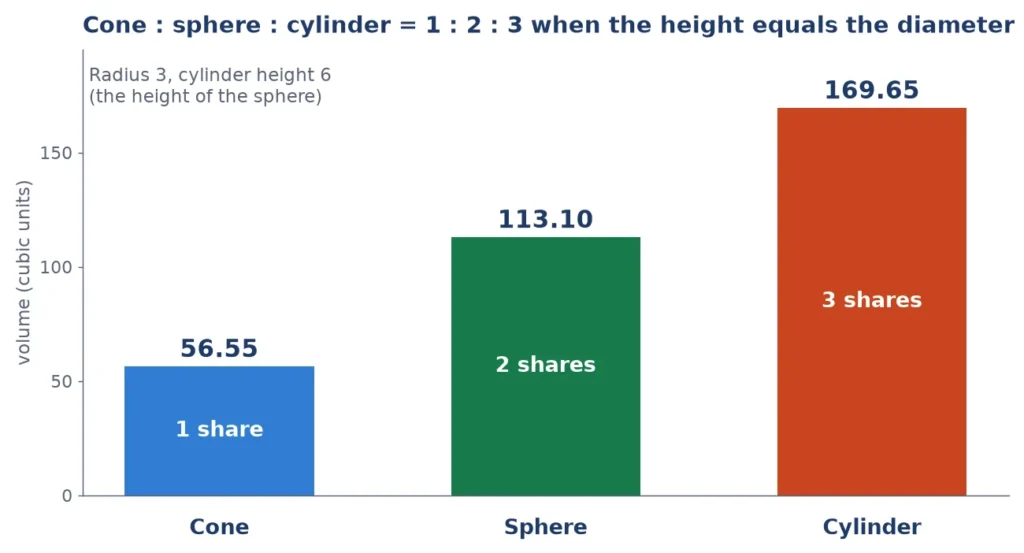
The Roman writer Cicero tells us that Archimedes was so proud of this relationship that he asked for a sphere inside a cylinder to be carved on his tomb. You can see the pattern for yourself by entering the three shapes into the volume calculator one after another.
Volume calculator in gallons, liters and cubic feet
Volume is often needed in a unit other than the one you measured in. A volume calculator in gallons answers questions such as how much water a tank holds, and a volume calculator in cubic feet or cubic yards helps when buying soil, gravel or concrete. The conversion table under every answer shows nine units at once.
| Unit | Equals |
|---|---|
| 1 cubic foot (ft³) | 1,728 in³ = 7.48052 US gallons = 28.3168 liters = 6.22884 UK gallons |
| 1 cubic yard (yd³) | 27 ft³ = 201.974 US gallons = 764.555 liters |
| 1 cubic meter (m³) | 1,000 liters = 264.172 US gallons = 35.3147 ft³ = 1.30795 yd³ |
| 1 US gallon | 231 in³ = 3.78541 liters = 0.133681 ft³ |
| 1 UK (imperial) gallon | 4.54609 liters = 277.42 in³ = 1.20095 US gallons |
| 1 liter | 1,000 cm³ = 61.0237 in³ = 0.264172 US gallons |
US and UK gallons are different sizes: the US gallon is defined as 231 cubic inches and the UK or imperial gallon as exactly 4.54609 liters, according to the NIST conversion factors. The 60 ft³ tank from earlier holds about 449 US gallons or 374 UK gallons. For other volume units, use the unit converter.
Concrete and soil are sold by the cubic yard, so a patio slab 10 ft by 12 ft and 4 inches thick needs 10 × 12 × (4 ÷ 12) = 40 ft³, which is 1.48 yd³ before any waste allowance. The concrete calculator adds waste and bag counts, and the mulch calculator does the same for garden beds.
Volume to weight: using density
To turn volume into weight, multiply by density: weight = volume × density. Pick a material in the volume calculator and it does the sum, or type a density in kilograms per cubic meter. Water is the easy reference: 1 liter weighs about 1 kg, and 1 US gallon weighs about 8.35 pounds. The values below are typical; real concrete, sand and steel vary with the mix, moisture and grade.
| Material | kg per m³ | g per cm³ | lb per ft³ |
|---|---|---|---|
| Water | 1,000 | 1 | 62.4 |
| Ice | 917 | 0.917 | 57.2 |
| Sand, dry and loose | 1,600 | 1.6 | 99.9 |
| Concrete, typical | 2,400 | 2.4 | 149.8 |
| Aluminum | 2,700 | 2.7 | 168.6 |
| Steel | 7,850 | 7.85 | 490.1 |
| Copper | 8,960 | 8.96 | 559.4 |
| Lead | 11,340 | 11.34 | 707.9 |
| Gold | 19,320 | 19.32 | 1,206.1 |
Example: a concrete slab 10 ft by 10 ft and 4 inches thick has a volume of 33.33 ft³, which is 0.944 m³. At 2,400 kg/m³ it weighs about 2,265 kg, or 4,994 pounds. A sand pile of 1 cubic yard weighs about 0.7646 × 1,600 = 1,223 kg, roughly 2,700 pounds when dry. A 10 cm steel cube (1,000 cm³) weighs 7.85 kg. The density article on Wikipedia has a longer list.
Why doubling the size multiplies the volume by 8
Length, area and volume scale differently. If you multiply every side of a shape by 2, lengths double, areas grow 4 times and volume grows 8 times, because volume depends on three lengths multiplied together. Triple every side and the volume is 27 times bigger. This is why a 16-inch cube holds eight times as much as an 8-inch cube, and why a ball of radius 6 holds eight times as much as a ball of radius 3.

The same rule explains why large containers are such good value. Doubling a tank’s width, depth and height uses 4 times as much material for the walls but holds 8 times the water, so the surface area per gallon falls by half.
Volume, capacity and surface area
Volume is the space a shape takes up, and capacity is how much a container can hold, usually quoted in liters or gallons. For a thin-walled container they are almost the same number. For a thick one, such as a pipe or a clay pot, the capacity is the volume of the empty space inside, which is why the hollow cylinder option shows both.
Surface area is the total area of the outside, in square units, and it is what you need for paint, wrapping paper or insulation. The volume calculator shows the surface area for every shape except the triangular prism; for flat shapes, use the area calculator.
Real-life volume calculator examples
- Fish tank: 60 cm × 30 cm × 40 cm = 72,000 cm³ = 72 liters, or about 19 US gallons. Subtract a few percent for gravel and decorations.
- Planter box: 4 ft × 2 ft × 1 ft deep = 8 ft³, which is 0.3 cubic yards of soil; the box holds 59.8 US gallons.
- Rain barrel: a cylinder 2 ft across and 3 ft tall holds π × 1² × 3 = 9.42 ft³, or 70.5 US gallons.
- Sandbox: 5 ft × 5 ft × 8 in deep = 16.67 ft³, about 0.62 cubic yards of play sand.
- Shipping box: 20 in × 16 in × 12 in = 3,840 in³, which is 2.22 ft³ or about 63 liters.
- Cooking: a cylindrical pot 8 in across and 6 in deep holds π × 16 × 6 = 301.6 in³, about 5.2 US quarts (231 in³ per gallon).
- Homework: enter the numbers from the question and compare each line of the working with your own.
For other jobs, the square footage calculator measures rooms and the paint calculator turns wall area into gallons of paint.
Common volume calculator mistakes
- Diameter instead of radius: the formulas use the radius. If your can is 8 cm across, the radius is 4 cm. Choose Diameter in the calculator to avoid halving it yourself.
- Mixed units: 10 ft × 36 in × 2 ft is not a valid sum. Convert everything to one unit first.
- Square instead of cubic units: volume is cubic. 1 m³ is 1,000,000 cm³, not 10,000 or 100.
- Slant height as height: for cones and pyramids the height is the straight-up distance from the base to the tip.
- Forgetting the one third: cones and pyramids hold a third of the matching cylinder or prism.
Volume worksheets with cubes: how layers work
Volume worksheets with cubes teach that a box is made of layers of unit cubes. Count the cubes in one layer (length × width), then multiply by the number of layers (height). This is the idea behind the volume of a rectangular prism, and the table shows four boxes.
| Box (l × w × h) | Cubes in one layer | Layers | Unit cubes in all |
|---|---|---|---|
| 3 × 2 × 2 | 6 | 2 | 12 |
| 4 × 3 × 2 | 12 | 2 | 24 |
| 5 × 4 × 3 | 20 | 3 | 60 |
| 6 × 5 × 4 | 30 | 4 | 120 |
Volume practice problems with answers
Use this table as a volume worksheet: cover the last two columns, work out each volume, then check with the calculator above. These volume practice problems with answers use whole numbers and one decimal place and cover the shapes the calculator knows. Volume practice for school often asks for composite figures made of two boxes: find the volume of each part and add them.
| Shape | Dimensions | Volume | Unit |
|---|---|---|---|
| Rectangular prism | l = 8, w = 5, h = 3 | 120 | cubic units |
| Rectangular prism | l = 12, w = 4, h = 6 | 288 | cubic units |
| Cylinder | r = 3, h = 10 | 282.7 | cubic units (using π) |
| Cone | r = 4, h = 9 | 150.8 | cubic units (using π) |
| Sphere | r = 5 | 523.6 | cubic units (using π) |
| Cube | side = 7 | 343 | cubic units |
The answer is always in cubic units, such as cubic centimeters. For more printable practice, use the free geometry worksheets and the measurement worksheets; volume of a rectangular prism is a fifth grade standard, and cylinders, cones and spheres come in eighth grade.
Volume calculator questions people ask
How do I use a volume calculator for a cylinder?
Choose Cylinder, pick the unit, say whether you know the radius or the diameter, and enter that and the height. For a radius of 3 and a height of 10 the volume is 282.74 cubic units, and the surface area is 245.04. The volume calculator shows the formula with your numbers filled in.
How do I calculate volume in cubic feet and cubic yards?
Measure length, width and height in feet and multiply them for cubic feet. Divide by 27 for cubic yards, because 1 yd³ = 3 × 3 × 3 = 27 ft³. A hole 6 ft long, 3 ft wide and 2 ft deep is 36 ft³, or 1.33 yd³.
How do I find the volume in liters?
Work out the volume in centimeters cubed, then divide by 1,000, since 1 liter is 1,000 cm³. Or measure in meters and multiply the cubic meters by 1,000. A tank 0.5 m × 0.4 m × 0.3 m holds 0.06 m³, which is 60 liters.
How do I find the volume of a pool?
For a rectangular pool, multiply length × width × average depth, then multiply cubic feet by 7.48 for US gallons. For a round pool use π × r² × average depth. Pools that slope use the average of the shallow and deep depths.
How do I work out mass from volume?
Multiply the volume by the density of the material. One cubic meter of water weighs about 1,000 kg and of concrete about 2,400 kg. Choose a material in the volume calculator to see the weight in kilograms and pounds.
Volume calculator: frequently asked questions
What is the formula for the volume of a cylinder?
V = π × r² × h: the area of the circular base times the height. A cylinder with a radius of 3 and a height of 10 has a volume of about 282.74 cubic units.
How do I find the volume of a sphere from its diameter?
Halve the diameter to get the radius, then use V = ⁴⁄₃ × π × r³. In the volume calculator, choose Diameter in the round-measurements box and type the diameter directly.
Why is a cone one third of a cylinder?
A cone with the same base and height as a cylinder fills exactly one third of it. You can show this by filling a paper cone with rice three times to fill the matching cylinder.
What units does the volume calculator use?
Whatever length unit you pick, cubed. It also shows the answer in cubic inches, feet, yards, meters, milliliters, liters, US gallons, UK gallons and US fluid ounces.
What is the difference between volume and capacity?
Volume is the space a shape takes up; capacity is how much a container can hold, often measured in liters or gallons. For thin-walled containers they are nearly equal.
Can I find the volume of a triangular prism?
Yes. Choose Triangular prism and enter the triangle base, the triangle height and the length. The volume is ½ × base × height × length.
How many gallons are in a cubic foot?
One cubic foot holds 7.48052 US gallons, or 6.22884 UK gallons. To convert cubic feet to US gallons, multiply by 7.48052.
How do you find the volume of a composite figure?
Split it into simple shapes such as boxes and cylinders, find the volume of each with the calculator and add the volumes. Subtract any hollow parts.
Is the volume calculator free?
Yes. It is free to use on any device with no sign-up, and the formulas sheet is a free printable PDF.
Where can I get volume practice problems with answers?
The practice table above has six volume problems with answers, and the cubes table shows how layers work. For printable sheets, see the geometry and measurement worksheets linked there.
Related calculators
- Area calculator for flat shapes
- Unit converter for gallons, liters and cubic feet
- Concrete calculator
- Mulch calculator
- Square footage calculator
- Paint calculator
- Cups to grams converter
- All calculators
Sources and further reading
- NIST Guide for the Use of the International System of Units, Appendix B: conversion factors
- Volume (Wikipedia)
- Density (Wikipedia)
- Common Core 5th grade standards: volume of rectangular prisms
Last updated: October 2026.