
This gingerbread house template gives you true-scale patterns for four projects: a classic cookie-dough house, a small house for a tray or a lunchbox treat, a paper house that children color and fold, and a set of cookie shapes to trace. Every PDF prints at 100% on US Letter or A4 and carries a one-inch scale bar, so you can check the size with a ruler before you cut anything. Each gingerbread house template printable comes in US Letter and A4, and the paper gingerbread house template needs no baking at all. Each gingerbread house template prints on standard paper.
Quick answer: This free gingerbread house template has four printable sets: a classic house 150 mm (5.9 in) wide, a small house 60 mm (2.4 in) wide, a paper house with fold lines and glue tabs, and four cookie shapes to trace. Print at 100% on Letter or A4, cut out the pieces, and trace them onto dough rolled 1/8 inch thick.
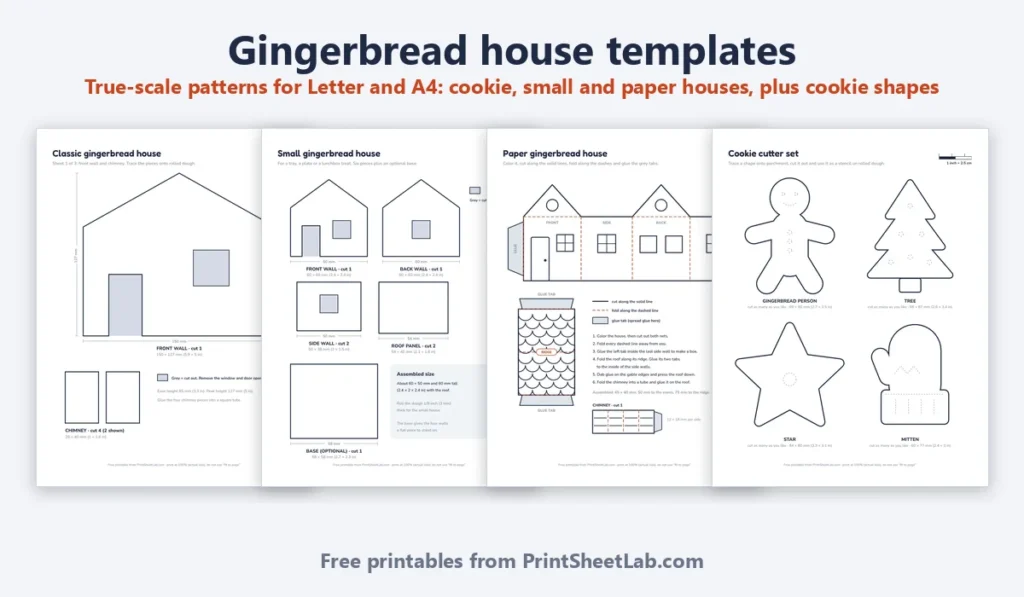
Gingerbread house template downloads
There are four printable sets, free on PrintSheetLab, each as a US Letter and an A4 PDF, and one pack with all six pages. Click a picture to open the PDF.


All six pages, Letter All six pages, A4
Which gingerbread house template should you make?
Make the classic house if you want a centerpiece, the small house if you want a quick treat, and the paper house if you do not want to bake. The table compares the four sets.
| Set | Pieces | Assembled size | Best for | Time and effort |
|---|---|---|---|---|
| Classic house | 5 piece types, 10 pieces | 150 × 120 × 127 mm (5.9 × 4.7 × 5 in) | A family project or a holiday table centerpiece | Bake and cool one day, build the next |
| Small house | 5 piece types, 6 pieces plus an optional base | 60 × 50 × 60 mm (2.4 × 2 × 2.4 in) | Place settings, lunchboxes, a first try | Shorter: fewer and smaller pieces |
| Paper house | 2 nets and a chimney | 45 × 40 × 75 mm (1.8 × 1.6 × 3 in) | Young children, classrooms, no oven | Fastest: no baking, only cutting and gluing |
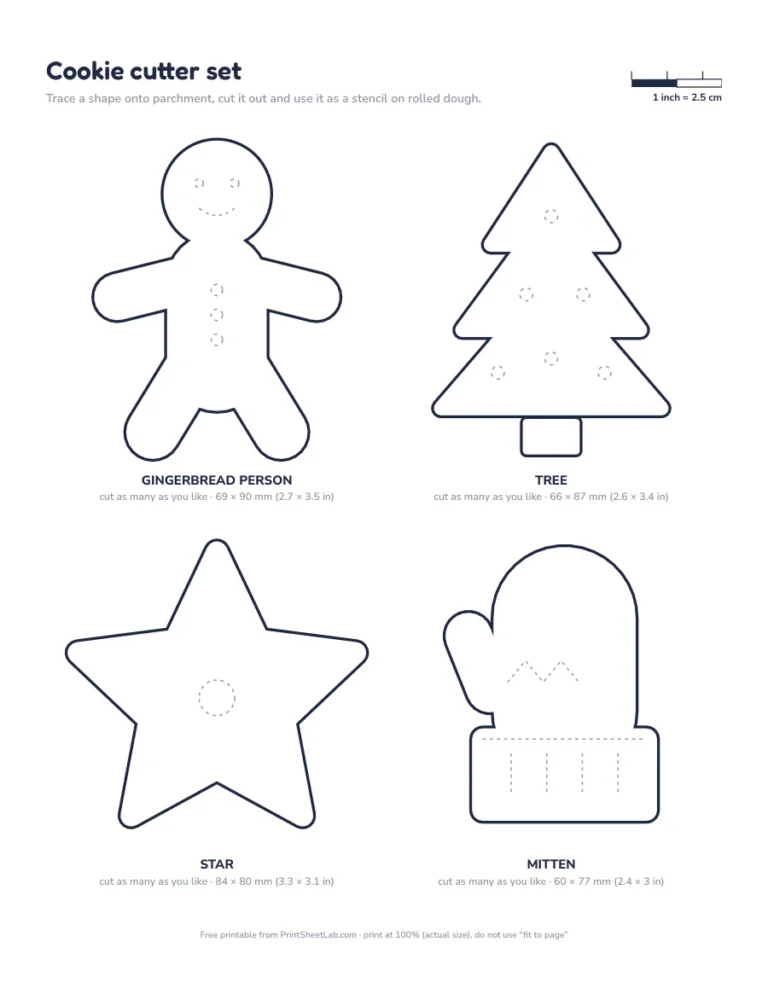
| Cookie shapes | 4 outlines | Up to 84 × 90 mm (3.3 × 3.5 in) | Decorating cookies, house trim, ornaments | Quick: trace once, reuse every year |
Gingerbread house patterns: piece sizes in inches and centimeters
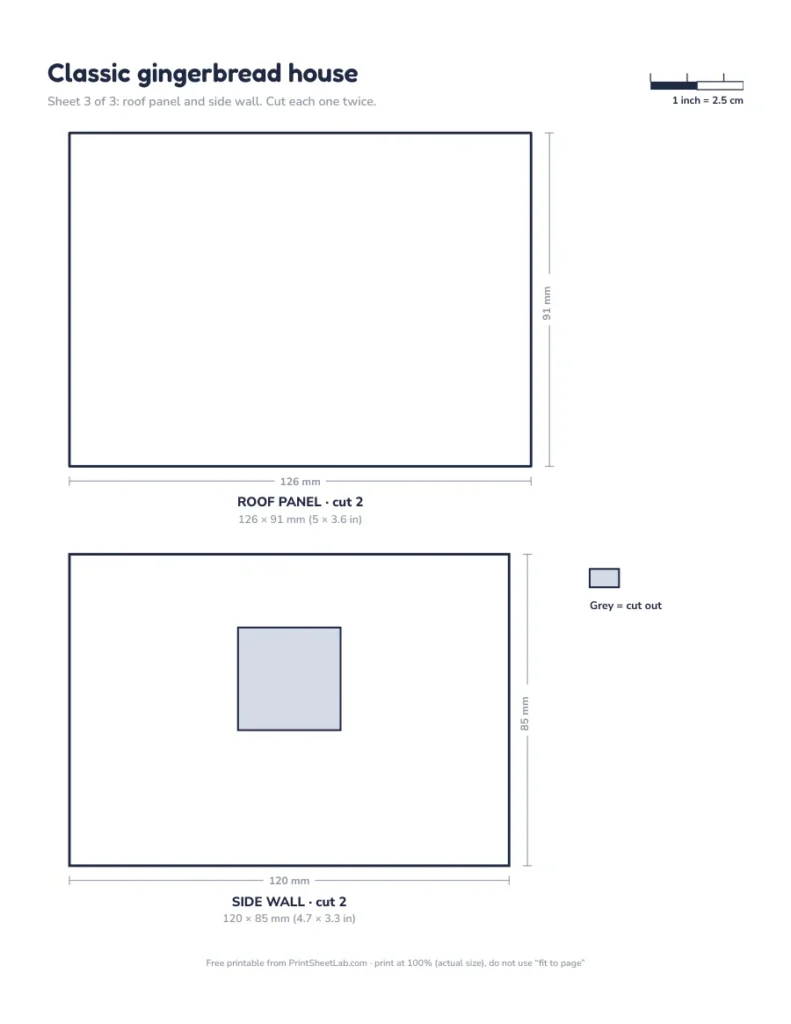
Every piece is listed below in millimeters, centimeters and inches, so you can check a pattern against a ruler or redraw it on cardboard. The classic house has two wall types, a roof panel and a chimney, and the roof panels are slightly larger than the walls so they overhang the eaves.
| Classic house piece | Cut | Millimeters | Centimeters | Inches |
|---|---|---|---|---|
| Front wall (with door and window cutouts) | 1 | 150 × 127 | 15.0 × 12.7 | 5.9 × 5 |
| Back wall (with one window cutout) | 1 | 150 × 127 | 15.0 × 12.7 | 5.9 × 5 |
| Side wall (with window cutout) | 2 | 120 × 85 | 12.0 × 8.5 | 4.7 × 3.3 |
| Roof panel | 2 | 126 × 91 | 12.6 × 9.1 | 5 × 3.6 |
| Chimney | 4 | 26 × 40 | 2.6 × 4.0 | 1 × 1.6 |
| Door cutout | – | 26 × 48 | 2.6 × 4.8 | 1 × 1.9 |
| Window cutout (front, back and sides) | – | 28 × 28 | 2.8 × 2.8 | 1.1 × 1.1 |
The small gingerbread house template is a 60 mm version of the same shape, so it works as a first try before the full-size house.
| Small house piece | Cut | Millimeters | Centimeters | Inches |
|---|---|---|---|---|
| Front wall (door and window) | 1 | 60 × 60 | 6.0 × 6.0 | 2.4 × 2.4 |
| Back wall (one window) | 1 | 60 × 60 | 6.0 × 6.0 | 2.4 × 2.4 |
| Side wall | 2 | 50 × 38 | 5.0 × 3.8 | 2 × 1.5 |
| Roof panel | 2 | 54 × 40 | 5.4 × 4.0 | 2.1 × 1.6 |
| Base (optional) | 1 | 68 × 58 | 6.8 × 5.8 | 2.7 × 2.3 |
| Paper house and cookie shapes | Cut | Millimeters | Centimeters | Inches |
|---|---|---|---|---|
| Paper house wall strip with glue tab and gables | 1 | 182 × 75 | 18.2 × 7.5 | 7.2 × 3 |
| Paper roof with two glue tabs | 1 | 44 × 83.2 | 4.4 × 8.3 | 1.7 × 3.3 |
| Gingerbread person | as many as you like | 69 × 90 | 6.9 × 9.0 | 2.7 × 3.5 |
| Tree | as many as you like | 66 × 87 | 6.6 × 8.7 | 2.6 × 3.4 |
| Star | as many as you like | 84 × 80 | 8.4 × 8.0 | 3.3 × 3.1 |
| Mitten | as many as you like | 60 × 77 | 6.0 × 7.7 | 2.4 × 3 |
How do you print the patterns at the right size?
Print every PDF at 100% (actual size) and turn off “fit to page” or “scale to fit”. Each piece sits inside a 190 by 250 mm area, so it fits on both Letter and A4 with a margin on every side.
- Print the sheet and measure the scale bar in the top right corner. It should be exactly 1 inch (25.4 mm) long. If it is shorter or longer, the printer scaled the page.
- Cut each piece out along the solid outline. Cut the grey window and door cutouts out of the paper pattern too.
- For a pattern you will reuse, glue the paper pieces onto thin cardboard, such as a cereal box, and cut again.
- Lay the pattern on rolled dough and cut around it with a small sharp knife, or trace it onto parchment and cut through the paper.
How do you assemble a gingerbread house?
Bake the pieces, let them cool completely, then glue them together with stiff icing, building the walls first and the roof last. The diagram shows the order for the classic house.
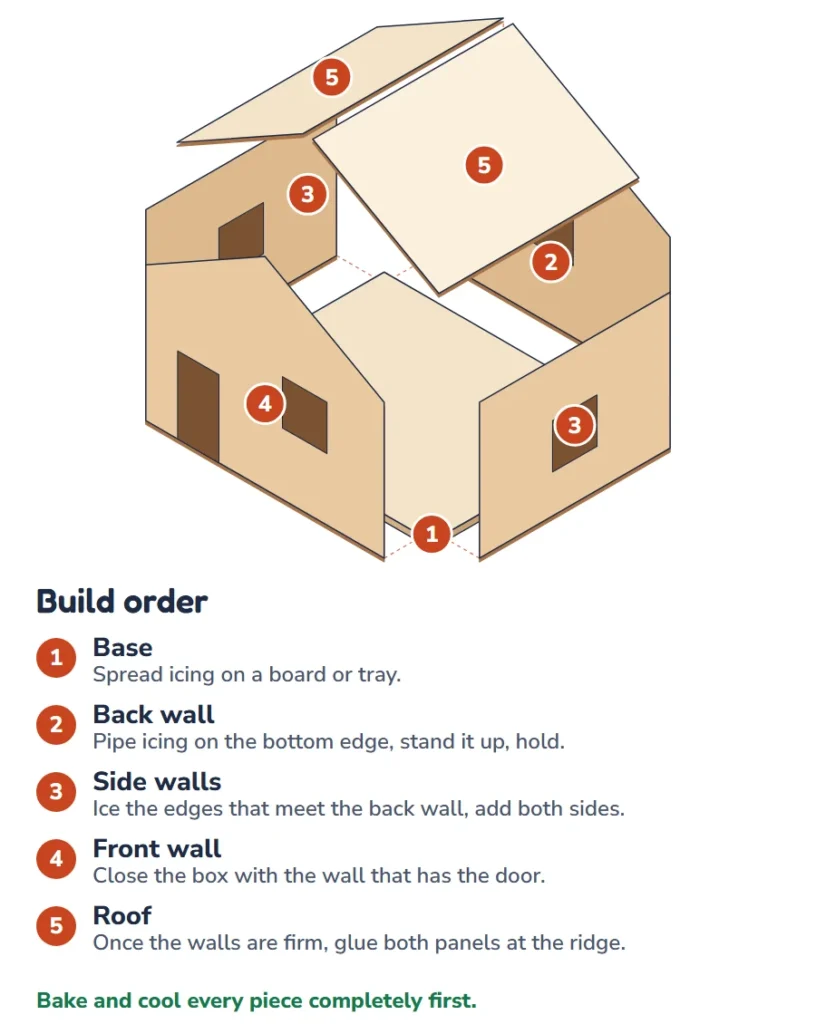
This method follows the construction gingerbread recipe from King Arthur Baking, described here in our own words. The recipe makes enough dough for a house of about 10 by 7 inches plus decorations, which is more than the classic house here needs. Check it for the ingredient amounts.
- Chill the dough. Make a stiff dough and chill it for at least 1 hour. Work with a quarter of it at a time and keep the rest cold.
- Roll it thin. Roll the dough 1/8 inch (3 mm) thick on parchment paper, so the pieces can go onto the baking sheet on the parchment.
- Cut the pieces. Lay each pattern on the dough, cut around it, and cut out the window and door openings. Re-roll the scraps.
- Bake at 350°F. King Arthur bakes 1/8 inch pieces for 10 to 12 minutes, until they are set and very lightly browned at the edges. Check the smaller pieces of the small house at the early end of that range.
- Trim and cool. Trim rough edges while the pieces are still warm, then cool them completely. Warm pieces are soft and will not hold a wall up.
- Make the icing “glue”. King Arthur’s royal icing whips egg whites, or meringue powder mixed with water, with cream of tartar and confectioners’ sugar. The longer it is whipped, the stiffer it gets and the faster it hardens, which is what you want for gluing.
- Build the walls first. Pipe icing along the base and the edges, stand the walls up and hold each one until the icing grabs. Let the walls dry until they feel firm before you add the roof.
- Add the roof and decorate. Pipe icing along the top of the walls and the peak, set the two roof panels and hold them until they stay. Decorate once the roof is firm.
King Arthur says dough for construction projects is perfectly edible. It simply has more flour than cookie dough, which makes it sturdier.
How do you build the paper gingerbread house?
The paper house is a flat net that you color, cut out, fold and glue into a small house with a pitched roof. It needs scissors, glue and a few crayons, and no oven.
- Color the house on paper first, because flat paper is easier to color than a folded box.
- Cut out the wall strip and the roof along the solid lines.
- Fold along every dashed line, away from you, and press each fold with a ruler edge for a crisp crease.
- Glue the left tab inside the last wall to close the box.
- Fold the roof along its ridge, glue its two tabs to the inside of the side walls, and dab glue on the gable edges.
- Fold the chimney into a tube and glue it on the roof.
Print the paper house on thicker paper for a sturdier house, or glue the printout onto thin card before cutting. The same shape works as a classroom craft: every child colors the same net, and every house comes out different.
Gingerbread food safety and tips
Raw dough, raw eggs and hot sugar are the three real hazards in a gingerbread project, and each one has a simple rule.
- Raw flour: processing raw grain into flour does not kill harmful bacteria such as Salmonella and E. coli. The FDA says never to eat or taste raw flour, dough or batter, and not to let children play with raw dough. Wash hands and surfaces after handling it.
- Raw eggs: the same FDA page says cooking is the only way to be sure foods made with flour and raw eggs are safe. The royal icing is not cooked, so use the meringue powder option instead of fresh egg whites if children will be near it.
- Hot sugar: some bakers melt crushed hard candy into the window openings. Melted sugar can cause deep burns, and Shriners Children’s advises 20 minutes of cool water on a sugar burn, not frozen peas. Let an adult do all the candy melting, and skip it with young children.
- Allergens: the FDA lists nine major food allergens: milk, eggs, fish, crustacean shellfish, tree nuts, peanuts, wheat, soybeans and sesame. Gingerbread dough contains wheat, and the King Arthur recipe also uses buttermilk, butter and an egg. Read the labels on candy and sprinkles before you share a house.
- Tip: build on a tray or a board covered with foil, so the finished house can be moved without touching the icing.
Print the gingerbread house template on card stock if you want the paper house to stand up on its own.
Frequently asked questions
8 quick answers
What size is a printable gingerbread house?
The classic house in this set is 150 mm (5.9 in) wide, 120 mm (4.7 in) deep and 127 mm (5 in) tall to the peak. The small house is 60 mm (2.4 in) wide.
How thick should gingerbread house dough be?
The King Arthur construction recipe rolls the dough 1/8 inch (3 mm) thick. The recipe’s bake time of 10 to 12 minutes is for pieces of that thickness.
How long do you bake gingerbread house pieces?
King Arthur bakes 1/8 inch pieces at 350°F for 10 to 12 minutes, until they are set and very lightly browned at the edges, then cools them completely.
Why did my gingerbread house walls slide or fall?
The usual causes are pieces that were still warm, or icing that was too soft. Cool the pieces completely, whip the icing stiff, and let the walls dry before you add the roof.
Can I print the templates on A4 paper?
Yes. Every set has a US Letter PDF and an A4 PDF, and every piece fits inside a 190 by 250 mm area, so nothing is cut off on either size.
Can I make a gingerbread house without baking?
Yes. Print the paper house, color it, cut it out and glue it together. It has fold lines and glue tabs and needs no oven.
What are the cookie shapes for?
Trace the gingerbread person, tree, star or mitten onto parchment, cut the paper out and use it as a stencil on rolled dough, or use the shapes to decorate the house.
How many pieces does the small gingerbread house template have?
It has 5 piece types and 6 pieces, plus an optional base, for a house about 60 × 50 × 60 mm. It fits on one sheet and works as a first try before the full-size house; check the small pieces at the early end of the baking time.
More Christmas printables
- Christmas coloring pages, including a gingerbread house picture to color
- Christmas activities for kids for the days before the holiday
- Christmas worksheets and the days until Christmas countdown
- Easy Elf on the Shelf ideas and Christmas jokes for kids
- All holiday worksheets
Sources
- Construction Gingerbread for Gingerbread Houses, King Arthur Baking (chilling, 1/8 inch rolling, 350°F for 10 to 12 minutes, trimming and cooling, royal icing)
- Handling Flour Safely: What You Need to Know, U.S. Food and Drug Administration
- Food Allergies, U.S. Food and Drug Administration (the nine major allergens)
- Scald burns from melted sugar, Shriners Children’s
Did you like this?
Last updated: