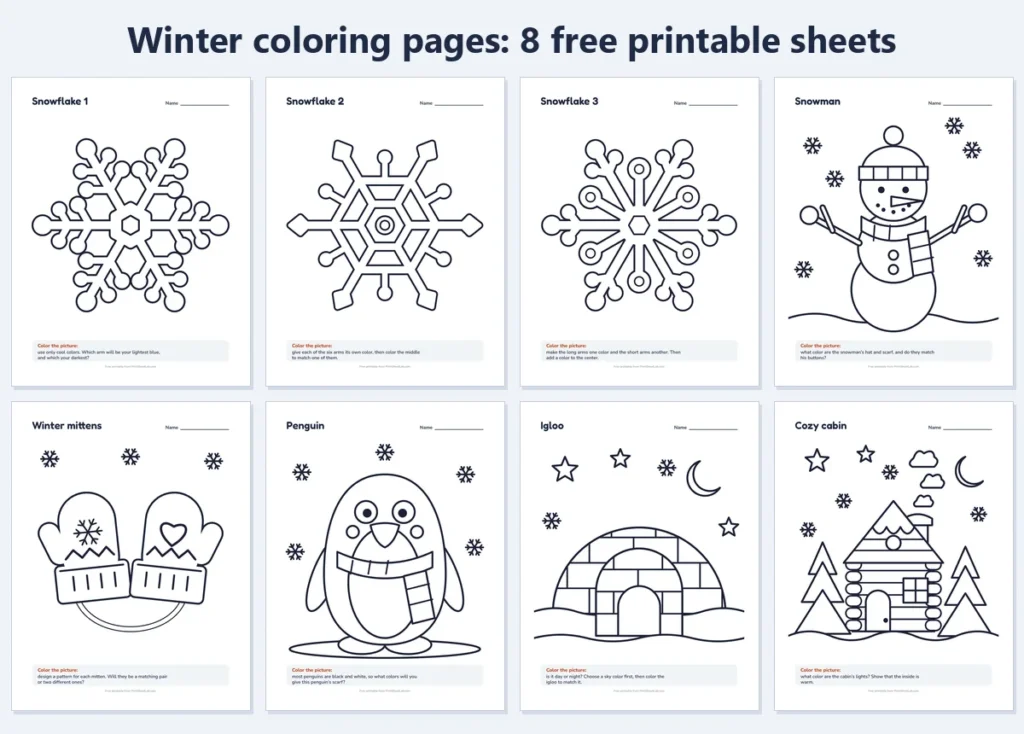
These winter coloring pages are eight original line drawings with thick, clean outlines: three snowflakes, a snowman, a pair of mittens, a penguin, an igloo and a cozy cabin with pine trees. Each picture has large spaces for crayons and ends with a color-the-picture prompt, so a child has a first idea to try. They are made for children from about 3 to 10 and for parents and teachers who want a quiet winter activity. Together they make a set of winter coloring sheets: three snowflake coloring pages, a snowman coloring page and four more winter scenes. All the winter coloring pages are free to print at home or in school.
Quick answer: This set of winter coloring pages has 8 free printable sheets: three snowflakes, a snowman, mittens, a penguin, an igloo and a cabin. Each has thick outlines, large spaces to color and a prompt at the bottom. They print on US Letter or A4 and suit ages 3 to 10.
Winter coloring pages to print
All eight pages are free on PrintSheetLab and listed below, each as a US Letter and an A4 PDF, with one combined PDF of the whole set. Click a picture to open the PDF.



All 8 pages, Letter All 8 pages, A4
Which of the winter coloring pages is right for your child?
The penguin and the snowman are the easiest pages, and the cabin is the hardest. The table sorts all eight by how much detail there is to color, with a suggested age for each. The ages are our suggestion, so move up or down to match the child.
| Page | What is in the picture | Difficulty for coloring | Best age |
|---|---|---|---|
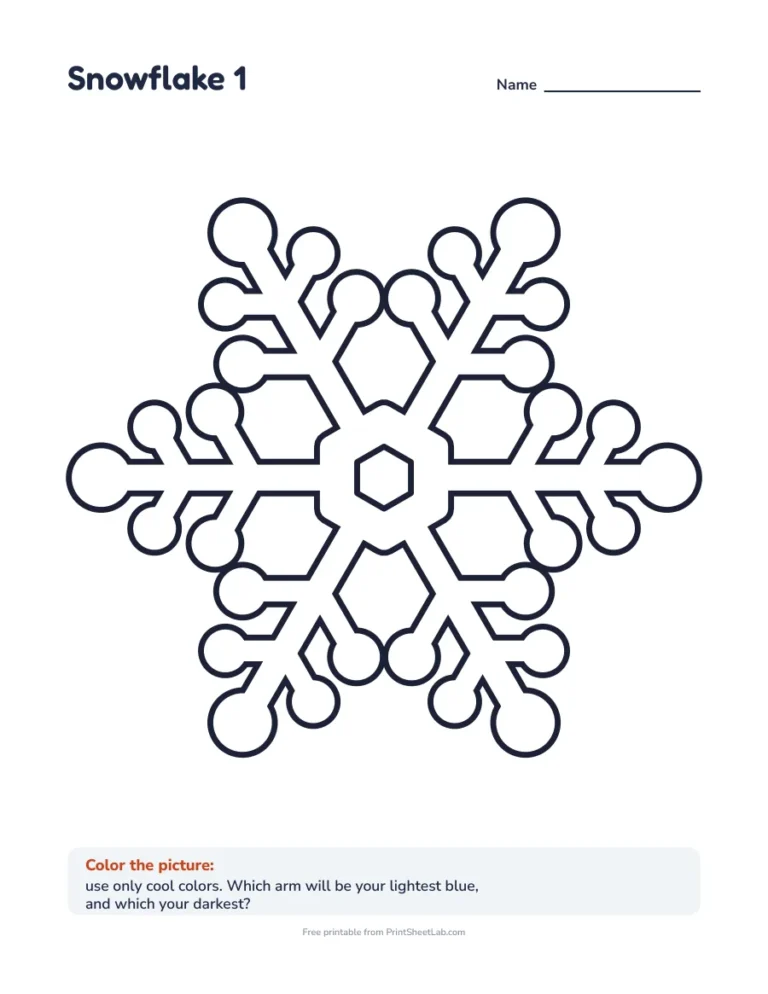
| Snowflake 1 | A snowflake with six long arms, each with two pairs of branches | Medium: narrow arms need a steady hand | 6 to 10 |
| Snowflake 2 | A hexagon snowflake with a ring, spokes and diamond tips | Easy to medium: wide, simple spaces | 5 to 9 |
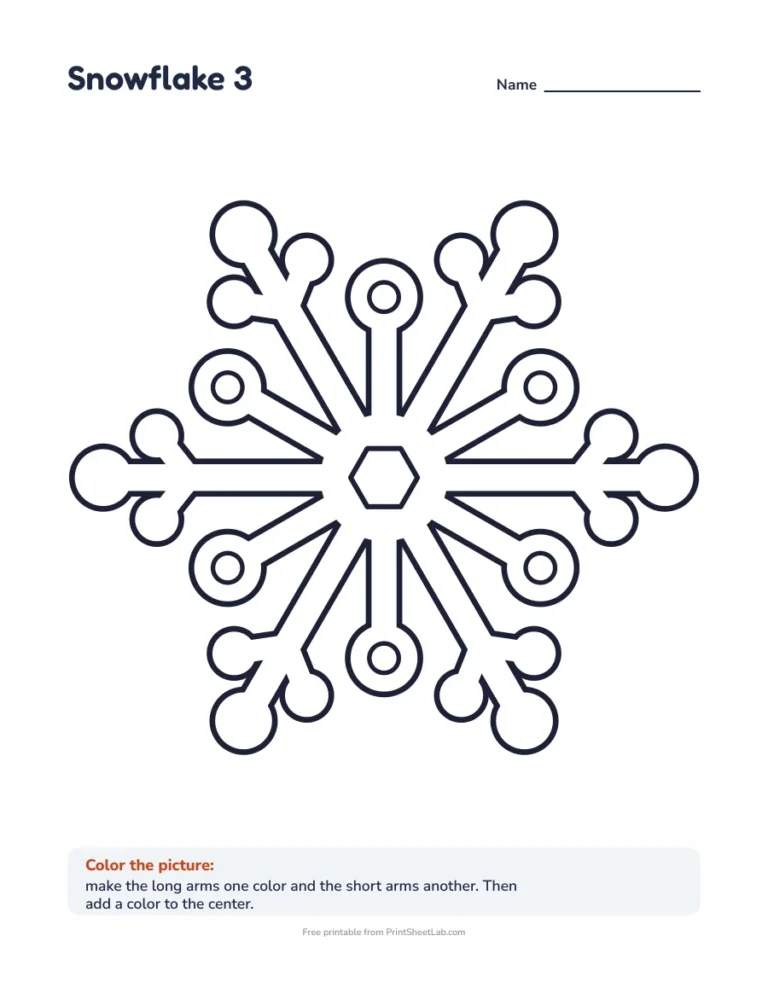
| Snowflake 3 | A star-shaped snowflake with long branched arms and short arms with round ends | Medium: many small round spaces | 6 to 10 |
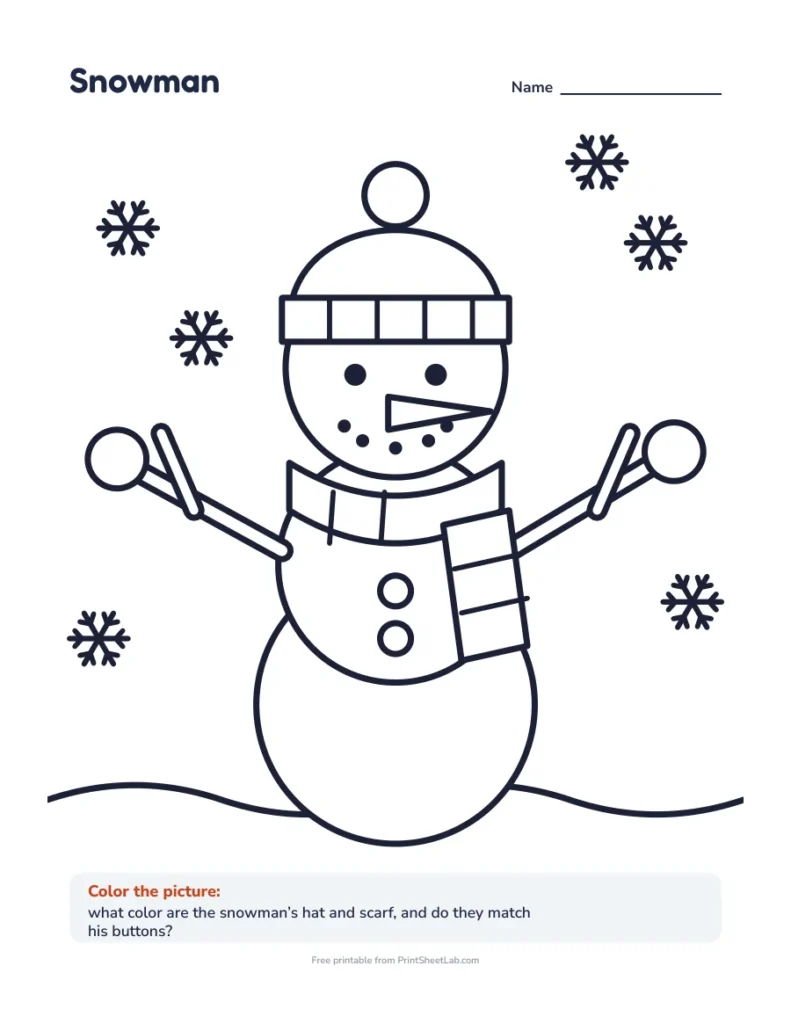
| Snowman | A snowman in a knit beanie and scarf, with stick arms and falling snowflakes | Easy: three big circles and a few details | 3 to 7 |
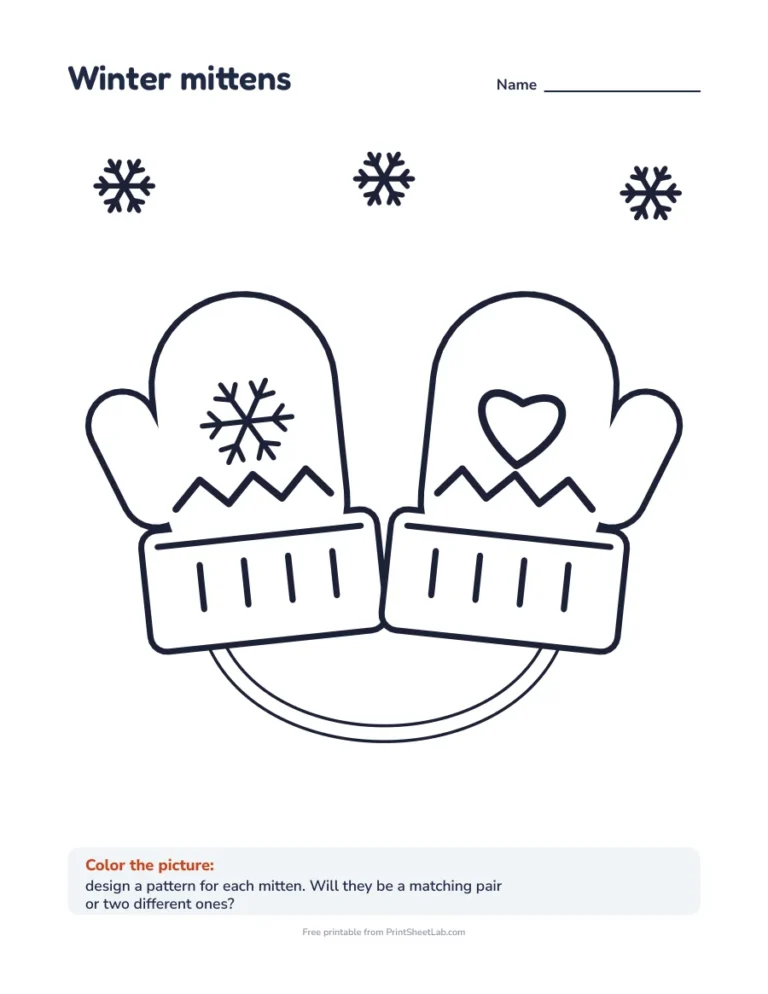
| Winter mittens | Two mittens joined by yarn, one with a snowflake and one with a heart | Easy to medium: big shapes, patterns to invent | 4 to 8 |
| Penguin | A round penguin with a belly, flippers, feet and a scarf, standing on an ice floe | Easy: large smooth shapes | 3 to 7 |
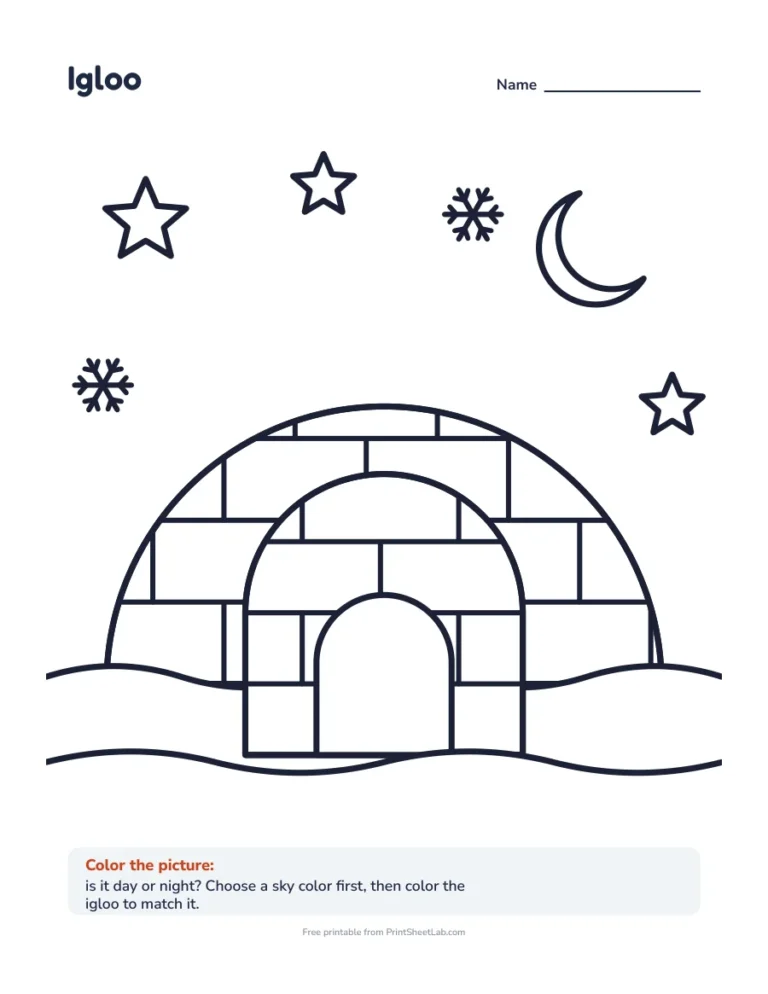
| Igloo | An igloo made of snow blocks with an entrance tunnel, a crescent moon and stars | Medium: a wall of blocks to fill | 6 to 10 |
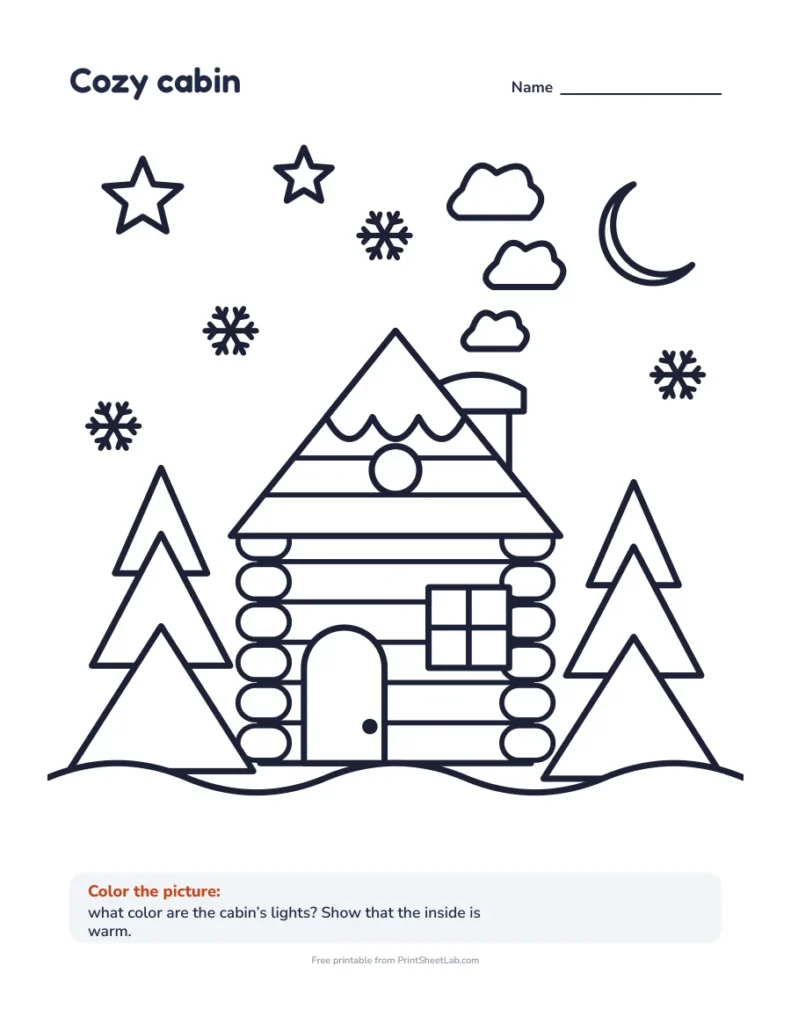
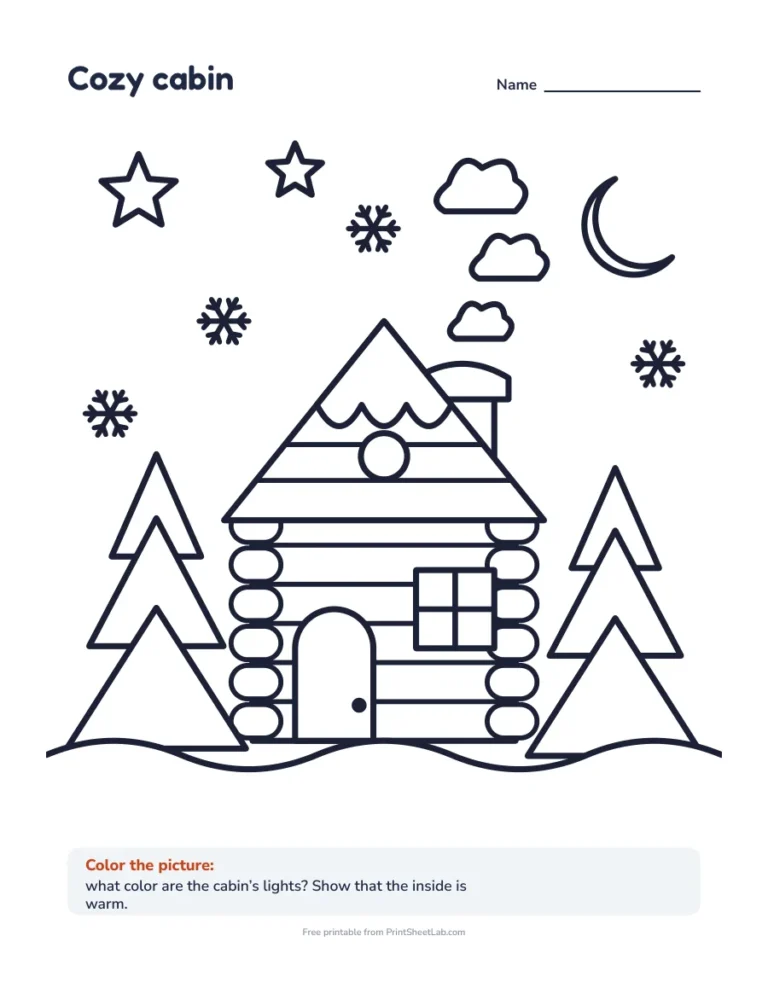
| Cozy cabin | A log cabin with a snowy roof, smoke from the chimney and two pine trees | Hardest: logs, roof lines and trees | 7 to 10 |
Difficulty here means how many separate spaces there are and how small they get. The penguin and the snowman are made from a few big shapes, so even a child who colors with a whole fist can stay inside the lines. The snowflakes have narrow arms and need a steadier hand, and the cabin has logs, roof lines, trees and a window to decide on.
Winter coloring ideas: mixing colors, textures and prompts
The easiest way to make a winter picture look cold, cozy or magical is to choose the colors on purpose, and the prompt at the bottom of every page is a starting point for that choice.
Mixing colors for snow, ice and night skies
Snow does not have to be left plain white, because a little blue or lilac in the shadows makes it look cold and soft. Layering two colors lightly gives a third color, and the chart shows six mixes that suit winter scenes.
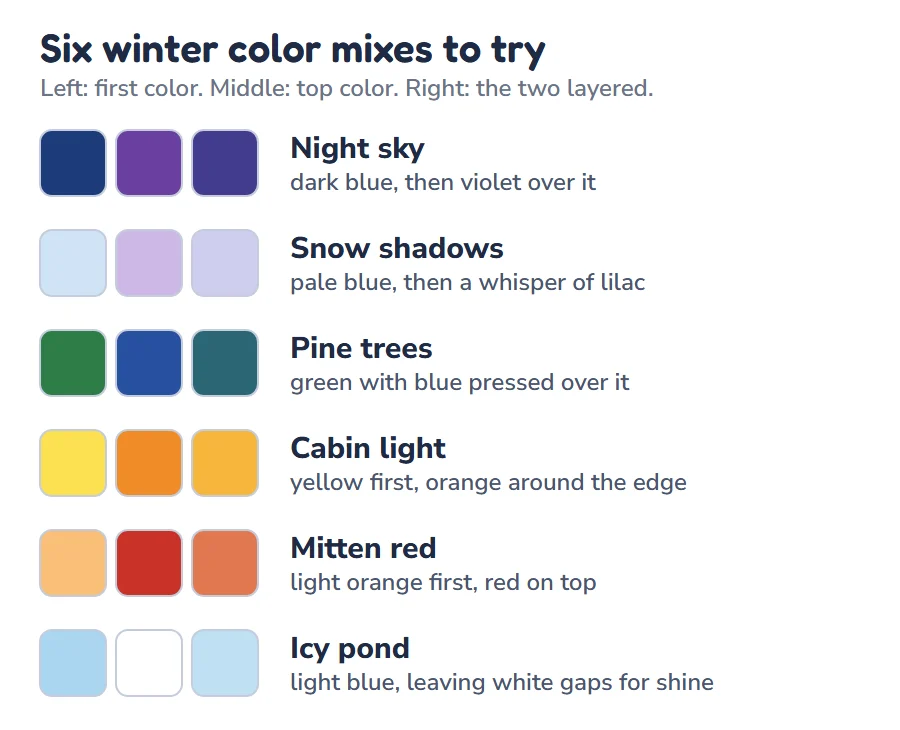
- Cold and warm: use cool colors (blues, violets, greens) for snow, sky and trees, then add one warm color, such as yellow in the cabin window, so that the warm spot stands out.
- Light to dark: color the lightest shade first and press harder only where you want it darker, because pencil and crayon are hard to lighten again.
- Night or day: on the igloo page, decide on the sky before the igloo. A dark sky makes a pale igloo glow, and a pale sky makes a blue igloo look icy.
Texture ideas with crayons and colored pencils
Texture comes from how you move the crayon, so changing the direction of your strokes changes how the surface looks.
- Logs: color the cabin logs with long strokes that follow each log, and use a darker brown pencil along the bottom edge of each one.
- Knitted look: make rows of small “v” marks on the mittens and the snowman’s beanie.
- Wax resist: press a white crayon hard onto the snowflake pages, then paint over the page with a dark or bold watercolor. The crayon wax repels the paint, so the snowflake shows through, as the Ormond Memorial Art Museum explains. Use heavier paper for this.
- Salt sky: sprinkle a little salt on a wet watercolor sky. The Artful Parent says the salt absorbs the liquid and leaves white spots that look like snow. Let the paint dry, then rub the salt off.
- Sparkle: add white gel pen dots over dark blue or purple for stars and falling snow.
Tips for preschoolers
Preschoolers do best when there is no wrong color, so start with the snowman or the penguin and let them choose anything, including a green snowman.
- Offer chunky crayons and tape the page to the table so it does not slide.
- Keep a session short and put the page away unfinished if the child is done.
- Read the prompt aloud and treat the answer as a conversation, not a test.
- Praise the choices (“you used so much purple”) instead of how neat the coloring is.
Tips for older kids
Older children enjoy a challenge, and the cabin, the igloo and the snowflakes give them room for one.
- Limit the palette to three colors plus black and see how many different shades you can make by layering.
- Add a background to the snowman, the penguin or the mittens: a sky, a frozen lake, a row of trees.
- Color the three snowflakes as a set, each in its own color family, and hang them in a window.
- Draw something that is not on the page, such as the inside of the igloo or a trail of footprints in the snow.
The prompts printed on the pages
Every page ends with a short instruction, and you can read these aloud for a family art hour or a classroom.
- Snowflake 1: Use only cool colors. Which arm will be your lightest blue, and which your darkest?
- Snowflake 2: Give each of the six arms its own color, then color the middle to match one of them.
- Snowflake 3: Make the long arms one color and the short arms another. Then add a color to the center.
- Snowman: What color are the snowman’s hat and scarf, and do they match his buttons?
- Winter mittens: Design a pattern for each mitten. Will they be a matching pair or two different ones?
- Penguin: Most penguins are black and white, so what colors will you give this penguin’s scarf?
- Igloo: Is it day or night? Choose a sky color first, then color the igloo to match it.
- Cozy cabin: What color are the cabin’s lights? Show that the inside is warm.
Why do snowflakes have six sides?
Snow crystals have six sides because of how water molecules line up in ice. Kenneth Libbrecht, a physics professor at the California Institute of Technology, explains on SnowCrystals.com that the six-fold symmetry of a snow crystal arises from the arrangement of water molecules in the ice crystal lattice.
The same source says a stellar snow crystal begins as a small hexagonal plate, and branches sprout from its six corners as it grows. The six arms look alike because they all grow through the same changing temperatures and humidities at the same time. They look similar rather than identical, as Wikipedia notes, because each arm grows independently from a corner of the hexagon.
You can use that idea to draw your own. The three snowflake pages here were each built from one arm that is repeated six times, turning it 60 degrees each time, which is how six-fold symmetry works. Draw one arm with branches on a sheet of paper, then copy it five more times around the same center and compare the result with the pages.
How do you print the pages?
Print each PDF at 100% (actual size) on US Letter or A4 paper. Every picture sits inside a 190 by 250 mm area, so nothing is cut off on either paper size.
- Use regular printer paper for crayons and colored pencils. Put a spare sheet under the page if you use markers, because they can bleed through.
- The pages are black line art, so they copy cleanly on a school printer, and you can print the same page for a whole class.
- Print the combined PDF for the whole set, or open one page to print a single sheet.
- The name line at the top right is there for classrooms, and the bottom panel holds the color-the-picture prompt.
Keep the winter coloring pages handy for snow days and the long evenings of the winter break.
Frequently asked questions
9 quick answers
Are these winter coloring pages free?
Yes. All eight pages are free to download and print, each as a US Letter and an A4 PDF.
What age are they for?
They suit ages 3 to 10. The penguin and the snowman are easiest, from about age 3, and the cabin is best from about age 7.
Is anything Christmas-only in this set?
No. The pictures are winter themes only, so they work all winter. For Santa, a tree and a reindeer, use the Christmas coloring pages instead.
Which crayons or pencils work best?
Crayons and colored pencils work on regular printer paper. Markers can bleed through thin paper, and watercolor needs heavier paper.
Why do snowflakes have six arms?
Because the water molecules in an ice crystal line up in a hexagonal pattern, so a snow crystal grows with six-fold symmetry, as the Caltech physicist Kenneth Libbrecht explains.
Can I print on A4 paper?
Yes. Pick the A4 button under any picture, or the A4 button for the combined PDF.
How can I draw my own snowflake?
Draw one arm with branches, then repeat it six times around a center point, turning it 60 degrees each time.
Which of the snowflake coloring pages is easiest?
Snowflake 2, the hexagon with a ring, spokes and diamond tips, has wide, simple spaces and suits ages 5 to 9. Snowflakes 1 and 3 have narrow arms or many small round spaces, so they suit ages 6 to 10.
How can a preschooler enjoy the snowman coloring page?
It is made from three big circles and a few details, so it suits ages 3 to 7. Offer chunky crayons, tape the page to the table and let any color be right, even a green snowman. Read the prompt about the hat and scarf aloud.
More winter and Christmas printables
- Christmas coloring pages with a tree, Santa, a reindeer and more
- Gingerbread house template with true-scale patterns, including a paper house to color
- Winter worksheets and Winter I spy
- Christmas activities for kids
- All holiday worksheets
Sources
- The Science of Snowflakes, SnowCrystals.com by Kenneth G. Libbrecht, California Institute of Technology (six-fold symmetry, hexagonal plate, arms growing in synchrony)
- Snowflake, Wikipedia (the six arms grow independently from the corners of the hexagon)
- Watercolor Resist Painting, Ormond Memorial Art Museum & Gardens (wax crayon repels watercolor)
- A Fun Winter Painting Idea for Kids, The Artful Parent (salt on wet watercolor leaves white spots)
Did you like this?
Last updated: