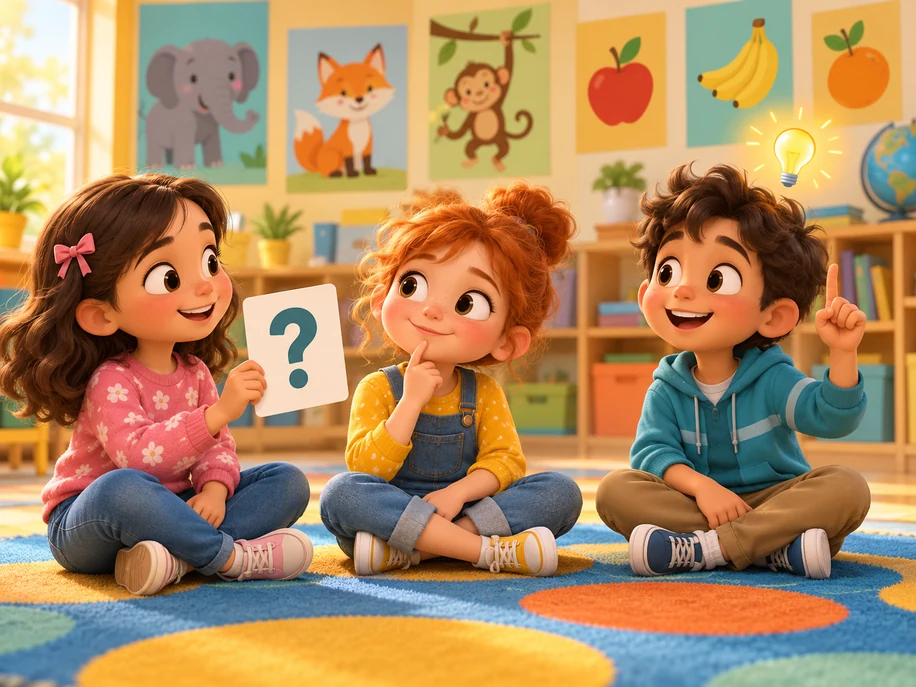
Riddles are short, funny and just hard enough to make a child stop and think, which is why riddles for kids printable pages work so well at school, at home and on long car rides. This free set has six PDFs: three themed riddle pages about animals, food and things at home, an easy picture-choice page for early readers, a harder three-clue page for ages 8 and up, and a set of cut-out riddle cards. Every riddle was written for this page, and every PDF includes an answer key. Each riddles for kids printable set comes with answers.
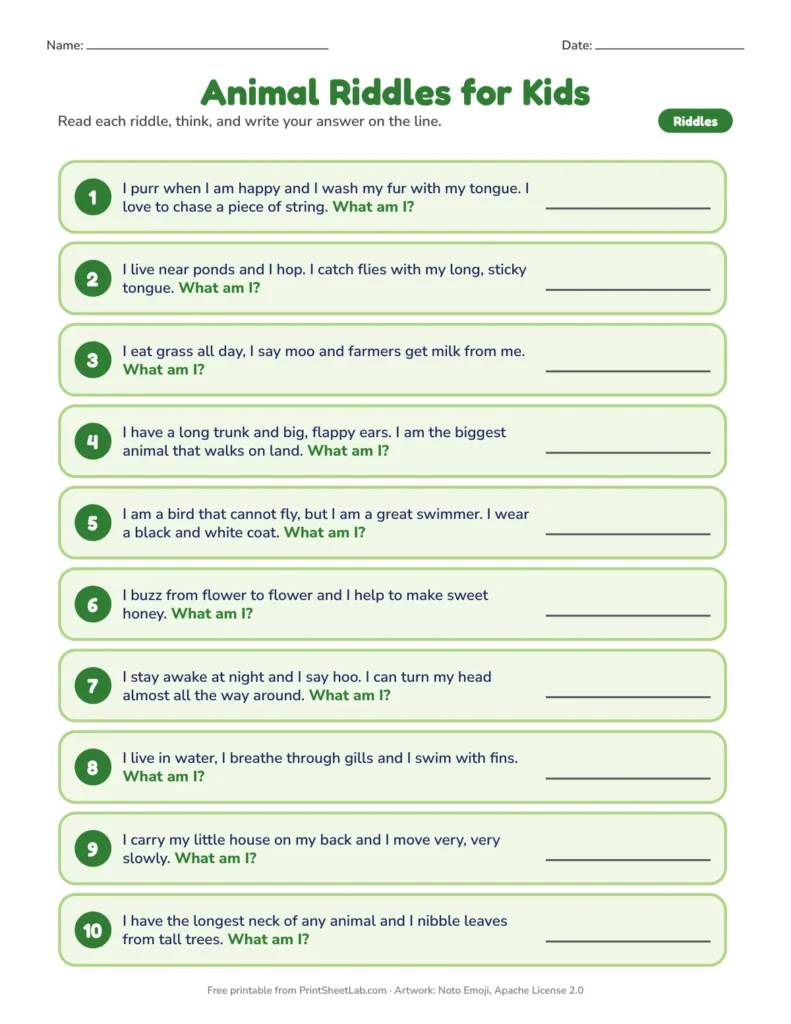
Quick answer: print one page, read each riddle aloud together and let the child write or say the answer. Use the easy picture riddles for ages 4 to 6, the animal, food and home pages for ages 6 to 8 and the what-am-i page for ages 8 and up. Page 2 of each PDF has the answers.
Riddles for kids printable (PDF)
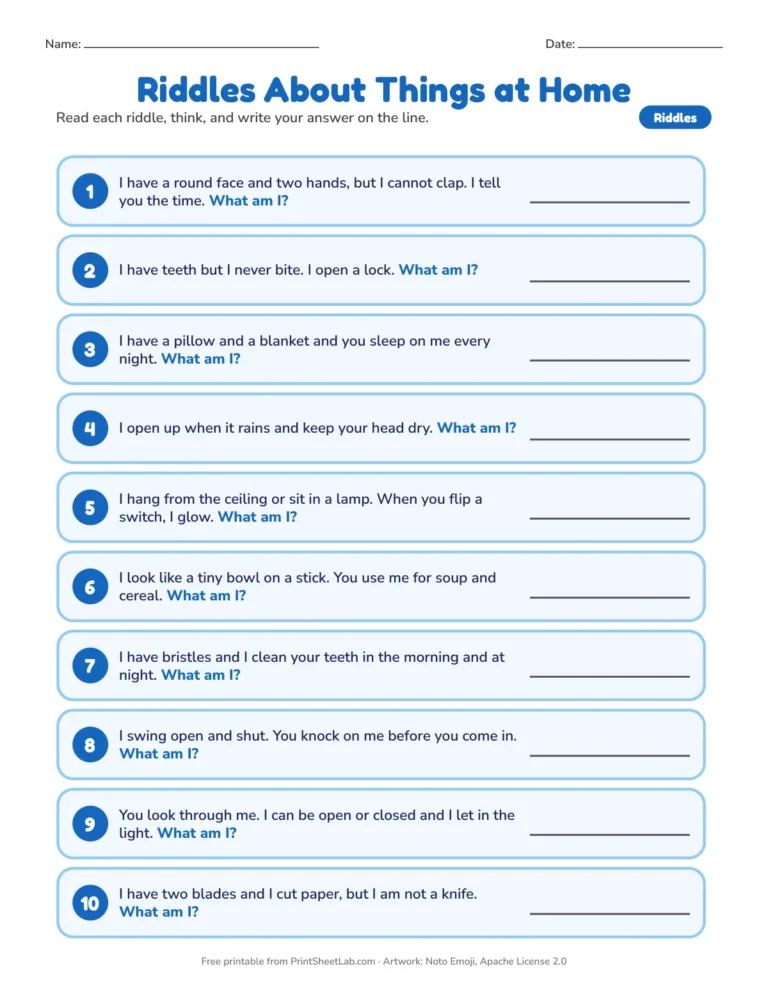
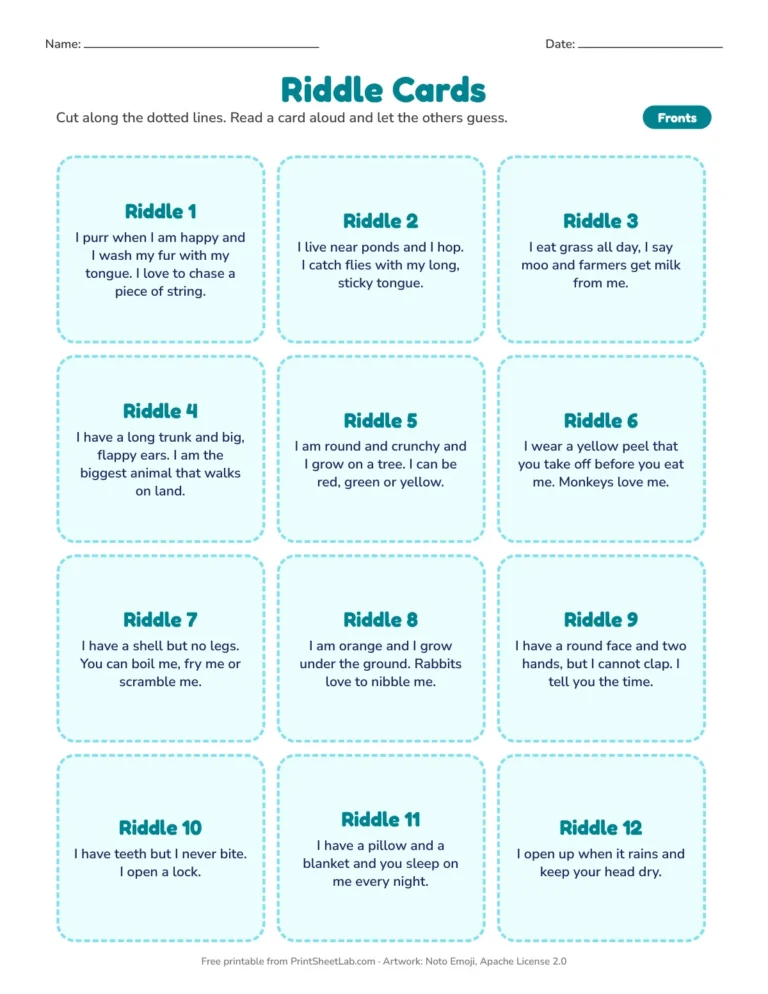
Six sets, each a PDF with the riddles on page 1 and the answers on page 2. Click a picture to open it.




Which riddles for kids printable set should you start with?
| Set | Best for | How it works |
|---|---|---|
| Easy picture riddles | Ages 4 to 6 | A short riddle and three pictures. Children circle the answer. |
| Animal, food and home riddles | Ages 6 to 8 | Ten riddles per page, each with a line for the answer. |
| What am I? riddles | Ages 8 and up | Three clues each. The more clues you read, the easier the guess. |
| Riddle cards | All ages, groups | Cut the cards, read the riddle aloud, then flip for the answer. |
How to use riddles for kids at home or in class
- Read slowly. Read each riddle twice, with a pause so children can picture the answer.
- Ask for a guess, then a reason. “What makes you think so?” turns a guess into reasoning practice.
- Give one clue at a time. On the what-am-i page, read the first clue and let children guess before you read the next.
- Celebrate wrong answers that fit. A guess that matches some of the clues shows real thinking.
- Check with the answer key. Page 2 of each PDF shows the answers with a picture.
Why riddles are good for learning
- Listening: children must hold several details in mind to find the one answer.
- Vocabulary: riddles use describing words such as sticky, flappy and crunchy.
- Inference: kids connect clues to what they know, a key reading skill.
- Confidence: a child who solves a riddle gets a quick, happy win.
Ideas for a riddle time
- Riddle of the day: post one riddle from these sheets on the fridge or the board every morning and reveal the answer at dinner.
- Riddle bag: put the cut-out riddle cards in a bag and let each child draw one to read aloud.
- Team game: two teams take turns, and a team scores a point for each correct answer.
- Write your own: older children write a riddle about a favorite animal or toy, and the class guesses.
- Car-ride game: keep a few cards in the glove box for traffic jams and waiting rooms.
Tips for writing riddles for kids
A good children’s riddle starts with something the child knows. Describe how it looks, what it does and where you find it. Put the most special clue last, because it gives the answer away. Keep the sentences short and avoid tricks that need an adult’s knowledge. Printed riddles with the answers on a second page also let a busy parent check a guess without searching online. After a few tries with any riddle set, children can write riddles about their own pets, toys and snacks.
How these sheets are made
Every sheet is generated by a program. Every riddle was written for this page, and each answer is printed on page 2 of its PDF. The riddle cards are laid out so the answer side lines up with the question side when you print on both sides. The pictures are Noto Emoji artwork from Google, used under the Apache License 2.0; the project is on GitHub. A credit line is printed on every page.
Put one riddles for kids printable sheet in a lunchbox or on the fridge for a daily brain-teaser.
Frequently asked questions
6 quick answers
Are these printable riddles free?
Yes. Print as many copies as you like for your own children or class, with no account or sign-up.
What age are the riddles for?
The picture riddles suit ages 4 to 6, the animal, food and home riddles suit ages 6 to 8 and the what-am-i riddles suit ages 8 and up.
Are the answers included?
Yes. Page 2 of every PDF shows the answers, and the easy riddle page circles the right picture.
Can I read the riddles aloud to a younger child?
Yes. Read the riddle aloud, let the child look at the pictures and ask them to point to the answer.
Are the riddles original?
Yes. All riddles were written for these pages, and each describes a thing in simple, kind words with no tricks.
How do I use the riddle cards?
Cut along the dotted lines. Read the riddle on the front, let children guess and then turn the card to show the answer. Print page 2 on the back if your printer prints on both sides.
More puzzles and word games
- Every puzzle and brain teaser on PrintSheetLab.
- Printable mazes and charades for kids.
- Classroom bingo and picture bingo for kids.
- Memory game printable and same and different worksheets.
- Rebus puzzles for picture word riddles.
- Indoor scavenger hunt with clue cards.
Did you like this?
Last updated: