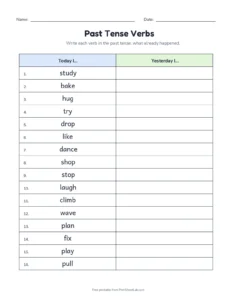
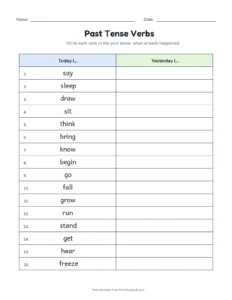
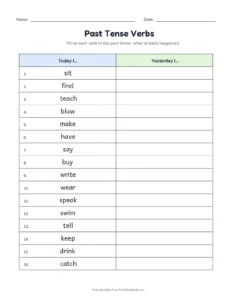
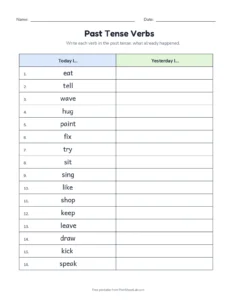
Change the numbers, layout and number of problems, then download a new PDF with its answer key.
These free past tense verbs worksheets give children in grades 1 to 3 practice turning today’s verbs into yesterday’s: regular verbs that take -ed, like jump and jumped, and irregular verbs that change, like go and went. Each page has a two-column table with 16 verbs, and the maker draws from 28 regular and 46 irregular verbs, 74 in all, so every sheet is different. Every download has an answer key, in color or black and white.
Past tense verbs worksheets to print (PDF)
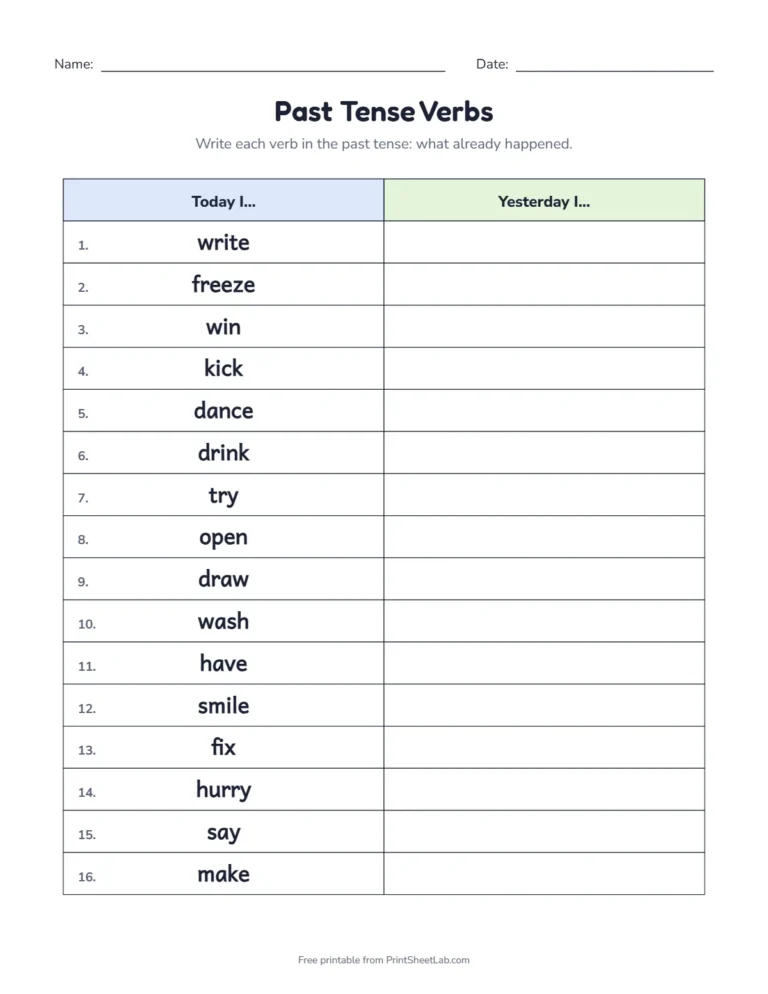
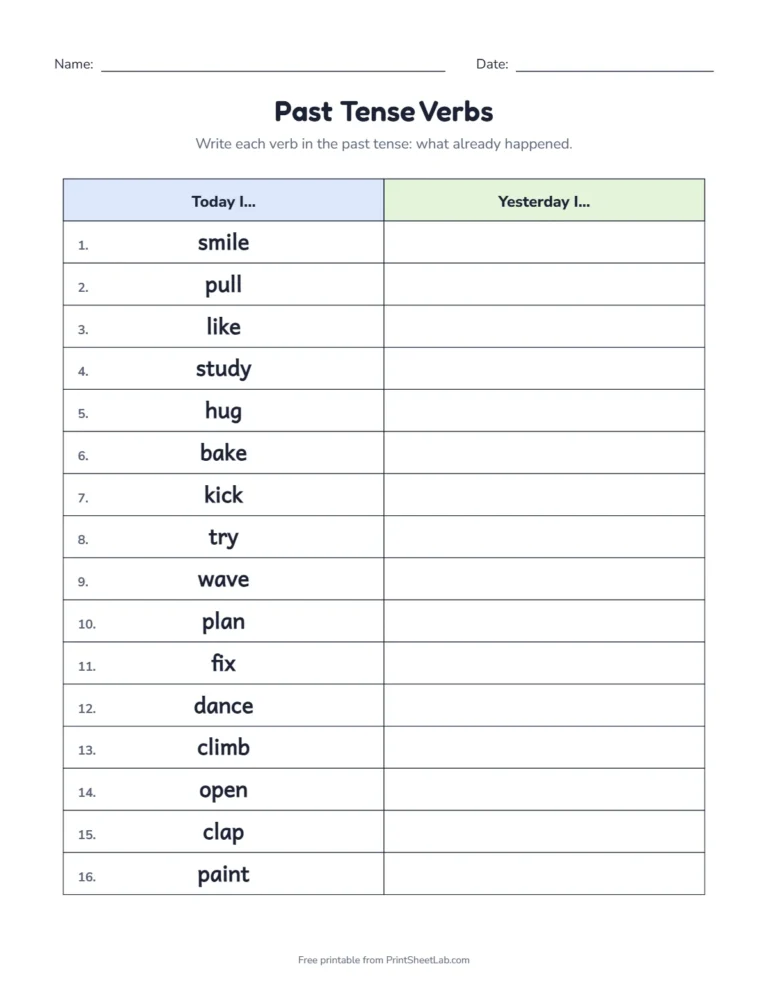
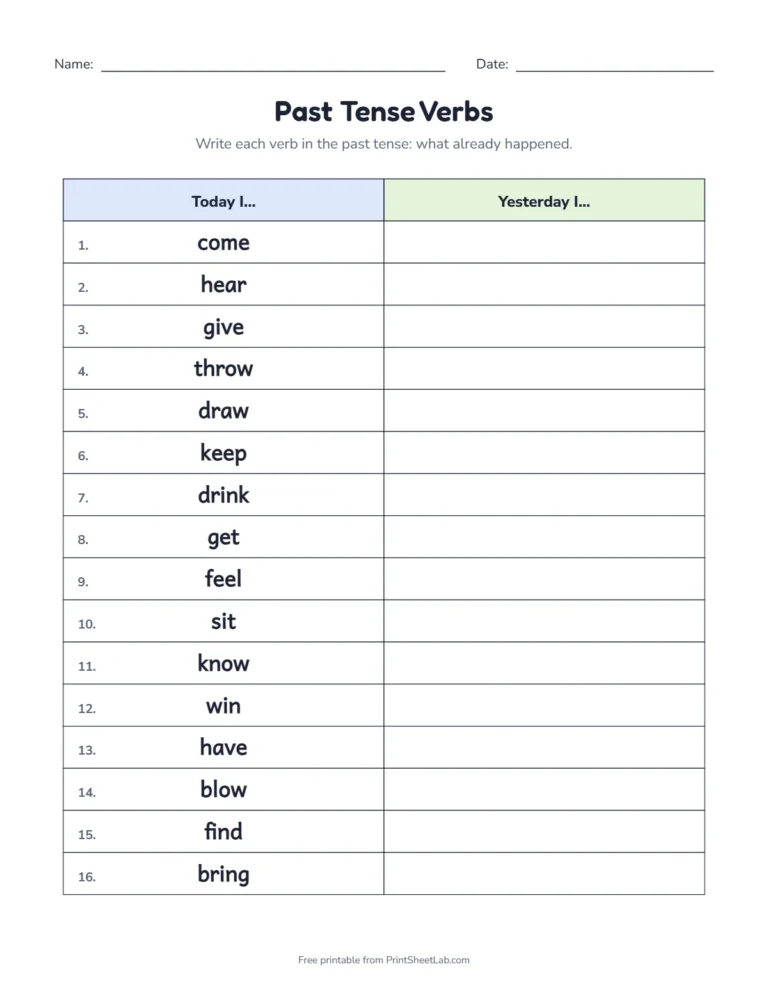
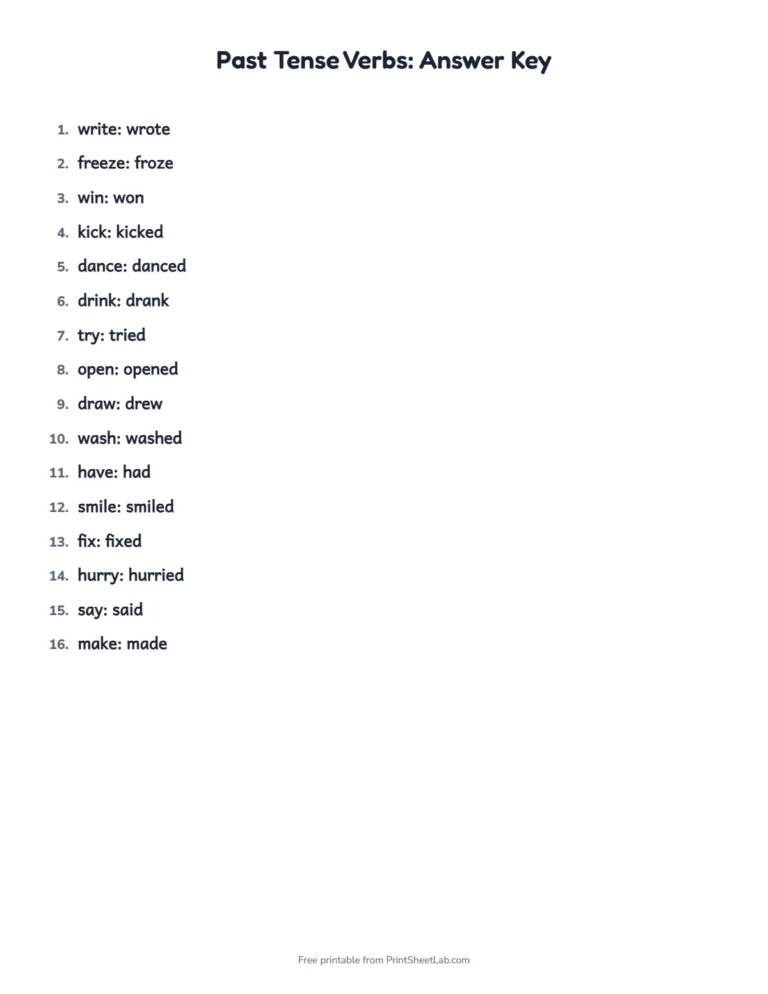
The pages below show a mixed sheet, a regular verbs sheet with -ed endings, an irregular verbs sheet and an answer key. Use the maker at the top of this page to change the number of pages, the font, black and white ink or the paper size, then press New sentences for a fresh set. Every sheet has an answer key.
Past tense verbs worksheets: what is the past tense?
The past tense tells what already happened. Children say “Today I jump” and “Yesterday I jumped” and write the changed verb in the second column. The sheets use the sentence frame Today I… and Yesterday I… because it makes the time change clear. Wikipedia’s past tense article describes how languages mark past events.
Regular past tense verbs: the -ed rules
Regular verbs follow a pattern. Here is how the 28 regular verbs in the maker are divided:
Rule
How many verbs
Examples
add -ed
11
jump → jumped, play → played, walk → walked, laugh → laughed, open → opened
Children can learn these four rules in four short lessons. Use the regular past tense verbs worksheet for this practice, and the irregular past tense verbs worksheet for the next step. The double-the-letter rule applies to short verbs with one vowel and one final consonant, such as hop, so hopping has two p’s.
How -ed sounds: three endings
The -ed ending is spoken in three ways, which is why spelling it is tricky. In jumped it sounds like /t/, in played it sounds like /d/, and in painted it adds a whole syllable, /id/. Of the 28 regular verbs, 14 end in a /t/ sound, 13 end in a /d/ sound and only painted adds a syllable. Reading the verbs aloud helps children hear that all three are written the same way.
Irregular verbs worksheet: the 46 irregular past tense verbs
Irregular verbs do not follow the -ed rule, and children learn them by sight and by practice. Grouping them by pattern makes them easier to remember:
make → made, sleep → slept, tell → told, sit → sat, feel → felt, keep → kept
vowel change or other
22
go → went, see → saw, eat → ate, run → ran, sing → sang, swim → swam
The most common irregular verbs, such as go, see, eat, run, make and take, are the ones children use all the time, so they are worth learning first. Many children say “goed” or “runned” because they are applying the regular rule, a sign they understand the pattern.
Past tense verbs worksheets for grade 2: a five-day plan
Day
What to do
Monday
Say “Today I… Yesterday I…” for ten verbs, then do the regular verbs page
Tuesday
Learn the four -ed rules with the examples above
Wednesday
Do the irregular verbs page and group the verbs by pattern
Thursday
Write a diary entry about yesterday and circle the past tense verbs
Friday
Do a mixed page, then check with the answer key
ed verbs worksheet: spelling the regular past tense
An ed verbs worksheet is mostly a spelling exercise. The sound is easy, but the spelling needs one of four rules, and the maker covers all four. After children fill in the table, ask them to read each pair aloud, then sort the pairs by the rule they used. Doing this on a small whiteboard before writing makes the final copy neat and correct.
Regular and irregular verbs: which to teach first?
Start with regular verbs, because their rules give children confidence, and then add the irregular verbs they use every day: go, see, eat, run and make. Introduce a few irregular verbs per week rather than all 46 at once, and keep a class chart of the ones learned. Review the whole list each month, because irregular forms must be remembered rather than worked out.
Teaching the past tense grade by grade
Grade
What children learn about the past tense
Standard
1
Use verbs to convey past, present and future
L.1.1.e
2
Form and use the past tense of frequently occurring irregular verbs
L.2.1.d
3
Form and use regular and irregular verbs and the simple tenses