
Free prefixes and suffixes worksheets for grades 2 to 5, with an answer key on every sheet. Make prefix worksheets and suffix worksheets in two levels: build words from their meanings, split words into prefix, base word and suffix, circle the right word, or match words to what they mean. Below the generator you will find a prefixes and suffixes list with meanings, the spelling rules that trip children up, and teaching ideas for class or home.
Play the prefix and suffix quiz
Read the meaning and choose the word that matches. It is a quick warm-up before the prefixes and suffixes worksheets below. Switch between prefixes and suffixes any time.
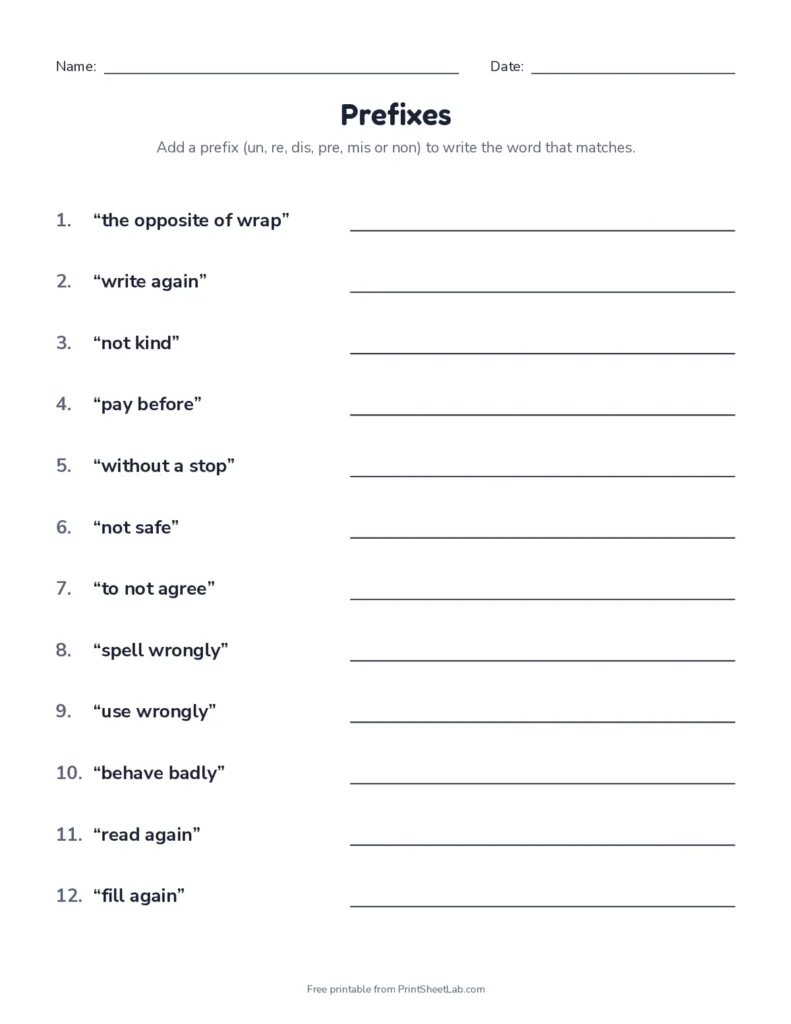
Ready-to-print prefixes and suffixes worksheets (PDF)
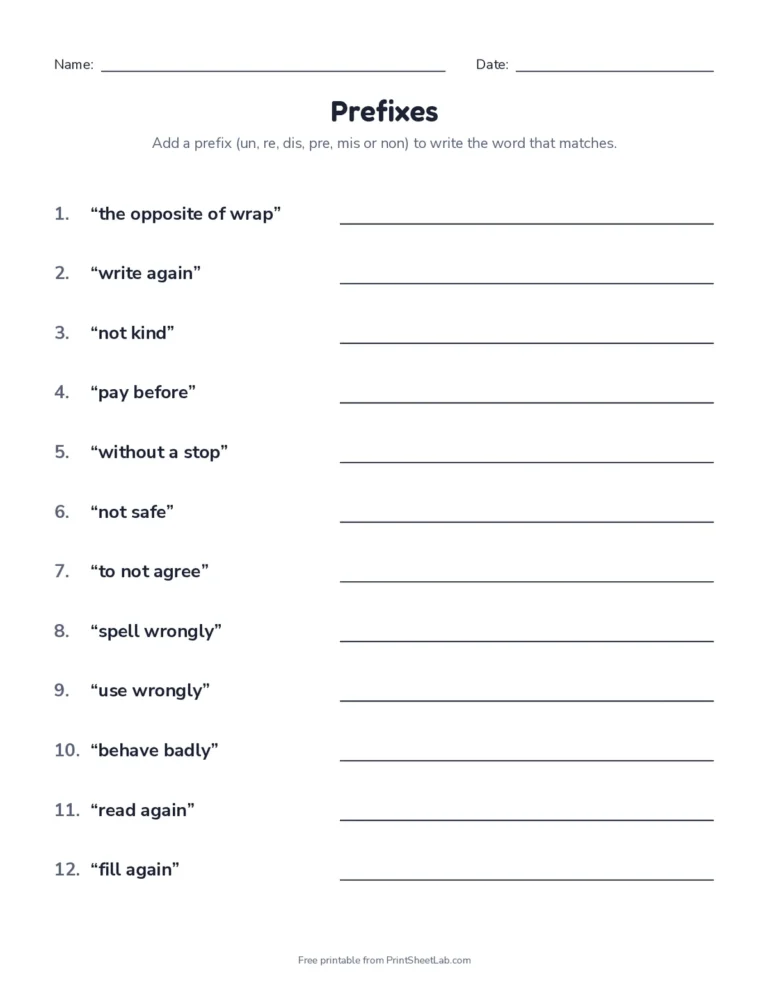
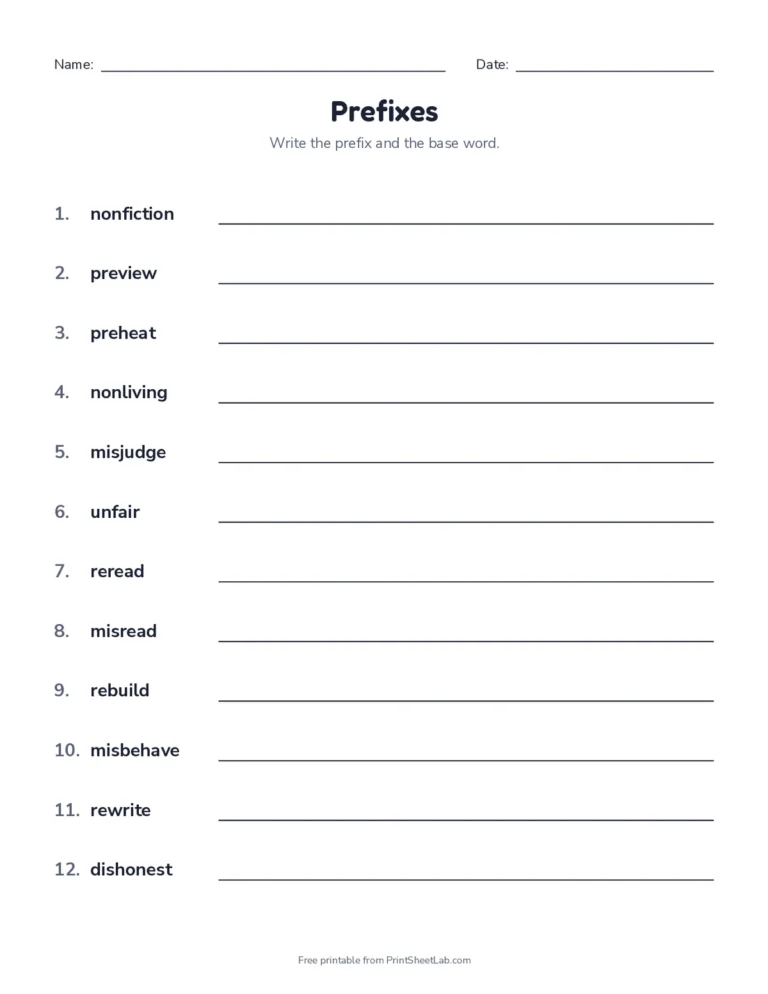
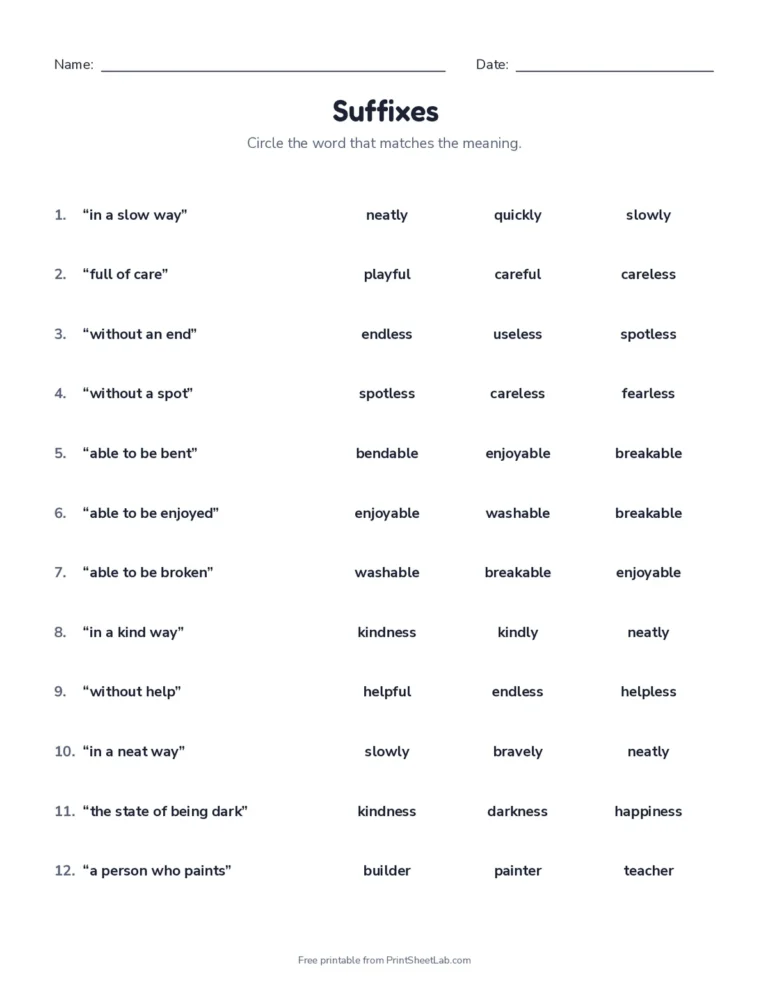
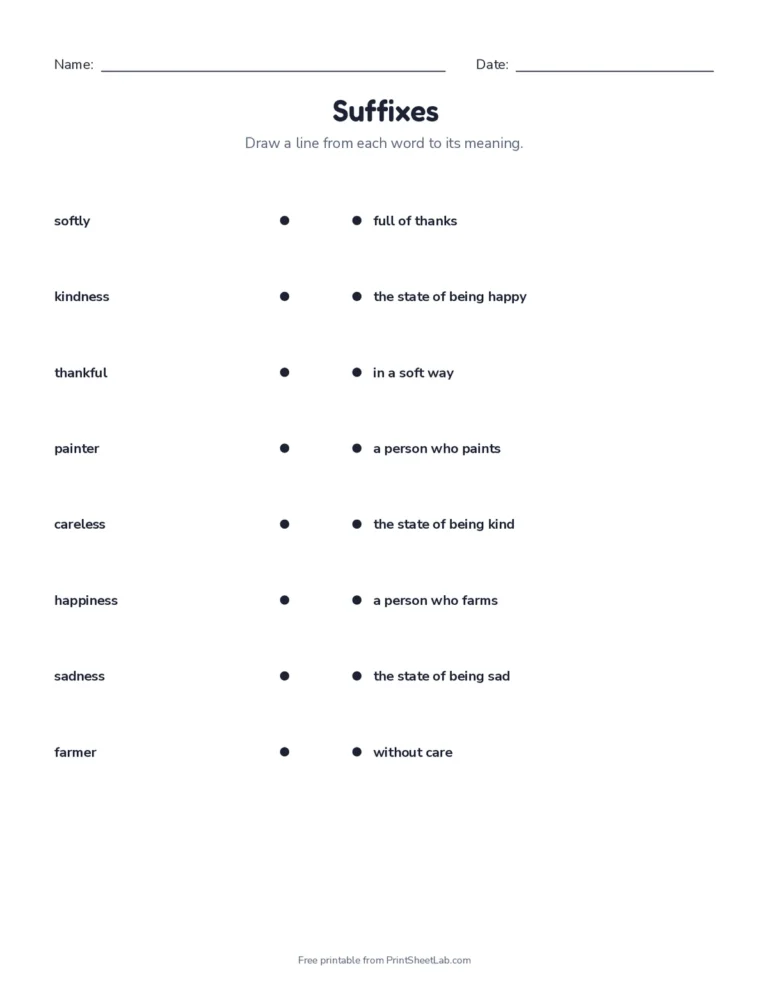
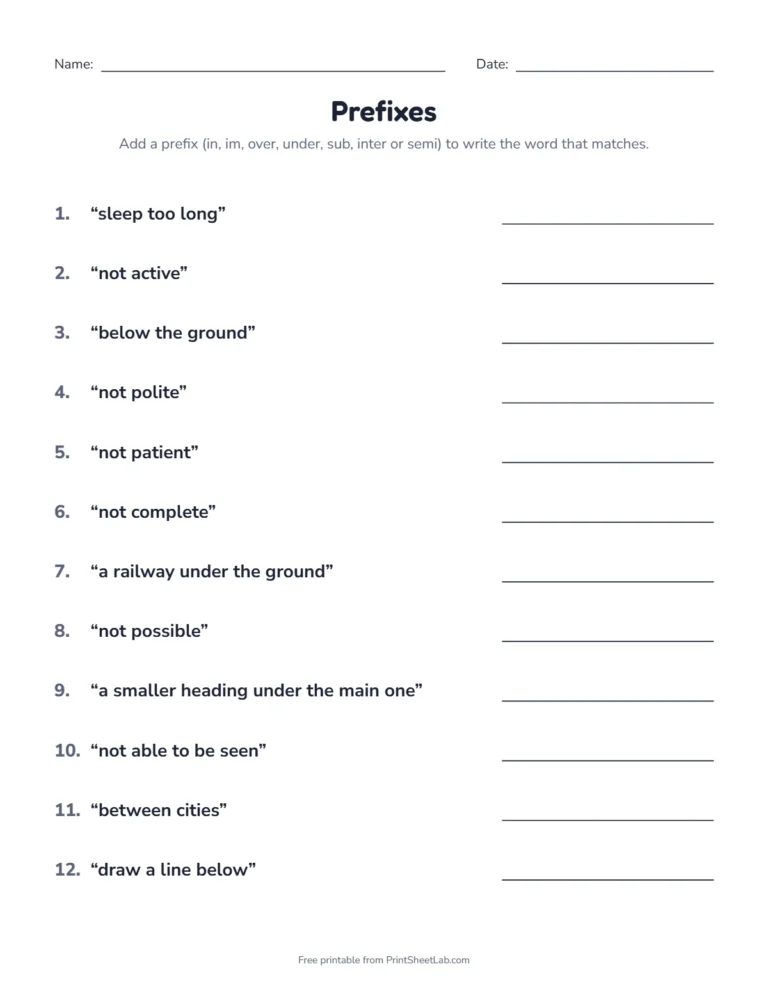
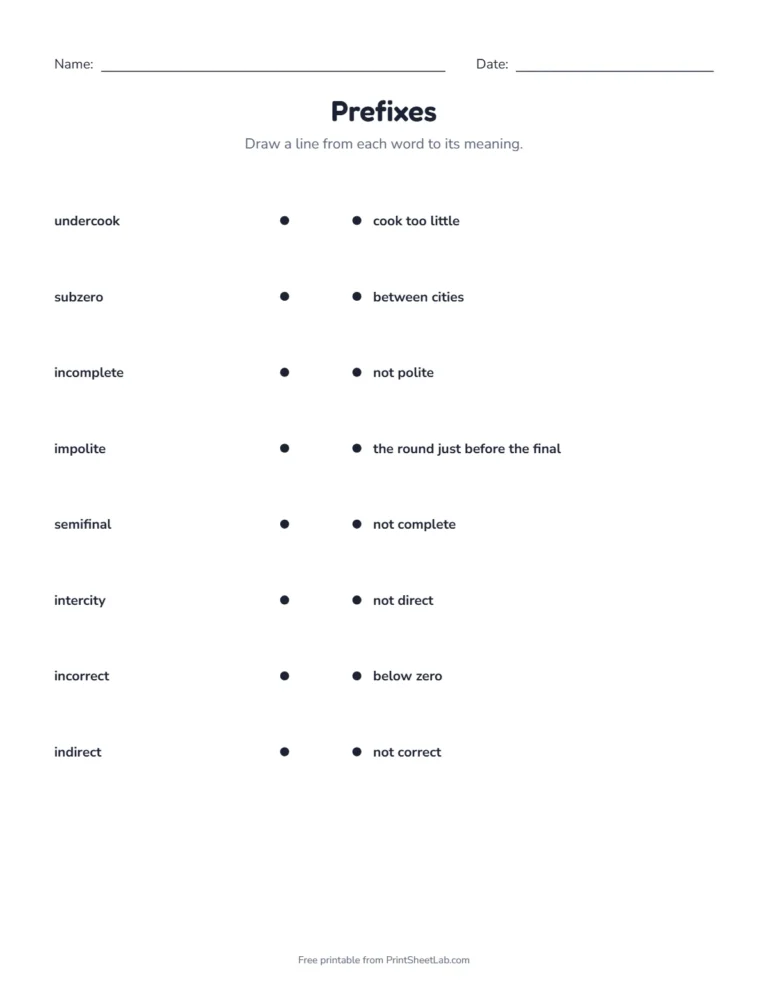
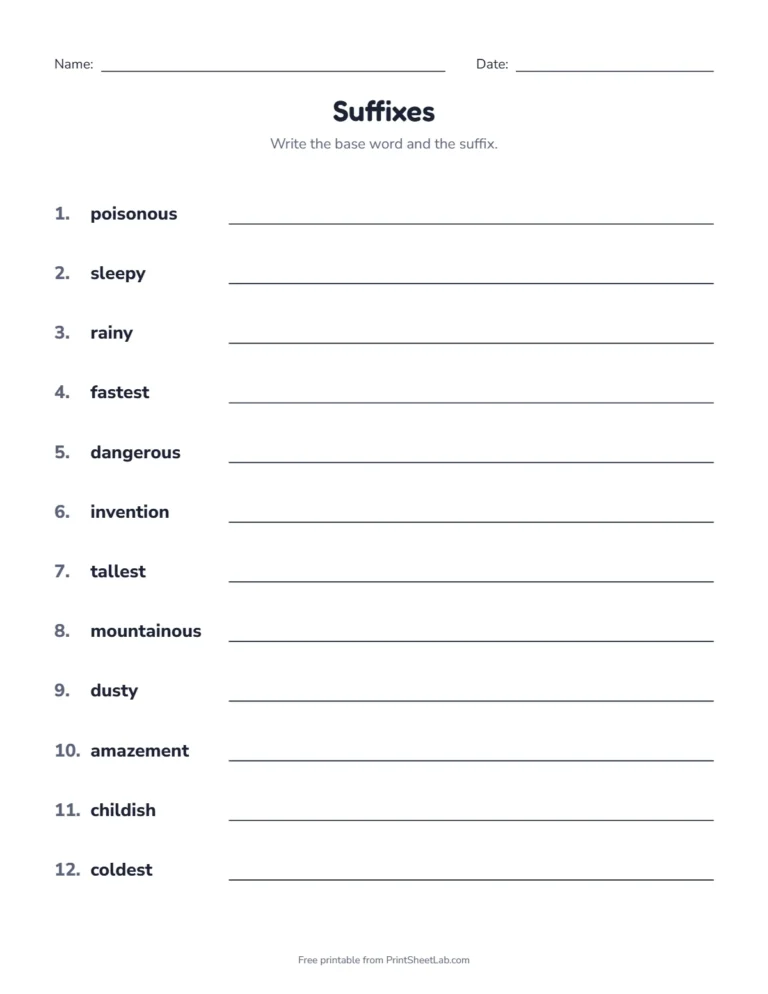
The first four prefixes and suffixes worksheets suit grades 2 and 3, the last four grades 4 and 5. Each opens as a PDF with its answer key; Customize lets you switch the activity or print several different pages at once.
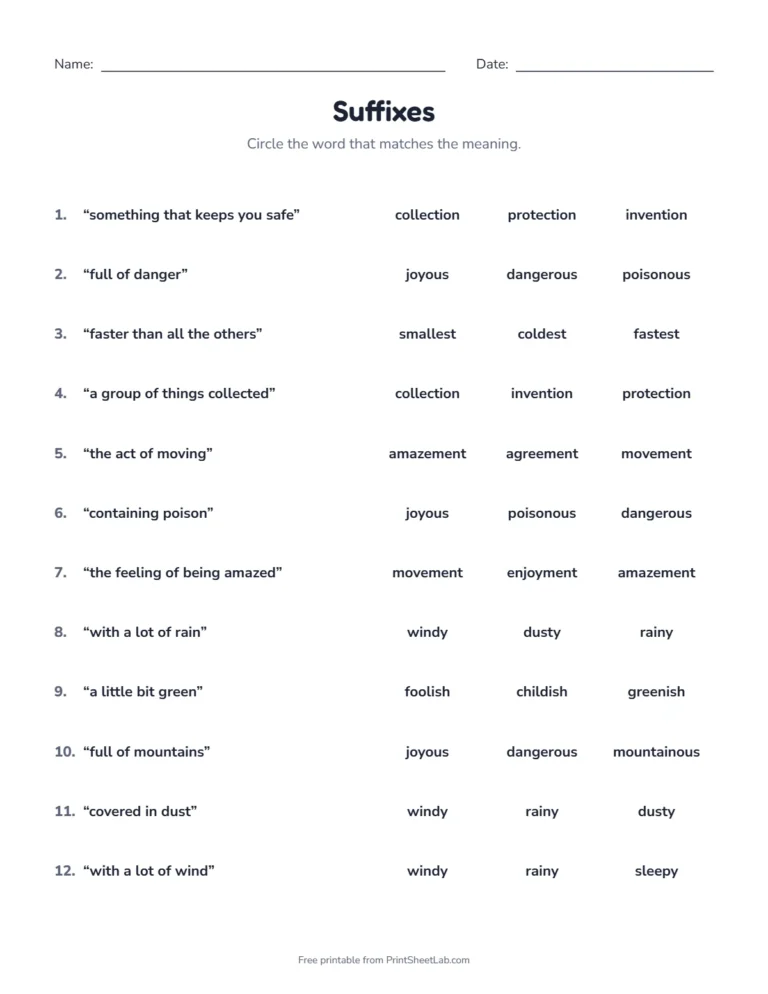
Prefixes and suffixes list with meanings (grades 2 and 3)
| Word part | Meaning | Example |
|---|---|---|
| un- | not, opposite of | unkind, untie |
| re- | again | reread, refill |
| dis- | not, opposite of | disagree, disappear |
| pre- | before | preheat, preview |
| mis- | wrongly | misspell, misread |
| non- | not | nonfiction, nonstop |
| -ful | full of | helpful, joyful |
| -less | without | fearless, endless |
| -ly | in a certain way | quickly, kindly |
| -er | a person who | teacher, painter |
| -ness | the state of being | kindness, darkness |
| -able | able to be | washable, breakable |
Grades 4 and 5 prefixes and suffixes list
Choose Grades 4 to 5 to get prefixes and suffixes worksheets with these harder word parts. Many of them change the meaning in a bigger way than un- or -ful, so they are a good next step once the first twelve feel easy.
| Word part | Meaning | Examples |
|---|---|---|
| in-, im- | not | incorrect, invisible, impossible, impolite |
| over- | too much, above | overcook, oversleep, overflow |
| under- | too little, below | undercook, underwater, underline |
| sub- | under, below | subway, subzero, subheading |
| inter- | between, among | interact, international, intercity |
| semi- | half, partly | semicircle, semifinal |
| -ment | the act or result of | movement, payment, enjoyment |
| -ous | full of, having | dangerous, joyous, mountainous |
| -est | the most | tallest, fastest, coldest |
| -y | having a lot of | rainy, windy, dusty |
| -ish | like, a little | childish, foolish, greenish |
| -ion | the act or thing made | action, collection, invention |
Spelling rules when you add a suffix
Prefixes almost never change the spelling of the base word: mis + spell is misspell, with both s’s kept. Suffixes are trickier. These four rules cover most words on our suffix worksheets:
- Drop the silent e before a suffix that starts with a vowel: bake + er = baker, close + est = closest. Keep it before a consonant: hope + ful = hopeful, move + ment = movement.
- Change y to i when a consonant comes before the y: happy + ness = happiness, easy + ly = easily. Keep the y when a vowel comes before it: enjoy + ment = enjoyment.
- Double the last consonant in short words with one vowel and one final consonant: hot + est = hottest, sad + er = sadder, run + er = runner.
- Use im- before b, m and p instead of in-: impossible, imperfect, immature.
Prefix worksheets: what students practice
Our prefix worksheets come in two levels. Grades 2 to 3 use un-, re-, dis-, pre-, mis- and non-, which together cover a huge share of the prefixed words children meet in early reading. Grades 4 to 5 add in-, im-, over-, under-, sub-, inter- and semi-. On every sheet, students either build a word from a meaning (“read again” becomes reread), split a word into prefix and base word, circle the word that fits a meaning, or match words to their definitions.
Suffix worksheets: what students practice
Our suffix worksheets follow the same pattern. The first level practices -ful, -less, -ly, -er, -ness and -able. The second adds -ment, -ous, -est, -y, -ish and -ion, where students start to see how a suffix often changes the part of speech: move is a verb, movement is a noun; danger is a noun, dangerous is an adjective. That link to grammar is one reason suffix work fits so well alongside our grammar worksheets.
Teaching ideas for prefixes and suffixes
- Word part of the week: pick one prefix or suffix on Monday, list words with it all week, and finish with one of the prefixes and suffixes worksheets on Friday.
- Word sums: write words as sums, such as re + play + ed = replayed, so children see every part.
- How many words? Start with one base word, such as kind, and see how many words the class can build: unkind, kindly, kindness, unkindness.
- Real or made up? Mix real words (unhappy) with made-up ones (unblue) and ask which are real. It builds a feel for which parts fit together.
- Read and spot: during independent reading, collect words with prefixes or suffixes on sticky notes and sort them on a chart.
Prefixes and suffixes in the standards
Prefixes and suffixes appear in the Common Core language standards from grade 2 onward. Grade 2 students work out the meaning of a word made by adding a known prefix to a known word (L.2.4b). Grade 3 students do the same with prefixes and suffixes and decode words with common affixes (L.3.4b, RF.3.3a), and grades 4 and 5 move on to Greek and Latin affixes and roots. See the grade 3 language standards for the exact wording. Level 1 of our prefixes and suffixes worksheets matches the grade 2 and 3 goals, and level 2 prepares for grades 4 and 5. If you want to go deeper into the linguistics, prefixes and suffixes are both kinds of affix.
Four activities in our prefixes and suffixes worksheets
- Write the word from its meaning, like “read again” = reread.
- Split the word into base word and suffix.
- Circle the word that matches the meaning.
- Match word and meaning by drawing lines.
On our prefixes and suffixes worksheets, each activity works for both levels and both word types, so you can make sixteen different kinds of page, and press New for fresh words every time.
Frequently asked questions
7 quick answers
What is the difference between a prefix and a suffix?
A prefix goes at the beginning of a word (un + happy). A suffix goes at the end (help + ful). Both change the meaning of the base word.
Why learn prefixes and suffixes?
A few word parts unlock hundreds of words. A child who knows that re- means again can work out rebuild, refill and replay without a dictionary. That is why prefixes and suffixes worksheets pay off so quickly.
What is a base word?
A base word is a complete word that a prefix or suffix is added to. In unkindness, the base word is kind. A root, like port in transport, carries meaning but is often not a word on its own.
Which prefixes should children learn first?
Start with un-, re-, dis- and in- (including im-). In a well-known study of school reading material, White, Sowell and Yanagihara (1989) found that these few prefixes account for more than half of all prefixed words students meet.
What grade learns prefixes and suffixes?
Most children meet simple prefixes such as un- and re- in grade 2, add common suffixes in grade 3, and work with harder affixes like inter-, sub- and -ous in grades 4 and 5. Our prefixes and suffixes worksheets follow the same order.
Do suffixes change the spelling of a word?
Sometimes. Drop a silent e before a vowel suffix (bake to baker), change y to i after a consonant (happy to happiness), and double the last consonant in short words like hot to hottest.
Are these prefixes and suffixes worksheets free?
Yes. Print as many prefix and suffix pages as you like for your family or class, without an account.