Print free staff paper and blank sheet music in the layout you need: a single music staff, a piano grand staff, guitar tab, staff with tab, bass tab, ukulele tab or empty chord charts. Choose large staves for children or standard and small for everyday writing, add bar lines, title and composer lines, and a note name helper for beginners. Letter or A4, portrait or landscape.
Learn to read notes: a staff game
A note appears on the staff. Tap its letter name to score a point and hear it played. Switch to Tap to play notes to touch any line or space and hear how it sounds, or change to the bass clef for piano left hand, cello and bass.
Ready-to-print staff paper (PDF)
Open any page as a PDF and print, or press Customize to change the size, bars, color or paper.

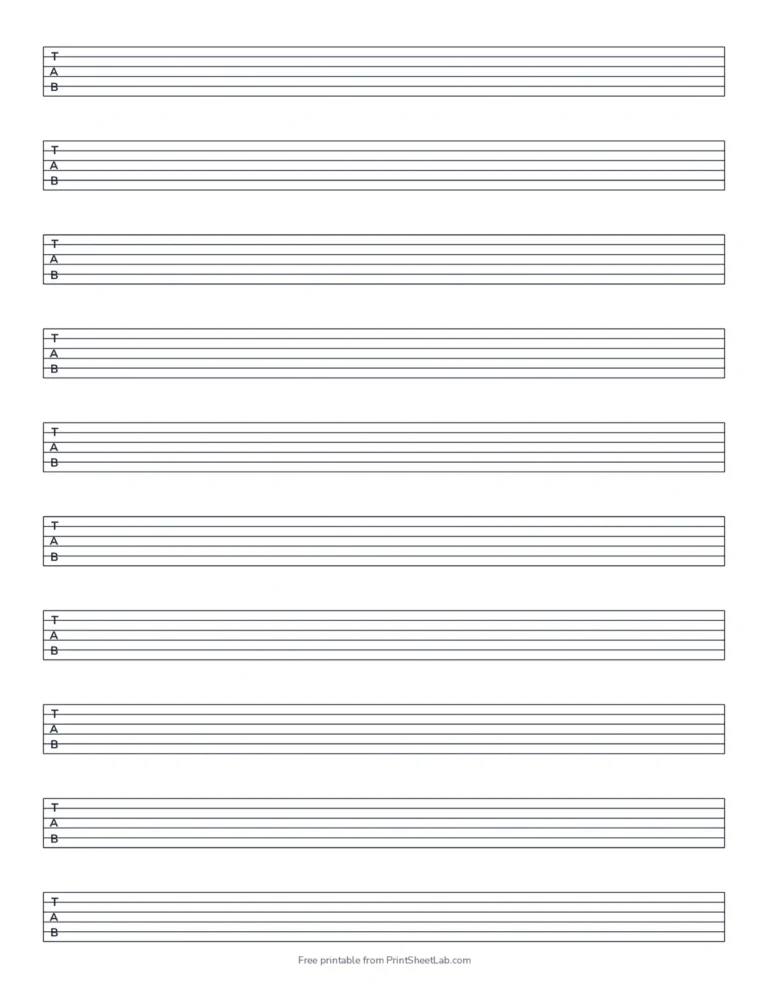
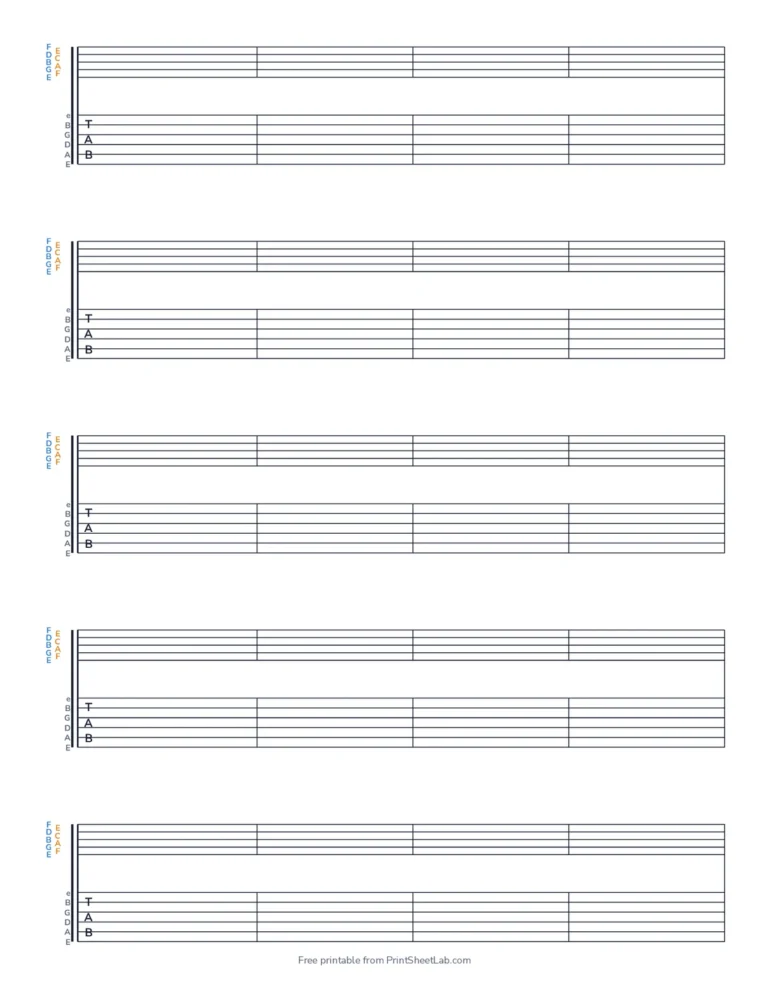

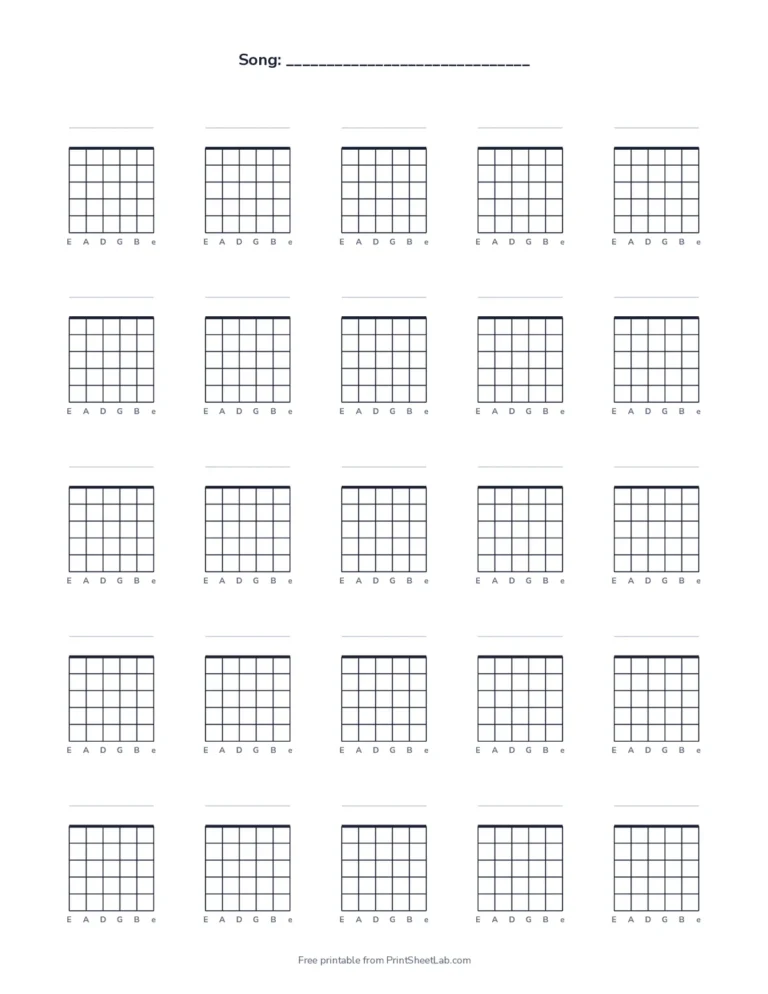
Which staff paper do I need? Music staff paper and printable staff paper
Every sheet below is printable staff paper, and the first row is plain music staff paper for melodies. Guitar tab paper, bass tab and chord charts are on the same page.
| Paper | Best for |
|---|---|
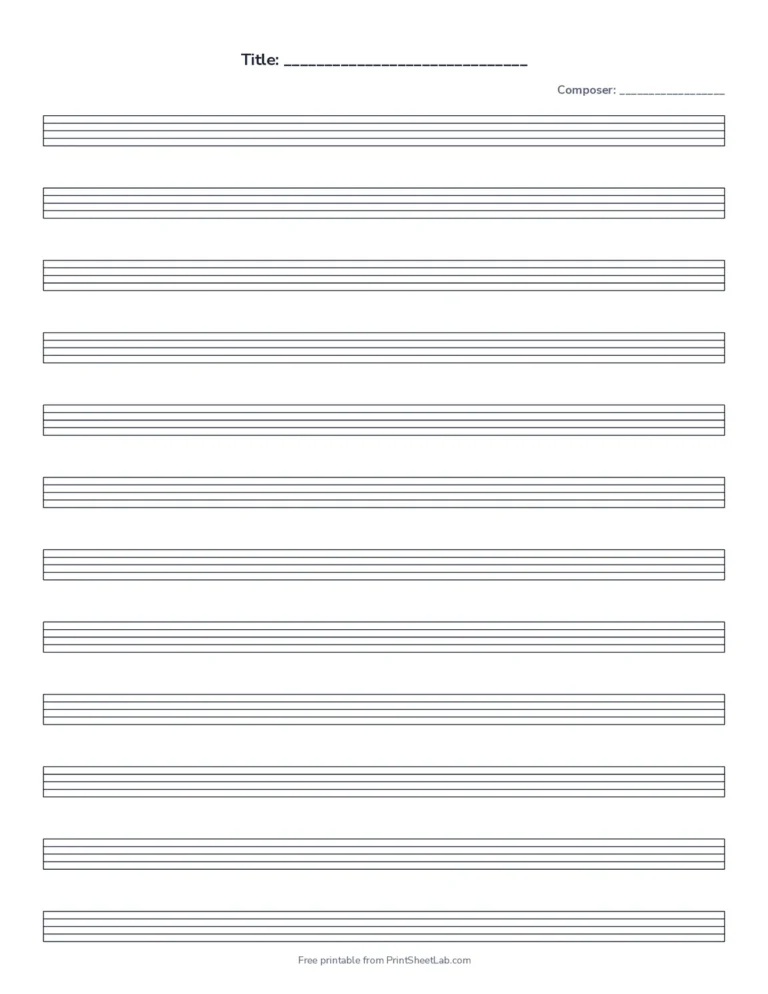
| Music staff | Melodies, singing, recorder, violin, flute and any single-line instrument |
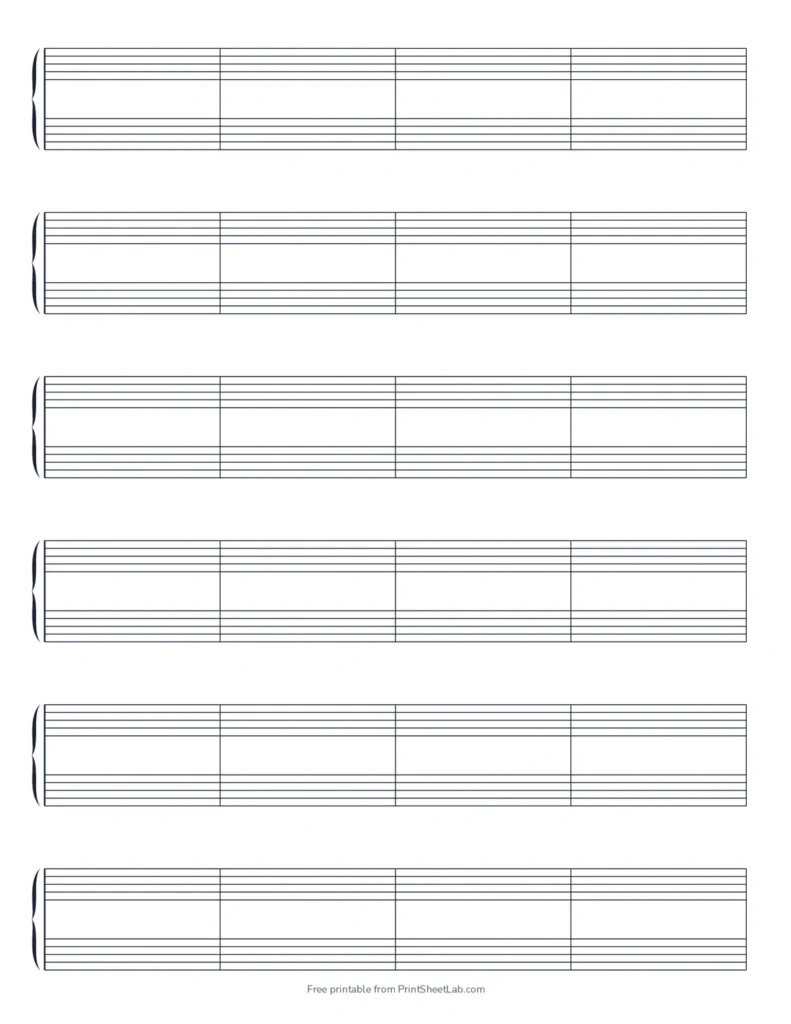
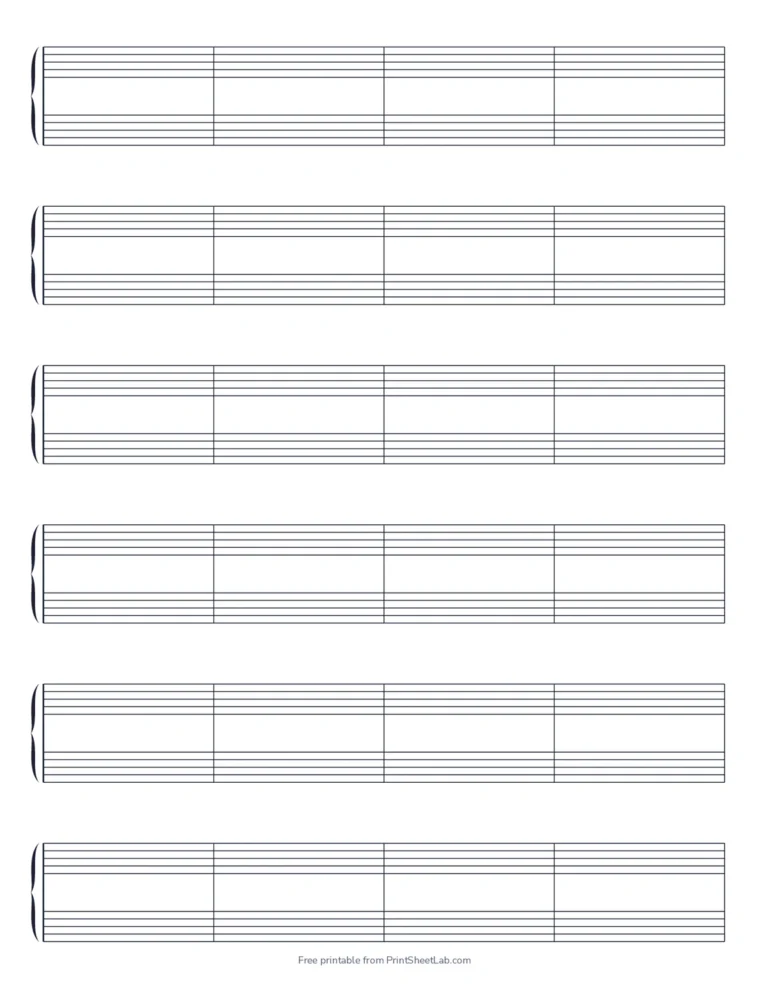
| Grand staff | Piano and keyboard: treble staff for the right hand, bass staff for the left, joined by a brace |
| Large staff with note names | Children and beginners: big spaces and the letter names of every line and space |
| Guitar tab | Guitar tablature with six lines, one per string |
| Staff + tab | Guitar lessons that show notes and tab together |
| Bass tab and ukulele tab | Four-string instruments |
| Chord charts | Writing down guitar or ukulele chord shapes for a song |
How to remember the notes
- Treble clef lines (bottom to top) are E, G, B, D, F: “Every Good Boy Deserves Fudge”.
- Treble clef spaces spell F A C E, “face”.
- Bass clef lines are G, B, D, F, A: “Good Boys Do Fine Always”.
- Bass clef spaces are A, C, E, G: “All Cows Eat Grass”.
- Middle C sits on a small ledger line between the two staves of the grand staff.
Turn on the note name helper in the maker to print these letters beside every staff, then turn it off once your child knows them.
Notes on the staff and how high they sound
Each line and space of the staff is one note, and each step up the staff is a higher pitch. These tables list every line and space with the note name and its frequency in hertz, using the standard tuning where A above middle C is 440 Hz. Middle C (C4) is 261.63 Hz, one ledger line below the treble staff and one above the bass staff.
| Position on the treble staff | Note | Frequency |
|---|---|---|
| Line 1 (bottom) | E4 | 329.63 Hz |
| Space 1 | F4 | 349.23 Hz |
| Line 2 | G4 | 392.00 Hz |
| Space 2 | A4 | 440.00 Hz |
| Line 3 | B4 | 493.88 Hz |
| Space 3 | C5 | 523.25 Hz |
| Line 4 | D5 | 587.33 Hz |
| Space 4 | E5 | 659.26 Hz |
| Line 5 (top) | F5 | 698.46 Hz |
| Position on the bass staff | Note | Frequency |
|---|---|---|
| Line 1 (bottom) | G2 | 98.00 Hz |
| Space 1 | A2 | 110.00 Hz |
| Line 2 | B2 | 123.47 Hz |
| Space 2 | C3 | 130.81 Hz |
| Line 3 | D3 | 146.83 Hz |
| Space 3 | E3 | 164.81 Hz |
| Line 4 | F3 | 174.61 Hz |
| Space 4 | G3 | 196.00 Hz |
| Line 5 (top) | A3 | 220.00 Hz |
The staff gives each note a fixed place, so a line of music is easy to read once you know the positions. For the history and conventions, see Wikipedia’s staff (music) article.
How long is a note? Note values in a bar
Bar lines divide the staff paper into bars (measures), and each bar holds a fixed number of beats. In 4/4 time there are four beats in a bar, so the length of each note decides how many fit:
| Note | Beats (in 4/4 time) | How many fill one bar |
|---|---|---|
| Whole note | 4 | 1 |
| Half note | 2 | 2 |
| Quarter note | 1 | 4 |
| Eighth note | 1/2 | 8 |
| Sixteenth note | 1/4 | 16 |
A bar can mix values, such as one half note and two quarter notes. Choose 4 bars per line on the generator to write four bars of 4/4 across the page.
Parts of a music staff and guitar tab paper
- Staff (stave): five lines and four spaces. Notes higher on the staff sound higher.
- Bar lines split the music into measures. Choose 2 to 6 bars per line, or none for free writing.
- Final double bar: a thin and a thick line that mark the end of a piece.
- Tablature (tab): each line is a string, and numbers show which fret to press. The top line is the highest string.
- Chord chart: vertical lines are strings, horizontal lines are frets, and the thick line at the top is the nut.
Frequently asked questions
6 quick answers
Is this staff paper free to print?
Yes. All staff paper, tab paper and chord charts are free for personal, school and studio use, with no sign-up.
How many staves are on a page?
Standard size fits 13 staves on a portrait Letter page (12 with the title lines), small fits more, and the large size for children fits 8 with wide spaces. Grand staff pages hold 6 piano systems.
What size staff is best for kids?
Choose Large. Its spaces are big enough for young children to draw note heads neatly, and you can add the note name helper.
What is the difference between staff paper and manuscript paper?
They are the same thing. Staff paper, music manuscript paper and blank sheet music all mean paper printed with empty music staves for writing notes by hand.
Can I print guitar tab with a staff above it?
Yes. Choose Staff + guitar tab. Each system has a five-line staff with a six-line tab below, joined at the start, so you can write the notes and the frets together.
Can I print landscape sheet music?
Yes. Switch to Landscape for longer lines, which is handy for tab and for writing on a music stand.
More printable paper
- Lined paper for lyrics and notes.
- Graph paper.
- Dot grid paper.
- Printable paper maker for every other kind of paper.
- All printable paper.