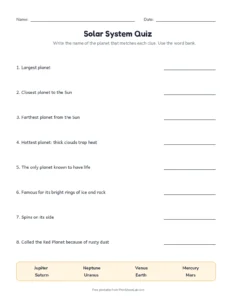
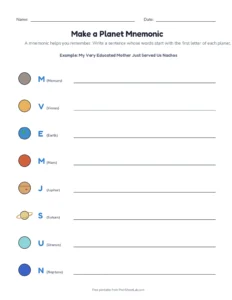
Free solar system worksheets for kids: a colorful planets in order poster, a page to label the planets with a word bank, eight planet fact cards, a solar system quiz with answer key and a make-your-own planet mnemonic page. Great for space units from kindergarten to 5th grade.
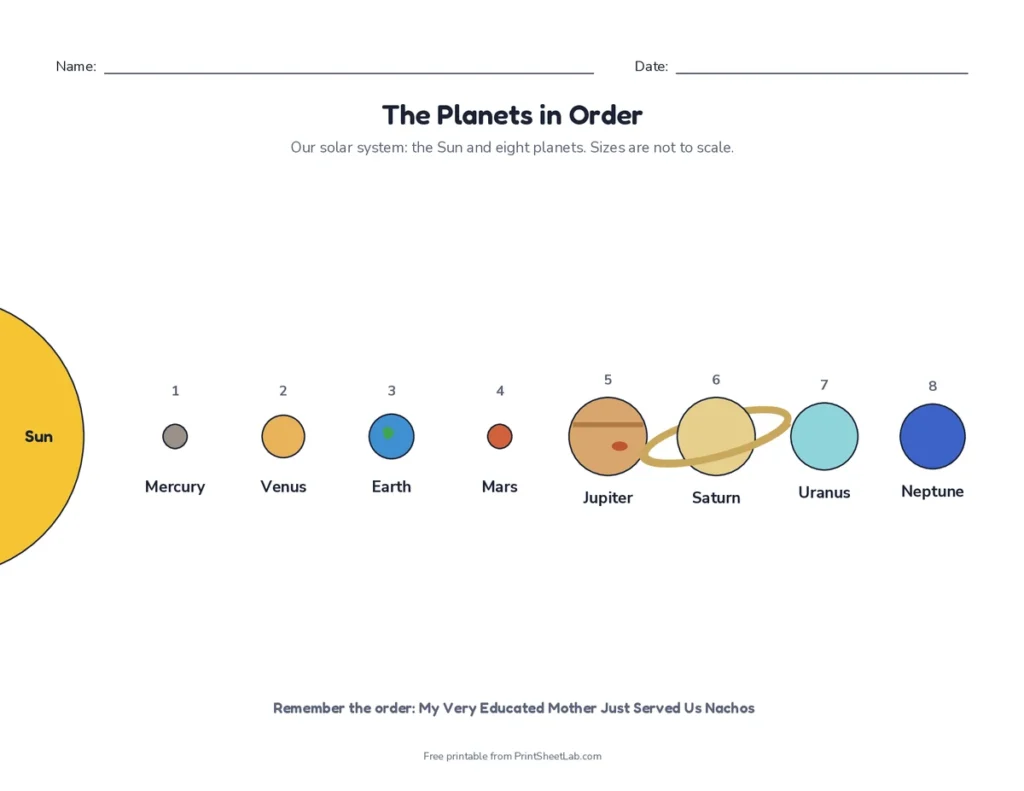
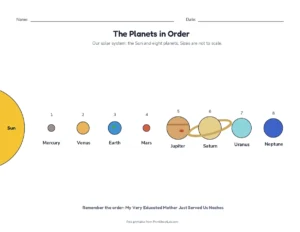
The eight planets from the solar system worksheets generator above. Sizes are not to scale.
Put the planets in order
Tap the planets in order, starting with the one closest to the Sun. How fast can you do it?
Ready-to-print solar system worksheets (PDF)
The full set prints as one PDF with answer keys. To print a single page or switch to black and white to save ink, choose Customize.
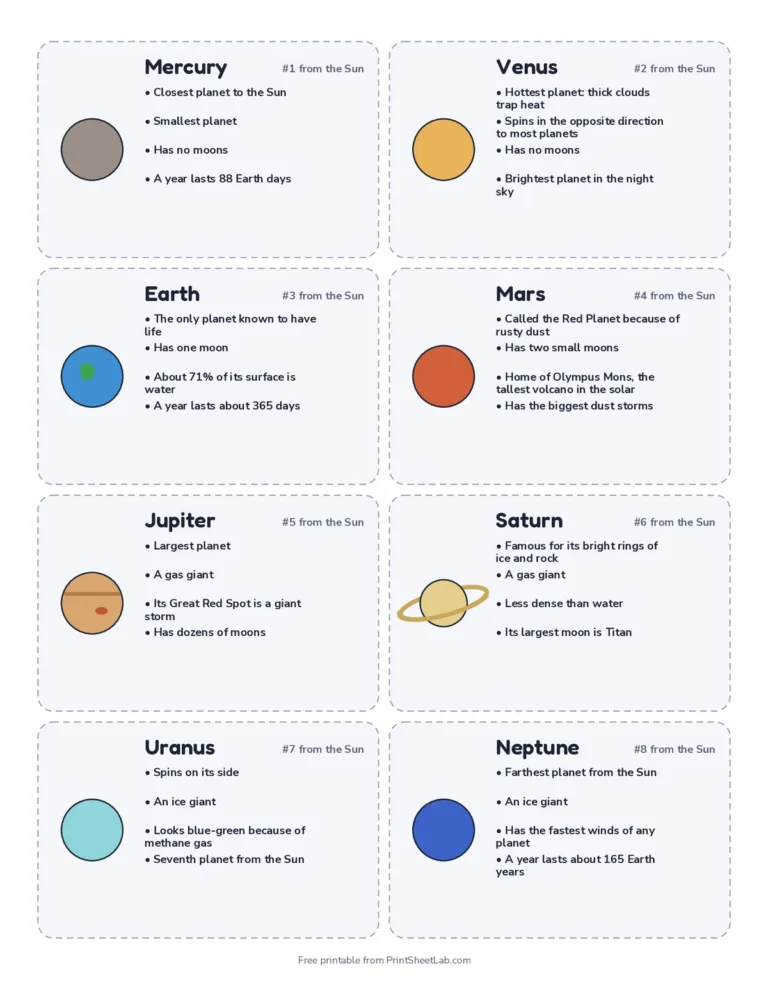
Solar system pack7 pages with answer keys.PDFCustomizePlanet fact cards8 planets, 4 facts each.PDFCustomize
The eight planets at a glance
#
Planet
Fun fact
1
Mercury
The smallest planet and the closest to the Sun. A year lasts just 88 Earth days.
2
Venus
The hottest planet, because its thick clouds trap heat.
3
Earth
The only planet known to have life, with one moon.
4
Mars
The Red Planet, home of Olympus Mons, the tallest volcano in the solar system.
5
Jupiter
The largest planet, with a giant storm called the Great Red Spot.
6
Saturn
Famous for its bright rings made of ice and rock.
7
Uranus
An ice giant that spins on its side.
8
Neptune
The farthest planet, with the fastest winds.
Planets in order: distance, size and year length
These rounded numbers help children compare the planets. Distance is in astronomical units (AU), where 1 AU is the average distance from Earth to the Sun, about 93 million miles. Size compares each planet’s width with Earth’s.
Planet
Distance from the Sun
Width compared with Earth
One year lasts
Mercury
0.4 AU
about 0.4 times
88 Earth days
Venus
0.7 AU
about 0.95 times
225 Earth days
Earth
1 AU
1
365 days
Mars
1.5 AU
about 0.5 times
687 Earth days
Jupiter
5.2 AU
about 11 times
12 Earth years
Saturn
9.5 AU
about 9 times
29 Earth years
Uranus
19.2 AU
about 4 times
84 Earth years
Neptune
30.1 AU
about 4 times
165 Earth years
Notice the pattern: the farther a planet is from the Sun, the longer its year, because it has a bigger loop to travel and moves more slowly. For up-to-date facts, photos and mission news, visit NASA’s solar system pages.
Label the planets: inner and outer planets
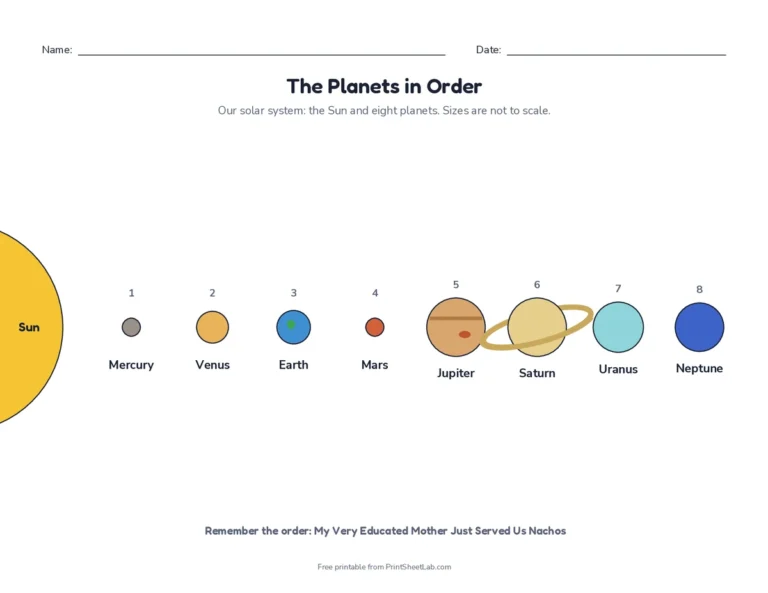
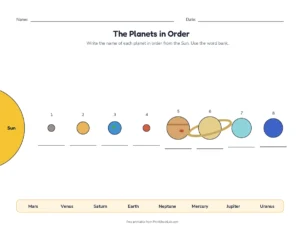
When children name each planet, it helps to sort them into two groups first. The four inner planets, Mercury, Venus, Earth and Mars, are small, rocky worlds close to the Sun. Beyond the asteroid belt come the four outer planets: Jupiter and Saturn are gas giants, while Uranus and Neptune are ice giants. On our labeling page, start by finding the biggest planet (Jupiter) and the one with rings (Saturn), then fill in the rest from the Sun outward.
How to remember the order
Try the sentence “My Very Educated Mother Just Served Us Nachos”. The first letter of each word matches a planet, in order from the Sun. Better still, use the mnemonic page to invent your own silly sentence.
Build a scale model of the solar system
A paper model shows how far apart the planets really are. Unroll a long strip of paper or a roll of receipt tape and let 10 cm stand for 1 AU. Mark the Sun at one end, then measure out each planet: Mercury at 4 cm, Venus at 7 cm, Earth at 10 cm, Mars at 15 cm, Jupiter at 52 cm, Saturn at 95 cm, Uranus at 1.9 m and Neptune at 3 m. Children are always surprised that the four inner planets fit into the first 15 cm while Neptune is three meters away. Cut out the planets from our solar system worksheets and glue them on.
Dwarf planets and Pluto
In 2006 the International Astronomical Union decided that a planet must clear its orbit of other objects. Pluto shares its path with many icy bodies in the Kuiper Belt, so it became a dwarf planet. Five dwarf planets are officially recognized: Ceres in the asteroid belt, and Pluto, Haumea, Makemake and Eris farther out. NASA’s Pluto and dwarf planets page has pictures from the New Horizons flyby.
Solar system worksheets by grade
Kindergarten and 1st grade: learn the names of the planets in order, color the poster and spot the Sun and the Earth.
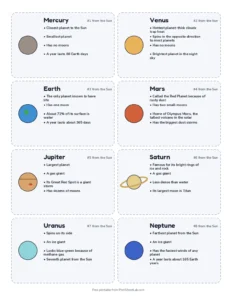
2nd and 3rd grade: label the planets with a word bank, sort inner and outer planets and read the planet fact cards.
4th and 5th grade: take the solar system quiz, compare distances and year lengths in the table above, and build the scale model.
Ideas for using the solar system worksheets
Planet of the day: read one planet fact card each morning, then add that planet to a class poster. After eight days the whole solar system is on the wall.
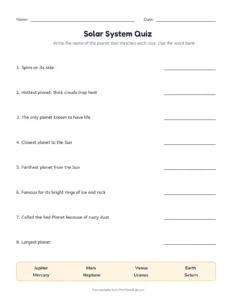
Quiz relay: split the class into teams and read questions from the solar system quiz. Teams race to find the answer on their fact cards.
Mnemonic contest: everyone writes a silly sentence on the mnemonic page, and the class votes for the funniest one that still keeps the order right.
Science notebook: glue the fact cards into a notebook and add one question per planet that children want to research.
Night sky link: Venus, Mars, Jupiter and Saturn are often visible without a telescope. Check a stargazing app, then look for them together after dinner.
The solar system worksheets work well as a one-week mini unit: poster and order on day one, labeling on day two, fact cards on days three and four, and the quiz plus scale model to finish.
Practice it as a game
Free online games for the same skill: balloon pop, memory match, races and more. No sign-up.
Jupiter. It is about 11 times wider than Earth, and all the other planets could fit inside it. The fact cards in our solar system worksheets compare every planet with Earth.
What grade learns about the solar system?
Children meet the Sun, Moon and planets in the early grades, and most schools teach the solar system in more depth in grades 3 to 5. These solar system worksheets cover kindergarten to 5th grade.
Are these solar system worksheets free?
Yes. Print the planet poster, label page, fact cards, quiz and answer key as often as you need, at home or in class.
Are the planets drawn to scale?
No. Real sizes and distances are so different that the small planets would be tiny dots, so the sizes show which planets are bigger or smaller, but not exactly how much.
Why is Pluto not included?
Since 2006, astronomers have classified Pluto as a dwarf planet, so the solar system has eight planets.
Does the quiz have an answer key?
Yes. The solar system quiz and the page where children label the planets both print with answer keys.