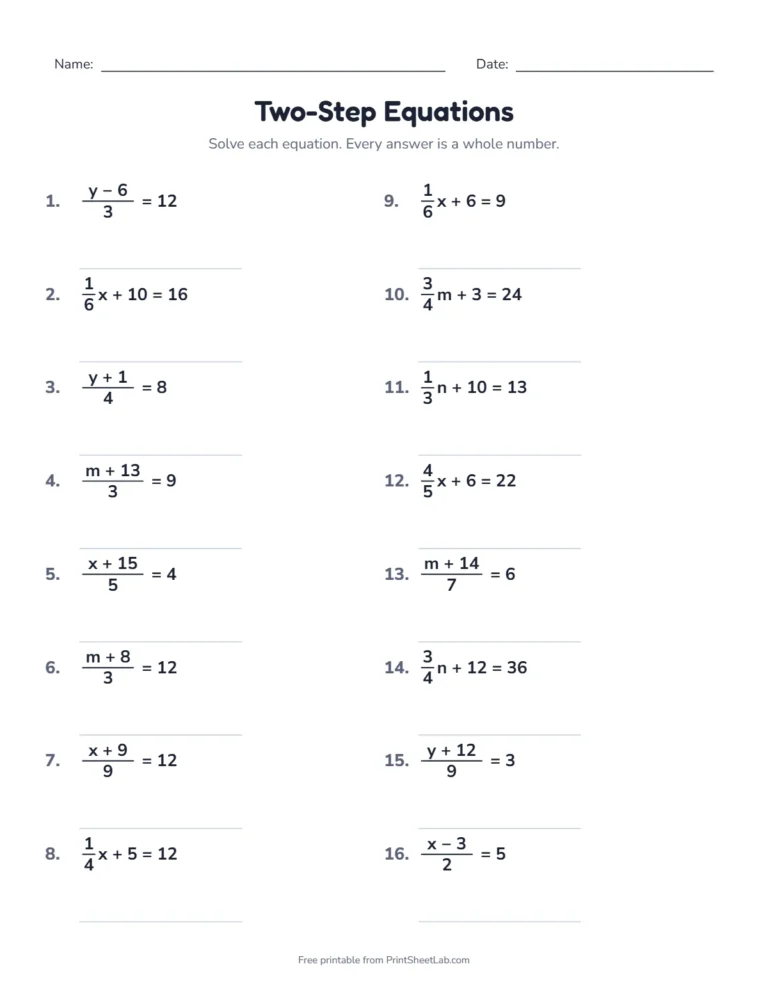
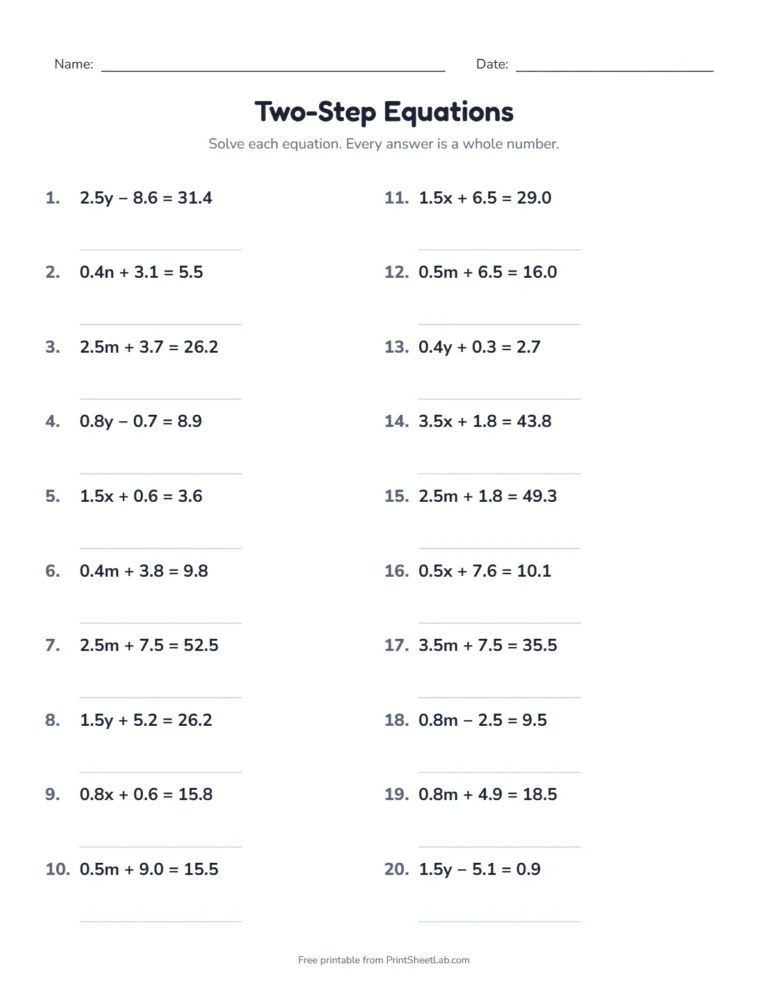
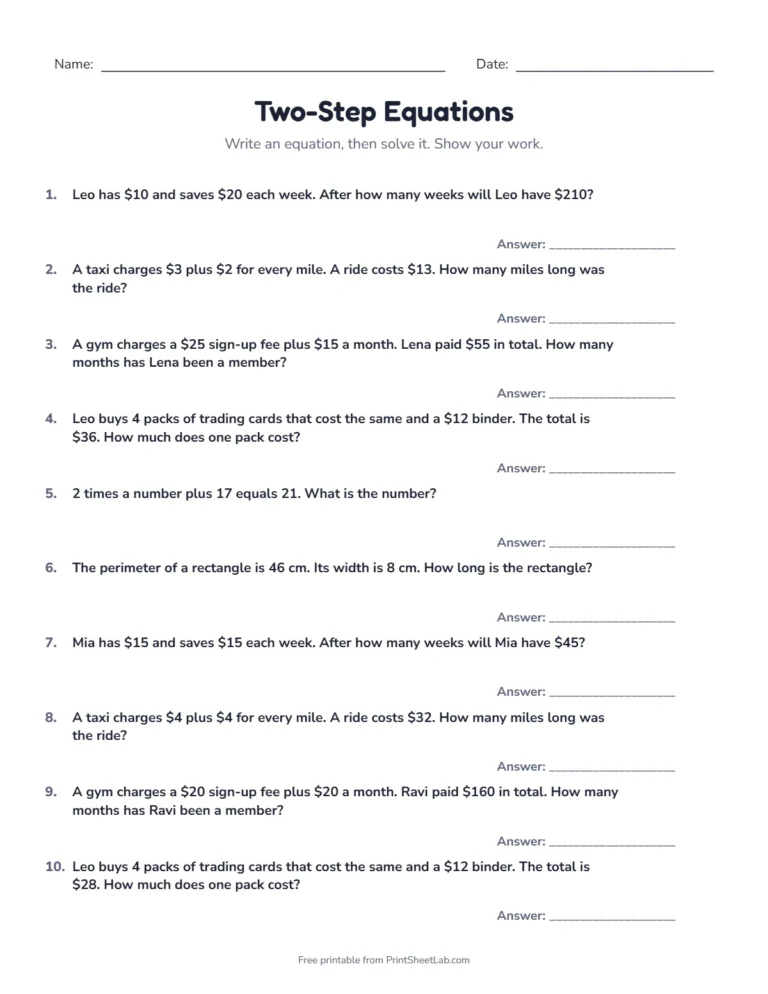
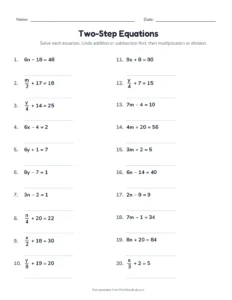
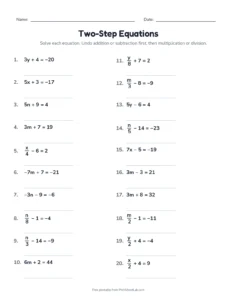
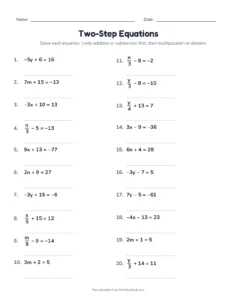
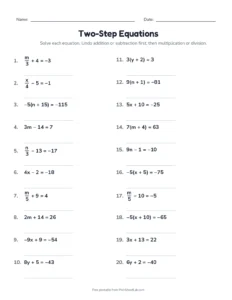
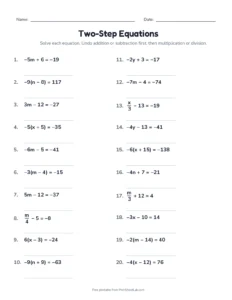
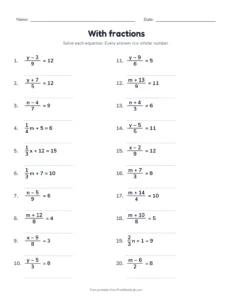
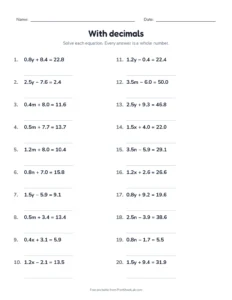
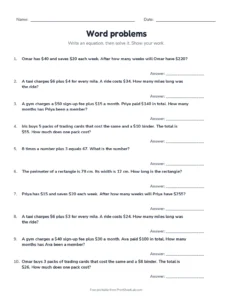
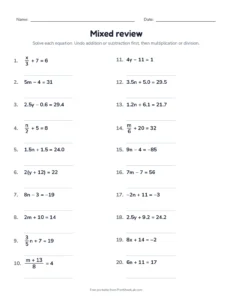
Free two-step equations worksheets for 7th and 8th grade, each one finishing with an answer key. Solve equations like 3x + 5 = 20, x/4 − 2 = 6 and 2(x + 3) = 18 with whole or negative numbers, move on to two-step equations with fractions and decimals, and finish with two-step equations word problems about savings, taxis and shopping. There are seven levels, and New problems shuffles a fresh set whenever you like.
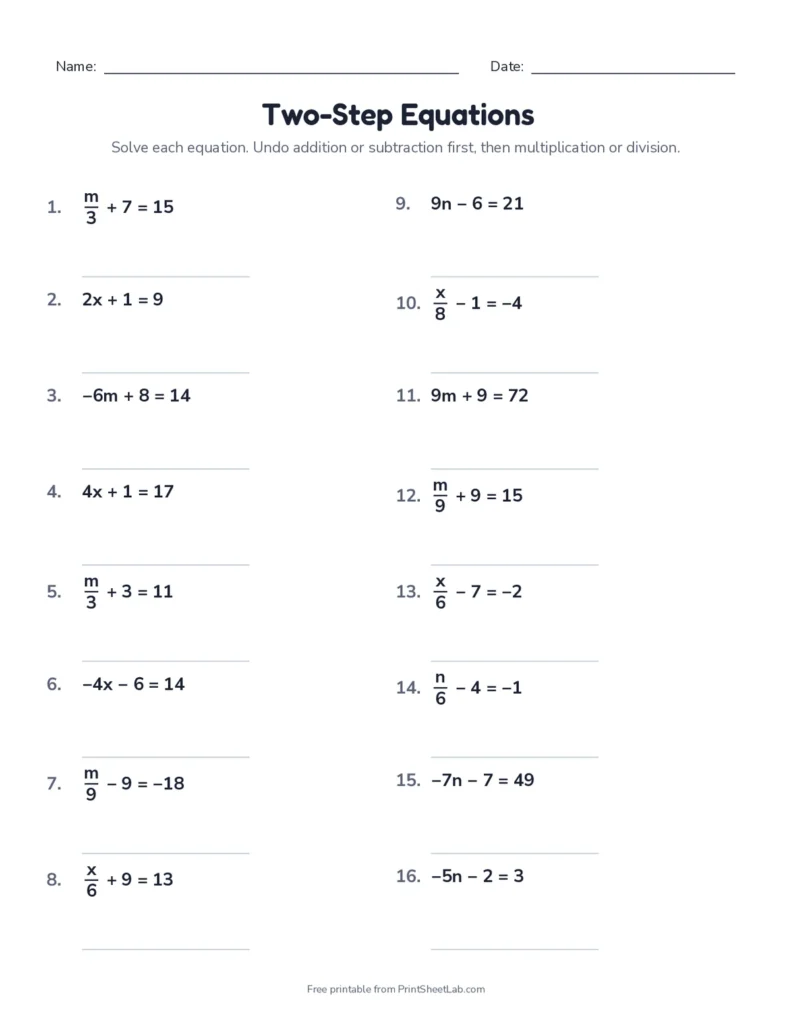
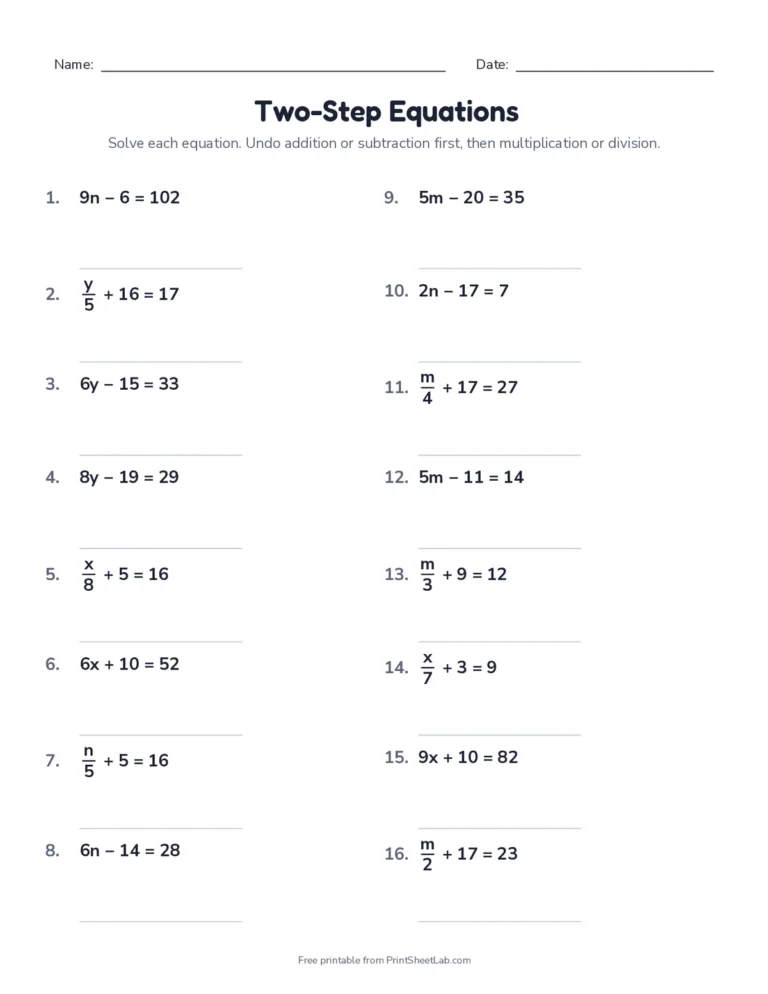
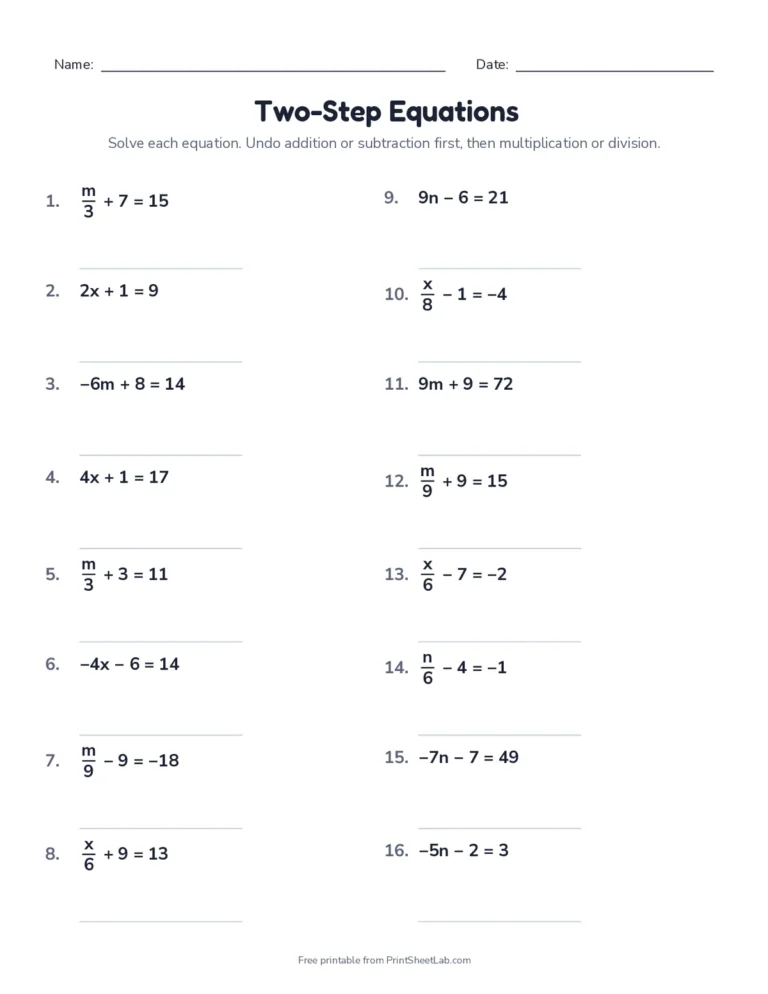
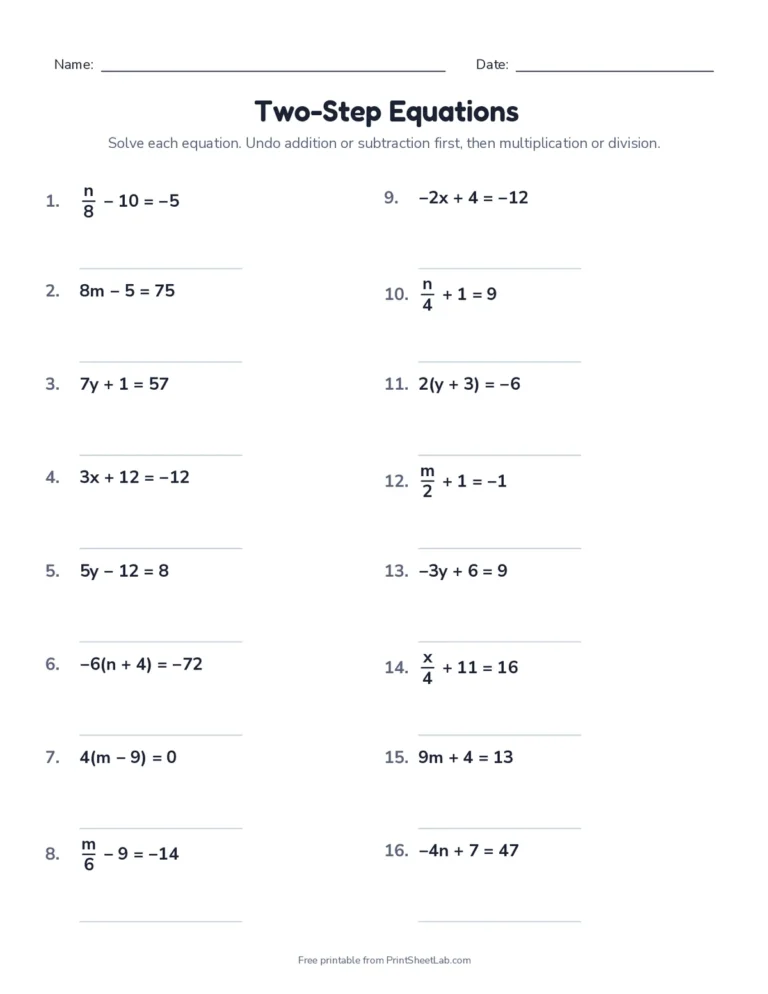
One of our two-step equations worksheets from the generator above, with negative numbers.
Solve two-step equations online
Solve for the variable, type the number and press Check.
Six levels are ready to download, from whole numbers to word problems, each with the answers on the last page. Customize opens that level in the generator so you can choose how many problems to print.
Work backwards from the order of operations: undo adding or subtracting first, then undo multiplying or dividing.
Step
3x + 5 = 20
x/4 − 2 = 6
1. Undo + or −
3x = 15
x/4 = 8
2. Undo × or ÷
x = 5
x = 32
3. Check
3 × 5 + 5 = 20 ✓
32 ÷ 4 − 2 = 6 ✓
For an equation like 2(x + 3) = 18 you can divide both sides by 2 first (x + 3 = 9), or distribute to get 2x + 6 = 18. Both give x = 6.
Two-step equations with fractions
Fractions show up in two-step equations in two ways. In (x + 4)/3 = 5, the whole left side is divided by 3, so undo the division first: multiply both sides by 3 to get x + 4 = 15, then subtract 4 to get x = 11. In (2/3)x + 4 = 10, the fraction is the coefficient: subtract 4 first to get (2/3)x = 6, then multiply both sides by the reciprocal, 3/2, to get x = 9. The fractions level mixes both kinds, and every answer is still a whole number, so students can focus on the steps instead of messy arithmetic.
Two-step equations with decimals
Decimal equations follow exactly the same two steps. For 2.5y − 8.6 = 31.4, add 8.6 to both sides to get 2.5y = 40, then divide by 2.5 to get y = 16. A handy trick is to multiply every term by 10 first, which turns 2.5y − 8.6 = 31.4 into 25y − 86 = 314 with no decimals at all. The decimals level of these two-step equations worksheets uses money-style numbers with one decimal place.
Two-step equations word problems
Real-life two-step problems almost always have the same shape: a starting amount plus a rate times a number of steps. “A taxi charges $3 plus $2 for every mile, and a ride costs $13” becomes 2m + 3 = 13, so m = 5 miles. Teach students to:
Find the one-time amount (the starting money, the sign-up fee, the binder). That is the constant, b.
Find the amount that repeats (per week, per mile, per pack). That is the coefficient, a.
Write ax + b = c, where c is the total.
Solve and check by putting the answer back into the story.
The word problems level rotates through savings, taxi fares, gym memberships, shopping, number puzzles and rectangle perimeters, so every page has a mix of contexts.
Two-step equations worksheets by grade
7th grade: solve equations of the form px + q = r and p(x + q) = r with integers and rational numbers, and write them from word problems, which is standard 7.EE.B.4a in the Common Core grade 7 expressions and equations. Use levels 1 to 6.
8th grade: use the mixed review level as a warm-up before multi-step equations and equations with variables on both sides.
Algebra 1 review: the decimals, fractions and word problem levels make quick bell-ringers before linear functions.
How to use two-step equations worksheets in class
Start a lesson with three equations from the whole numbers level on the board and solve them together, saying each inverse operation out loud. Then hand out a page from the next level and let students work in pairs, one solving and one checking by substitution, swapping roles every problem. Finish with the online practice above: students type answers and get instant feedback, which frees you to help anyone who is stuck. For homework, print a different set with New problems so answers cannot be copied, and use the answer key on the last page to mark it quickly.
Common mistakes on two-step equations worksheets
Dividing first. In 3x + 5 = 20, dividing everything by 3 gives x + 5/3 = 20/3, which is correct but messy. Undo the addition first.
Doing it to one side only. Whatever you do to the left side, do to the right side too.
Sign slips. To undo − 8, add 8. To undo × (−4), divide by −4, and the answer changes sign.
Forgetting to check. Put the answer back into the original equation; if both sides match, it is right.
Solving equations is the backbone of elementary algebra, and two-step equations are where the idea of inverse operations really clicks.
Solving reverses the order of operations. In 3x + 5, the 3 was multiplied first and the 5 was added last, so the 5 comes off first.
What grade are two-step equations?
Two-step equations are a 7th grade standard and are practiced again in 8th grade before multi-step equations. Our two-step equations worksheets cover both years.
How do you solve two-step equations with fractions?
If the whole side is divided, as in (x + 4)/3 = 5, multiply both sides by the denominator first. If the fraction is the coefficient, as in (2/3)x + 4 = 10, subtract first and then multiply by the reciprocal.
Do the two-step equations worksheets have answer keys?
Yes. Every PDF and every page you make in the generator ends with a key that shows the value of the variable for each problem.
Are the answers always whole numbers?
Yes. Every equation is built backward from a whole-number answer, including the fraction and decimal levels, so there are no messy remainders.