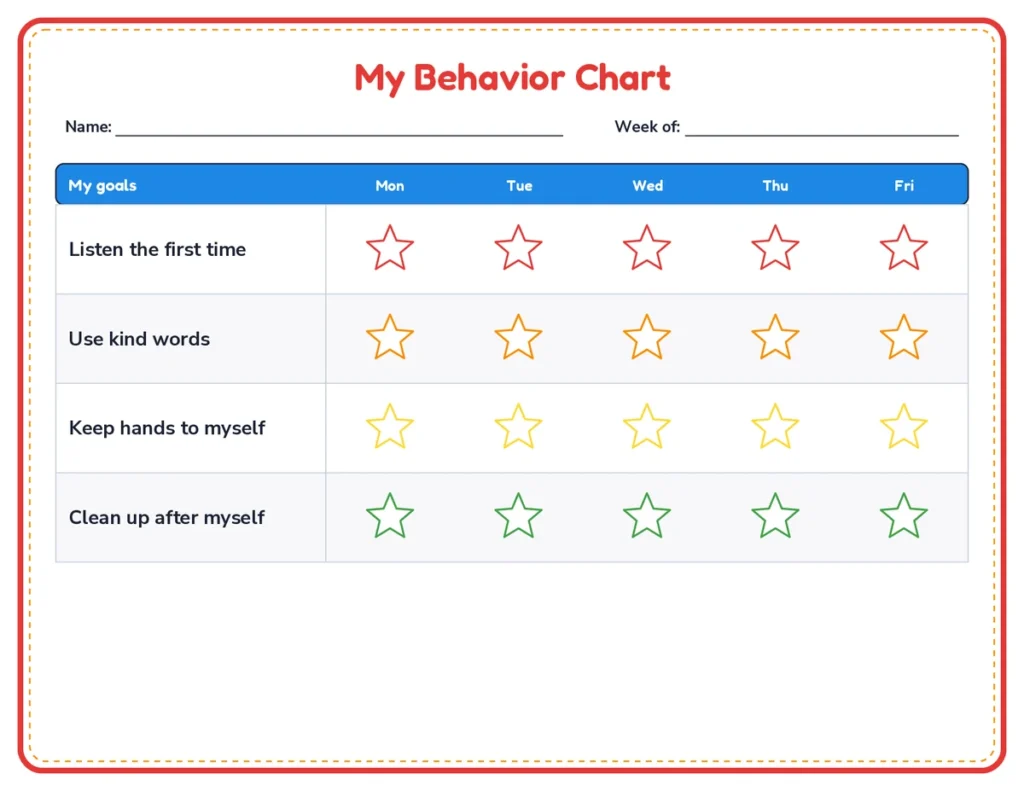
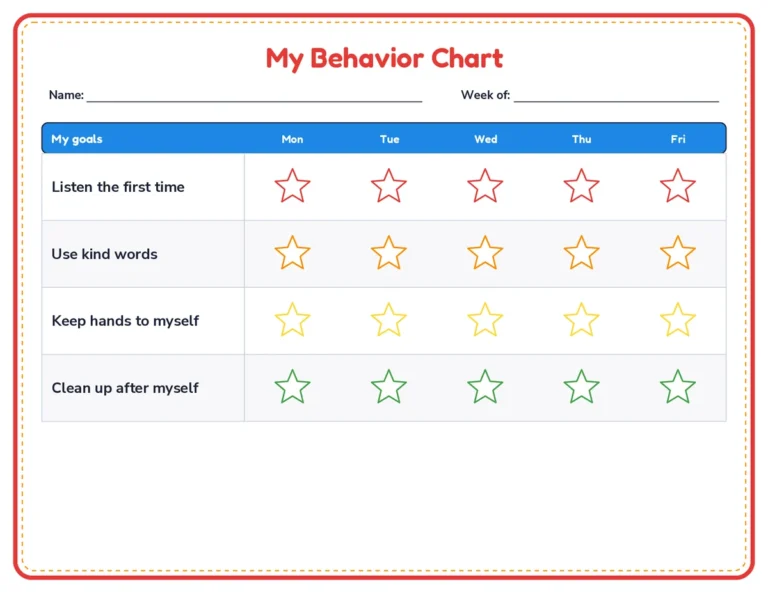
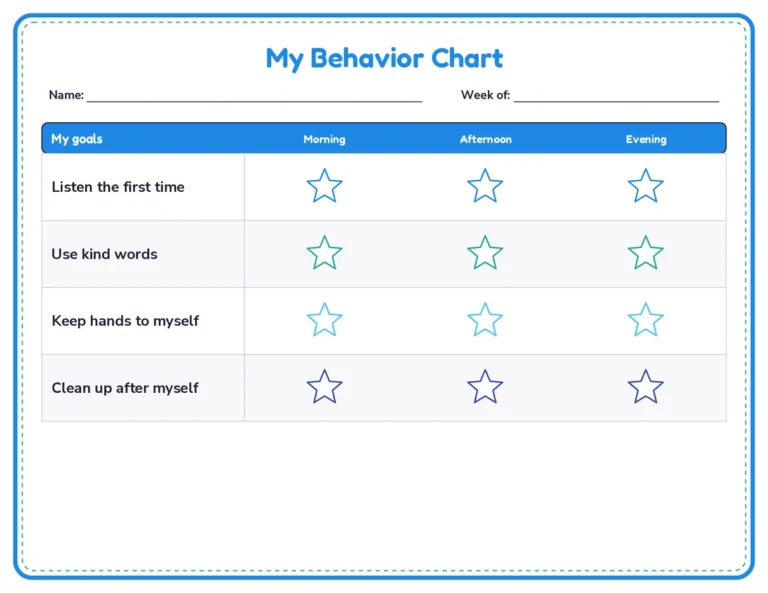
Make a free printable behavior chart for home or the classroom. Write up to 8 positive goals, choose columns for each day of the week or for morning, afternoon and evening, and children color a star each time they meet a goal. Add an optional reward to work toward.
In short: these free printable behavior charts for kids (also spelled behaviour chart) lists one to eight positive goals and gives a child a star each time they meet one. It works best with a few clear goals, quick praise and a small reward, and it is meant to be used for a few weeks while a new habit forms, not forever.
Track good behaviour on screen
Tap a star whenever a goal is reached. This browser remembers the stars until you clear them, so the chart can live on a family tablet.
Behavior chart printable PDFs
Each behavior chart printable below opens as a PDF. Choose Customize to use it as a behavior chart template and add your own goals.
Writing goals that work
- Say what to do, not what to stop. “Use kind words” is easier to follow than “no yelling”.
- Keep it short. Two to four goals at a time are plenty for most children.
- Make it specific. “Put my shoes by the door” beats “be tidy”.
- Notice the good. Color the star together and name what went well.
Goal ideas
| At home | At school |
|---|---|
| Listen the first time | Raise my hand to speak |
| Use kind words | Stay in my seat during work time |
| Keep hands to myself | Follow directions |
| Clean up after myself | Finish my work |
How to use a behavior chart for kids
- Pick goals together. Children follow goals they helped choose. Start with one to three.
- Explain each goal. Act it out: “Listening the first time looks like this.”
- Check in often. Young children need a star soon after the behaviour, not at the end of the week.
- Praise the effort. Say exactly what went well as you colour the star.
- Fade it out. Once a goal is easy, swap it for a new one or retire the chart.
Positive attention for good behaviour is one of the core ideas in the CDC’s positive parenting tips, and a chart simply makes that attention visible.
Behavior chart for kids by age: 3, 4, 5, 6 year olds and up
| Age | Chart layout | Goals and rewards |
|---|---|---|
| 3 and 4 year olds | Morning, afternoon and evening | One or two goals such as “use gentle hands”, a star straight away and a tiny reward the same day |
| 5 and 6 year olds | School days | Two or three goals, with a reward after a set number of stars, often at the weekend |
| 7 to 9 | Whole week | Three or four goals, including school ones like reading every evening |
| 10 to 12 | Whole week, child fills it in | Self-chosen goals such as homework before screens, reviewed together on Sunday |
Rewards that cost nothing
A behavior chart for kids works best when the reward is small and comes soon. These ideas cost nothing:
- An extra bedtime story or ten more minutes before lights out.
- Choosing what the family has for dinner on Friday.
- Fifteen minutes of a board game with a parent.
- Being the helper for a special job, such as watering the plants.
- A certificate from the award certificate maker to take to school.
Behaviour chart ideas for the classroom
In school, a classroom behavior chart works best as an individual chart for a small number of students who need extra support, alongside whatever whole-class system the teacher already uses. Keep personal charts in a folder rather than on the wall, so progress stays private, and print the school days layout so the chart matches the week. A short check at the end of each lesson gives the quick feedback younger pupils need. In upper grades, a behavior chart for students can be filled in by the student, with the teacher initialling it at the end of the day.
Behavior, reward or chore chart?
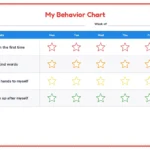
Behavior chart
For habits such as kind words or listening. Stars for each part of the day or week.
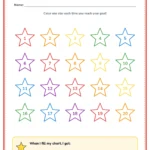
Reward chart
One goal, a row of stickers and a prize at the end, such as for potty training or reading.
Frequently asked questions
7 quick answers
Should a behavior chart take stars away?
Most parenting and teaching guides suggest only adding stars, never removing them, so the chart stays about progress and encouragement.
Morning, afternoon and evening, or days?
Use parts of the day for young children who need quick feedback. Use days of the week for older children and weekly goals.
How long should we use a behavior chart?
Usually two to six weeks for each goal. When the behaviour happens without reminders, celebrate, then change the goal or stop using the chart.
What if my child never earns a star?
The goal is too hard or too vague. Make it smaller and more specific, check in more often, and make sure the first stars are easy to win.
Do behavior charts work for autistic children?
Many autistic children respond well to clear, visual routines. Keep each goal concrete, use one goal at a time, give the star immediately and follow any advice from the child’s teacher or therapist, who knows what motivates them best.
Is this an editable behavior chart?
Yes. This free printable behavior chart is fully editable: type your own goals, the child’s name and an optional reward in the maker, choose a colour theme, then print or save the PDF.
Can teachers use these in class?
Yes. A classroom behavior chart can be printed for each pupil with the school days layout; there is no cost and no account to set up.