Change the numbers, layout and number of problems, then download a new PDF with its answer key.
Long division 2-digit divisors is the step in grade 5 where the four steps stay the same but guessing each digit of the answer becomes harder. The five PDFs on this page divide 3-digit and 4-digit numbers by 2-digit divisors, with and without remainders, and every answer key shows each step. They follow standard 5.NBT.B.6 of the Common Core standards for grade 5 number and operations in base ten, and the notes below show how to estimate, how to correct a guess and how to check.
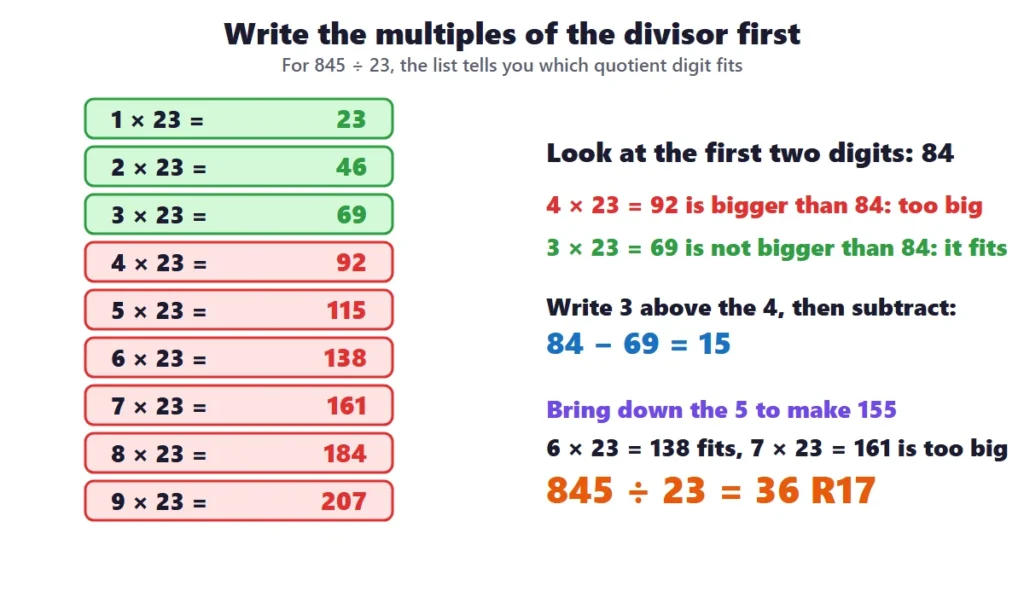
Multiples of 23. Which quotient digit fits?
Dividing by a 2-digit number
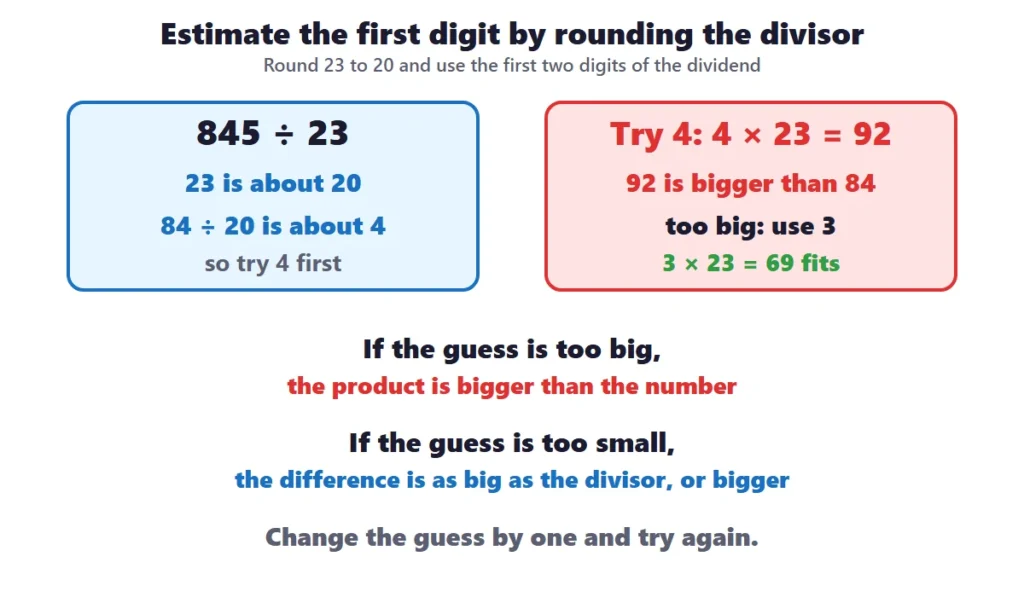
With a 2-digit divisor, the hardest step is guessing how many times it goes in. Round the divisor to the nearest ten to estimate. For 845 ÷ 23, think 84 ÷ 20, about 4. Try 4: 4 × 23 = 92, too big, so use 3. 3 × 23 = 69, and 84 − 69 = 15.
If a guess is too big, the product will be larger than the number you are dividing. If it is too small, the difference after subtracting will be as big as the divisor or bigger. Either way, change the guess by one and try again.
What is on this page
3-digit numbers divided by divisors from 11 to 25, dividing evenly.
3-digit numbers with remainders.
4-digit numbers divided by 2-digit divisors.
Long division 2-digit divisors worksheets: what is in the set
There are 5 long division 2-digit divisors worksheets on this page, and every one has an answer key except for any cut-out games. Three sets divide 3-digit numbers and two sets divide 4-digit numbers, with divisors from 11 to 40.
Worksheet
What children do
Standard
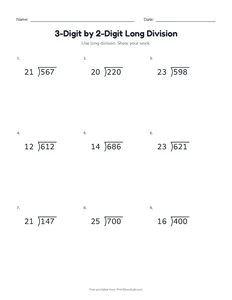
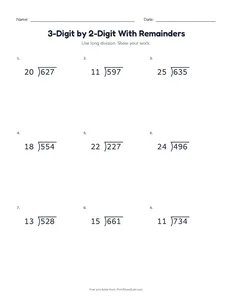
3-Digit by 2-Digit Long Division
9 problems with divisors from 11 to 25 that divide evenly.
5.NBT.B.6
3-Digit by 2-Digit With Remainders
9 problems that all have a remainder.
5.NBT.B.6
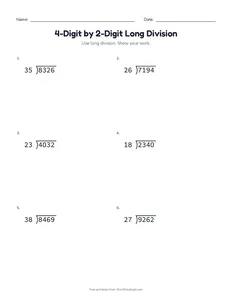
4-Digit by 2-Digit Long Division
6 problems with 4-digit numbers and 2-digit divisors.
5.NBT.B.6
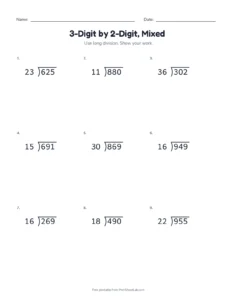
3-Digit by 2-Digit, Mixed
Divisors from 11 to 40, some with remainders.
5.NBT.B.6
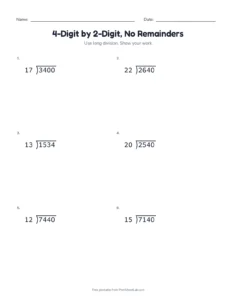
4-Digit by 2-Digit, No Remainders
Six exact divisions by two-digit numbers.
5.NBT.B.6
Long division 2 digit divisor worksheets: how the sets are built
The long division 2 digit divisor worksheets in this pack use divisors from 11 to 40. Three sets divide 3-digit numbers, with and without remainders, and two sets divide 4-digit numbers. The problems with divisors from 11 to 25 come first, because their multiples are the easiest to write down. Every answer key shows each round of the four steps.
Long division 2-digit divisors: the multiples list
With long division 2-digit divisors, the best help is to write the multiples of the divisor at the side of the page before starting. Then each round is a matter of finding the biggest multiple that is not bigger than the number we divide. Wikipedia’s article on long division describes the same idea as a table of multiples. This table shows the multiples of six divisors:
Divisor
× 1
× 2
× 3
× 4
× 5
× 6
× 7
× 8
× 9
× 10
12
12
24
36
48
60
72
84
96
108
120
14
14
28
42
56
70
84
98
112
126
140
16
16
32
48
64
80
96
112
128
144
160
18
18
36
54
72
90
108
126
144
162
180
23
23
46
69
92
115
138
161
184
207
230
25
25
50
75
100
125
150
175
200
225
250
The list is easy to make: double the divisor to get 2 ×, double again to get 4 ×, and add to get the rest. For 23, the multiples are 23, 46, 69, 92, 115, 138, 161, 184 and 207. The times tables worksheets page has the one-digit multiples that this work depends on.
Dividing by 2 digit numbers: four worked examples
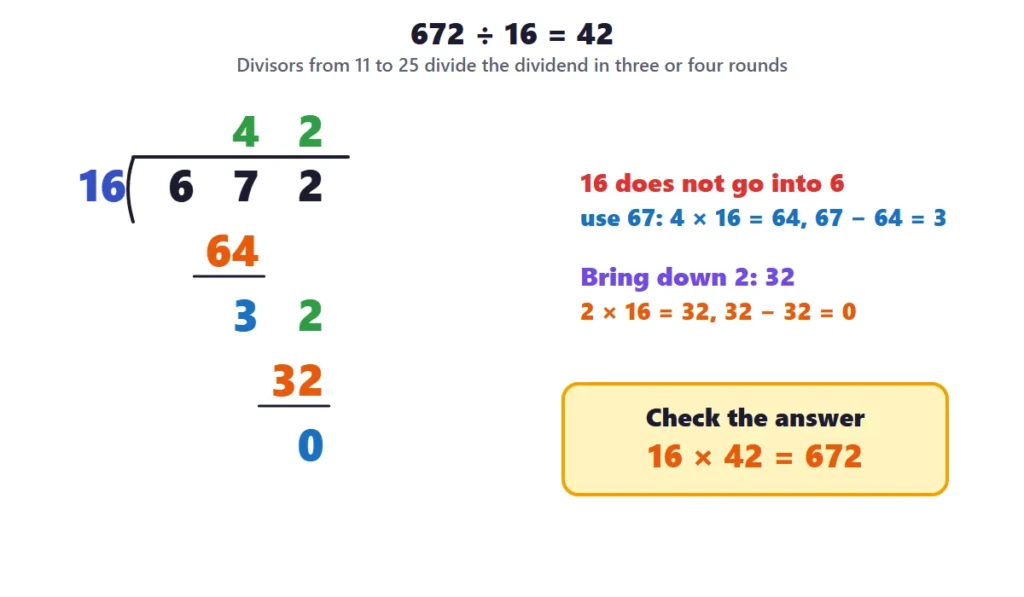
When dividing by 2 digit numbers, the four steps are the same as for one-digit divisors. These tables show the steps for four problems. The first has a first digit that needs two digits of the dividend:
672 ÷ 16 = 42
Round
Number we divide
Digit of the answer
Multiply
Subtract
Next
1
67
4
4 × 16 = 64
67 − 64 = 3
bring down the 2
2
32
2
2 × 16 = 32
32 − 32 = 0
done
The second has a remainder:
845 ÷ 23 = 36 R17
Round
Number we divide
Digit of the answer
Multiply
Subtract
Next
1
84
3
3 × 23 = 69
84 − 69 = 15
bring down the 5
2
155
6
6 × 23 = 138
155 − 138 = 17
done
The third has a four-digit dividend:
4,368 ÷ 12 = 364
Round
Number we divide
Digit of the answer
Multiply
Subtract
Next
1
43
3
3 × 12 = 36
43 − 36 = 7
bring down the 6
2
76
6
6 × 12 = 72
76 − 72 = 4
bring down the 8
3
48
4
4 × 12 = 48
48 − 48 = 0
done
The fourth has a zero in the answer, because 25 does not go into 15 after the 5 is brought down:
3,750 ÷ 25 = 150
Round
Number we divide
Digit of the answer
Multiply
Subtract
Next
1
37
1
1 × 25 = 25
37 − 25 = 12
bring down the 5
2
125
5
5 × 25 = 125
125 − 125 = 0
bring down the 0
3
0
0
0 × 25 = 0
0 − 0 = 0
done
2 digit divisor division: guessing the digit and correcting it
In 2 digit divisor division, the hardest step is to guess how many times the divisor goes in. A wrong guess is not a mistake, but a step in the method. If the product is bigger than the number, the guess is too big. If the difference after subtracting is as big as the divisor, the guess is too small. This table shows the trial steps for 845 ÷ 23:
Round
Try
Multiply
Compare with
Result
Next
845 ÷ 23, first digit
5
5 × 23 = 115
84
too big
try 4
845 ÷ 23, first digit
4
4 × 23 = 92
84
too big
try 3
845 ÷ 23, first digit
3
3 × 23 = 69
84
fits
84 − 69 = 15
845 ÷ 23, second digit
7
7 × 23 = 161
155
too big
try 6
845 ÷ 23, second digit
6
6 × 23 = 138
155
fits
155 − 138 = 17
The rule is to change the guess by one and try again. A child who understands this rule can always find the right digit in at most two or three tries. The multiples list at the side of the page makes each try a matter of reading, not calculating.
Long division grade 5: estimating by rounding the divisor
For long division grade 5, children are taught to round the divisor to the nearest ten and to use the first digits of the dividend to estimate. For 845 ÷ 23, round 23 to 20, and 84 ÷ 20 is about 4. This table shows six problems, the estimate for the first digit and the real digit:
672 ÷ 16. Three steps and a check.
Problem
Divisor rounded
First digits ÷ rounded divisor
Estimate for the first digit
Real first digit
Estimate right?
Answer
845 ÷ 23
20
84 ÷ 20
4
3
off by 1
36 R17
672 ÷ 16
20
67 ÷ 20
3
4
off by 1
42
938 ÷ 31
30
93 ÷ 30
3
3
yes
30 R8
1,485 ÷ 27
30
148 ÷ 30
4
5
off by 1
55
5,214 ÷ 42
40
52 ÷ 40
1
1
yes
124 R6
3,477 ÷ 38
40
347 ÷ 40
8
9
off by 1
91 R19
The estimate is often one more than the real digit, because rounding the divisor down makes the estimate too big. That is why 4 × 23 = 92 is too big, and the digit is 3. When the divisor is rounded up, the estimate can be too small. Both cases are normal. The estimating with rounding and rounding worksheets pages have practice with rounding.
Double digit division worksheets: how long is the answer?
The double digit division worksheets in this pack use three-digit dividends first, and the answer has one or two digits. This table counts the three-digit dividends from 100 to 999 for six divisors, with the share that divide evenly:
Divisor
Dividends with a 1-digit answer
Dividends with a 2-digit answer
Share with a 1-digit answer
Divide evenly
Share that divide evenly
11
10
890
1%
81
9%
12
20
880
2%
75
8%
15
50
850
6%
60
7%
18
80
820
9%
50
6%
20
100
800
11%
45
5%
25
150
750
17%
36
4%
For a divisor of 11, only the 10 dividends from 100 to 109 have a one-digit answer, and with a divisor of 20 the numbers from 100 to 199 do. About one dividend in 11 divides evenly by 11, and one in 20 by 20. The worksheets with remainders are therefore far more common than those with no remainders.
Checking long division with 2-digit divisors
The check is the same as for one-digit divisors: multiply the answer by the divisor and add the remainder. This table checks six answers:
Problem
Answer
Check: divisor × quotient + remainder
Equals the start?
672 ÷ 16
42
16 × 42 = 672
yes
845 ÷ 23
36 R17
23 × 36 + 17 = 845
yes
4,368 ÷ 12
364
12 × 364 = 4,368
yes
3,750 ÷ 25
150
25 × 150 = 3,750
yes
938 ÷ 31
30 R8
31 × 30 + 8 = 938
yes
1,485 ÷ 27
55
27 × 55 = 1,485
yes
The multiplication in the check uses the 2-digit by 2-digit multiplication skills, since the answer and the divisor can both have two digits. A child who checks each answer finds most mistakes without help.
Common mistakes with long division 2-digit divisors
Most mistakes are about the guess. This table shows five mistakes, what went wrong and the fix:
What the child writes or says
What went wrong
The fix
845 ÷ 23 = 4 …, because 4 × 23 = 92
does not see that 92 is bigger than 84
if the product is bigger than the number, the digit is too big: try 3
The difference after subtracting is 25, and 25 is bigger than the divisor 23
the digit in the answer is too small
if the difference is as big as the divisor or bigger, add 1 to the digit
672 ÷ 16 = 402
writes the first digit in the wrong place
16 does not go into 6: use 67, and put the 4 above the 7
Divides 845 by 2 and 3, the digits of the divisor
splits the divisor into digits
the divisor 23 is one number: use the whole of it
4,368 ÷ 12 = 36
forgets a digit of the answer
bring down every digit: the answer is 364
Long division 2-digit divisors word problems
Story problems use packing and sharing with bigger numbers. Ask children to estimate by rounding the divisor and then to divide:
Word problem
Working
Answer
A farm has 672 apples to pack in boxes of 16. How many boxes does it fill?
672 ÷ 16
42 boxes
845 students are split into groups of 23. How many full groups, and how many students are left?
845 ÷ 23
36 groups, 17 left
A factory makes 4,368 toys in 12 hours at a steady rate. How many toys an hour?
4,368 ÷ 12
364 toys an hour
A school buys 3,750 pencils to share equally among 25 classes. How many does each class get?
3,750 ÷ 25
150 pencils
A bakery has 938 rolls to pack in bags of 31. How many full bags can it fill?
938 ÷ 31
30 bags and 8 rolls left
A bus trip of 1,485 miles takes 27 equal days. How many miles a day, and how many are left?
1,485 ÷ 27
55 miles a day, 0 left
Games and activities for long division 2-digit divisors
Children learn long division 2-digit divisors best when they play with it. These games use things that are found at home or in a classroom:
Multiples list race: write the first nine multiples of a divisor as fast as you can, and check them with a partner
Guess and check: guess the digit, multiply and compare, and count how many tries it takes
Estimate first: estimate each problem by rounding the divisor, and then use the real steps
Digit cards: draw three digit cards and a divisor card between 11 and 25, and divide
Check partner: swap worksheets and check each answer by multiplying
Remainder story: make up a story for a problem with a remainder, and say what the remainder means
Extra support and extra challenge with long division 2-digit divisors
For children who need more support: make sure the long division with one-digit divisors is secure. Write the multiples of the divisor at the side of the page, and use them for every round. Use grid paper to keep the digits in the right columns, and start with divisors of 11, 12 and 15, which are easier to multiply.
For children who need more challenge: ask for the answer to 10,000 ÷ 25 using doubling, for a division where the guess has to be corrected twice, and for the biggest 3-digit number that leaves a remainder of 22 when divided by 23. The 4-digit by 2-digit worksheets with no remainders are a good challenge.
How to tell that a child is ready to move on from long division 2-digit divisors
The child lists the multiples of the divisor.
The child estimates the first digit by rounding the divisor.
The child corrects a guess that is too big or too small.
The child checks the answer by multiplying and adding the remainder.
A 20-minute lesson on long division 2-digit divisors
A short lesson is the best way to introduce long division 2-digit divisors. This 20-minute plan can be used in a classroom, at a tutoring session or at home, and it uses the worksheets at the end:
Minutes
Activity
What to say or ask
0 to 3
Make the multiples list for 23 together
How can we find 4 × 23 from 2 × 23?
3 to 8
Estimate 845 ÷ 23 by rounding 23 to 20
What is 84 ÷ 20, about?
8 to 13
Try 4, find that 92 is too big, and try 3
How do we know the guess is too big?
13 to 18
Finish the division, and check by multiplying
What do we add back?
18 to 20
Start a worksheet and check one answer
Check the first guess with the list.
Where long division 2-digit divisors fits across the grades
No skill stands alone. This table shows what children learn before and after long division 2-digit divisors, with the standard that goes with each step:
This page is the last of the whole-number long division pages. The whole sequence is on the long division worksheets page.
Helping at home with long division 2-digit divisors
Parents do not need to be experts to help with long division 2-digit divisors. These suggestions work well, and each takes only a few minutes:
Make the multiples list together before the homework starts.
Ask the child to guess the first digit, and to say why it is too big or too small.
Use a calculator only to check the answer, not to find it.
Look for the divisors that appear in daily life, such as 12 eggs, 24 hours and 52 weeks.
Praise a corrected guess, since it shows understanding.
How to check progress in long division 2-digit divisors
A teacher or parent can check progress with the answer key and a few questions. This table shows three common situations, what they mean and what to do next:
What you see
What it means
What to do next
The child makes many wrong guesses
The estimating step is missing
Round the divisor to the nearest ten and use the first digits
The child gets 9 of 10 right in every set
The skill is secure
Move on to the next topic, or to larger numbers
The child makes mistakes in the multiplication
The multiples are being worked out in the head
Write the multiples list before starting
A five-day plan for long division 2-digit divisors
Most children need about a week of short sessions for long division 2-digit divisors. This plan follows the order of the worksheets on this page:
Day
What to do
Practice
Day 1
Review 3-digit by 1-digit, and list the multiples of 16
Set A, divisors from 11 to 25
Day 2
Estimate the first digit by rounding the divisor
With remainders
Day 3
Correct a guess that is too big or too small
Mixed, divisors from 11 to 40
Day 4
Divide 4-digit numbers by 2-digit divisors
4-digit by 2-digit
Day 5
Check every answer by multiplying
No remainders, 4-digit by 2-digit
When the plan for long division 2-digit divisors is complete, the child is ready to divide any multi-digit number. The whole sequence is on the long division worksheets page.
Frequently asked questions
6 quick answers
What grade learns long division with 2-digit divisors?
Grade 5, which divides up to 4-digit numbers by 2-digit divisors (Common Core 5.NBT.B.6).
How can I make estimating easier?
Write the first few multiples of the divisor at the side of the page before you start.
What grade learns long division with 2-digit divisors?
Grade 5, which divides up to 4-digit dividends by 2-digit divisors (Common Core 5.NBT.B.6). Grade 4 uses only one-digit divisors.
How can I make estimating easier?
Write the first nine multiples of the divisor at the side of the page before you start. Then each guess is read from the list, and you only need to find the biggest multiple that is not bigger than the number.
What do you do if your guess is too big?
If the product is bigger than the number you are dividing, the guess is too big, so subtract 1 from it and try again. If the difference is as big as the divisor, the guess is too small, so add 1.
Is long division 2-digit divisors much harder than one-digit divisors?
The steps are the same, but each guess is harder because the divisor has two digits. Writing the multiples of the divisor beside the problem makes long division 2-digit divisors much easier, since every guess can be read from the list.