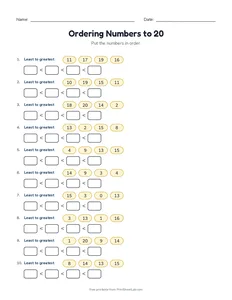
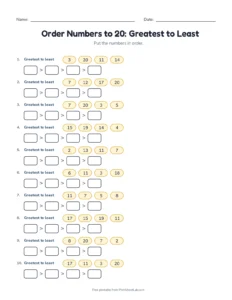
Kindergarten children first compare groups of objects: which group has more? Then they compare written numbers from 1 to 10. These sheets start with pictures, move to numbers to 10 and then to 20, and finish with putting four numbers in order.
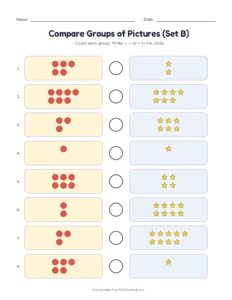
Compare the pictures: count two groups and write >, < or =.
Numbers to 10 and 20: 20 comparisons per page.
Ordering: put four numbers from least to greatest.
Comparing numbers to 20 worksheets: what is in the set
There are 7 comparing numbers to 20 worksheets on this page, and every one has an answer key except for any cut-out games. The first two sets compare groups of pictures, the next three compare written numbers to 10 and to 20, and the last two order four numbers.
Worksheet
What children do
Standard
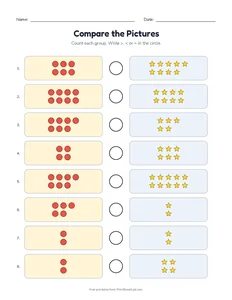
Compare the Pictures
Count two groups and write >, < or =.
K.CC.C.6
Compare Groups of Pictures (Set B)
Count two groups and write >, < or =.
K.CC.C.6
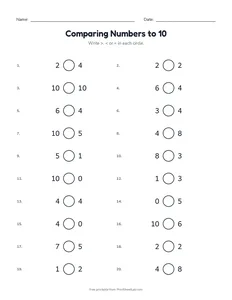
Comparing Numbers to 10
20 comparisons with numbers from 0 to 10.
K.CC.C.6
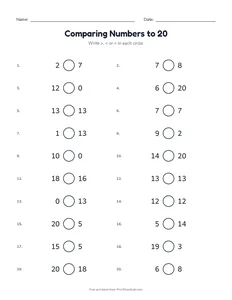
Comparing Numbers to 20
20 comparisons with numbers from 0 to 20.
K.CC.C.6
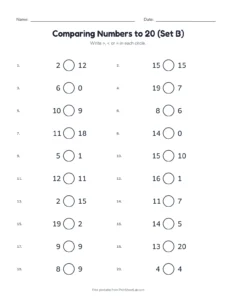
Comparing Numbers to 20 (Set B)
Twenty more pairs to compare.
K.CC.C.6
Ordering Numbers to 20
Put four numbers in order from least to greatest.
K.CC.C.6
Order Numbers to 20: Greatest to Least
Put each set in order from greatest to least.
K.CC.C.6
Comparing numbers to 20: how many pairs are there?
When children are comparing numbers to 20, there are 441 ordered pairs of numbers from 0 to 20. In exactly one pair out of 21 the numbers are equal. This table shows how the pairs divide for three ranges of numbers:
Numbers
Ordered pairs
First is greater (>)
First is less (<)
Equal (=)
Share that are equal
0 to 5
36
15
15
6
16.7%
0 to 10
121
55
55
11
9.1%
0 to 20
441
210
210
21
4.8%
Of all pairs from 0 to 20, only 4.8% are equal, so most of the 20 comparisons on each worksheet need a greater than or less than sign. Children should still meet the equals sign, because it is the one that is easiest to forget.
Greater than less than kindergarten: the language of comparing
Greater than less than kindergarten work starts with everyday words and moves to the signs. Children say “more” and “fewer” about groups of objects, and “greater” and “less” about numbers. The Common Core standards for kindergarten ask children to compare two groups of objects (K.CC.C.6) and to compare two written numbers from 1 to 10 (K.CC.C.7). The Common Core standards for kindergarten counting and cardinality describe both. This table shows how the words and signs fit together:
Word
What it means
Sign
Example
more
the group with objects left over
>
9 > 7: nine is more than seven
fewer
the group with fewer objects
<
7 < 9: seven is fewer than nine
the same
a one-to-one match leaves nothing over
=
5 = 5
greater than
for numbers
>
14 > 9
less than
for numbers
<
9 < 14
equal to
for numbers
=
12 = 12
The signs are formally taught in grade 1, so a kindergarten class can use words only. The worksheets give the signs so that children who are ready can use them. Wikipedia’s article on inequality explains the signs for older readers.
Comparing numbers 1-10: all the pairs, by difference
For comparing numbers 1-10, there are 45 different pairs of numbers that are not equal. The difference between the two numbers tells how hard a pair is: numbers that differ by 1 or 2 need careful counting, and numbers that differ by 6 or more are easy to see. The table counts the pairs for each difference:
Difference between the numbers
Different pairs from 1 to 10
Example
How hard it is
1
9
1 and 2
needs careful counting
2
8
1 and 3
needs careful counting
3
7
1 and 4
medium
4
6
1 and 5
medium
5
5
1 and 6
medium
6
4
1 and 7
easy to see
7
3
1 and 8
easy to see
8
2
1 and 9
easy to see
9
1
1 and 10
easy to see
Half of the pairs differ by 4 or less. A worksheet that has only easy pairs does not make children count carefully, so the comparing numbers to 10 worksheet mixes close pairs with far ones.
More or less worksheets: four ways to compare 14 and 9
More or less worksheets can be solved in several ways. A child who knows more than one way can check their own work. These are the four strategies, with the comparison of 14 and 9 as the example:
Strategy
How it works for 14 and 9
How you know
Match one to one
draw a line from each counter in one group to a counter in the other
the group with counters left over has more
Count and compare
count both groups and say the numbers
the later number in the count is greater
Use a number line
find both numbers on a number line
the one further right is greater
Use ten frames
show each number on a ten frame
the number with more filled spaces is greater
Comparing teen numbers: look at the tens first
When children are comparing numbers to 20, the numbers 10 to 19 all have 1 ten, so only the ones decide. A single-digit number is always less than a teen number. Of the 45 pairs of different teen numbers, each is decided by the ones digit alone. The table shows five examples and the place that decides:
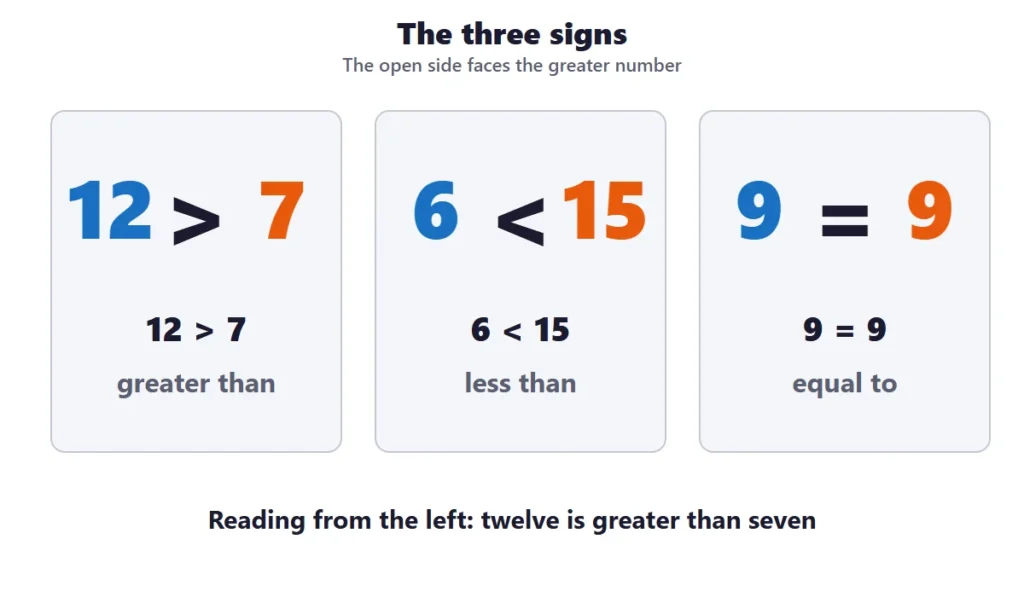
The three signs. Greater, less and equal.
Pair
Which place decides?
Answer
14 and 17
both have 1 ten, so compare the ones
14 < 17
19 and 12
both have 1 ten, so compare the ones
19 > 12
8 and 15
8 has no tens, 15 has 1 ten
8 < 15
20 and 13
20 has 2 tens, 13 has 1 ten
20 > 13
16 and 16
every place matches
16 = 16
Ordering numbers to 20: how many orders are there?
When ordering numbers to 20, children put four numbers from least to greatest, or from greatest to least. A set of four numbers can be arranged in 24 ways, so guessing is unlikely to work. The number of orders grows quickly:
Numbers to order
Possible orders
Chance of guessing the order
3
6
1 in 6
4
24
1 in 24
5
120
1 in 120
6
720
1 in 720
A good strategy is to find the least number first, then the least of the numbers that are left. The six sets below show the numbers as they might appear on a worksheet, with the answer in both orders:
Numbers
Least to greatest
Greatest to least
5, 8, 17, 15
5 < 8 < 15 < 17
17 > 15 > 8 > 5
17, 6, 3, 11
3 < 6 < 11 < 17
17 > 11 > 6 > 3
18, 15, 10, 9
9 < 10 < 15 < 18
18 > 15 > 10 > 9
13, 14, 19, 16
13 < 14 < 16 < 19
19 > 16 > 14 > 13
18, 7, 14, 15
7 < 14 < 15 < 18
18 > 15 > 14 > 7
19, 20, 18, 7
7 < 18 < 19 < 20
20 > 19 > 18 > 7
Common mistakes when comparing numbers to 20
Children make a small number of mistakes with comparing numbers. This table shows five of them and the right answer:
Pair
What the child does
Right answer
9 and 12
says 9 is greater because 9 is more than 1
12 > 9
15 and 8
says 8 is greater because it is the last digit
15 > 8
13 and 14
counts the groups and loses track
13 < 14
6 and 6
writes < because the groups look different
6 = 6
18 and 11
looks at the ones digits only
18 > 11
The most important idea is that a number is not its digits. In 12 the digit 1 is a ten, so 12 is more than 9 even though 9 is more than 1.
Comparing numbers to 20 word problems
Word problems ask children to compare real groups. Ask which group has more or fewer, and then write the sign:
Word problem
Working
Answer
Mia has 12 stickers and Leo has 9. Who has more?
12 > 9
Mia has more
A box has 7 red pens and 14 blue pens. Which color has fewer?
7 < 14
red pens
Ana has 15 marbles and Sam has 15 marbles. Who has more?
15 = 15
the same
There are 18 ducks and 11 geese. Are there more ducks or geese?
18 > 11
more ducks
A team scores 9 points and another scores 16. Who scored fewer points?
9 < 16
the first team
A shelf has 20 books and a box has 13 books. Which has more?
20 > 13
the shelf
Games and activities for comparing numbers to 20
Children learn comparing numbers to 20 best when they play with it. These games use things that are found at home or in a classroom:
Which has more?: put two handfuls of counters on the table and ask which has more before counting
Card war: each player turns a card from 1 to 10, and the player with the greater number wins both cards
Alligator signs: make the sign with your arms like a mouth that opens towards the greater number
Number line jump: stand on two numbers on a floor number line, and the one on the right is greater
Dice duel: roll two dice each, add them, and compare the totals
Order the lineup: give four children number cards and ask them to line up from least to greatest
Extra support and extra challenge with comparing numbers to 20
For children who need more support: use objects at first, and match them one to one. Keep the numbers within 10 until the child can compare without counting. Say the sentence in full: “nine is less than twelve”. Use the ten frame worksheets to show the numbers as filled spaces.
For children who need more challenge: ask for a number that is between two given numbers, such as one between 8 and 12, and for the number that is 3 greater than 14. Ask the child to explain why 9 is less than 12 although 9 is more than 1.
How to tell that a child is ready to move on from comparing numbers to 20
The child compares two groups of objects by matching, without counting.
The child says which of two numbers to 20 is greater, and can explain why.
The child reads the three signs and uses them with few mistakes.
The child puts four numbers in order from least to greatest.
When all four are true, move on to comparing 2 and 3 digit numbers, where the same idea is used for numbers with tens and hundreds.
A 20-minute lesson on comparing numbers to 20
A short lesson is the best way to introduce comparing numbers to 20. This 20-minute plan can be used in a classroom, at a tutoring session or at home, and it uses the worksheets at the end:
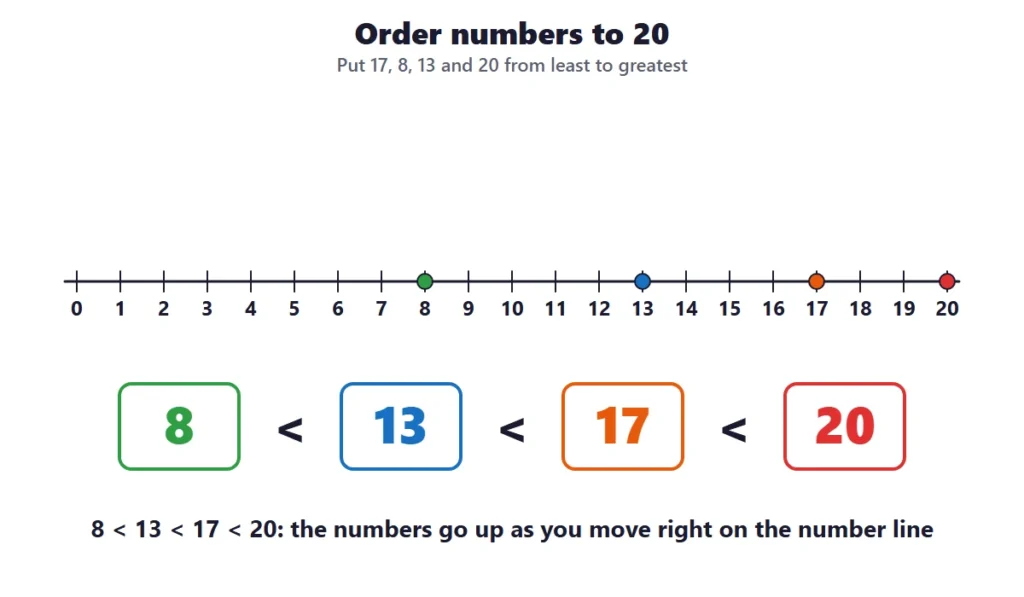
Ordering. Least to greatest.
Minutes
Activity
What to say or ask
0 to 3
Show two groups of counters on the table
Which group has more? How do you know?
3 to 8
Match the counters one to one with strings
What is left over? Which group has more?
8 to 13
Write the numbers and the sign on the board
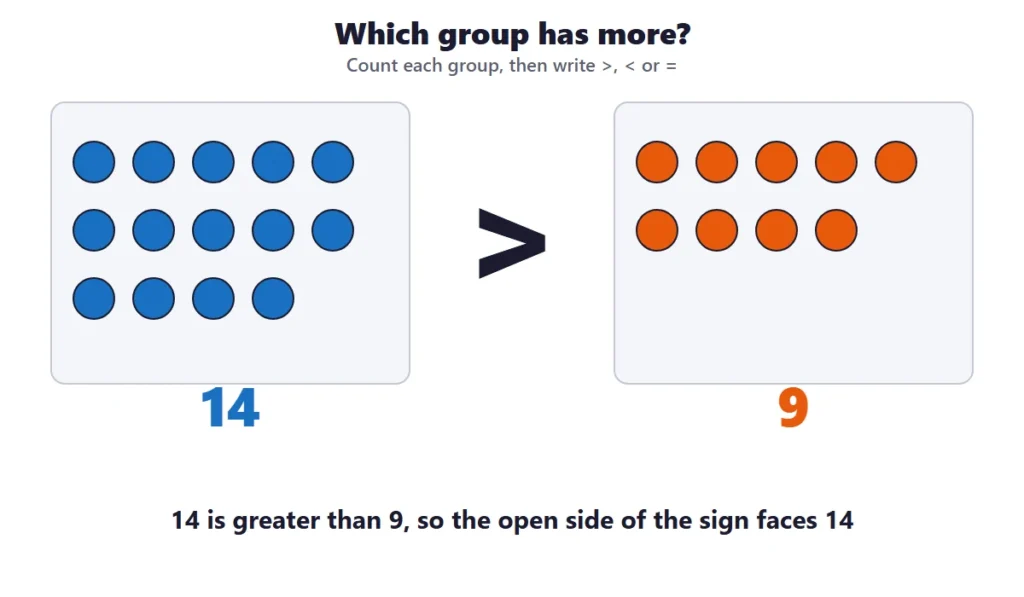
Fourteen is greater than nine. The sign opens towards fourteen.
13 to 18
Do four comparisons together on a number line
Which number is further to the right? Is it greater or less?
18 to 20
Start a worksheet, and check one answer
How can you check your answer with a different method?
Where comparing numbers to 20 fits across the grades
No skill stands alone. This table shows what children learn before and after comparing numbers to 20, with the standard that goes with each step:
This page is the first step. When children can order numbers to 20, they are ready for numbers with tens and hundreds on the comparing 2 and 3 digit numbers page.
Helping at home with comparing numbers to 20
Parents do not need to be experts to help with comparing numbers to 20. These suggestions work well, and each takes only a few minutes:
Ask “which has more?” at snack time: two piles of crackers, or two cups of blocks.
Play a card game of “war” with the cards from 1 to 10, and say the signs aloud.
Ask for the number between two numbers, such as the number between 12 and 14.
Look for numbers to 20 on clocks, calendars and signs, and ask which is greater.
Praise careful counting, and let the child correct their own mistakes with the answer key.
How to check progress in comparing numbers to 20
A teacher or parent can check progress with the answer key and a few questions. This table shows three common situations, what they mean and what to do next:
What you see
What it means
What to do next
The child compares groups correctly but guesses with written numbers
The child may not yet connect numerals to quantities
Go back to counting and to the ten frame worksheets
The child gets 9 of 10 right on every set
The skill is secure
Move on to ordering and to 2-digit numbers
The child writes the signs the wrong way round
The child understands the idea but not the symbol
Use the open-mouth picture, and say the sentence aloud each time
A five-day plan for comparing numbers to 20
Most children need about a week of short sessions for comparing numbers to 20. This plan follows the order of the worksheets on this page:
Day
What to do
Practice
Day 1
Compare two groups of objects by matching one to one
5 pairs of groups
Day 2
Compare the pictures worksheets, then write the signs
Line the objects up in two rows and match them one to one. The row with objects left over has more.
When do children use the > and < signs?
Kindergarten children usually say “more”, “less” or “the same”. The signs are formally used in grade 1 (1.NBT.B.3), but many classes start earlier.
At what age do children learn to compare numbers?
Children compare groups of objects at 4 or 5, and compare written numbers to 10 in kindergarten. The signs for greater than and less than are formally taught in grade 1.
What is the easiest way to remember the greater than sign?
The open side of the sign faces the greater number, and the point faces the lesser. Some teachers use a hungry alligator that wants to eat the bigger number.
Why do the worksheets use pictures first?
Pictures let children compare by matching, which does not depend on counting correctly. After that, they compare written numbers, and the pictures are no longer needed.