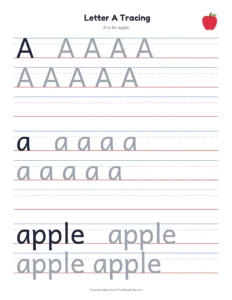
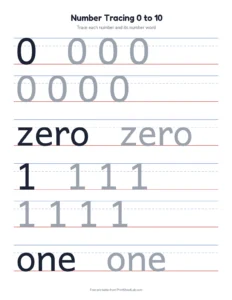
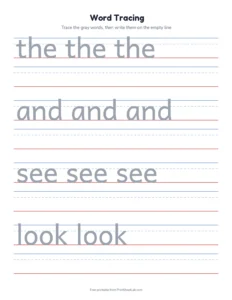
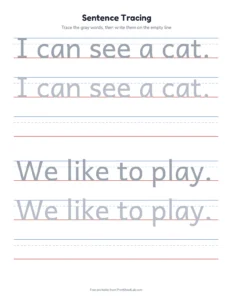
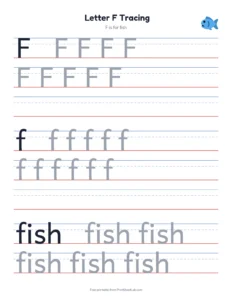
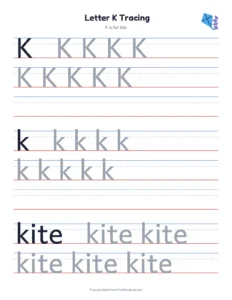
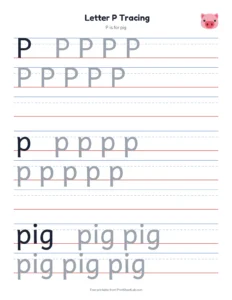
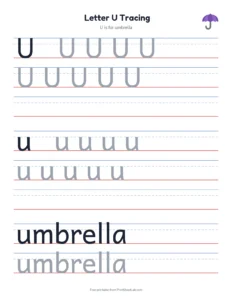
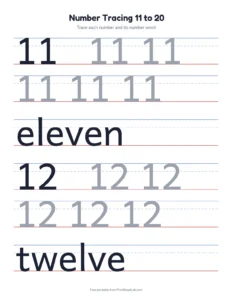
Kindergarten tracing worksheets help five and six year olds move from pre-writing lines to writing letters, numbers, words and sentences. These tracing worksheets for kindergarten cover letters A to Z in five groups, the numbers 0 to 20, common sight words and short sentences. Print a ready PDF, or use the maker below to trace your own words.
Quick answer: Kindergarten tracing worksheets practice the writing skills in the kindergarten standards: printing upper- and lowercase letters, writing the numbers 0 to 20, and copying common words and short sentences. This page has 9 free kindergarten tracing worksheets (PDF) with letters A to Z, numbers 0 to 20, sight words and sentences, plus a maker. Updated October 2026.
Ready-to-print samples
A few of the ready PDFs on this page. The full list is under Ready-to-print worksheets.
Letters A to EUpper and lower case with pictures.PDFNumbers 0 to 10Numerals with number words.PDFSight wordsThe, and, see, look, play, said.PDFSentencesFive short sentences.PDF
What kindergarteners trace and write
The kindergarten language standards ask for a small set of writing skills. This table shows each skill and the worksheet that practices it:
Kindergarten skill
Standard
Trace it on
Print many upper- and lowercase letters
L.K.1.a
Letter tracing: groups A to E up to U to Z
Write the numbers 0 to 20
K.CC.A.3
Number tracing 0 to 10 and 11 to 20
Recognize and read a few sight words
RF.K.3.c
Tracing sight words
Write a sentence
W.K.2 and L.K.2
Tracing sentences
Tracing for kindergarten: from letters to sentences
A good order for tracing for kindergarten is letters, then numbers, then words, then sentences. The letter groups on this page follow the alphabet in five sets, with both uppercase and lowercase letters and a picture word on each page. The number sheets add the word for each number, which links the numeral to the word and the quantity. Sight words come next, and sentences last, because a sentence needs spacing, capitals and a full stop.
Kindergarten tracing worksheets and tracing worksheets for kindergarten
This page is also searched as tracing worksheets for kindergarten, tracing kindergarten worksheets, kindergarten tracing, tracing for kg and tracing paper for kindergarten. All are the free PDFs above. For tracing paper for kindergarten, the maker draws the blue top line, the dashed middle line and the red baseline for you, so letters sit on the right lines. To trace the letter A in kindergarten, choose Letter A in the maker, or print the A to E sheet.
A weekly plan for kindergarten tracing
Day
Focus
Suggested block
Monday
Trace a letter group page
10 min
Tuesday
Trace numbers 0 to 10 or 11 to 20
10 min
Wednesday
Trace sight words
10 min
Thursday
Trace one sentence, then write it alone
10 min
Weekly total
Four short sessions
40 min
A kindergarten tracing checklist
Use this checklist at the start and end of the year. Tick each line when your child can do it without a model, and give extra practice to any line that is not yet ticked:
Skill
Can your child do it?
Sheet to use
Print the capital letters without a model
Yes / not yet
Letters A to E, F to J, K to O, P to T and U to Z
Print the lowercase letters on the lines
Yes / not yet
Letter tracing for kindergarten
Write the numbers 0 to 20
Yes / not yet
Numbers 0 to 10 and 11 to 20
Copy five common words
Yes / not yet
Tracing sight words
Copy a short sentence
Yes / not yet
Tracing sentences
Tips for tracing in kindergarten
Start at the top: nearly every letter and number begins at the top or the middle line.
Say the strokes aloud: for example, down, up and around for a lowercase a.
Fade the support: move from the dark model to the gray rows and then to the empty row.
Mix the subjects: one page of letters one day and numbers the next keeps the practice fresh.
Keep a folder: a folder of finished pages shows the progress over the year.
Tracing paper for kindergarten: what the lines mean
The blue top line is where tall letters and capitals reach, the dashed middle line is where small letters reach, and the red baseline is where every letter sits. Letters such as g, j, p, q and y hang below the red line. If a child struggles with the lines, the maker can switch to gray lines or no lines.
Kindergarten tracing worksheets for different learners
Some kindergartners already write well, while others still need support. For a child who needs more help, return to the tracing lines and shapes and the large size. For a child who is ready for more, move to the sentences sheet and ask them to write a sentence of their own below the traced one. Both children can use the same page, with a different number of rows.
How to fit tracing into a kindergarten day
Short, regular tracing works better than long sessions. Many teachers use a tracing page as a morning warm-up, a station in a center rotation or a quiet activity after lunch. At home, five minutes after breakfast or before a story is easy to keep up. Whatever the time, keep it calm and positive, and praise the effort.
Frequently asked questions
7 quick answers
Where can I download free kindergarten tracing worksheets?
Open any worksheet in the Ready-to-print list on this page, choose US Letter or A4, then print or save the PDF. They are free, and no account is needed.
What should a kindergartener be able to trace and write?
By the end of kindergarten, most children print many upper- and lowercase letters, write the numbers 0 to 20 and copy a short sentence.
How long should a kindergarten tracing session be?
Ten minutes is plenty. One page of tracing a day, done carefully, helps more than a long session that ends in tired hands.
Can a kindergartener trace without lines?
Many can, but handwriting lines help children keep letters the right size and sitting on the baseline. The maker can show gray lines or no lines when a child is ready.
How many sight words should a kindergartener write?
There is no fixed number, but many kindergarten programs aim for the first 20 to 40 sight words by the end of the year. The tracing sets here give 40 and 52 to choose from.
Should kindergarteners trace in pencil or crayon?
Crayon or a soft pencil are both fine. A short, thick crayon is easier for children who still need a stronger grip.
What if my child dislikes tracing?
Keep the sessions very short, trace in sand or with a finger first, let the child choose the color, and offer a reward such as a sticker. Tracing should feel like a game, not a test.