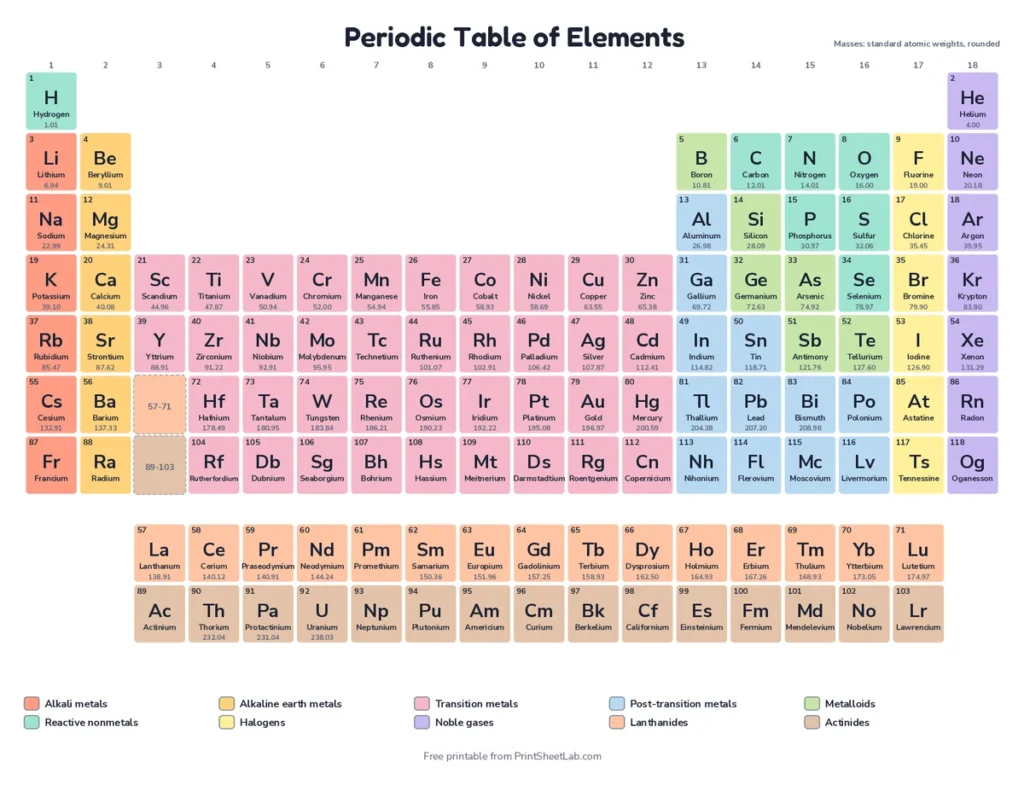
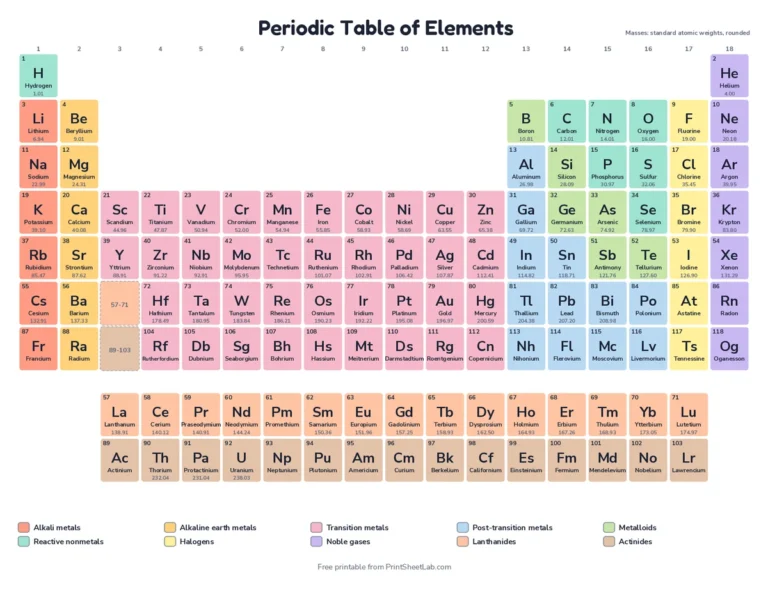
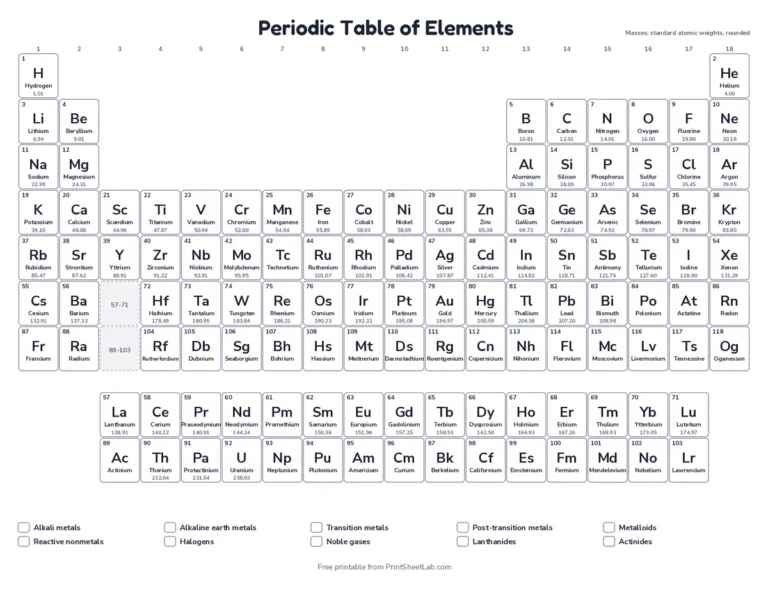
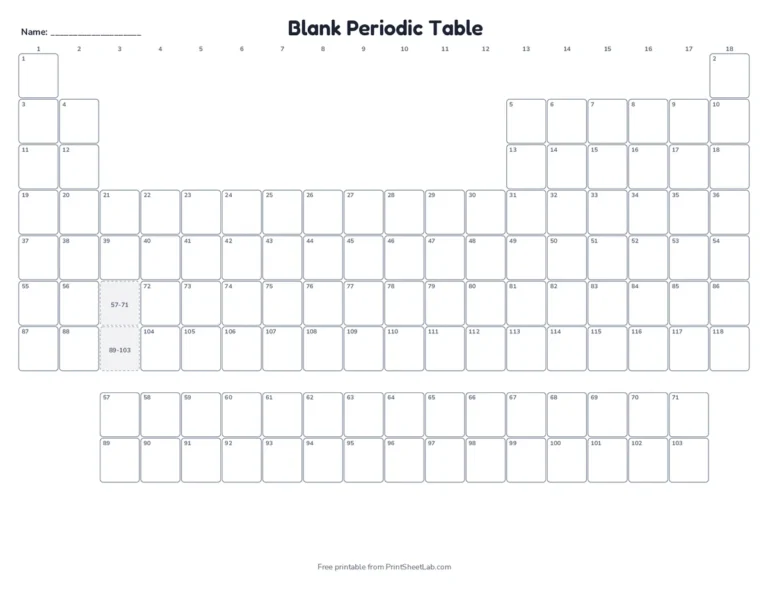
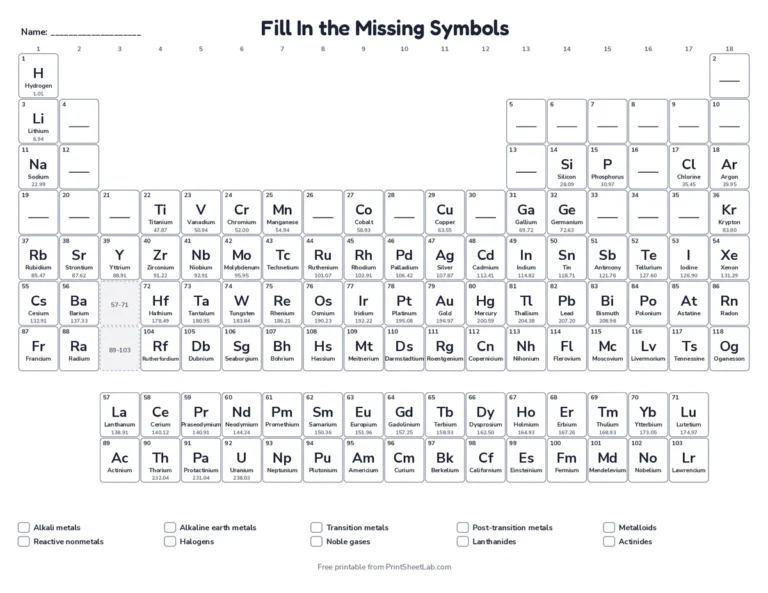
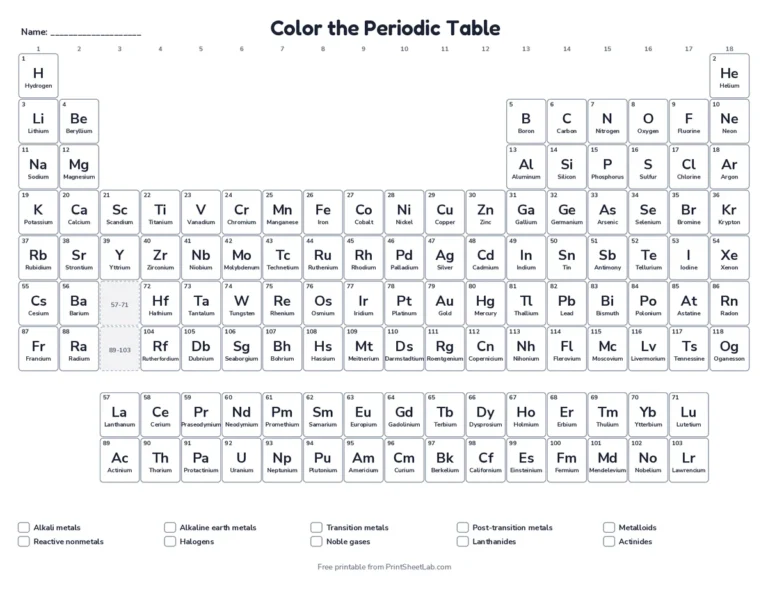
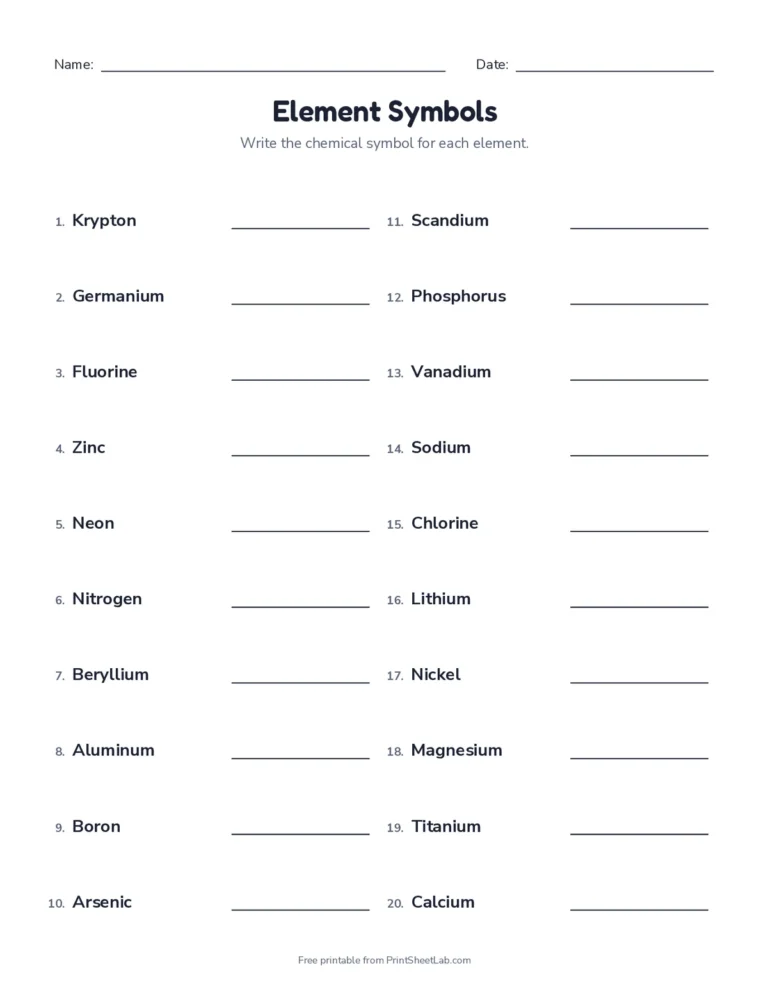
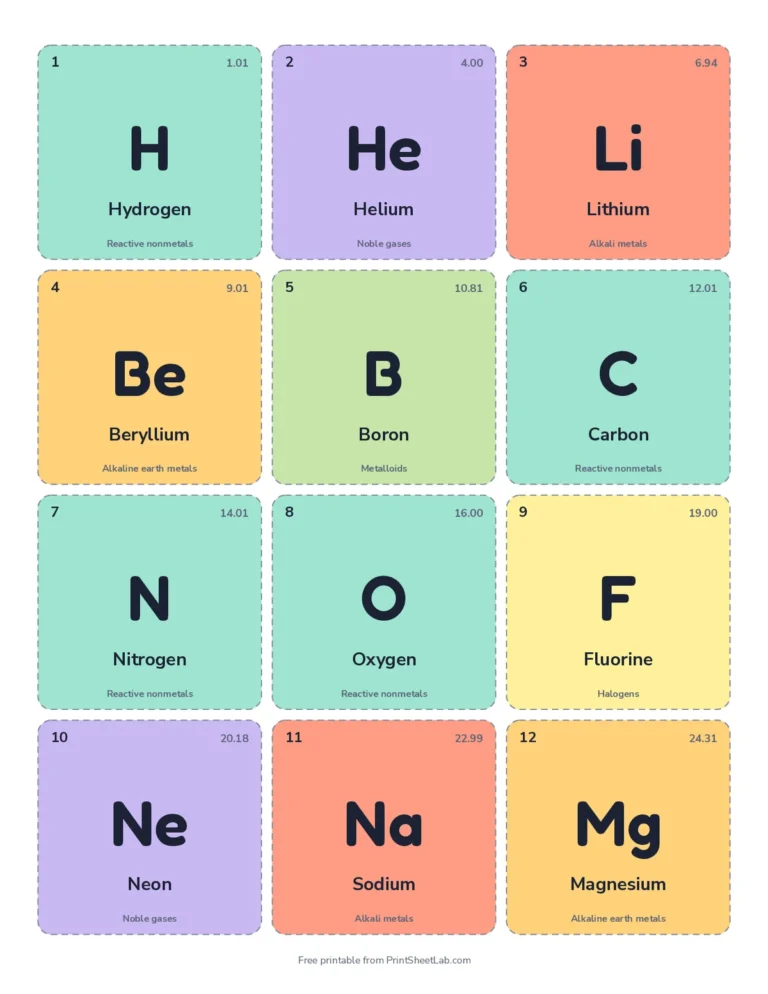
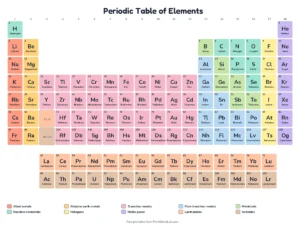
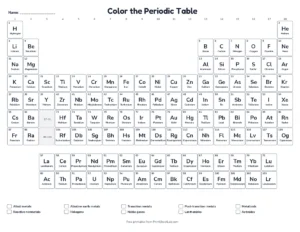
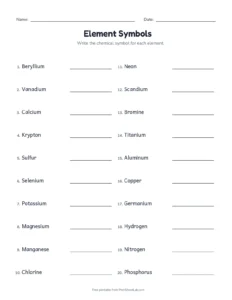
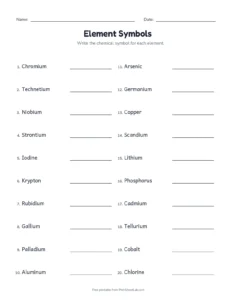
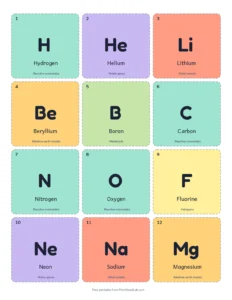
This free printable periodic table shows the periodic table of elements in full color, with atomic numbers, symbols, names and atomic masses for all 118 elements. Or make a blank periodic table, a fill-in-the-missing-symbols worksheet, a color-by-category activity, an element symbols quiz or element flash cards, with answer keys. Tables print landscape on Letter or A4.
The color periodic table from the generator above, with all 118 elements colored by family.
Tap any element to see its name, atomic number, atomic mass, group and period. Switch to a Find it game and race to find elements by name, starting with the first 20.
Printable periodic table PDFs and worksheets
Choose a periodic table below for an instant PDF, or hit Customize to hide details, switch to grayscale or change the paper.
Color periodic tableAll 118, names + masses.PDFCustomizeBlack and white tableInk-saving version.PDFCustomizeBlank periodic tableWith atomic numbers.PDFCustomizeFill in the symbols20 missing + key.PDFCustomizeColor by familyColoring activity.PDFCustomizeElement symbols quiz36 elements + key.PDFCustomizeElement flash cardsFirst 36 elements.PDFCustomize
Which printable periodic table should I print?
Color printable periodic table: every element shaded by family, with names, symbols and atomic masses. Best for a binder, a desk or a classroom wall.
Black and white printable periodic table: the same layout in grayscale to save ink, ideal for copying a class set.
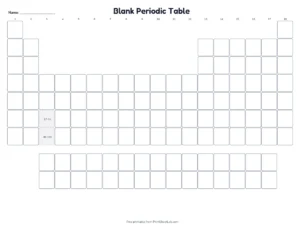
Blank periodic table: empty boxes, with or without atomic numbers, for quizzes and memory practice.
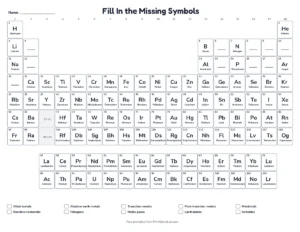
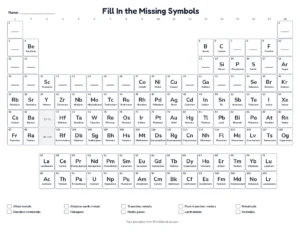
Fill-in worksheet: a partly finished table where students write the missing symbols, with an answer key.
Every printable periodic table fits on one landscape page and stays readable even on A4, because the boxes are measured to fill the paper.
Blank periodic table worksheets
A blank periodic table is one of the best ways to see what a student really knows. Ask them to write the symbols of the first 20 elements, shade the metals, nonmetals and metalloids in three colors, or label the groups (alkali metals, halogens, noble gases). Keep the atomic numbers on for younger students so they have something to anchor to, and turn them off for a real challenge. The same blank periodic table works for a quick warm-up, a homework page or an end-of-unit test.
How to read the periodic table of elements
Atomic number (top left of each box): the number of protons in one atom. The table is ordered by this number, from hydrogen (1) to oganesson (118).
Symbol: one or two letters, the first always a capital. Some come from Latin names, like Fe for iron (ferrum), Au for gold (aurum) and Na for sodium (natrium).
Atomic mass: the average mass of the atom, measured in atomic mass units. Elements that have no stable form have no standard atomic weight, so their boxes show no mass.
Periods are the 7 rows. Elements in the same row have the same number of electron shells.
Groups are the 18 columns. Elements in the same group behave in similar ways, like the very reactive alkali metals in group 1 and the unreactive noble gases in group 18.
The two rows below are the lanthanides and actinides. They belong in periods 6 and 7 but are placed underneath so the table fits on a page.
Element families at a glance
Family
Examples
What they are like
Alkali metals
Lithium, sodium, potassium
Soft, shiny and very reactive, especially with water
Alkaline earth metals
Magnesium, calcium
Reactive metals found in rocks, bones and shells
Transition metals
Iron, copper, gold, silver
Strong, shiny metals that conduct electricity
Metalloids
Silicon, boron
In between metals and nonmetals; used in computer chips
Halogens
Fluorine, chlorine, iodine
Very reactive nonmetals that form salts
Noble gases
Helium, neon, argon
Very unreactive gases; neon glows in signs
Tips for learning the elements
Start with the first 20, from hydrogen to calcium. They are the most common in school science.
Learn the odd symbols separately: Na, K, Fe, Cu, Ag, Sn, Au, Hg and Pb.
Use the flash cards a few minutes a day, then test yourself with the symbols quiz.
Color the table by family with the color-by-category activity to see the patterns.
Frequently asked questions
7 quick answers
Is this printable periodic table free?
Yes. The color periodic table, blank table, worksheets and flash cards cost nothing to print, and teachers may copy them for every student.
How many elements are on the periodic table?
There are 118 known elements, from hydrogen (atomic number 1) to oganesson (atomic number 118).
Why do some elements have no atomic mass?
Elements such as technetium, promethium and most elements after bismuth have no stable form, so they have no standard atomic weight. Some tables show the mass number of the longest-lived form instead; we leave these boxes blank to keep the table accurate.
What is a blank periodic table used for?
Students fill in the symbols or names from memory, color the families, or mark metals, nonmetals and metalloids. Turn atomic numbers on or off to make it easier or harder.
Why is aluminum spelled that way?
This table uses the American spelling, aluminum. Many other countries, and the official international name, use aluminium.
Who decides what goes on the periodic table of elements?
The International Union of Pure and Applied Chemistry, IUPAC, approves new elements, their names and their standard atomic weights. The four newest elements, nihonium, moscovium, tennessine and oganesson, were named in 2016. For the history of the table, from Mendeleev onward, see the periodic table article on Wikipedia.
Does it print on one page?
Yes. The periodic table prints on one landscape Letter or A4 page. The flash cards and quizzes print in portrait.