Free ratio and proportion worksheets for 6th and 7th grade, with an answer key on every page. Use the ratio worksheets to simplify ratios and find equivalent ratios, the proportion worksheets to solve for a missing number, and the unit rate worksheets for prices, speeds and recipes. Harder levels cover sharing in a ratio, map scales and proportional relationships. Every sheet is new each time you press New problems.
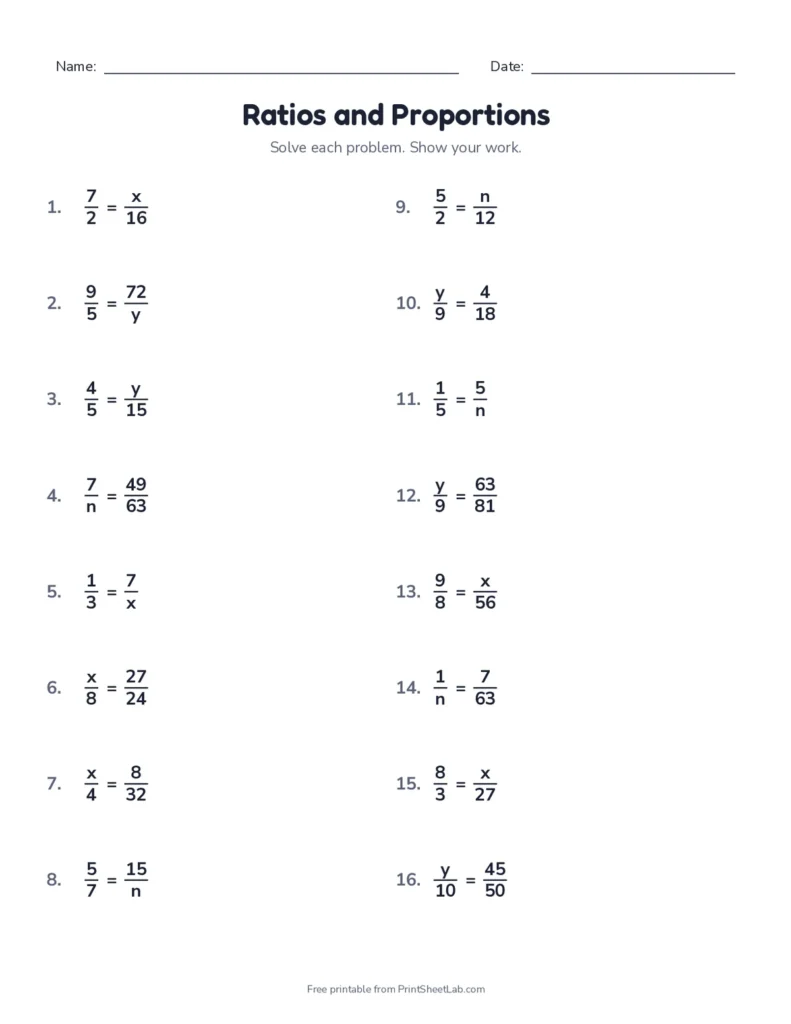
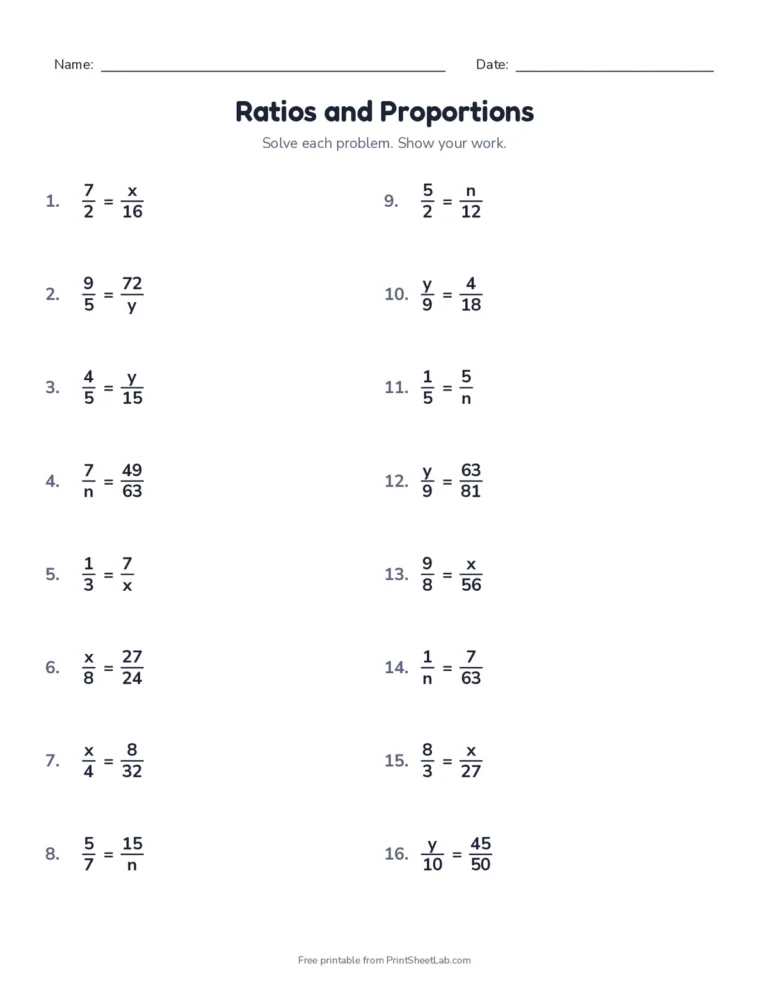
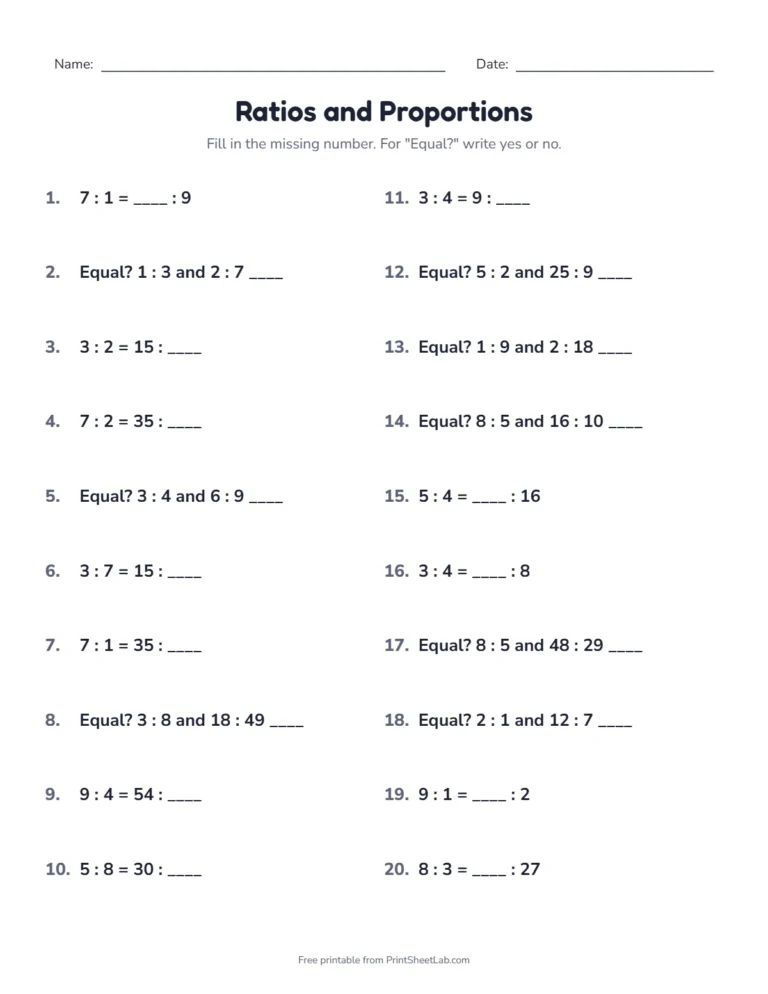
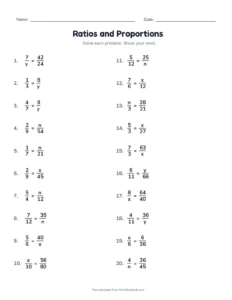
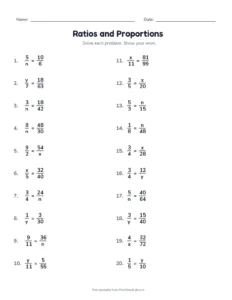
One of our proportion worksheets from the generator above: find the missing number in each proportion.
Check your ratio answers online
Type the answer and press Check. For ratios, type them like 2:3.
Ready-to-print ratio and proportion worksheets (PDF)
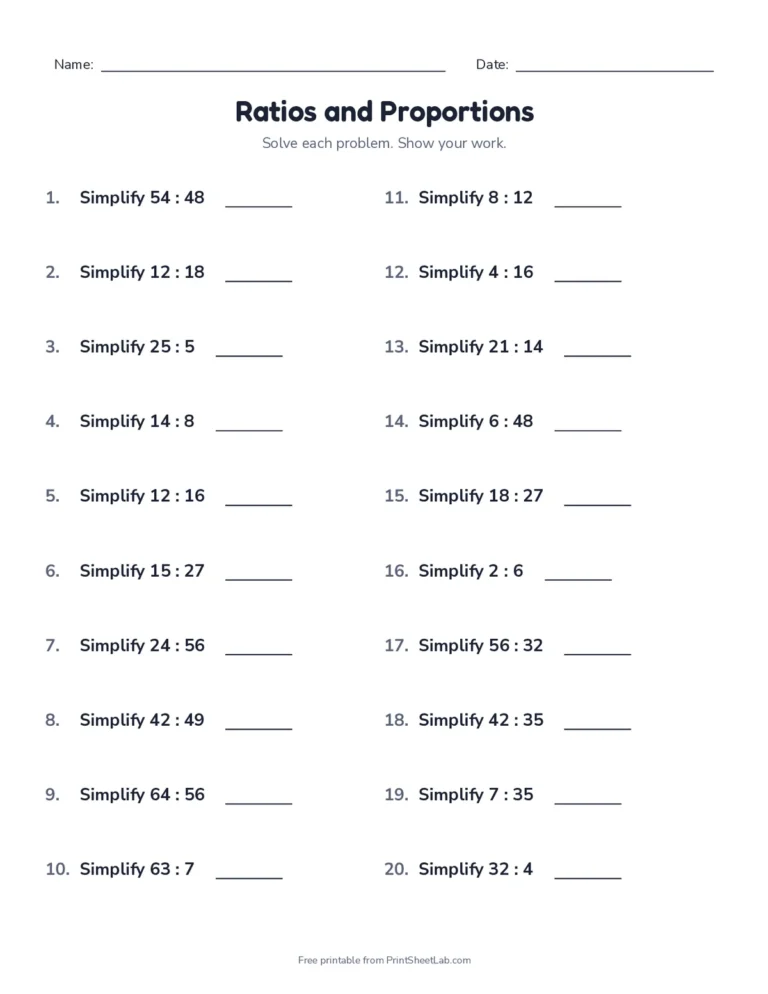
Six levels of ratio and proportion worksheets, from simplifying ratios to scale drawings, each as a PDF with answers. Customize opens the generator on that level so you can set the number of problems.
Simplifying ratiosLevel 1 + answer key.PDFCustomizeSolving proportionsLevel 2 + answer key.PDFCustomizeRatio and unit rate word problemsLevel 3 + answer key.PDFCustomizeEquivalent ratiosLevel 4 + answer key.PDFCustomizeSharing in a ratioLevel 5 + answer key.PDFCustomizeScale and proportional relationshipsLevel 6 + answer key.PDFCustomize
Proportion worksheets: how to solve a proportion
A proportion says two ratios are equal, like 3/4 = x/20. There are two quick ways to find x:
Scale it: 4 was multiplied by 5 to get 20, so multiply 3 by 5 too. x = 15.
Cross-multiply: 3 × 20 = 4 × x, so 60 = 4x and x = 15.
A unit rate is a rate for one of something: if 4 notebooks cost $12, one costs $3. Once you know the unit rate, any other amount is easy.
Ratio worksheets: simplifying and equivalent ratios
A ratio compares two amounts in a fixed order. If a fruit bowl holds 6 apples and 4 pears, the ratio of apples to pears is 6 : 4, which simplifies to 3 : 2 when you divide both numbers by 2. Equivalent ratios are made by multiplying or dividing both numbers by the same amount, so 3 : 2, 6 : 4, 9 : 6 and 30 : 20 all describe the same mix. A ratio table lines these up in columns, and a double number line shows them as matching marks on two lines. Our ratio worksheets start with simplifying, then move to filling in missing numbers in equivalent ratios and deciding whether two ratios are equal. The ratio article on Wikipedia covers the notation in more depth.
Unit rate worksheets: the rate for one
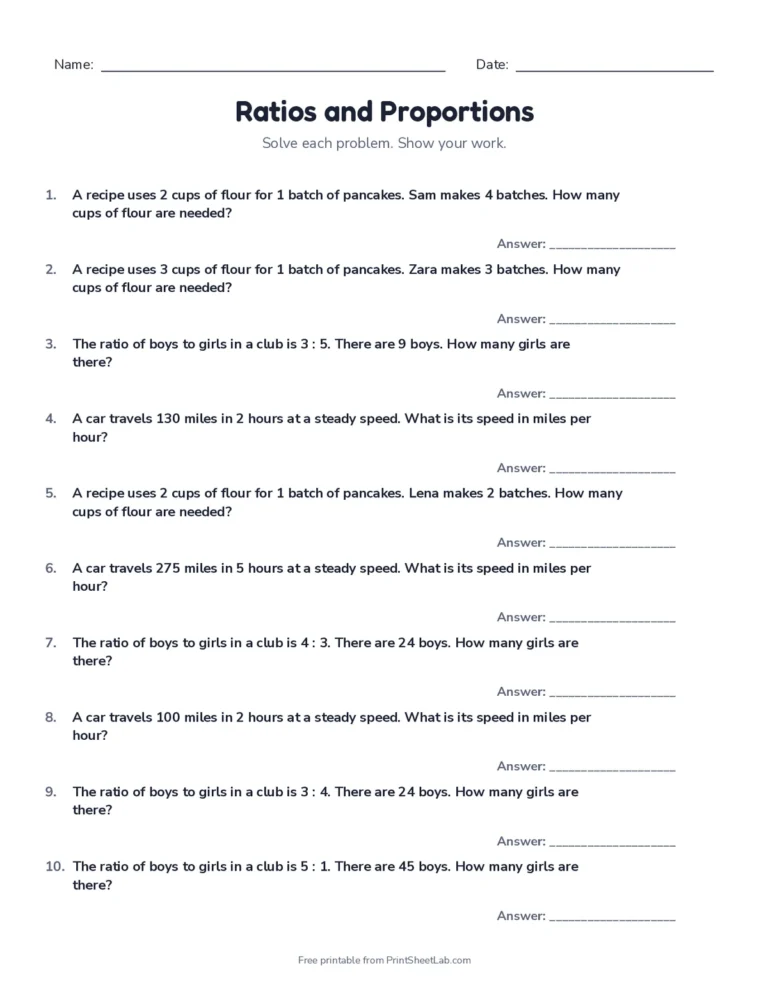
A unit rate tells you how much of one quantity goes with exactly one of another: miles per hour, dollars per pound, words per minute. To find it, divide. If 5 pounds of apples cost $7.50, the unit rate is $7.50 ÷ 5 = $1.50 per pound. Unit rates make comparison shopping easy: a 12-ounce box of cereal for $3.00 costs 25 cents an ounce, while a 16-ounce box for $3.60 costs 22.5 cents an ounce, so the bigger box is the better buy. Level 3 of these unit rate worksheets mixes prices, speeds and recipes.
Sharing in a ratio and part-to-whole questions
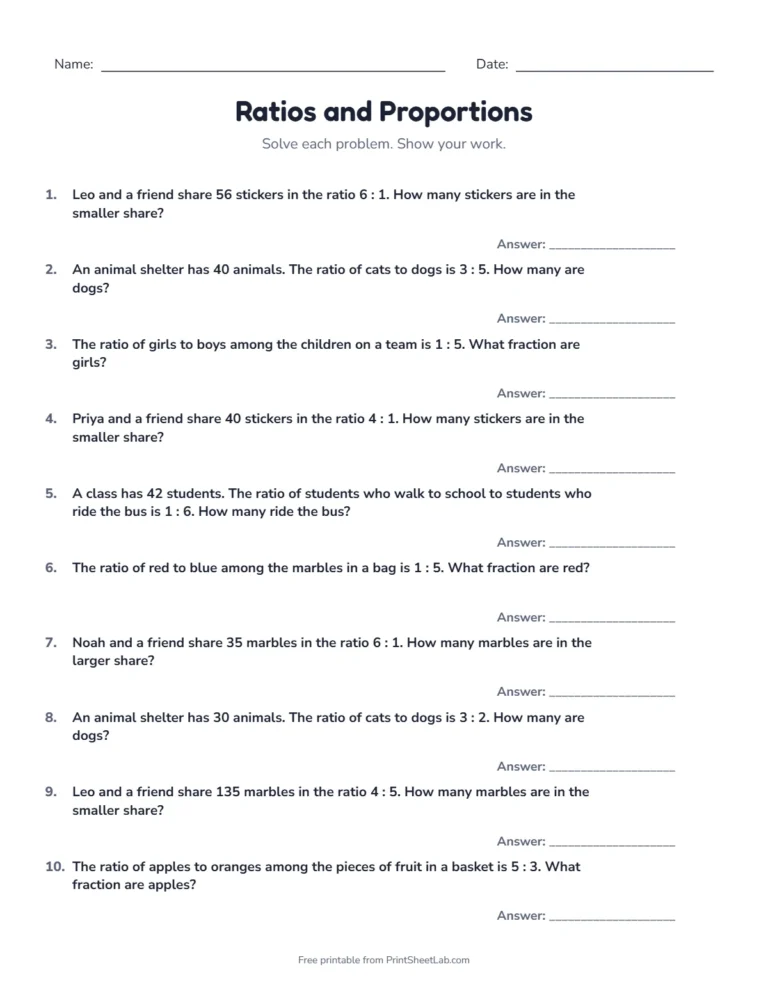
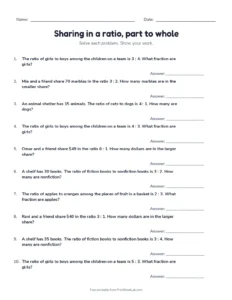
To share an amount in a given ratio, first add the parts. Sharing $60 in the ratio 2 : 3 means 2 + 3 = 5 parts, so each part is $60 ÷ 5 = $12. The shares are 2 × $12 = $24 and 3 × $12 = $36. The same total of parts answers part-to-whole questions: if red and blue marbles are in the ratio 2 : 3, then 2 out of every 5 marbles are red, so red marbles make up 2/5 of the bag. Level 5 of the ratio and proportion worksheets practices both kinds with money, stickers, classes and animal shelters.
Scale drawings and proportional relationships
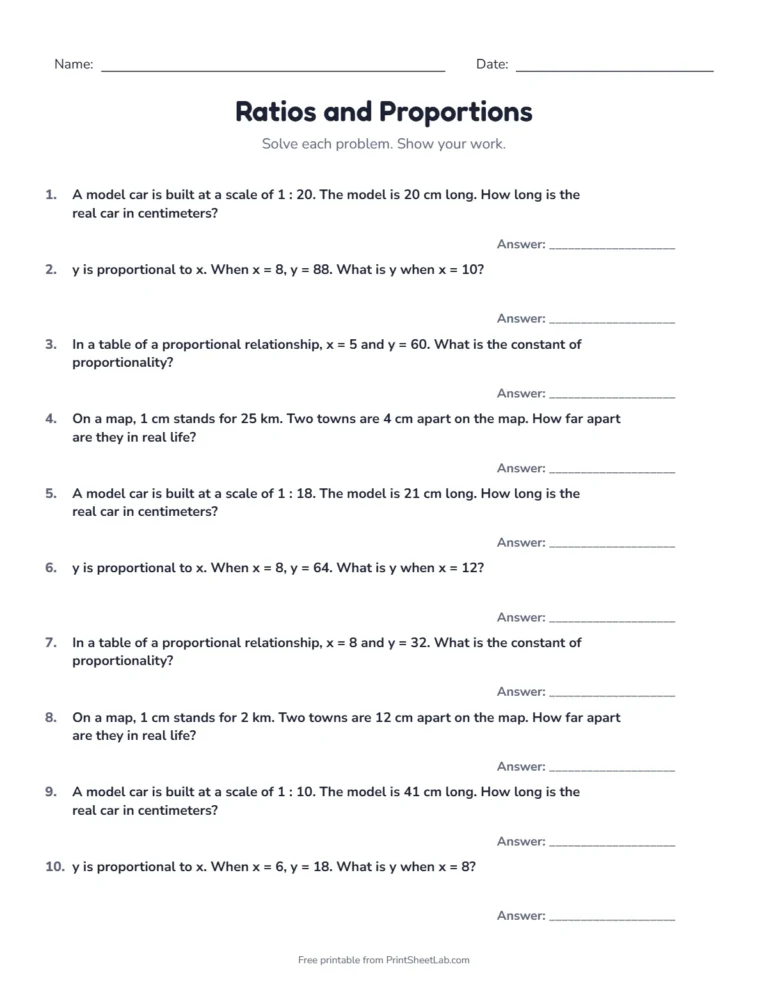
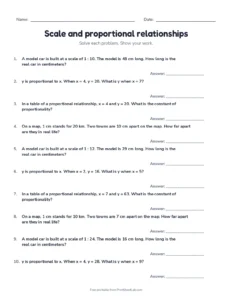
A map scale is a ratio in disguise. If 1 cm on a map stands for 25 km, then towns 4 cm apart are 4 × 25 = 100 km apart. Models work the same way: a 1 : 20 model car that is 21 cm long stands for a real car 420 cm, or 4.2 m, long. In a proportional relationship, y is always the same multiple of x, written y = kx, where k is the constant of proportionality. If y = 60 when x = 5, then k = 12, and when x = 8, y = 96. Level 6 of our ratio and proportion worksheets brings these ideas together for 7th grade.
Ratio and proportion worksheets by grade
6th grade: ratio language, equivalent ratios, ratio tables and unit rates, including unit pricing and constant speed (standards 6.RP.A.1 to 6.RP.A.3). Use levels 1, 3 and 4.
7th grade: unit rates with fractions, recognizing and representing proportional relationships, the constant of proportionality and multistep ratio problems, set out in the Common Core grade 7 ratios and proportional relationships standards. Use levels 2, 5 and 6.
8th grade and up: use the ratio and proportion worksheets as a quick review before slope, similar figures and linear equations.
Common mistakes on ratio and proportion worksheets
Swapping the order. Boys to girls 3 : 4 is not the same as girls to boys 3 : 4. Always write the ratio in the order the question gives.
Adding instead of multiplying. To go from 2 : 3 to 8 : __, multiply both parts by 4. Adding 6 to each part gives 8 : 9, which is a different ratio.
Mixing up part-to-part and part-to-whole. A ratio of 2 : 3 means 2 out of 5, not 2 out of 3.
Forgetting units. Compare like with like: convert hours to minutes or feet to inches before you write the ratio.
What is the difference between a ratio and a proportion?
A ratio compares two amounts, like 2 cats to 3 dogs (2 : 3). A proportion is an equation that says two ratios are equal, like 2/3 = 8/12.
How do I simplify a ratio?
Divide both numbers by their greatest common factor. For 12 : 18 the greatest common factor is 6, so the ratio is 2 : 3.
What is a unit rate?
A unit rate compares a quantity to exactly one unit of another, such as 60 miles per hour or $2 per pound. Divide the first amount by the second to find it.
Is 2 : 3 the same as 3 : 2?
No. Order matters in a ratio. If there are 2 cats for every 3 dogs, the ratio of cats to dogs is 2 : 3, but dogs to cats is 3 : 2.
What is the constant of proportionality?
It is the number k in y = kx, the amount y changes for each 1 that x changes. Divide any y value by its x value to find it.
What grade learns ratios?
Ratios and unit rates are a big part of 6th grade math. Proportions and proportional relationships continue in 7th grade. Our ratio and proportion worksheets cover both years.