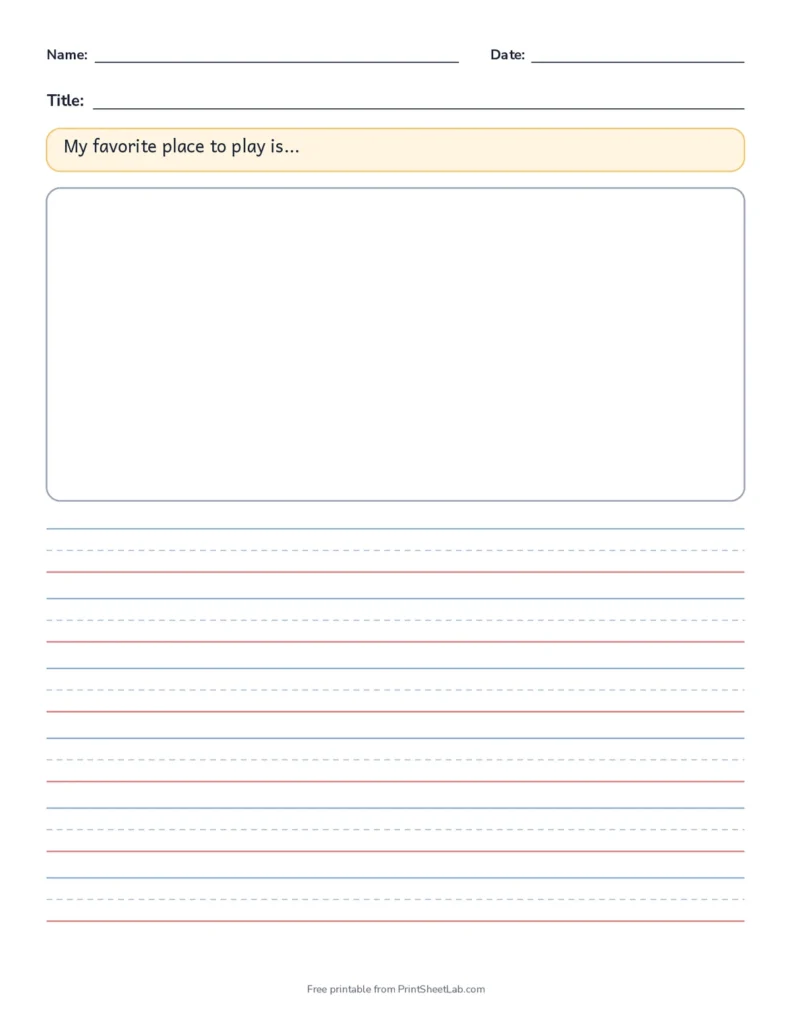
Make free story paper for kids in seconds: a big drawing box on top and primary writing paper lines below, sized from kindergarten to 3rd grade. Add one of 48 original writing prompts for kids or type your own, or switch to a comic strip, a story planner, a friendly letter, an acrostic poem or a haiku page. Every page can have a different prompt, so a whole week of writing prints at once.
New: after writing, try our reading comprehension passages and graphic organizers.
Story spark: spin a story idea
Stuck for an idea? Spin the three reels to mix a character, a place and a problem. Press Keep on any reel you like and spin the others again. When the idea feels right, print it at the top of a page.
Ready-to-print story paper (PDF)
Eight ready-made sets, from kindergarten pages to a haiku template. Each is a PDF you can print straight away; Customize lets you change the lines, the prompts or the layout.



Primary writing paper: which line size should I choose?
| Line size | Good for |
|---|---|
| 1 inch rows | Preschool and kindergarten: big letters and first words |
| 3/4 inch rows | Kindergarten and 1st grade: first sentences |
| 5/8 inch rows | 1st and 2nd grade: longer stories |
| 1/2 inch rows | 2nd and 3rd grade |
| Wide ruled | 3rd grade and up, journals and final drafts |
On primary writing paper the top rule is solid, the midline is dotted and the bottom rule is red, so children can see where tall letters, small letters and tails belong.
Eight kinds of writing pages
- Story paper: draw the picture first, then write about it. Drawing first helps young writers plan what to say.
- Half and half: a bigger picture for early writers who write one or two sentences.
- Writing lines only: for journals, longer stories and final copies.
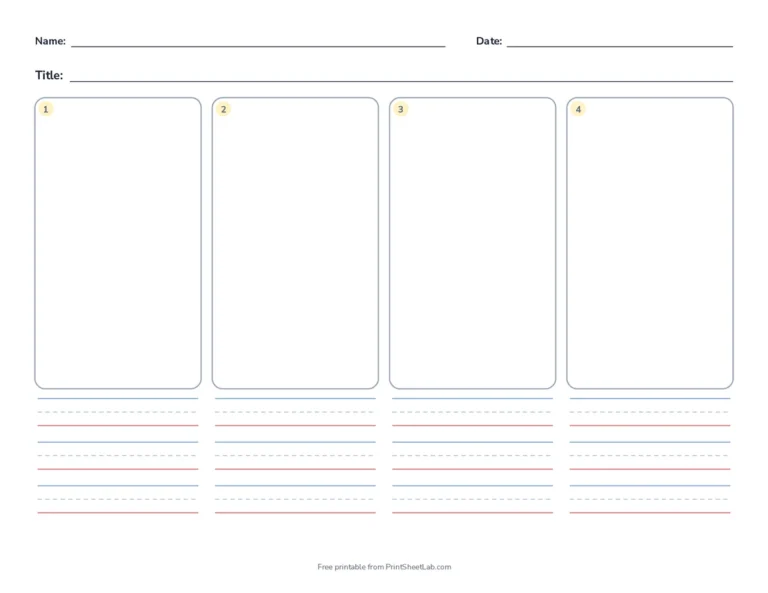
- Comic strip: 3, 4 or 6 panels with writing lines under each one, perfect for retelling and sequencing.
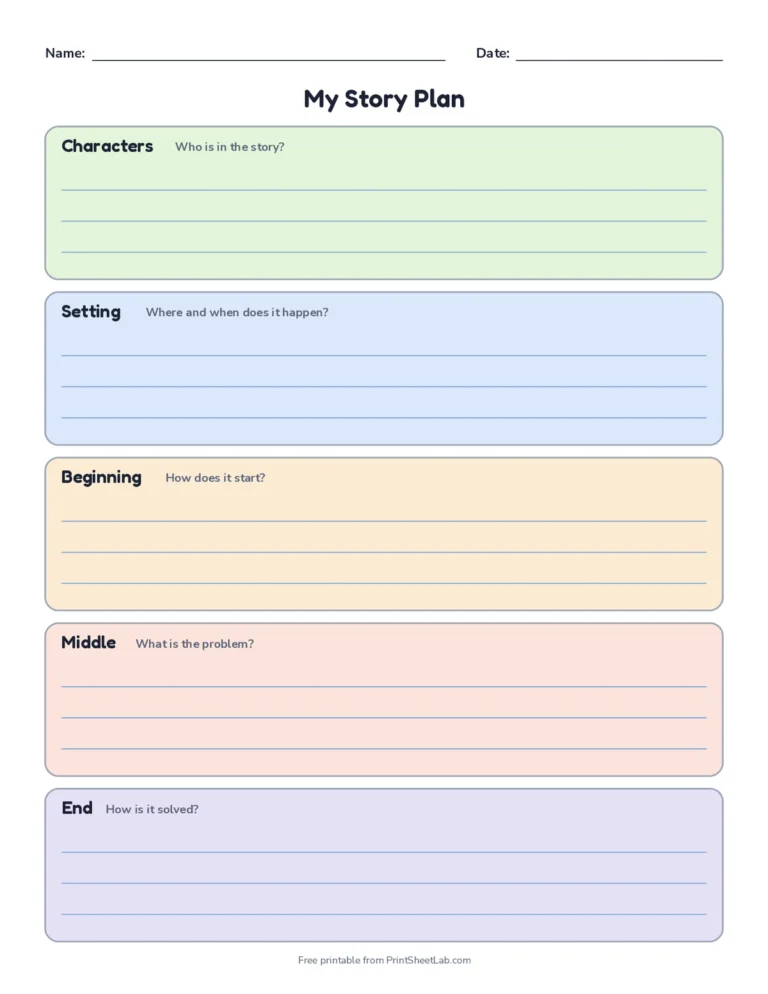
- Story planner: characters, setting, beginning, middle and end on one page.
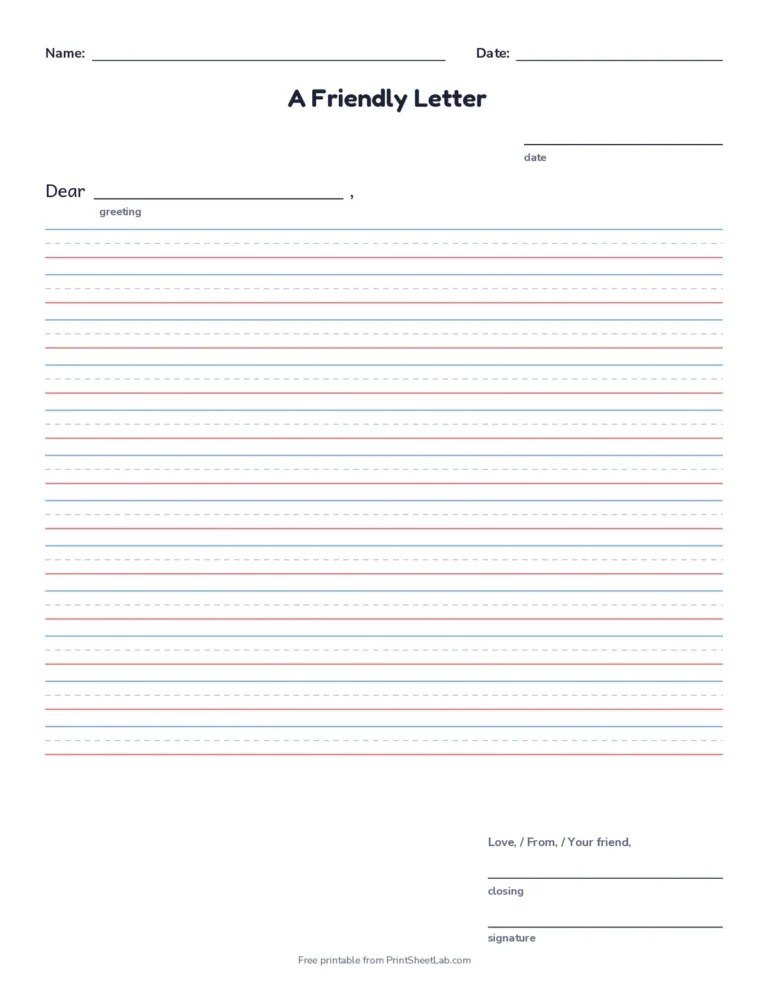
- Friendly letter: date, greeting, body, closing and signature, clearly labeled.
- Acrostic poem: type any word, such as a name or a season, and each letter starts a line.
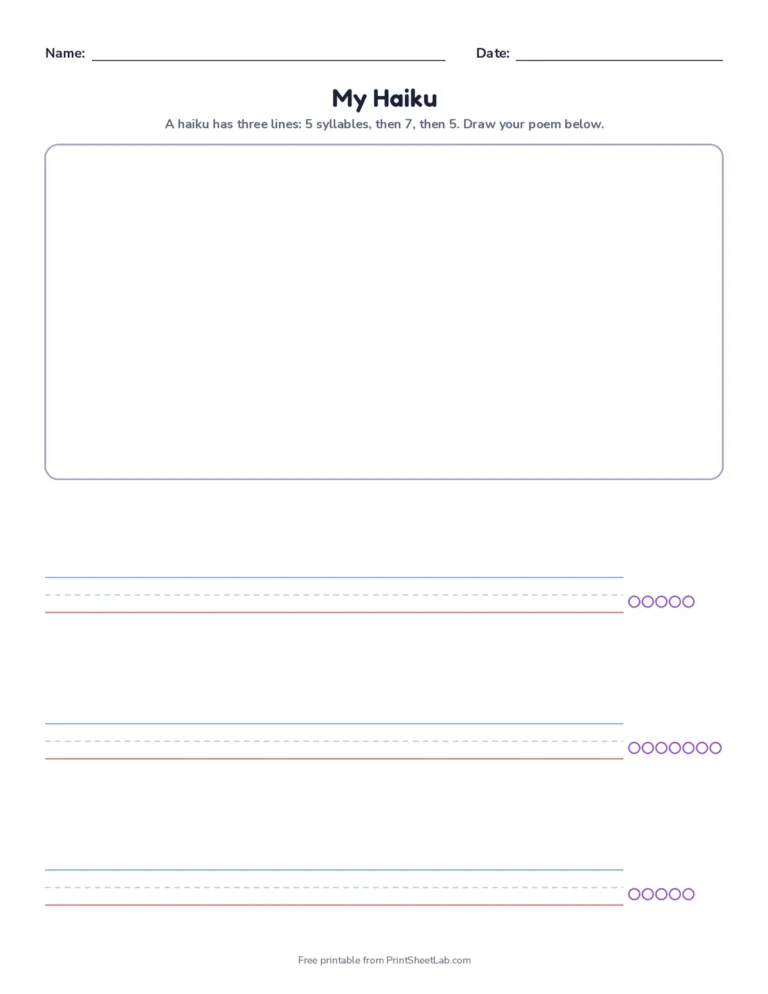
- Haiku: three lines with syllable dots for 5, 7 and 5 syllables, plus space to illustrate.
Writing prompts for kids: 12 ideas to start with
The generator has 48 original writing prompts for kids in two age groups, and you can type your own. Here are a dozen extra ideas to try tonight:
| Ages 5 to 8 | Ages 8 to 11 |
|---|---|
| Your teddy bear comes to life at night. Where does it go? | You find a door in your school that was not there yesterday. |
| Draw your dream treehouse and tell us what is inside. | Write a diary entry from the point of view of your pet. |
| A friendly dragon moves in next door. | You can swap places with any person for one day. Who and why? |
| What would you do on a day with no grown-ups? | Invent a new holiday and explain how people celebrate it. |
| Tell the story of the best snack ever. | A message in a bottle washes up on the beach. What does it say? |
| You shrink to the size of an ant in the garden. | Write about a time you were brave, even a little bit. |
Narrative writing with a beginning, middle and end is part of the Common Core writing standards from kindergarten onward; see the grade 1 writing standards (W.1.3) for what children are expected to do. For the haiku page, the haiku article on Wikipedia explains the 5-7-5 pattern and its Japanese roots.
Tips for young writers
- Talk first. Ask your child to tell you the story out loud before writing.
- Draw, then write. A picture holds the idea while little hands work on the words.
- Beginning, middle, end. Even a three-sentence story can have all three.
- Stretch the sounds. Let early writers spell words the way they hear them, then celebrate the ideas.
- Share it. Reading a finished story to someone makes writing feel worthwhile.
Frequently asked questions
6 quick answers
What is story paper?
Story paper is writing paper with a blank box at the top for a picture and handwriting lines at the bottom. Children draw a scene and then write about it, which is how many kindergarten and first grade classes teach writing.
Are the writing prompts different on each page?
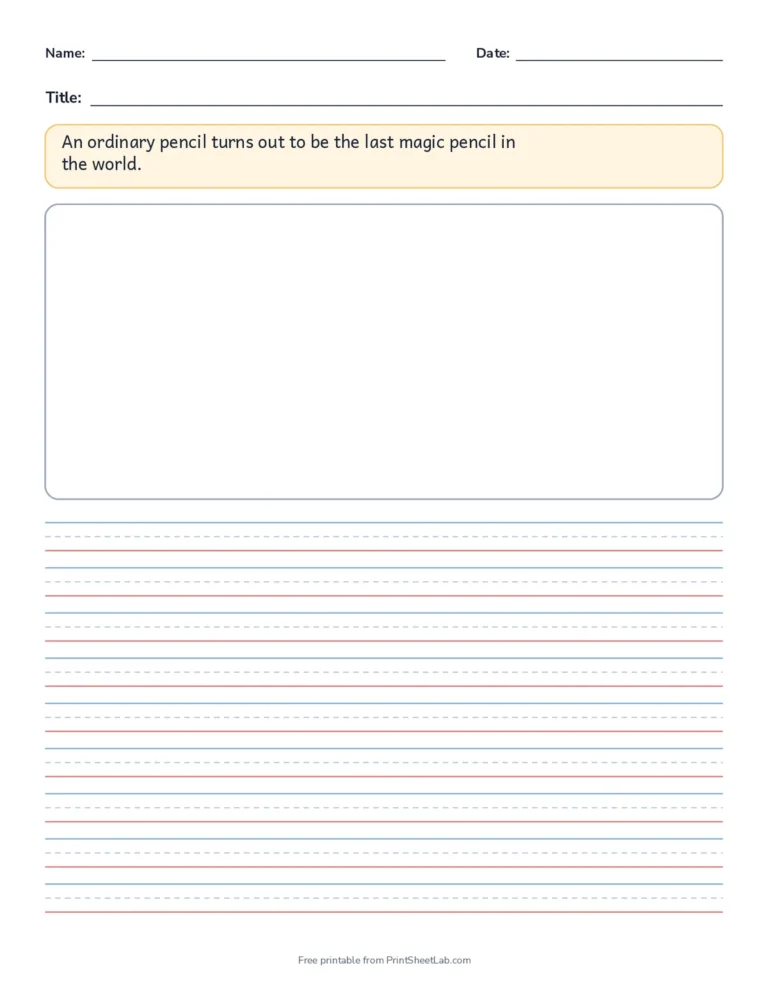
Yes. Choose prompts for ages 5 to 8 or 8 to 11 and print several pages: each page gets a different prompt. Press New prompts for another mix, or type your own prompt.
Can I print story paper without a prompt?
Yes. Set the writing prompt to No prompt for a plain page with a title line.
What size lines are best for kindergarten?
Most kindergarten children do best with 1 inch or 3/4 inch rows. Move to 5/8 inch rows in first grade as handwriting gets smaller and neater.
How do I make an acrostic poem?
Choose Acrostic poem and type a word. Each letter appears down the left side in color, and children write a word or sentence that starts with that letter and describes the topic.
Is this story paper free?
Yes. You can print every story paper page, prompt and template free of charge, as many times as you need, with no login.
More reading and writing generators
- Grammar worksheets for nouns, verbs and punctuation.
- Word family and CVC worksheets.
- Spelling worksheet generator.
- Handwriting paper for kindergarten.
- All reading and writing worksheets.