Change the numbers, layout and number of problems, then download a new PDF with its answer key.
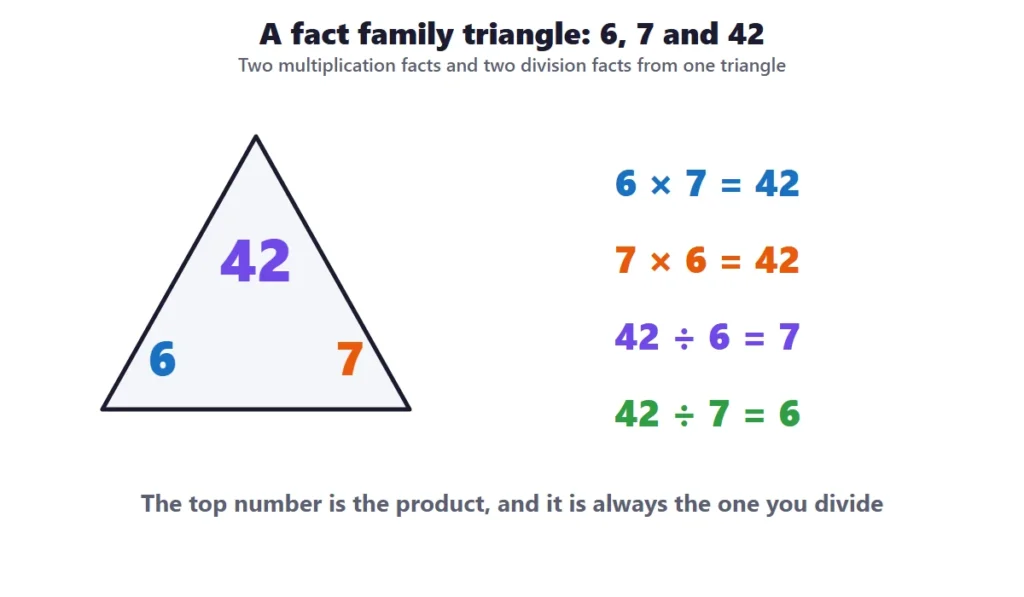
Fact family. 6, 7 and 42.
Quick answer: Division facts to 100 are the division facts that match the multiplication facts up to 9 × 9, such as 72 ÷ 8 = 9. This page has 10 free printable division facts worksheets with answer keys for grade 3. Updated October 2026.
About these division facts worksheets
Every division fact comes from a multiplication fact: 6 × 7 = 42 gives 42 ÷ 6 = 7 and 42 ÷ 7 = 6. By the end of grade 3, children are expected to divide within 100 fluently and know the facts from memory (Common Core 3.OA.C.7). The worksheets use divisors and answers from 1 to 10.
The best strategy: think multiplication
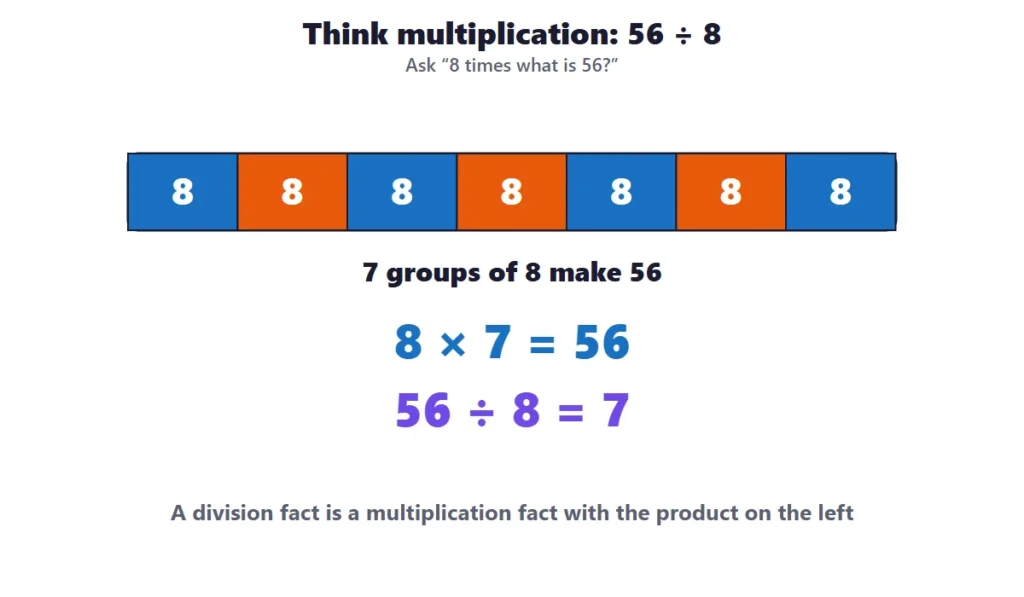
To solve 56 ÷ 8, ask “8 times what is 56?” A child who knows 8 × 7 = 56 has the answer. That is why the fact family sheet is on this page: it practices both directions at once.
What is on this page
Division facts, a harder set without ÷ 1 and ÷ 10, and missing number problems.
Fact family triangles for multiplication and division.
A caterpillar, a color-by-quotient picture, a riddle, match-up cards and bingo.
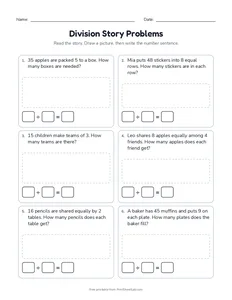
Story problems about sharing and grouping.
Division facts to 100 worksheets: what is in the set
There are 10 division facts to 100 worksheets on this page, and every one has an answer key except for any cut-out games. The first three sets are facts and missing numbers, the next ones use fact family triangles and puzzles, and the last has story problems.
Worksheet
What children do
Standard
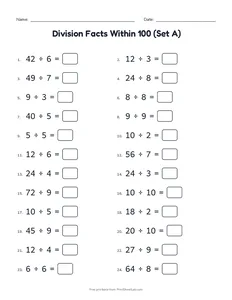
Division Facts Within 100 (Set A)
24 facts with divisors and answers from 1 to 10.
3.OA.C.7
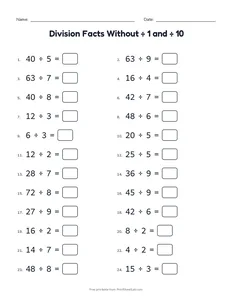
Division Facts Without ÷ 1 and ÷ 10
24 facts using divisors and answers from 2 to 9.
3.OA.C.7
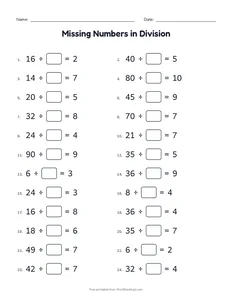
Missing Numbers in Division
Find the missing divisor: 42 ÷ ☐ = 7.
3.OA.C.7
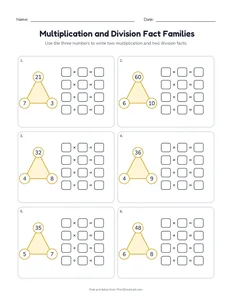
Multiplication and Division Fact Families
Write two multiplication and two division facts for each triangle.
3.OA.C.7
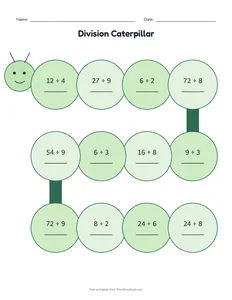
Division Caterpillar
Solve 12 division facts along the caterpillar.
3.OA.C.7
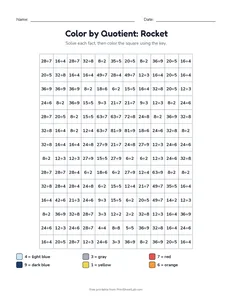
Color by Quotient: Rocket
Solve each fact and color by the key to reveal a rocket.
3.OA.C.7
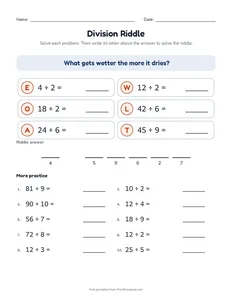
Division Riddle
Solve the facts to decode a riddle.
3.OA.C.7
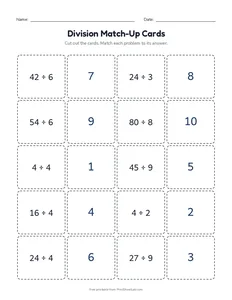
Division Match-Up Cards
Match 10 division facts to their answers.
3.OA.C.7
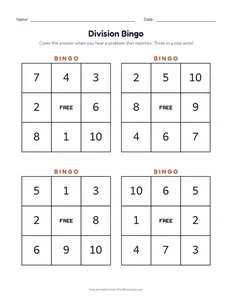
Division Bingo
Bingo boards and calling cards with division facts.
3.OA.C.7
Division Story Problems
Six sharing and grouping stories within 100.
3.OA.C.7
Division facts to 100: how many facts are there?
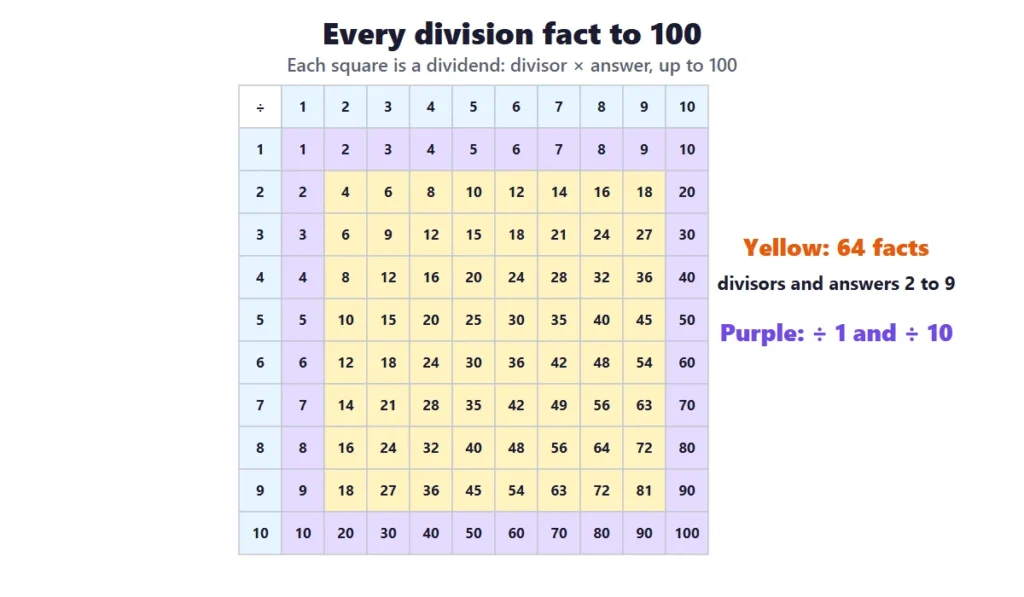
The facts in division facts to 100 use divisors and quotients from 1 to 10, so there are 100 facts in all. The two easy cases, dividing by 1 and by 10, take away 36 of them, and the 64 that are left have divisors and answers from 2 to 9. This table counts the facts:
Division facts worksheets: the 64 facts by divisor
Division facts worksheets are easier to plan when the facts are grouped by divisor. Each divisor from 2 to 9 has 8 facts, and the dividends are the multiples of the divisor from 2 times to 9 times. This table lists all 64:
Divisor
Dividends in the 64 facts
Quotients
2
4, 6, 8, 10, 12, 14, 16, 18
2 to 9
3
6, 9, 12, 15, 18, 21, 24, 27
2 to 9
4
8, 12, 16, 20, 24, 28, 32, 36
2 to 9
5
10, 15, 20, 25, 30, 35, 40, 45
2 to 9
6
12, 18, 24, 30, 36, 42, 48, 54
2 to 9
7
14, 21, 28, 35, 42, 49, 56, 63
2 to 9
8
16, 24, 32, 40, 48, 56, 64, 72
2 to 9
9
18, 27, 36, 45, 54, 63, 72, 81
2 to 9
Division worksheets grade 3: fact families
Division worksheets grade 3 use fact families, because every multiplication fact gives two division facts. For example, 6 × 7 = 42 gives 42 ÷ 6 = 7 and 42 ÷ 7 = 6. There are 36 different triangles with factors from 2 to 9, which is 28 with two different factors, and 8 squares. The 28 give 2 division facts each, and the 8 squares give only 1, so 28 × 2 + 8 = 64 facts. The squares are:
Square number
Division fact
Facts in the family
Why
4
4 ÷ 2 = 2
2
both factors are the same
9
9 ÷ 3 = 3
2
both factors are the same
16
16 ÷ 4 = 4
2
both factors are the same
25
25 ÷ 5 = 5
2
both factors are the same
36
36 ÷ 6 = 6
2
both factors are the same
49
49 ÷ 7 = 7
2
both factors are the same
64
64 ÷ 8 = 8
2
both factors are the same
81
81 ÷ 9 = 9
2
both factors are the same
Basic division worksheets: which dividends come up most?
Some dividends appear in many facts, so they are worth knowing well. Of the 64 division facts, the dividends 12, 18 and 24 each appear in 4 of them, and 16 and 36 appear in 3. This table shows the eight dividends that appear most often:
Facts table. 64 facts shaded.
Dividend
Division facts that have it
The facts
12
4
12 ÷ 2, 12 ÷ 3, 12 ÷ 4, 12 ÷ 6
18
4
18 ÷ 2, 18 ÷ 3, 18 ÷ 6, 18 ÷ 9
24
4
24 ÷ 3, 24 ÷ 4, 24 ÷ 6, 24 ÷ 8
16
3
16 ÷ 2, 16 ÷ 4, 16 ÷ 8
36
3
36 ÷ 4, 36 ÷ 6, 36 ÷ 9
6
2
6 ÷ 2, 6 ÷ 3
8
2
8 ÷ 2, 8 ÷ 4
10
2
10 ÷ 2, 10 ÷ 5
For example, 24 ÷ 3, 24 ÷ 4, 24 ÷ 6 and 24 ÷ 8 give the answers 8, 6, 4 and 3. Children who know all the pairs for 24 know four facts at once, and the same is true for 12 and 18. Teaching the dividends that appear most often first is an efficient way to learn the facts.
Division facts within 100: divisibility rules
When children know the divisibility rules, they can tell at a glance whether a division will have no remainder. The rules also help to check an answer. This table shows six rules, with the number of numbers from 1 to 100 that fit each rule. Wikipedia’s article on divisibility rules has more rules:
Divisible by
Rule
How many of 1 to 100
Example
2
the last digit is 0, 2, 4, 6 or 8
50
48
3
the digits add up to a multiple of 3
33
57 (5 + 7 = 12)
5
the last digit is 0 or 5
20
65
6
divisible by both 2 and 3
16
84
9
the digits add up to a multiple of 9
11
72 (7 + 2 = 9)
10
the last digit is 0
10
90
Division drills: tricks for each divisor
Division drills are faster when children have a trick for each divisor. These six tricks are used by many teachers, and each one is a way to turn division into something the child already knows:
Divide by
Trick
Example
÷ 2
halve the number
48 ÷ 2 = 24
÷ 4
halve twice
36 ÷ 4: 36 → 18 → 9
÷ 5
divide by 10, then double
45 ÷ 5: 4.5 × 2 = 9
÷ 8
halve three times
64 ÷ 8: 64 → 32 → 16 → 8
÷ 9
the digits of the answer ones add up to 9 (up to 9 × 9)
72 ÷ 9 = 8
÷ 10
drop the zero
70 ÷ 10 = 7
The tricks for 4 and 8 use halving, which is why the doubles and near doubles page is a good start. At 4 seconds a fact, the drills on this page take:
Practice
Facts
Seconds a fact
Time to allow
12-fact caterpillar
12
4
48 seconds
24-fact worksheet
24
4
1 minute 36 seconds
Mixed set of 40
40
4
2 minutes 40 seconds
Common mistakes with division facts to 100
Most mistakes come from confusing two multiplication facts that are close together. This table shows five of them, with the reason and the fix:
Mistake
Why
The fix
56 ÷ 8 = 6
confuses 8 × 6 = 48 with 8 × 7 = 56
think “8 times what is 56?”
42 ÷ 7 = 7
uses the square 7 × 7
say 6 × 7 = 42, so 42 ÷ 7 = 6
54 ÷ 6 = 8
confuses 6 × 8 = 48 and 6 × 9 = 54
count up the 6s: 6, 12, 18, 24, 30, 36, 42, 48, 54
0 ÷ 5 = 5
thinks zero divided is the number
0 ÷ 5 = 0 because 5 × 0 = 0
7 ÷ 1 = 1
thinks dividing by one gives one
dividing by 1 gives the same number
Division facts to 100 word problems
Story problems show where division facts to 100 are used. Ask children to write the division first, and to check the answer with multiplication:
Word problem
Working
Answer
There are 56 chairs in 8 equal rows. How many chairs are in each row?
56 ÷ 8
7 chairs
A class of 42 children makes teams of 6. How many teams are there?
42 ÷ 6
7 teams
A baker puts 72 rolls in boxes of 9. How many boxes does he fill?
72 ÷ 9
8 boxes
63 stickers are shared equally among 7 friends. How many does each get?
63 ÷ 7
9 stickers
A string of 48 beads is cut into 6 equal parts. How long is each part?
48 ÷ 6
8 beads
A book has 81 pages and Mia reads 9 pages a day. How many days will she take?
81 ÷ 9
9 days
Games and activities for division facts to 100
Children learn division facts to 100 best when they play with it. These games use things that are found at home or in a classroom:
Fact family dominoes: match a division fact with its multiplication fact
Division bingo: the worksheet pack has boards and calling cards with the facts
Beat the clock: solve 12 facts in under a minute, and try to beat your time
Missing number cards: turn over a card, and find the divisor that is missing
Think multiplication: say “six times what is 42?” before every answer
Fact family triangle: cover one corner of a triangle and ask for the missing number
Extra support and extra challenge with division facts to 100
For children who need more support: go back to equal groups and arrays, and work with the 2, 5 and 10 facts first. Use the fact family triangle to show that division is the reverse of multiplication. Practice a few facts a day and do not time the child until the facts are secure.
For children who need more challenge: ask for all the pairs that make 36 or 48, to find the missing divisor in 63 ÷ ☐ = 9 and to make up a story problem. The missing number worksheet and the riddle are both good challenges.
How to tell that a child is ready to move on from division facts to 100
The child answers division facts by thinking of the multiplication fact.
The child knows the squares from 4 to 81.
The child writes the four facts of a fact family.
The child answers 24 facts in about two minutes with at least 90% right.
A short lesson is the best way to introduce division facts to 100. This 20-minute plan can be used in a classroom, at a tutoring session or at home, and it uses the worksheets at the end:
Minutes
Activity
What to say or ask
0 to 3
Draw a fact family triangle with 6, 7 and 42
What are the four facts? Which is the biggest number?
3 to 8
Ask “8 times what is 56?” for four facts
How do you know the answer?
8 to 13
Practice the facts with 6, 7 and 8 using skip counting
Count in 7s up to 56.
13 to 18
Do the missing number worksheet together
Which number is missing, the divisor or the answer?
18 to 20
Start the fact worksheet and check one answer
Check with multiplication.
Where division facts to 100 fits across the grades
No skill stands alone. This table shows what children learn before and after division facts to 100, with the standard that goes with each step:
This page is the center of grade 3. The whole sequence is on the division worksheets page.
Helping at home with division facts to 100
Parents do not need to be experts to help with division facts to 100. These suggestions work well, and each takes only a few minutes:
Practice five facts a day at a fixed time, such as at breakfast.
Ask “how many 6s in 42?” while counting out cookies or chairs.
Use a deck of cards to make fact families: pick two cards and say all four facts.
Celebrate the facts the child knows, and write down the ones that need practice.
Use the answer key, and let the child check by multiplying.
How to check progress in division facts to 100
A teacher or parent can check progress with the answer key and a few questions. This table shows three common situations, what they mean and what to do next:
What you see
What it means
What to do next
The child knows the 2, 5 and 10 facts but not 6, 7 and 8
The facts with 6, 7 and 8 are the hardest for most children
Practice them with fact families and skip counting
The child gets 9 of 10 right in every set
The skill is secure
Move on to the facts to 144
The child divides by counting down
The child has not yet linked division to multiplication
Use the triangle, and say “think multiplication”
A five-day plan for division facts to 100
Most children need about a week of short sessions for division facts to 100. This plan follows the order of the worksheets on this page:
Basic division worksheets, division facts and division practice
This page is also searched as basic division worksheets, a basic division worksheet, division facts, division facts worksheets, a division facts worksheet, a division fact sheet, division practice, division practice worksheets, division fact practice, dividing facts, dividing worksheets and printable division pages. All are the free PDFs above, each with an answer key. Printable division pages work best in short sessions: do a few facts every day instead of a whole page once a week.
Division drills, division tests and timed division practice
A division test or a division timed test is useful only after children know the facts, so start with untimed sheets and then time a few. A common classroom goal, rather than a rule, is to answer a division fact in a few seconds. This table turns that into a plan for 20 facts:
Level
Time for 20 facts
About how long per fact
Learning the facts
5 to 10 minutes
15 to 30 seconds
Getting faster
3 to 4 minutes
9 to 12 seconds
Fluent
1 to 2 minutes
3 to 6 seconds
Keep timed division practice short, and stop if it causes stress. Remember that division facts are the multiplication facts in reverse, so practicing multiplication facts helps too.
Frequently asked questions
7 quick answers
What is a quotient?
The quotient is the answer to a division. In 42 ÷ 6 = 7, 42 is the dividend, 6 is the divisor and 7 is the quotient.
Can you divide by zero?
No. Division by zero has no answer, so no problem on these worksheets divides by 0.
Do the worksheets have answer keys?
Yes, on the last page of every PDF except the cut-out games.
How many division facts are there to learn?
There are 100 facts with divisors and answers from 1 to 10, and 64 of them have divisors and answers from 2 to 9. Dividing by 1 and by 10 is easy, so the 64 are the ones that need practice.
What is the best way to learn the division facts?
Learn them together with the multiplication facts, as fact families. A child who knows that 6 × 7 = 42 also knows 42 ÷ 6 and 42 ÷ 7, so each multiplication fact gives two division facts.
Why is zero divided by a number zero?
Because 5 × 0 = 0, so 0 ÷ 5 = 0. Dividing zero into groups gives no objects in each group. Dividing a number by zero has no answer, so the worksheets never ask for it.
Where can I download free division facts worksheets?
Open any worksheet in the gallery above, choose US Letter or A4, then print or save the PDF. They are free and each has an answer key.