Change the numbers, layout and number of problems, then download a new PDF with its answer key.
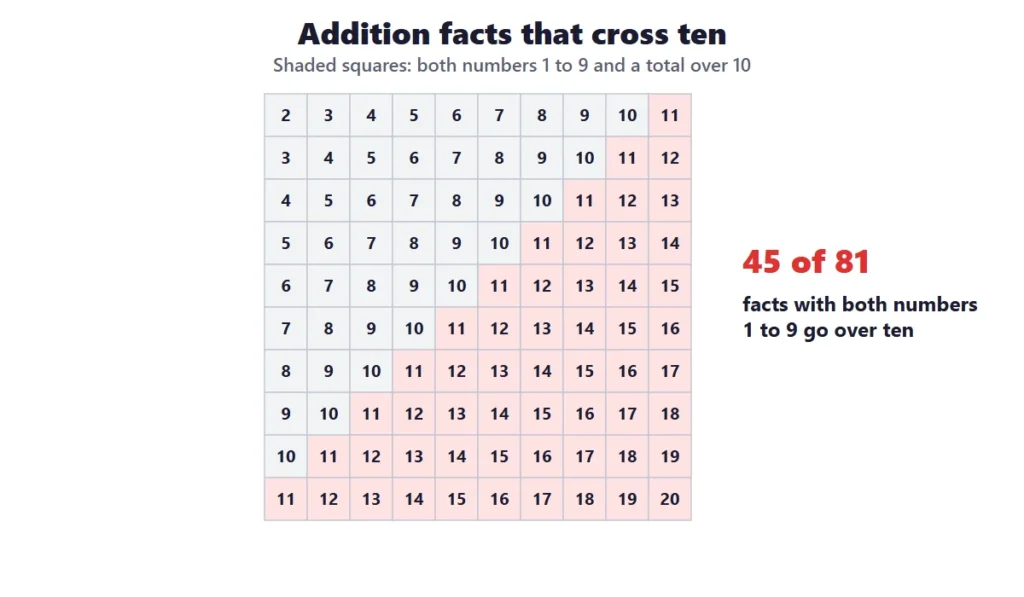
Facts that cross ten. 45 of 81 facts.
Quick answer: Addition within 20 means adding two numbers whose sum is 20 or less, such as 8 + 7 = 15. This page has 13 free printable addition within 20 worksheets with answer keys for grades 1 and 2. Updated October 2026.
About these addition within 20 worksheets
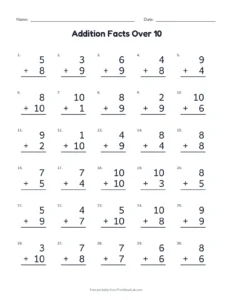
Once children are comfortable adding within 10, the next goal is every fact up to 10 + 10. These worksheets use addends from 0 to 10 and sums up to 20, the facts that children in the US are expected to know from memory by the end of grade 2.
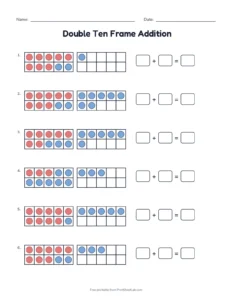
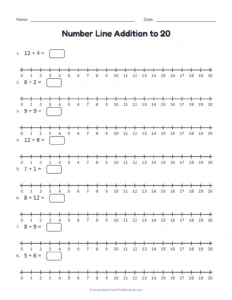
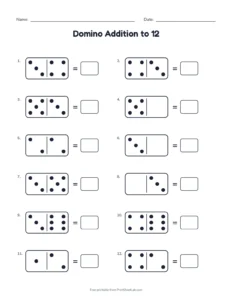
Facts over 10 are easier with a strategy, so the sheets mix visual models with fact practice: double ten frames show “make 10 and some more”, number lines to 20 show counting on, and dominoes and dice make doubles easy to spot.
Strategies for facts to 20
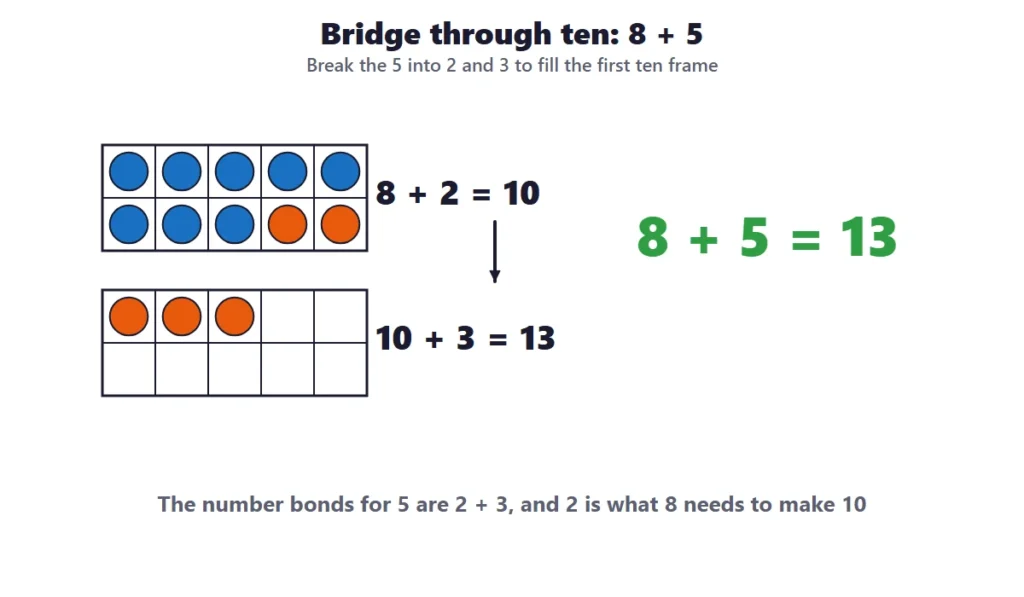
Make 10: 8 + 5 is 8 + 2 + 3, which is 10 + 3 = 13.
Doubles: 6 + 6 = 12, so 6 + 7 is one more, 13. See the doubles worksheets.
Turn it around: 2 + 9 is the same as 9 + 2, and counting on from 9 is quicker.
Adding 10: 10 + 6 = 16, the tens digit becomes 1.
Using the worksheets
Start with double ten frames and number lines so children see the totals.
Move to fact practice pages, first untimed, then as a short daily warm-up.
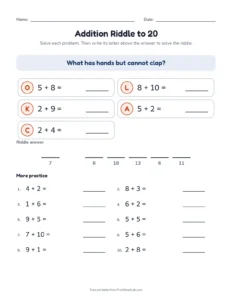
Use the mystery picture, riddle and bingo for review days.
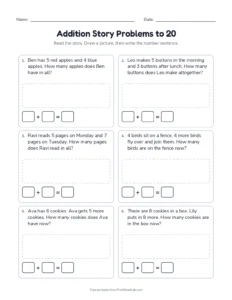
Finish with story problems to connect the facts to real situations.
Addition within 20 worksheets: what is in the set
There are 13 addition within 20 worksheets on this page, and every one has an answer key except for the bingo cards. They begin with models that show the totals, and end with fact practice and story problems:
Worksheet
What children do
Standard
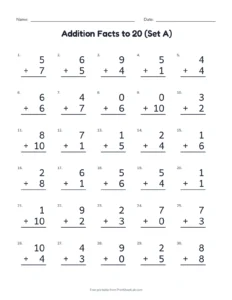
Addition Facts to 20 (Set A)
30 vertical addition facts with addends up to 10.
1.OA.C.6
Addition Facts to 20 (Set B)
Another 30 facts with sums up to 20.
1.OA.C.6
Double Ten Frame Addition
Two ten frames show sums from 11 to 20; write the number sentence.
1.OA.C.6
Number Line Addition to 20
Hop forward on a number line from 0 to 20.
1.OA.C.6
Domino Addition to 12
Add the dots on dominoes with up to 6 on each side.
1.OA.C.6
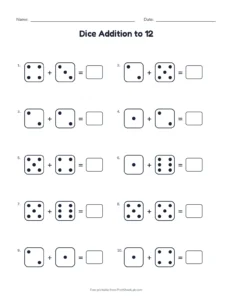
Dice Addition to 12
Add two dice and write the sum.
1.OA.C.6
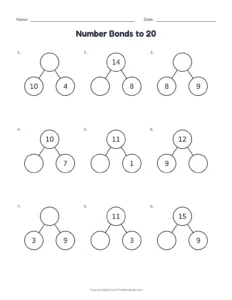
Number Bonds to 20
Find the missing part or whole in number bonds up to 20.
1.OA.C.6
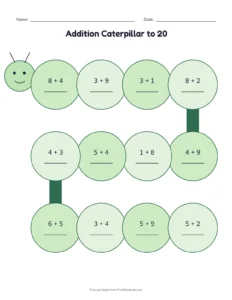
Addition Caterpillar to 20
Solve 12 facts along the caterpillar.
1.OA.C.6
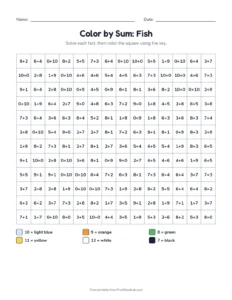
Color by Sum: Fish
Solve the facts and color by the key to reveal a fish.
1.OA.C.6
Addition Riddle to 20
Solve the facts to decode a riddle answer.
1.OA.C.6
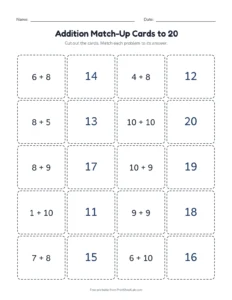
Addition Match-Up Cards to 20
Match 10 facts to their sums.
1.OA.C.6
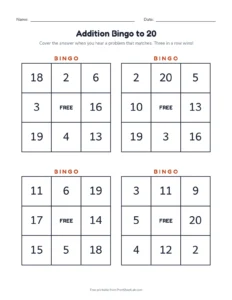
Addition Bingo to 20
Bingo boards and calling cards with sums up to 20.
1.OA.C.6
Addition Story Problems to 20
Six story problems with sums up to 20.
1.OA.C.6
Addition within 20: how many facts are there?
The facts in addition within 20 use two addends from 0 to 10, so there are 121 ordered facts and 66 different ones. Of the 66 different facts, 36 have a sum of 10 or less, and 30 cross ten. These 30 are the new facts that children learn in addition within 20, and this table shows them by sum:
Addition facts to 20: which strategy for which fact?
Every one of the 30 facts that cross ten can be solved with one of five strategies. This table assigns each fact to the first strategy that applies, in the order shown, so a child knows what to try first:
Strategy
Facts that cross ten
How it works
Examples
Add 10
10
the tens digit becomes 1 and the ones digit stays
1 + 10, 2 + 10, 3 + 10, 4 + 10, 5 + 10, …
Doubles
4
know the double
6 + 6, 7 + 7, 8 + 8, 9 + 9
Near doubles
4
double the smaller number and add 1
5 + 6, 6 + 7, 7 + 8, 8 + 9
Add 10, take 1
6
9 is one less than 10
2 + 9, 3 + 9, 4 + 9, 5 + 9, 6 + 9, …
Make 10
6
split the smaller number to fill a ten first
3 + 8, 4 + 7, 4 + 8, 5 + 7, 5 + 8, …
Because the strategies cover every fact, there is no need to count. The doubles and near doubles page has worksheets for the doubles and near doubles, and the making 10 page has the make-ten facts.
Sums to 20 worksheets: 12 facts with a strategy
These 12 facts are a sample of the facts that cross ten, with the strategy that works best and the working. Children can cover the last two columns and try to name the strategy first:
Bridge through ten. 8 + 5 = 13.
Fact
Best strategy
Working
Answer
5 + 8
Make 10
8 + 2 = 10, then 10 + 3 = 13
13
5 + 7
Make 10
7 + 3 = 10, then 10 + 2 = 12
12
4 + 7
Make 10
7 + 3 = 10, then 10 + 1 = 11
11
2 + 9
Add 10, take 1
10 + 2 = 12, and one less is 11
11
8 + 9
Near doubles
8 + 8 = 16, and one more is 17
17
5 + 10
Add 10
10 + 5 = 15
15
6 + 6
Doubles
6 + 6 = 12
12
6 + 10
Add 10
10 + 6 = 16
16
3 + 10
Add 10
10 + 3 = 13
13
2 + 10
Add 10
10 + 2 = 12
12
4 + 9
Add 10, take 1
10 + 4 = 14, and one less is 13
13
7 + 9
Add 10, take 1
10 + 7 = 17, and one less is 16
16
Addition facts to 20: adding 9
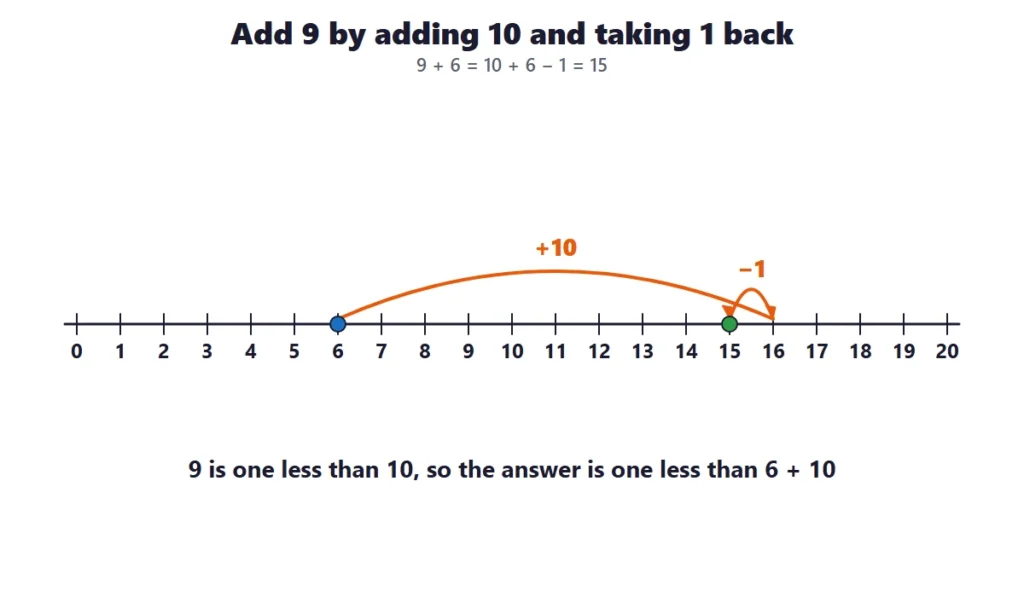
Facts with a 9 are the easiest to turn into a 10. Add 10 instead, and take 1 back. The table shows eight facts with a 9, and the number line diagram above shows 9 + 6:
Fact
Add 10
Take 1 back
Answer
9 + 2
10 + 2 = 12
12 − 1
11
9 + 3
10 + 3 = 13
13 − 1
12
9 + 4
10 + 4 = 14
14 − 1
13
9 + 5
10 + 5 = 15
15 − 1
14
9 + 6
10 + 6 = 16
16 − 1
15
9 + 7
10 + 7 = 17
17 − 1
16
9 + 8
10 + 8 = 18
18 − 1
17
9 + 9
10 + 9 = 19
19 − 1
18
Number bonds for addition within 20
Number bonds help children to see addition within 20 as the splitting of a number into two parts. For totals over 10, both parts must be 10 or less, so there are fewer bonds than for totals within 10. This table shows six totals, with the bonds that use two parts from 0 to 10:
Number
Number bonds with both parts 10 or less
Different bonds
11
1 + 10, 2 + 9, 3 + 8, 4 + 7, 5 + 6
5
12
2 + 10, 3 + 9, 4 + 8, 5 + 7
5
14
4 + 10, 5 + 9
4
15
5 + 10
3
17
2
20
1
For example, 12 has only 5 different bonds with both parts 10 or less (2 + 10, 3 + 9, 4 + 8, 5 + 7 and 6 + 6), and 20 has just one (10 + 10). The number bond worksheets to 20 ask children to find the missing part of a bond like this.
Adding 10 to a number: the easiest facts in addition within 20
Some of the facts in addition within 20 are not hard at all. When one of the numbers is 10, the answer is a teen number, and the tens digit is 1. Children should know these facts first, since they use place value and not counting:
Add 10 to
Answer
Pattern
3
13
the tens digit goes up by 1
6
16
the tens digit goes up by 1
9
19
the tens digit goes up by 1
14
24
the tens digit goes up by 1
17
27
the tens digit goes up by 1
The same idea is the basis for adding 9 and for the make-ten strategy, which is why the sheets with 10 + n are at the start of the fact practice pages.
Addition within 20 with dominoes and dice
The domino and dice worksheets stop at 12, because a double-six domino set and two dice cannot give a bigger sum. This table shows how many dominoes and how many dice rolls give each sum:
Sum
Dominoes with that sum (double-six set)
Ways to roll it with two dice
0
1
0
1
1
0
2
2
1
3
2
2
4
3
3
5
3
4
6
4
5
7
3
6
8
3
5
9
2
4
10
2
3
11
1
2
12
1
1
Common mistakes with addition within 20
When a fact crosses ten, children make mistakes that they do not make within 10. This table shows what the wrong answers look like for five facts:
Fact
Correct answer
Counted on from the wrong number
Forgot to add the leftover
Wrote the ten only
8 + 5
13
12
10
10
9 + 6
15
14
10
10
7 + 6
13
12
10
10
8 + 7
15
14
10
10
9 + 9
18
17
10
10
A child who writes 10 for 8 + 5 has made the ten but forgotten to add the leftover 3, and a child who counts on from the wrong number is usually one too small. Double ten frames show both mistakes clearly.
Addition within 20 story problems
Story problems show how addition within 20 is used. Ask children to draw the story first, then to write the number sentence and say the answer:
Word problem
Number sentence
Answer
Leo has 8 marbles and finds 5 more. How many marbles does he have?
8 + 5 = ?
13 marbles
There are 9 ducks in a pond and 6 more join them. How many ducks are there?
9 + 6 = ?
15 ducks
Mia has 7 red balloons and 6 blue balloons. How many balloons does she have?
7 + 6 = ?
13 balloons
A shelf has 8 books and a box has 7 books. How many books are there?
8 + 7 = ?
15 books
Ana picks 9 apples and 9 pears. How many pieces of fruit does she pick?
9 + 9 = ?
18 pieces of fruit
A team scores 6 goals in one game and 8 in another. How many goals is that?
6 + 8 = ?
14 goals
Addition worksheets grade 1: how addition within 20 fits the year
Addition worksheets grade 1 are mostly about addition within 20, and the standard for the year is to add and subtract within 20 using strategies (1.OA.C.6). A typical school year has children finish addition within 10 in the first months, spend the middle of the year on facts that cross ten, and end with addition within 100. The 13 worksheets on this page cover the middle part, so they suit children from about the middle of grade 1 to the start of grade 2.
Add 9. Add 10, take 1.
First grade addition: games and activities for addition within 20
First grade addition is a good time for games, since children are motivated by play. These activities practice the facts that cross ten:
Double dice: roll two dice, add them, and then add 10 to make a fact within 20. For example, 4 + 3 + 10 = 17.
Make-ten cards: deal two cards from a pack of the numbers 1 to 9. The player who can say the sum fastest, using make ten, takes both cards.
Ten-frame race: two players fill ten frames with counters, and the first to say the total of both frames wins the round.
Number line hop: draw a number line to 20 on the floor and let children hop forward by the second number.
Bingo to 20: the worksheet pack has bingo boards and calling cards for a whole class.
Support and challenge for addition within 20
For children who need more support: stay with addition within 10 until it is secure, then add 10 + n facts, which are easy, before the other facts. Use two ten frames, and let the child move the counters. Do not rush to timed fact practice.
For children who need more challenge: ask them to find all the pairs that add up to 17, or to add three numbers to 20. The number bond worksheets to 20 and the story problems both give practice with missing numbers.
How to know that a child has learned addition within 20
The child chooses a strategy, such as making ten or doubles, and does not count on their fingers.
The child can explain how they found 8 + 5.
The child knows all the doubles to 10 + 10.
The child answers about 20 facts in a minute on the fact practice pages, with at least 90% right.
A five-day plan for addition within 20
Most grade 1 children need a week or two of short sessions to become secure in addition within 20. This plan goes from review to the fact practice pages:
Day
What to do
Practice
Day 1
Review addition within 10 and the pairs that make 10
1st grade addition worksheets and first grade addition worksheets
The same pages are searched as addition worksheets for grade 1, first grade addition worksheets, 1st grade addition worksheets, addition worksheets for 1st graders, addition worksheet for grade 1, addition worksheets for grade 1 pdf and addition sheets for 1st grade. All are the free PDFs above, with an answer key on the last page. Parents also ask for adding for 1st graders and addition for 1st grade in general: this is the right page, and the addition hub has the 2nd grade sets.
Addition problems for 1st grade and 1st graders
Addition problems for 1st grade should stay within 20 and use a strategy. Addition problems for 1st graders that use doubles (7 + 7), making ten (9 + 6 is 10 + 5) or counting on are easier to remember than facts learned in order. Use the problem types in the worksheets above, and ask your child to explain how they got each answer.
Frequently asked questions
8 quick answers
How many addition facts are there within 20?
With both numbers from 0 to 10, there are 121 facts, but many are turn-arounds (3 + 8 and 8 + 3), so children really need to learn about 66.
What grade should know addition facts to 20?
Grade 1 adds and subtracts within 20, and by the end of grade 2 children are expected to know all sums of two one-digit numbers from memory.
Do these worksheets have answers?
Yes. Answer keys are on the last page of each PDF, except for the bingo cards, which do not need one.
Can I print on A4?
Yes. Every worksheet has a US Letter and an A4 PDF.
Which addition within 20 facts are the hardest?
Children usually find the facts with 7 and 8 the hardest, such as 8 + 7 and 7 + 6, because they are not doubles and do not have a 9 or a 10. These are the facts to practice with the make-ten strategy.
Is it all right to use fingers for addition within 20?
Fingers work for facts within 10, but they run out for facts within 20. Ten frames and the make-ten strategy replace the fingers, because they use the first ten as a base.
How fast should children know addition facts to 20?
A common goal is about 3 seconds for a fact, which is fast enough to count as recall. The fact practice pages can be timed once a child knows the strategies, and they should start untimed.
Where can I download free 1st grade addition worksheets?
Open any worksheet in the gallery above, choose US Letter or A4, then print or save the PDF. They are free and each has an answer key.