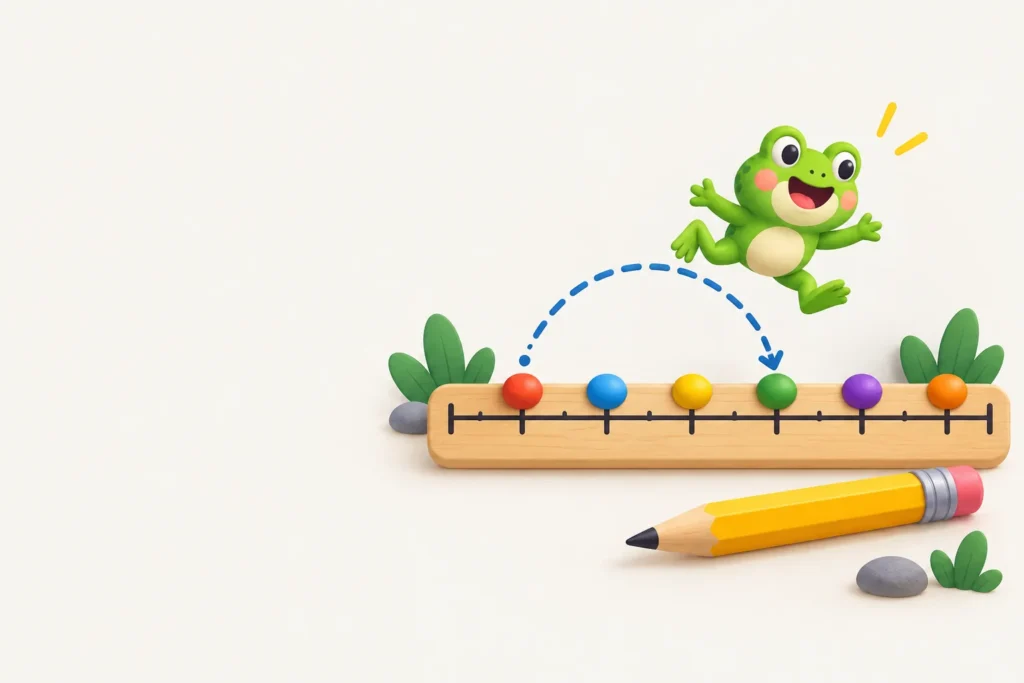
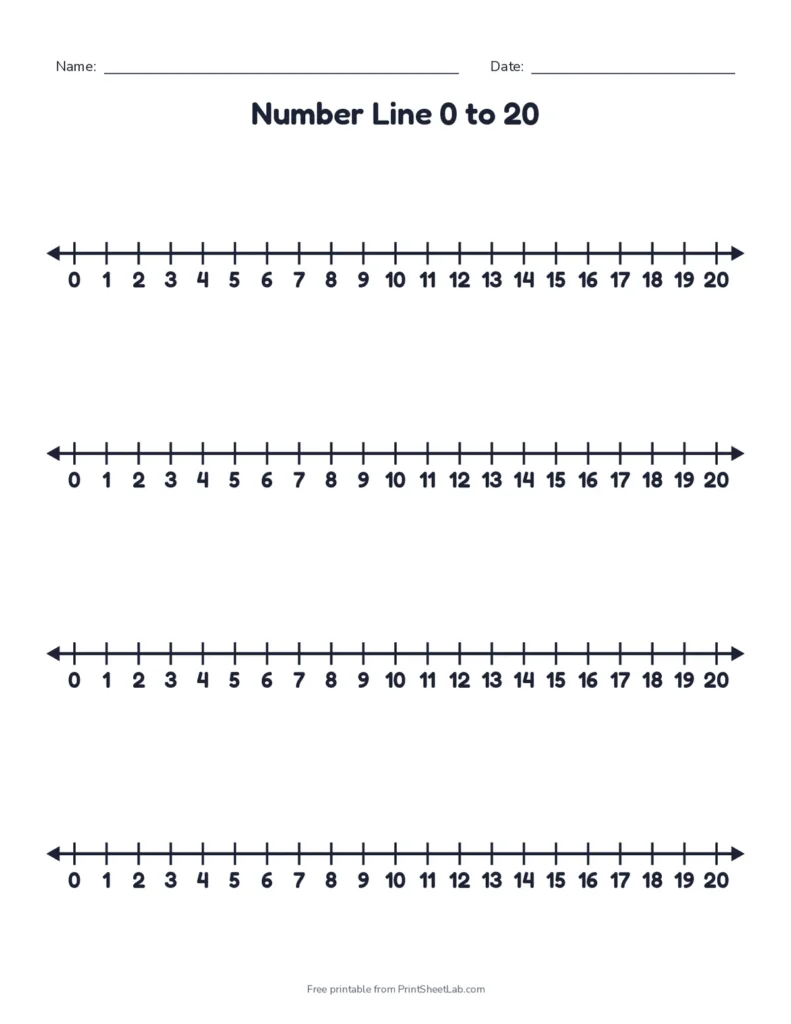
A number line is a straight line with numbers placed at equal distances along it. It is one of the most useful pictures in math: children use it to count, add, subtract, compare numbers, and later to understand negative numbers, fractions and decimals. Use the generator above to print a free printable number line from 0 to 10, 0 to 20 or 0 to 100, a blank number line, a number line with negative numbers, a fraction number line or decimal number line, and addition and subtraction on a number line worksheets with answer keys. Every page prints on US Letter or A4.
Working with negative numbers? Pair these lines with our integer worksheets.
Interactive number line
Meet the frog. Click any number to put the frog there, then press +1, +5, −1 or −5 to make it hop. The number sentence builds itself as it goes. Press New problem for a quick challenge: read the hop, then click the number where the frog lands.
Ready-to-print number lines (PDF)
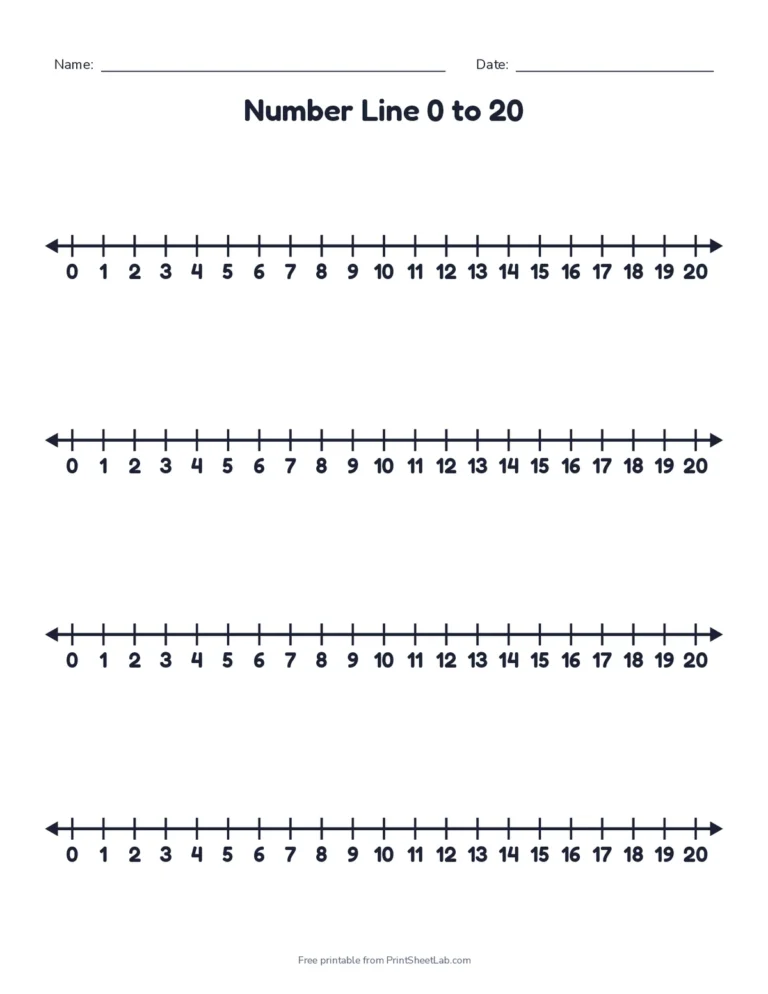
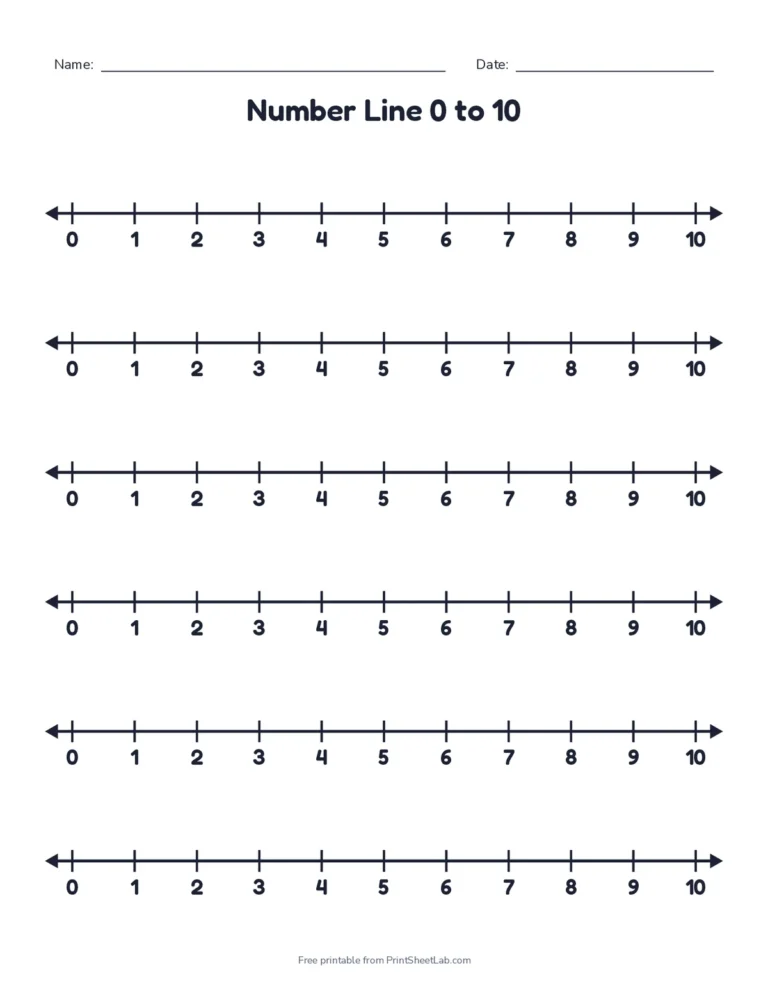
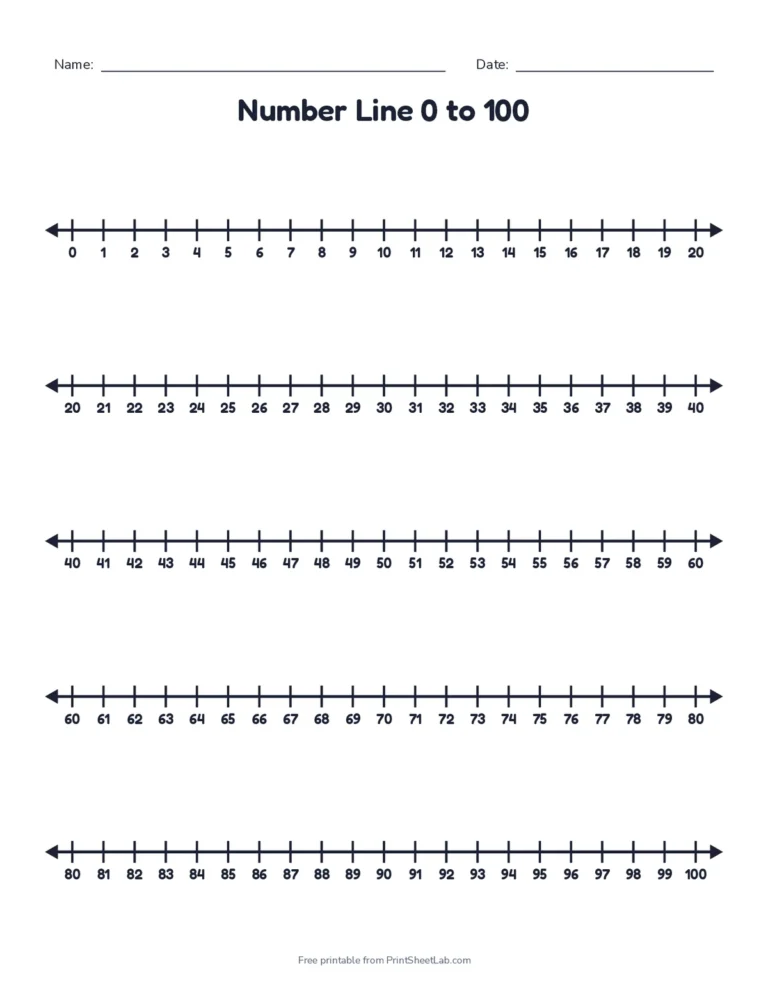
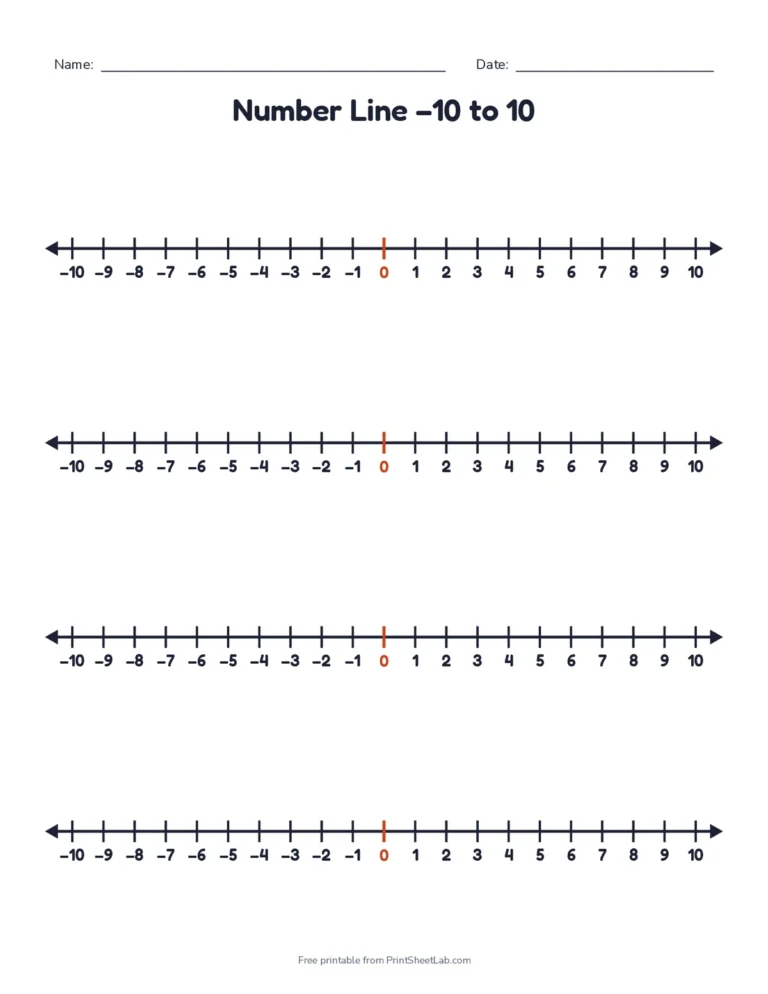
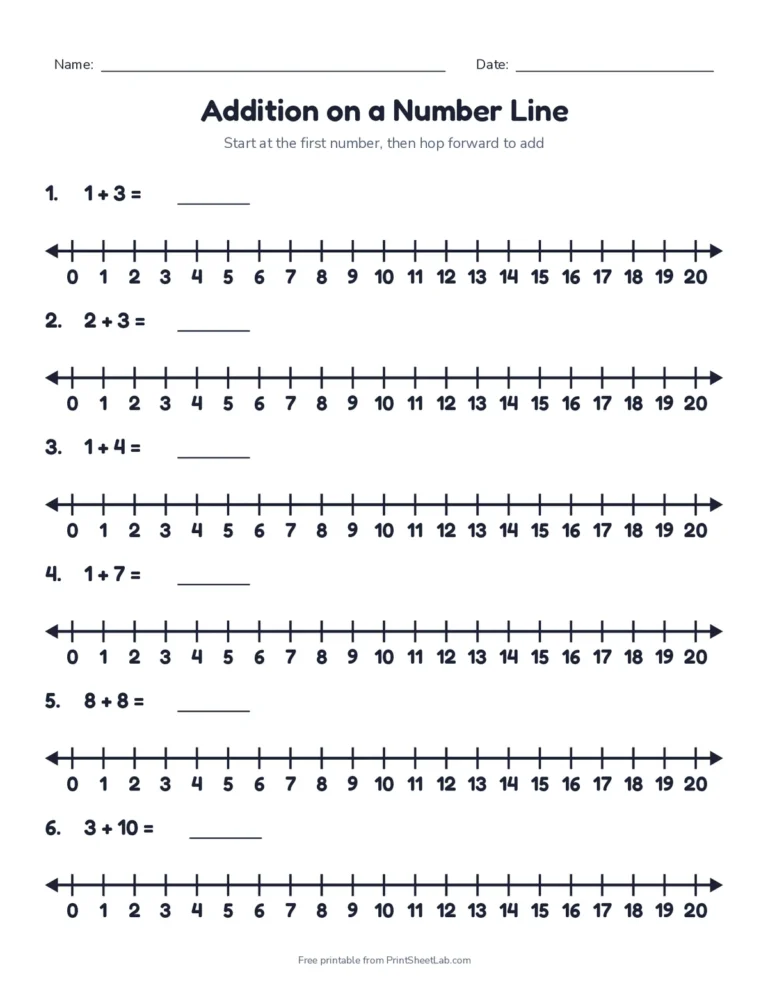
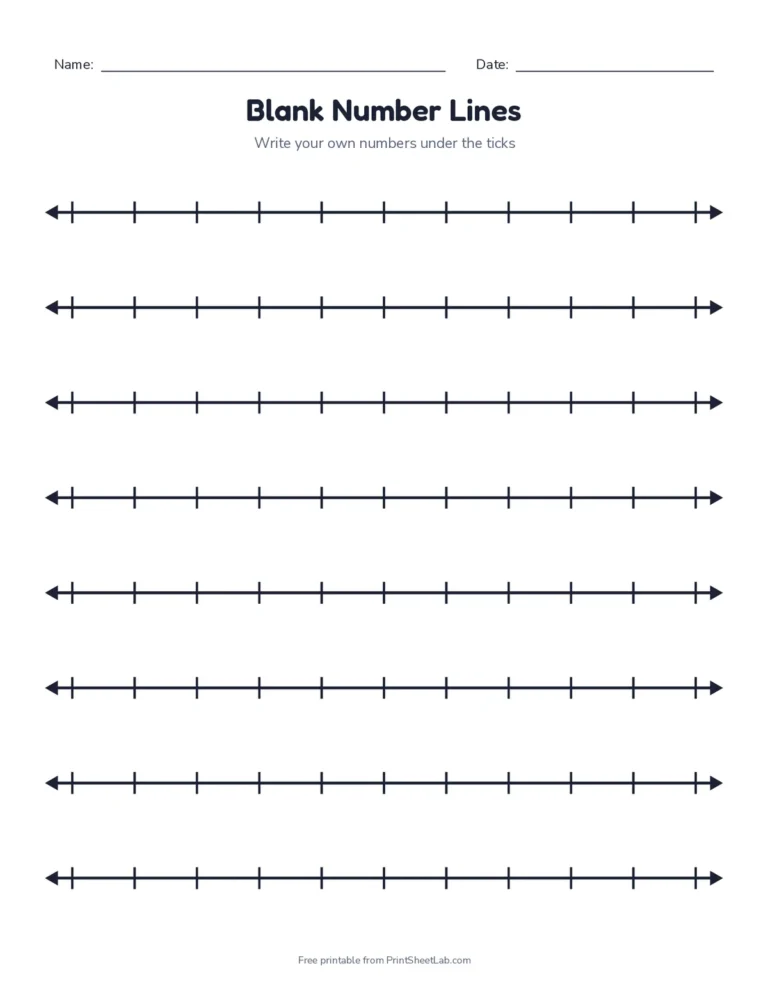
Each number line below is a finished PDF. Use Customize when you need a different range, more lines per page, another font or A4 paper.
How to use a number line
- Numbers get bigger to the right. Every step to the right adds one (or one “count by” step). Every step to the left takes one away.
- To add, start at the first number and hop to the right. For 7 + 5, put your finger on 7 and make 5 hops right. You land on 12, so 7 + 5 = 12.
- To subtract, start at the first number and hop to the left. For 13 − 4, start at 13 and make 4 hops left to land on 9.
- To find the difference, count the hops between two numbers. From 8 to 15 is 7 hops, so 15 − 8 = 7. This “counting up” strategy makes subtraction much easier for many children.
- To compare, look at the position. The number further right is always the greater number: 14 is right of 9, so 14 > 9, and −2 is right of −6, so −2 > −6.
Which printable number line should I use?
| Number line | Best for | Typical grade |
|---|---|---|
| 0 to 10 | Counting, one more and one less, first addition facts | Pre-K and kindergarten |
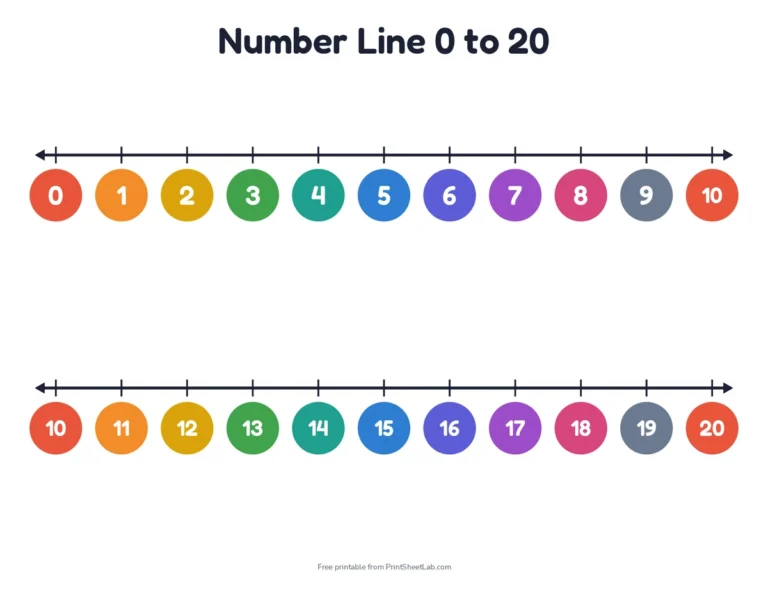
| 0 to 20 | Addition and subtraction within 20, teen numbers, making ten | Kindergarten to grade 1 |
| 0 to 100 | Counting to 100, adding tens, place value, rounding | Grades 1 and 2 |
| 0 to 100 by tens | Skip counting by 10, rounding to the nearest ten, mental math | Grades 2 and 3 |
| Fraction number line | Fractions as numbers, comparing and equivalent fractions | Grades 3 and 4 |
| Decimal number line | Tenths and hundredths, ordering and rounding decimals | Grades 4 and 5 |
| −10 to 10 | Negative numbers, integers, temperature and sea level | Grades 6 and 7 |
Addition and subtraction on a number line
The line turns an abstract sum into a journey you can see. Choose Addition on a number line or Subtraction on a number line in the generator to get a worksheet where every problem has its own line underneath. Children mark the starting number, draw the hops, and write where they land. The answer key draws each hop as an arc, so it doubles as a worked example.
- Start small. Set the numbers to 0 to 10 and the biggest hop to 5 for kindergarten, then move to 0 to 20.
- Turn on “Draw the hops for them” for a gentle first page: the hops are already drawn and children only read where they end.
- Count on from the bigger number. For 3 + 9, it is quicker to start at 9 and hop 3. Talking about why that works builds number sense.
- Make ten. For 8 + 5, hop 2 to reach 10, then 3 more to 13. The ten tick is a natural stopping point on a 0 to 20 line.
- Bigger numbers: on a 0 to 100 line counting by tens, 30 + 40 is four hops of ten.
Negative numbers on a number line
A line with negative numbers extends to the left of zero: −1, −2, −3 and so on. Zero sits in the middle and is printed in orange on our sheets so it is easy to find. Negative numbers are just as far from zero as their positive partners, so −4 and 4 are both four steps away. Turned upright, it works like a thermometer: temperatures below zero are negative, and warming up by 5 degrees is a hop of 5 upward. Print a −20 to 20 integer number line for adding and subtracting integers: adding a negative number means hopping left.
Fraction and decimal number lines
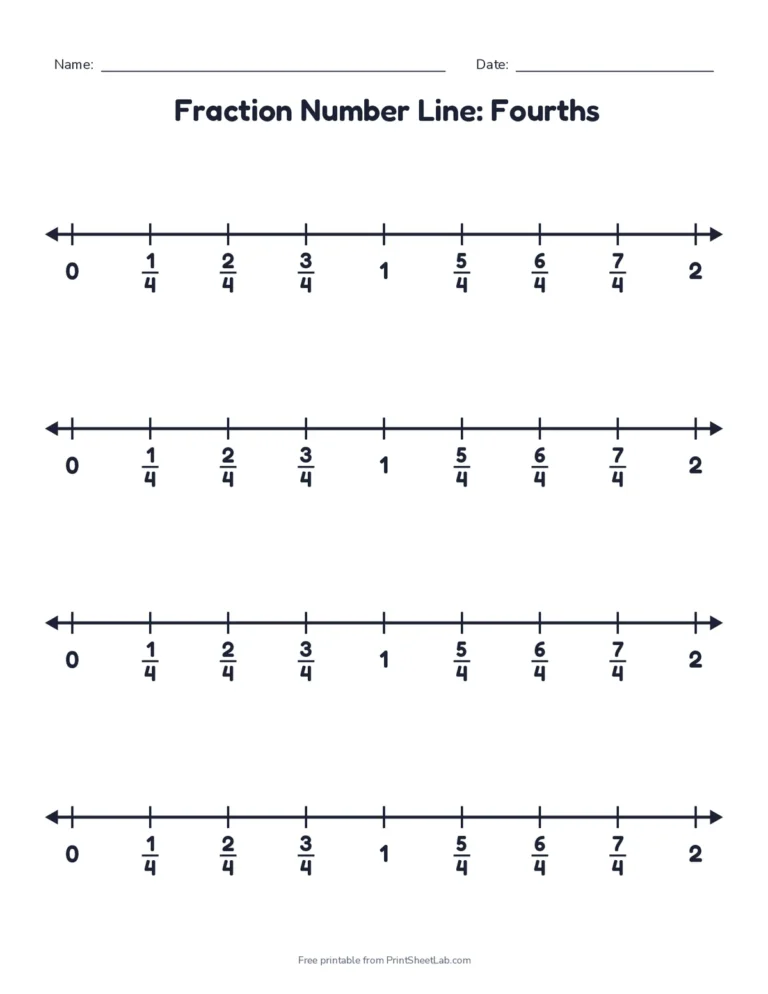
A fraction number line splits each whole into equal parts. On a line of fourths, the ticks between 0 and 1 are 1/4, 2/4 and 3/4, and 4/4 lands exactly on 1. Seeing fractions as points on a line (not only slices of pizza) is a key step in grade 3 and helps children understand that 5/4 is bigger than 1. Choose up to 2 or 3 to include improper fractions, or switch to mixed numbers such as 1 1/4.
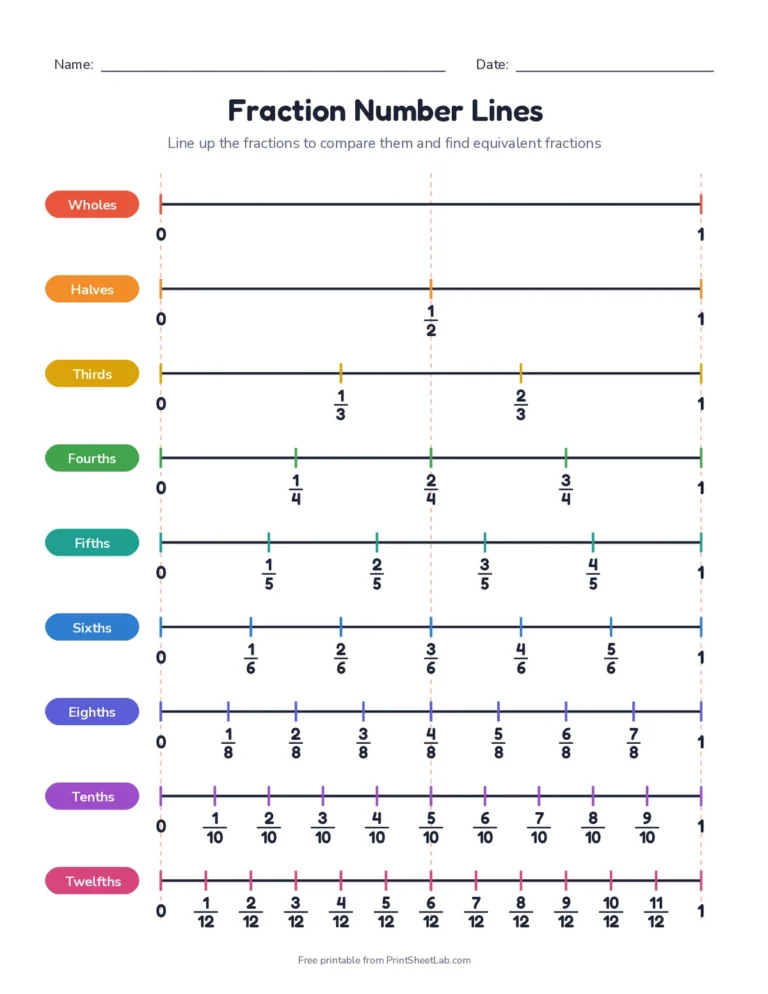
The fraction number lines chart stacks halves, thirds, fourths, fifths, sixths, eighths, tenths and twelfths on top of each other, all the same length. Line them up to spot equivalent fractions: 1/2, 2/4, 3/6, 4/8, 5/10 and 6/12 all sit on the dashed middle line.
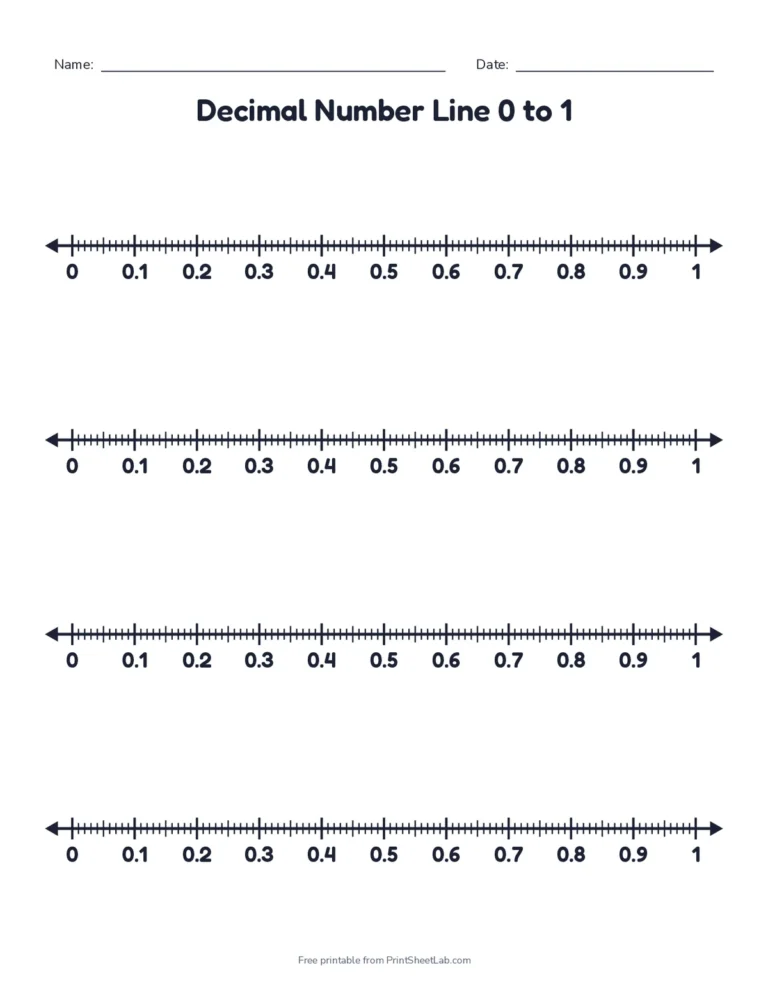
A decimal number line works the same way with tenths: 0.1, 0.2, 0.3 up to 1. Add small tick marks for hundredths to show that 0.35 sits halfway between 0.3 and 0.4, which makes rounding decimals visual.
Blank and missing number lines
A blank number line has tick marks but no numbers, so you can use it for anything: counting by 2s, a timeline, a range of temperatures or a set of decimals. Turn on “Number the two ends” to give children a starting and finishing point. The missing numbers sheets print numbered lines with some numbers replaced by boxes to fill in; choose how many are missing and print the answer key for quick checking.
Number line activities and games
- Hop and say: stand on a line of numbers taped to the floor, and hop forward or back as you call out the new number.
- Mystery number: “I am 3 more than 8. Where am I?” Children point to 11.
- Who is closer? Pick two numbers and a target, and decide which is closer on the line. This is rounding in disguise.
- Clothes-pin line: hang a string across the room and peg number cards on it in order, including fractions or negatives for older children.
- Hopping race: roll a die and hop forward; the first to reach 20 (or back to 0) wins.
Frequently asked questions
11 quick answers
What is a number line?
It is a straight line with numbers marked at equal intervals, as the number line article on Wikipedia explains. Numbers increase to the right and decrease to the left, and the arrows on each end show that the line keeps going forever.
How do you add on a number line?
Start at the first number and hop to the right as many times as the second number. The number you land on is the sum. For 6 + 3, start at 6, hop 3 times to the right and land on 9.
How do you subtract on a number line?
Start at the first number and hop to the left as many times as the number you are taking away. For 12 − 5, start at 12 and hop left 5 times to land on 7. You can also count the hops from the smaller number up to the larger one to find the difference.
How do you show negative numbers on a number line?
Negative numbers go to the left of zero. Each step left of zero is one less: −1, −2, −3 and so on. The further left a number is, the smaller it is, so −8 is less than −3.
How do you put fractions on a number line?
Split the space between 0 and 1 into as many equal parts as the denominator. For fourths, make 4 equal parts, and label the ticks 1/4, 2/4 and 3/4. The numerator tells you how many parts to count from zero.
What is a blank number line used for?
It lets children write in their own numbers. Teachers use it for counting by any number, open number line strategies, fractions, decimals, timelines and quick assessments.
What is an open number line?
It has no tick marks at all. Children mark only the numbers they need and draw hops of any size, such as a hop of 10 then a hop of 3 to add 13. Print our blank lines and ignore the ticks, or draw a plain line across the bottom of a page.
What grade uses number lines?
Number lines are used from preschool (counting to 10) all the way to middle school. Kindergarten and grade 1 add and subtract within 20, grades 2 and 3 work to 100 and 1,000 and start fractions, grades 4 and 5 add decimals, and grades 6 and 7 use negative numbers and integers.
Can I print a number line from 0 to 100?
Yes. Choose 0 to 100 by ones to print the whole line across four rows with every number shown, or 0 to 100 by tens for one line with small ticks for every number in between.
Can I make a number line with my own numbers?
Yes. Choose Custom range and type any start and end number between −1,000 and 10,000, then choose what to count by. The generator splits long lines into rows so the numbers stay big and readable.
Are these number lines free?
Yes. Every number line on this page is free to print and share with a class, and there is nothing to sign up for. Print as many copies as you need on Letter or A4 paper.
More counting and number practice
- Hundreds chart for counting and skip counting to 100 and beyond.
- Addition worksheets and subtraction worksheets for fact practice.
- Counting worksheets for preschool and kindergarten.
- Fractions worksheets and decimals worksheets.
- Comparing numbers worksheets with greater than and less than.
- Place value chart to see what each digit is worth.
- Number tracing worksheets to practice writing 0 to 20.