Change the numbers, layout and number of problems, then download a new PDF with its answer key.
These free 1st and 2nd grade reading comprehension worksheets give you nine original passages, four stories and five nonfiction texts, each with multiple-choice questions, a written question and an answer key. Every passage is short, between 74 and 125 words, written in short sentences, and printed large with room to look back for answers. Pick a passage, print the PDF and start reading.
1st and 2nd grade reading comprehension worksheets to print (PDF)
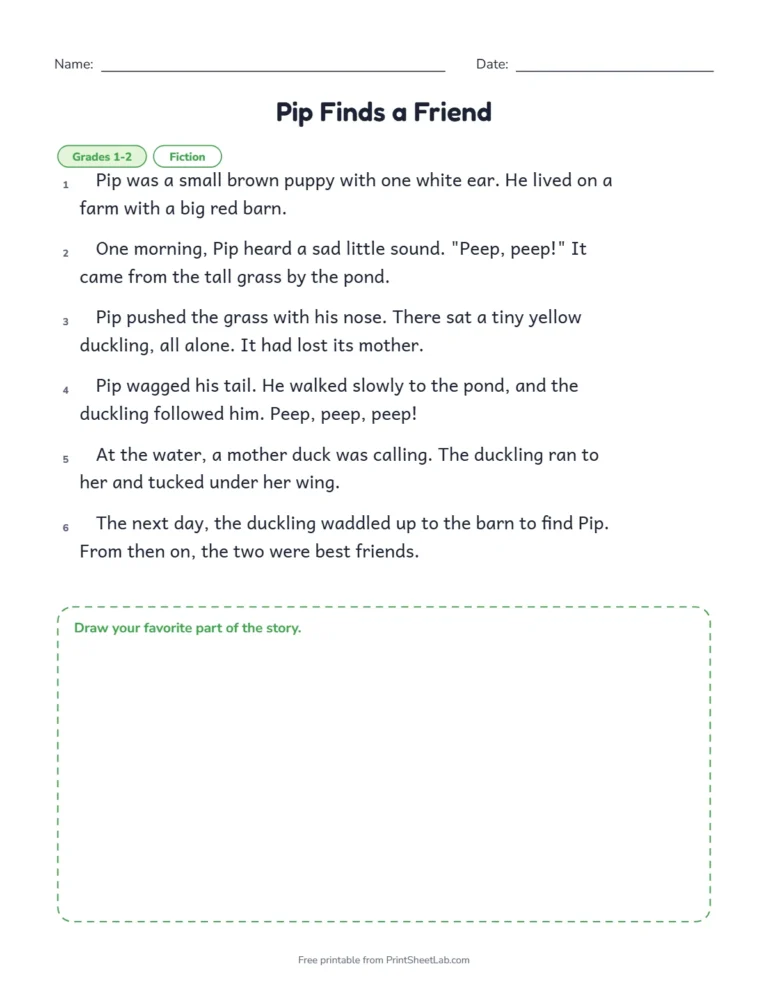
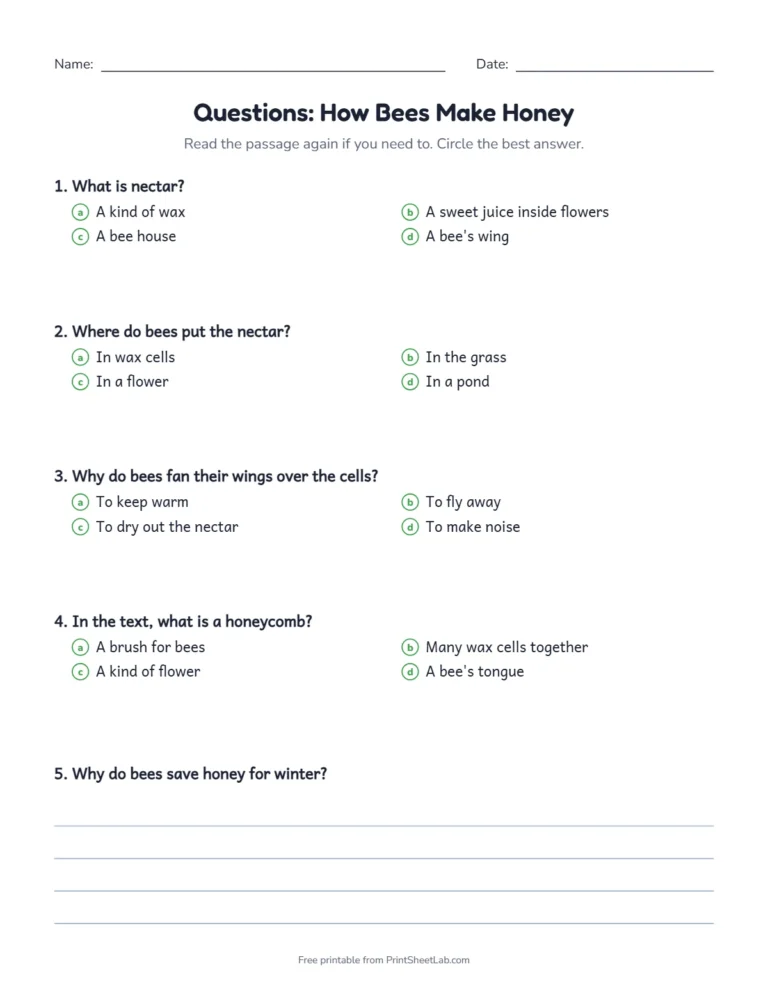
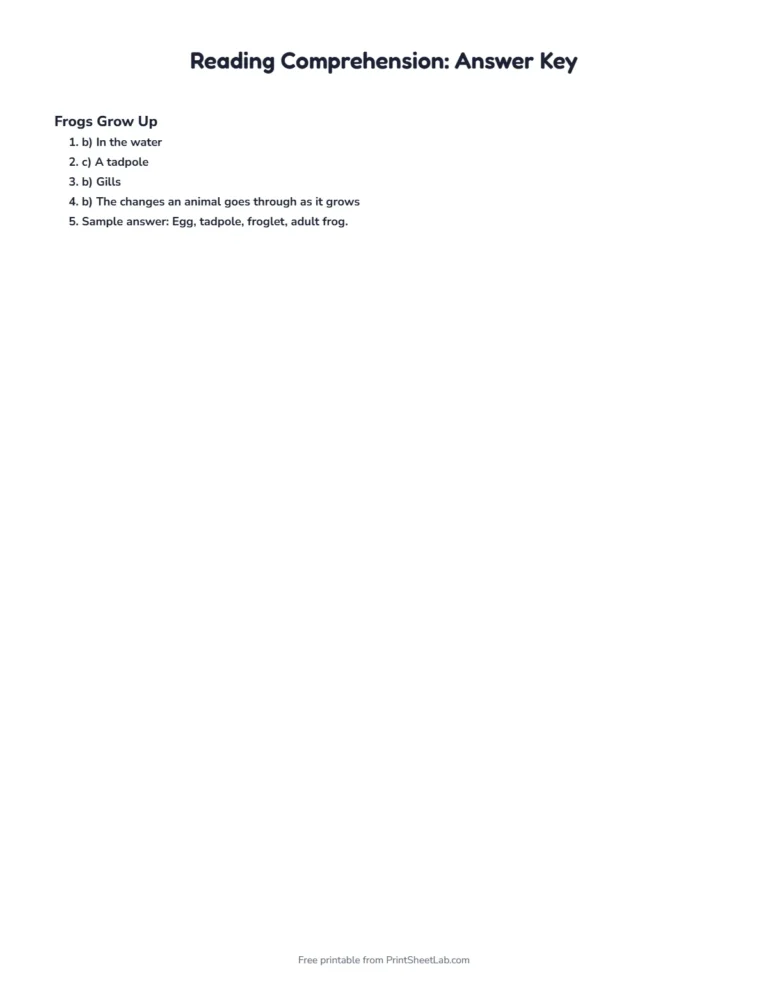
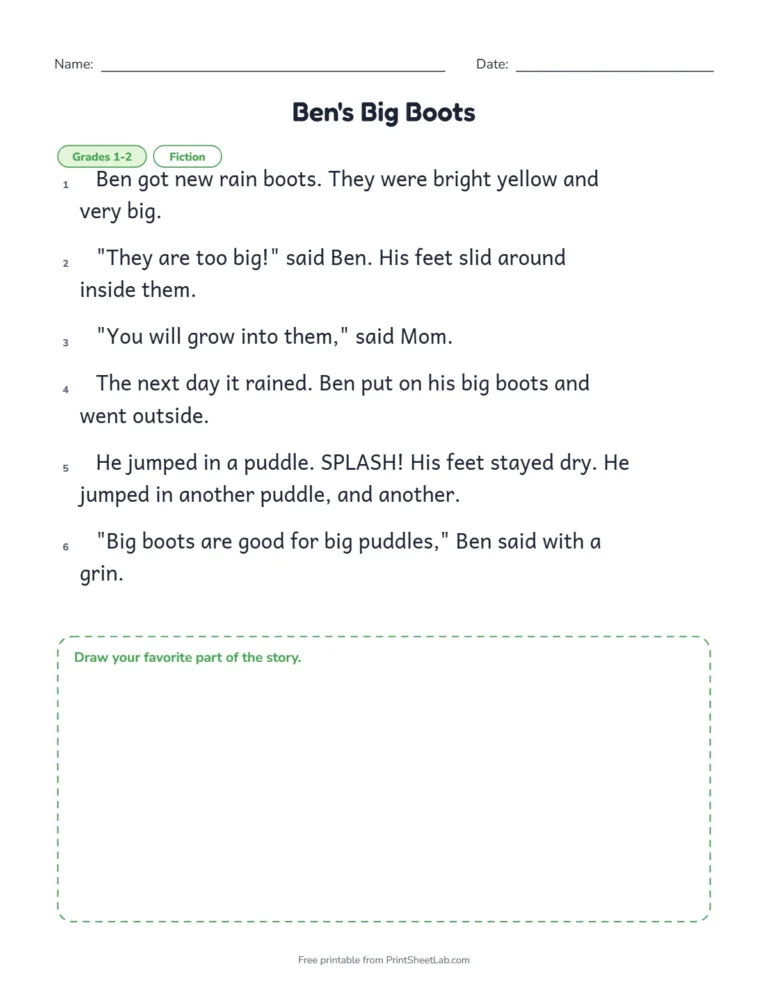
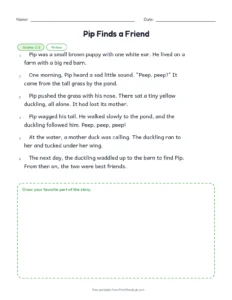
These four pages show what the generator prints: the passage Pip Finds a Friend, the questions for How Bees Make Honey, an answer key, and a large-text version of Ben’s Big Boots. Click a picture for the PDF, or use the generator above to choose any passage, turn the answer key on or off, or print the text only.
Passage: Pip Finds a FriendFiction, grade 1.PDFQuestions: honey beesNonfiction, grade 2.PDFAnswer keyFrogs Grow Up.PDFLarge textBen’s Big Boots.PDF
Reading passages for 2nd grade: the nine texts
All the passages are original, so children will not have read them before. The table shows the length of each text and an estimated reading level from the Flesch-Kincaid formula, which uses the length of the sentences and the words. The questions practice a different skill in each text:
Passage
Type
Words
Sentences
Words per sentence
Estimated grade level
What the questions practice
Pip Finds a Friend
Fiction
116
15
7.7
1.0
Key details, sequence and main idea; text evidence for kindness
The Lost Red Mitten
Fiction
121
14
8.6
2.1
Characters, details and cause and effect
Kiki’s Kite
Fiction
99
15
6.6
0.7
Cause and effect, and the lesson of the story
Ben’s Big Boots
Fiction
74
13
5.7
0.5
Problem and solution, and how a character feels
How Bees Make Honey
Nonfiction
123
13
9.5
3.3
A process in order, and a word in context
Frogs Grow Up
Nonfiction
125
15
8.3
1.9
Life cycle, sequence and a word in context
Why Do We Brush Our Teeth?
Nonfiction
107
13
8.2
2.5
Facts, a new word and why a habit matters
How Seeds Travel
Nonfiction
94
10
9.4
2.6
Facts and comparing ways seeds travel
Our Moon
Nonfiction
98
12
8.2
2.0
Facts, craters and how the Moon seems to change
The shortest passage is Ben’s Big Boots at 74 words, and the longest is Frogs Grow Up at 125. The average passage has 106 words and 8.0 words in a sentence. The estimated grade levels run from 0.5 to 3.3, so the set suits children who are just starting to read chapters as well as confident second graders.
1st grade reading comprehension worksheets: what is on each one
Each worksheet has three parts, which print as separate pages:
The passage. The text has numbered paragraphs, so children can say “in paragraph 3” when they look for an answer. Choose “Large text” for early readers.
The questions. Four multiple-choice questions come first, and then one written question with lines for the answer. The questions start with finding a detail and move toward explaining.
The answer key. It gives the correct choice for each question and a sample written answer, so you can check the work quickly.
You can also print the passage on its own, to read together before the questions come out, or print the questions without the key for a test.
2nd grade reading comprehension: skills and standards
Reading comprehension is a set of skills, not one. These are the main question types in the set, with the standards they support:
Question type
Example from the passages
Standard
Key details: who, what, where
Where did Pip find the duckling?
RL.1.1, RL.2.1
Sequence of events
What happened after Pip walked to the pond?
RL.2.3, RI.2.3
Main idea or topic
What is this story mostly about?
RL.2.2, RI.2.2
Word meaning in context
In the text, what is a honeycomb?
L.2.4, RI.2.4
Cause and effect
Why do bees fan their wings over the cells?
RI.2.3
Lesson or moral
What lesson does the story teach?
RL.2.2
The Common Core asks children in grade 2 to ask and answer questions about key details (RL.2.1 and RI.2.1) and to say what a story’s lesson or moral is (RL.2.2). The questions on these sheets are written to match.
Short stories with questions: samples
Here are some of the actual questions, with their answers, so you can see the level of the questions:
Pip Finds a Friend, fiction: “Where did Pip find the duckling?” Answer: In the tall grass by the pond.
How Bees Make Honey, nonfiction: “What is nectar?” Answer: A sweet juice inside flowers.
The Lost Red Mitten, fiction: “Where was the lost mitten?” Answer: On the snowman’s arm.
The written question asks children to explain, using a detail from the text. For example:
Pip Finds a Friend: How do you know Pip was kind? Use a detail from the story.
How Bees Make Honey: Why do bees save honey for winter?
Our Moon: Why does the Moon seem to change shape?
First grade reading worksheets: how to use them
Read the passage together first. Take turns reading a paragraph, and talk about any word that is new.
Let the child read it again alone. The second reading is when the sentences start to make sense.
Answer the multiple-choice questions. Tell the child to put a finger on the sentence that shows the answer.
Do the written question last. Ask the child to say the answer aloud first, then write it. One sentence is plenty at this age.
Check with the key. Look at the sample answer together. It is a model, not the only right answer.
Short regular practice works better than a big session. Five to ten minutes with one passage is enough. For a full week, use one story a day, and mix fiction and nonfiction. Children at this age read aloud at roughly 40 to 100 words per minute, so a passage of 74 to 125 words takes between one and three minutes to read. If you need background reading research, see Wikipedia’s reading comprehension article.
Reading comprehension for 1st grade: where to start
Reading comprehension for 1st grade starts with the shortest texts. Choose Ben’s Big Boots at 74 words or Kiki’s Kite at 99 words, read it aloud together, and let the child answer the questions by pointing to the sentence that shows the answer. When that feels easy, move to a text of about 100 words, such as Our Moon or Why Do We Brush Our Teeth?, and let the child read it alone first.
Strategies that help young readers
Look back. Teach children that the answer is in the text, and that they should find it again, not guess from memory.
Picture it. After each paragraph, ask “what do you see in your head?”
Retell it. Ask the child to tell the beginning, middle and end in their own words. Use the reading graphic organizers for a story map.
Ask “why”. The written question on every sheet asks why, which is the beginning of inference.
Read the nine passages: full text
This is the full text of every passage in the 1st and 2nd grade reading comprehension worksheets, so you can read them on screen first, or choose the one you want to print. Use the generator above to print a passage with its questions and answer key.
1. Pip Finds a Friend: 1st and 2nd grade reading comprehension worksheets
Fiction, 116 words. From the 1st and 2nd grade reading comprehension worksheets.
Pip was a small brown puppy with one white ear. He lived on a farm with a big red barn.
One morning, Pip heard a sad little sound. “Peep, peep!” It came from the tall grass by the pond.
Pip pushed the grass with his nose. There sat a tiny yellow duckling, all alone. It had lost its mother.
Pip wagged his tail. He walked slowly to the pond, and the duckling followed him. Peep, peep, peep!
At the water, a mother duck was calling. The duckling ran to her and tucked under her wing.
The next day, the duckling waddled up to the barn to find Pip. From then on, the two were best friends.
2. The Lost Red Mitten: 1st and 2nd grade reading comprehension worksheets
Fiction, 121 words. From the 1st and 2nd grade reading comprehension worksheets.
It was a snowy day, and Lena went out to play. She wore her warm coat, her blue hat and her new red mittens.
Lena built a snowman with a carrot nose. She made snow angels and threw snowballs with her brother, Sam.
When it was time to go inside, Lena looked at her hands. One red mitten was gone!
Lena and Sam looked everywhere. They looked by the snowman. They looked by the snow angels. No mitten.
Then Sam laughed and pointed. The snowman was wearing the red mitten on the end of his stick arm!
“You gave it to him when you made his arms,” said Sam. Lena giggled, took back her mitten and went inside for hot cocoa.
3. Kiki’s Kite: 1st and 2nd grade reading comprehension worksheets
Fiction, 99 words. From the 1st and 2nd grade reading comprehension worksheets.
Kiki made a kite from paper, sticks and string. She painted a big orange fish on it.
She ran across the park, but the kite bumped along the grass. It would not fly.
Grandpa smiled. “We need wind,” he said. “Let’s wait.”
Kiki sat on the bench and waited. She watched the trees. Soon the leaves began to shake and the flags began to flap.
“Now!” said Grandpa. Kiki ran into the wind and let the string out slowly.
Up, up went the kite! The orange fish swam across the blue sky, and Kiki laughed all the way home.
4. Ben’s Big Boots: 1st and 2nd grade reading comprehension worksheets
Fiction, 74 words. From the 1st and 2nd grade reading comprehension worksheets.
Ben got new rain boots. They were bright yellow and very big.
“They are too big!” said Ben. His feet slid around inside them.
“You will grow into them,” said Mom.
The next day it rained. Ben put on his big boots and went outside.
He jumped in a puddle. SPLASH! His feet stayed dry. He jumped in another puddle, and another.
“Big boots are good for big puddles,” Ben said with a grin.
5. How Bees Make Honey: 1st and 2nd grade reading comprehension worksheets
Nonfiction, 123 words. From the 1st and 2nd grade reading comprehension worksheets.
Honeybees are busy insects. They fly from flower to flower all day long.
Inside each flower is a sweet juice called nectar. A bee sips the nectar with its long tongue and keeps it in a special honey stomach.
When its honey stomach is full, the bee flies back to the hive. It passes the nectar to other bees.
The bees put the nectar into little wax rooms called cells. Many cells together make a honeycomb.
Next, the bees fan their wings over the cells. The moving air dries out the nectar, and it slowly turns thick and sticky. Now it is honey!
The bees close each cell with wax. They save the honey to eat in winter, when there are no flowers.
Nonfiction, 125 words. From the 1st and 2nd grade reading comprehension worksheets.
A frog does not start life looking like a frog. It changes a lot as it grows. These changes are called a life cycle.
First, a mother frog lays eggs in the water. The eggs are soft and look like jelly.
Next, a tadpole hatches from each egg. A tadpole has a long tail and lives underwater. It breathes with gills, like a fish.
As the tadpole grows, it gets back legs and then front legs. Now it is called a froglet.
The froglet’s tail gets shorter and shorter. It grows lungs so it can breathe air.
Last, the froglet becomes an adult frog. It can hop on land and swim in the water. Someday it may lay eggs, and the life cycle starts again.
7. Why Do We Brush Our Teeth?: 1st and 2nd grade reading comprehension worksheets
Nonfiction, 107 words. From the 1st and 2nd grade reading comprehension worksheets.
Your teeth help you bite, chew and smile. You need to take good care of them.
After you eat, tiny germs called bacteria stay on your teeth. They make a sticky layer called plaque.
The germs in plaque love sugar. They make acid that can make holes in your teeth. These holes are called cavities.
Brushing gets rid of plaque. Brush two times a day for two minutes, and don’t forget your back teeth!
Toothpaste with fluoride helps make your teeth strong. Flossing cleans the spaces between your teeth where a brush can’t reach.
Visit the dentist for checkups too. A clean mouth means a happy smile!
8. How Seeds Travel: 1st and 2nd grade reading comprehension worksheets
Nonfiction, 94 words. From the 1st and 2nd grade reading comprehension worksheets.
Plants cannot walk, but their seeds can travel far away. Moving away gives a new plant room to grow.
Some seeds fly on the wind. Dandelion seeds have soft, fluffy tops that float like tiny parachutes.
Some seeds ride on animals. Burrs have little hooks that stick to fur and socks.
Birds eat berries, and the seeds inside can be dropped far away.
Some seeds float on water. A coconut can float across the sea and grow on a new beach.
Next time you go outside, look for seeds that are on the move!
9. Our Moon: 1st and 2nd grade reading comprehension worksheets
Nonfiction, 98 words. From the 1st and 2nd grade reading comprehension worksheets.
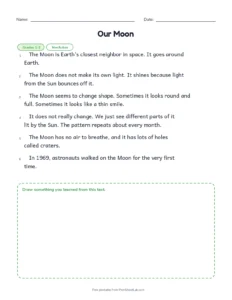
The Moon is Earth’s closest neighbor in space. It goes around Earth.
The Moon does not make its own light. It shines because light from the Sun bounces off it.
The Moon seems to change shape. Sometimes it looks round and full. Sometimes it looks like a thin smile.
It does not really change. We just see different parts of it lit by the Sun. The pattern repeats about every month.
The Moon has no air to breathe, and it has lots of holes called craters.
In 1969, astronauts walked on the Moon for the very first time.
Printing tip
Print at 100% or “Actual size” and turn off “Fit to page”, so every measurement on the sheet is exact. Choose Letter or A4 paper in the generator before you download the PDF.
1st and 2nd grade reading comprehension worksheets: frequently asked questions
How many questions does each passage have?
Each passage has four multiple-choice questions and one written question. The multiple-choice questions ask for a detail, the order of events, a word meaning and the main idea or lesson.
Fiction or nonfiction first?
Mix them. Stories build interest, and nonfiction teaches children to read for facts, which the grade 2 standards expect alongside stories.
Can I print just the passage?
Yes. Choose “Passage only” in the generator, or pick Large text for beginning readers.
Are the passages really for both grades?
Yes. The estimated reading level runs from below grade 1 to about grade 3. Start with the shortest texts for grade 1 and use the longer ones for grade 2.
Are these reading comprehension worksheets free?
Yes. They are free to print for home and classroom use, with no sign-up.