Change the numbers, layout and number of problems, then download a new PDF with its answer key.
Reading graphic organizers help children plan a retelling, pull out the main idea or compare two things before they write. These six free printable reading graphic organizers work with any story or nonfiction book: a story map, a Somebody-Wanted-But-So-Then summary, a main idea chart, a character traits chart, a Venn diagram and a reading log. Pick one and print the PDF.
Reading graphic organizers to print (PDF)
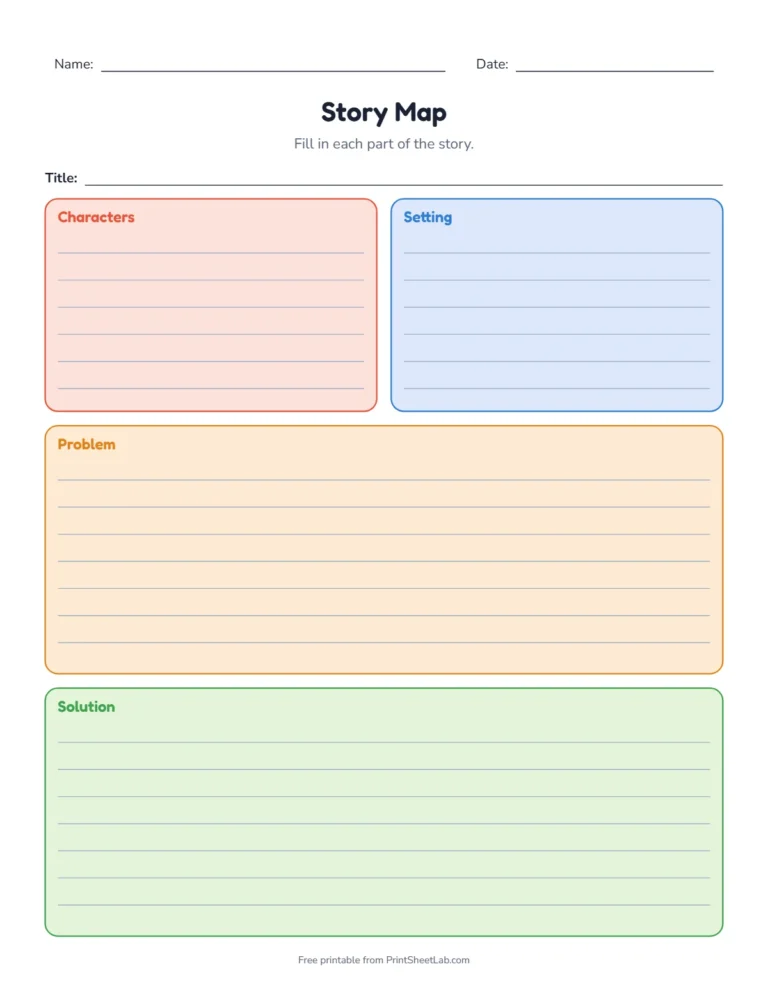
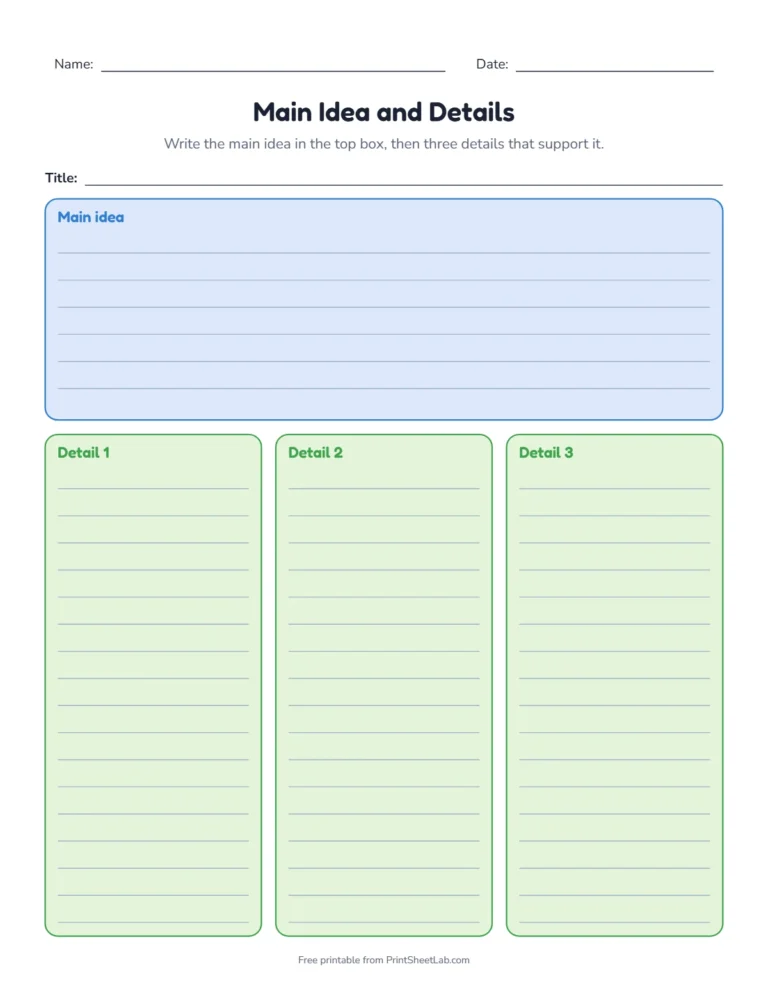
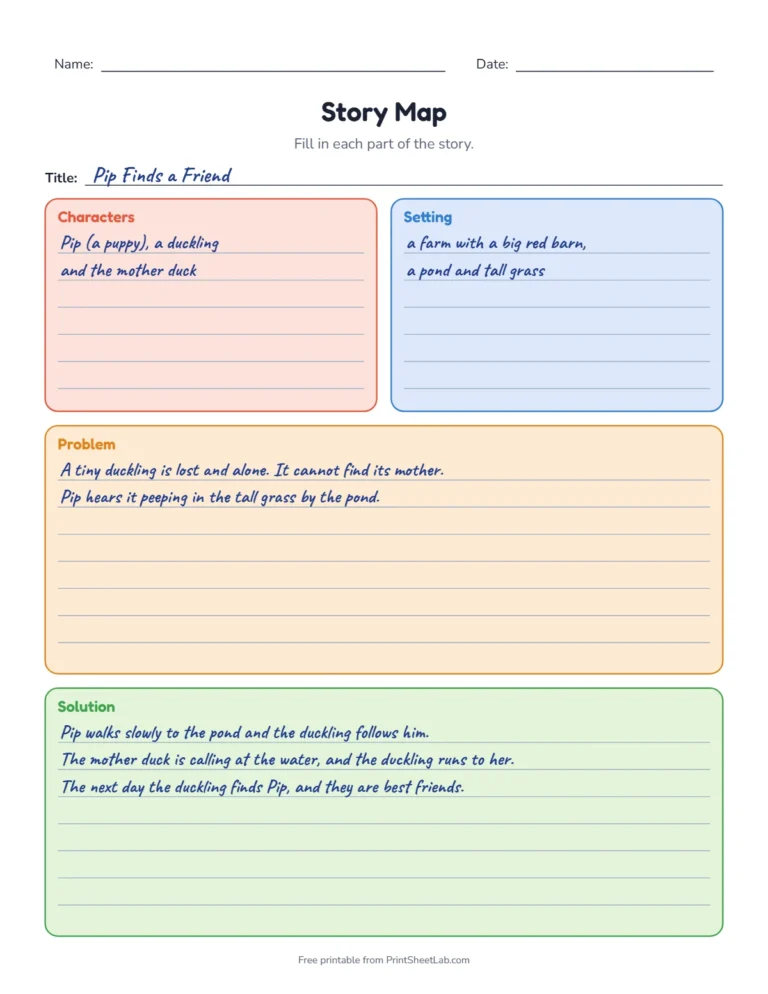
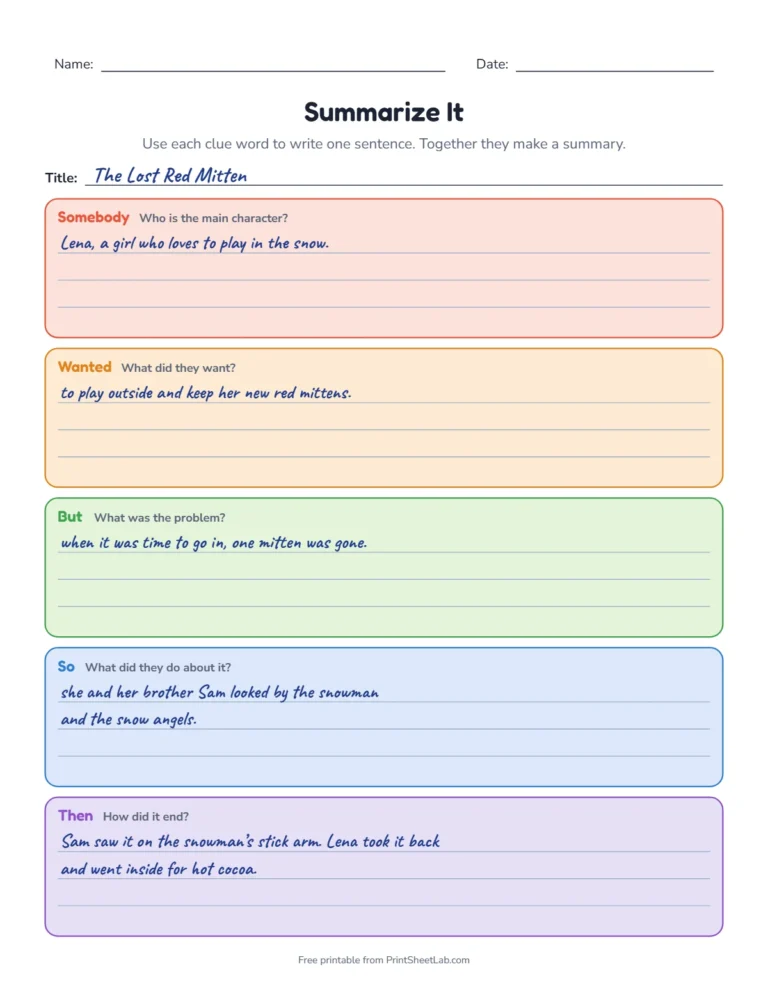
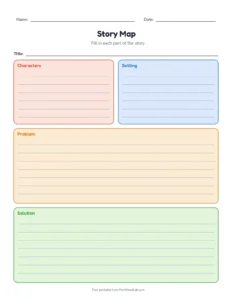
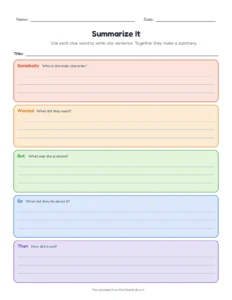
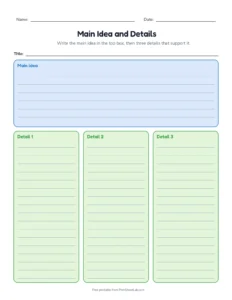
These four pages show the organizers: a blank story map, a main idea and details chart, a story map filled in for Pip Finds a Friend, and a Somebody-Wanted-But-So-Then summary filled in for The Lost Red Mitten. Click a picture for the PDF, or use the generator above to choose any of the six organizers.
Story mapBlank, one page.PDFMain idea and detailsOne idea, three details.PDFStory map examplePip Finds a Friend.SWBST exampleThe Lost Red Mitten.
The six reading graphic organizers at a glance
Every one of these reading graphic organizers prints on one page with a title line and a name line. They have no answer key, because they work with any book and the answers depend on what the child is reading:
Organizer
Use it for
Parts
Standards it supports
Story map
Characters, setting, problem and solution of a story
Four boxes: characters, setting, problem and solution
RL.2.5, RL.3.3
Somebody-Wanted-But-So-Then
A five-part summary of a story in one sentence each
Five rows: Somebody, Wanted, But, So, Then
RL.2.2, RL.3.2
Main idea and details
Nonfiction: the big idea and the facts that support it
One main idea box and three detail boxes
RI.2.2, RI.3.2
Character traits
A trait, and the evidence from the text that shows it
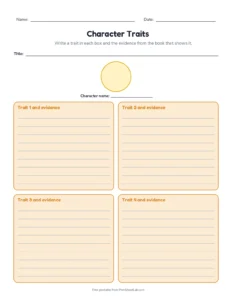
A character circle and four trait-and-evidence boxes
RL.3.3, RL.4.3
Venn diagram
Compare and contrast two characters, books or topics
Two overlapping circles: differences outside, likenesses in the middle
RL.3.9, RI.3.9
Reading log
Track books, pages and minutes read
A table with date, title, pages or minutes and a star rating
Reading fluency and stamina
Story map graphic organizer: an example
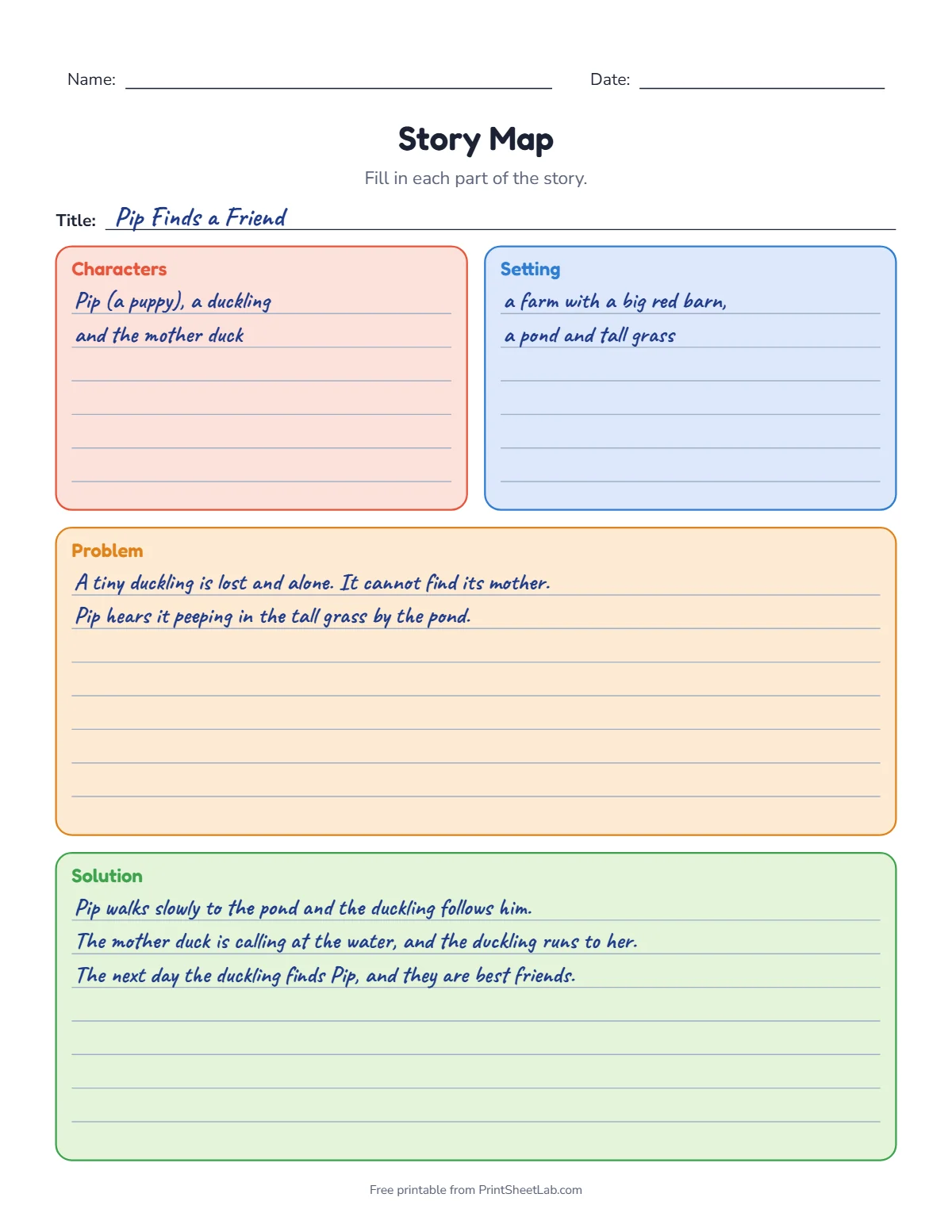
A story map has four parts. The filled example uses the story Pip Finds a Friend from the 1st and 2nd grade passages. The characters are Pip the puppy, a duckling and the mother duck. The setting is a farm with a big red barn, a pond and tall grass. The problem is that a tiny duckling is lost and cannot find its mother. The solution comes when Pip walks slowly to the pond, so the duckling can follow him to its mother, and the two become best friends. A child who can fill in these four boxes has understood who the story is about, where it happens and how it is solved.
Somebody Wanted But So Then: a five-sentence summary
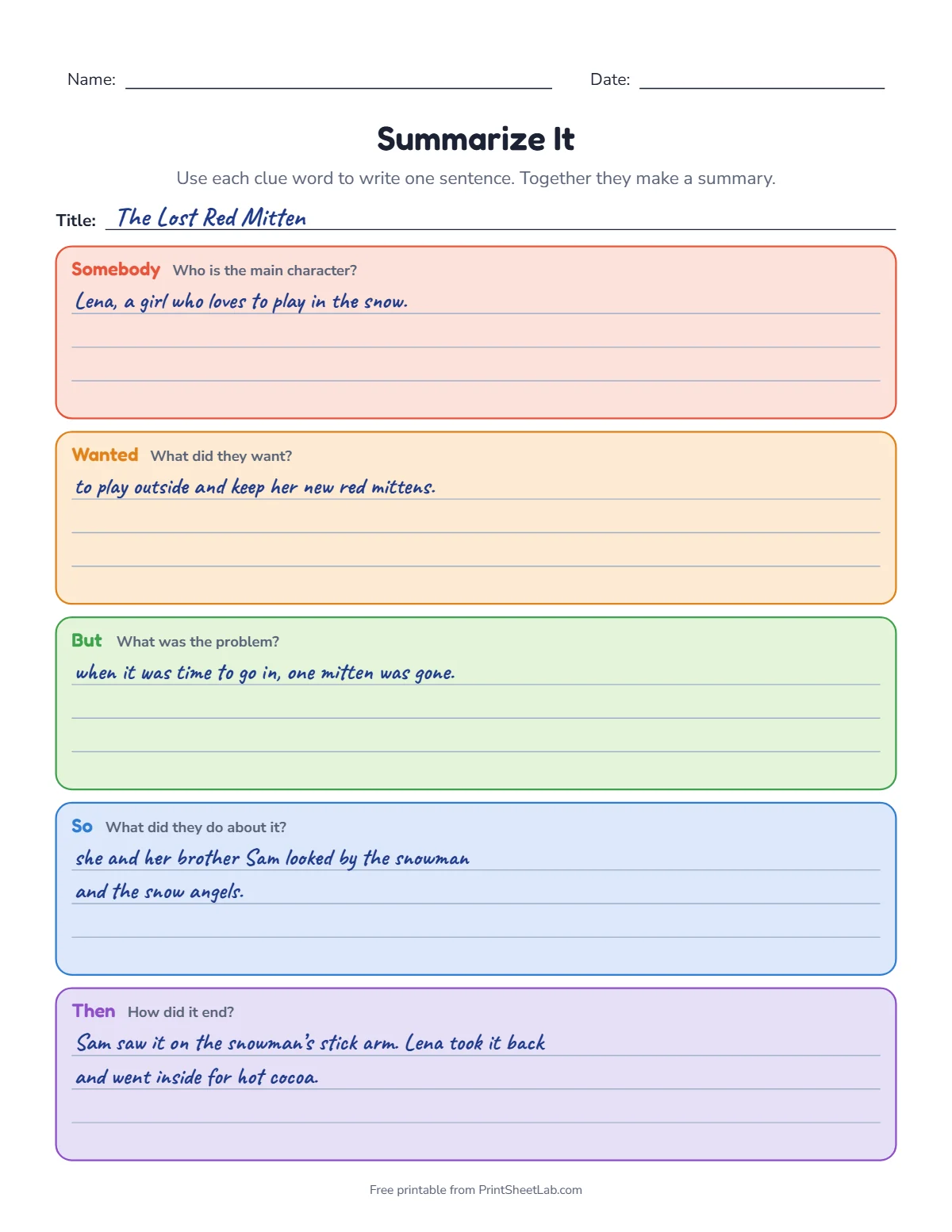
A summary is short, and the clue words in these reading graphic organizers keep it that way. The somebody wanted but so then organizer (often called SWBST) gives one clue word for each part of a story. The filled example summarizes The Lost Red Mitten:
Clue word
Question
Example from The Lost Red Mitten
Somebody
Who is the main character?
Lena
Wanted
What did the character want?
To play outside and keep her new red mittens
But
What was the problem?
When it was time to go in, one mitten was gone
So
What did the character do about it?
She and her brother Sam looked by the snowman and the snow angels
Then
How did it end?
Sam saw the mitten on the snowman’s stick arm, and Lena took it back
Join the five answers with the clue words and you have a summary: “Lena wanted to keep her new red mittens, but one was gone, so she and Sam looked everywhere, and then Sam found it on the snowman.”
Main idea graphic organizer for nonfiction
A main idea graphic organizer has one big box for the main idea and three boxes for the details that support it. For How Bees Make Honey, the main idea could be “Bees turn nectar into honey in a series of steps.” The details are that bees sip nectar from flowers, that they put it in wax cells and fan it with their wings, and that they close the cells and save the honey for winter. If a child cannot find three details, the main idea may be too wide. If the details do not fit, it may be too narrow.
Character traits graphic organizer: trait and evidence
The character traits organizer asks for a trait and the evidence that shows it. “Maya is calm” is only a claim. “After the juice spilled, Maya took a deep breath and grabbed her notebook” is evidence. Teach children to use a trait word that is more specific than “nice” or “mean”, such as determined, creative or stubborn. The same chart works for story characters in grades 1 to 6, and the evidence column prepares students for the written responses in the reading comprehension worksheets.
Venn diagram and reading log
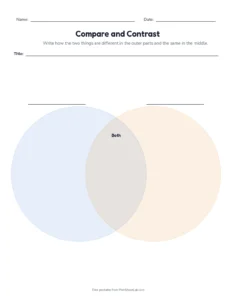
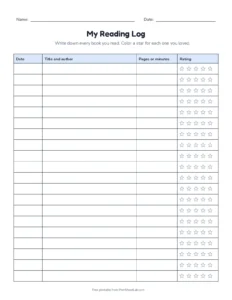
The Venn diagram has two overlapping circles. Write what is different about each item in the outer parts, and what they share in the middle. It works for two characters, two versions of a story, or two animals, such as a tadpole and a frog. The reading log is a page with columns for the date, the title, the pages or minutes read and a rating of five stars to color in. Keep one in a folder or a reading journal.
Venn diagram example: a tadpole and an adult frog
A Venn diagram shows what is different in the outer parts and what is the same in the middle. For a reading example, compare the two stages in Frogs Grow Up, a passage in the 1st and 2nd grade set:
Only the tadpole
Both
Only the adult frog
Lives only in water
The same animal at different stages of its life cycle
Lives on land and in water
Breathes with gills, like a fish
Can swim
Breathes air with lungs
Has a long tail
Starts as an egg laid in water
Hops, and has no tail
Has no legs at first
May lay eggs, so the life cycle starts again
Notice that the middle is often the hardest part to fill. If students struggle, ask “What do both of these need? What are they both called?” The Venn diagram works just as well for two characters, two books or two versions of a story.
Reading log printable: a sample page
The reading log printable has columns for the date, the title and author, the pages or minutes read, and a rating of five stars. This is how a child might fill in the first few rows:
Date
Title and author
Pages or minutes
Rating
Sep 2
Charlotte’s Web, E. B. White
20 minutes
5 stars
Sep 3
Frog and Toad Are Friends, Arnold Lobel
12 pages
4 stars
Sep 5
The Wild Robot, Peter Brown
25 minutes
5 stars
Sep 6
Matilda, Roald Dahl
18 pages
4 stars
A log is useful for more than counting. At the end of the month, ask the child to look through the ratings and say which book they would read again, and why. That conversation is a quick check of understanding and taste.
Which reading graphic organizer for which grade?
Every organizer can be used at every level, but some match the standards for a grade better than others. This table is a starting point:
Grade
Start with
Ask
1
Story map
Who is in the story, and where does it happen?
2
Story map and Somebody-Wanted-But-So-Then
What was the problem, and how was it solved?
3
Main idea and details, and character traits
What is this mostly about? What does the character do that shows how they feel?
4
Venn diagram and main idea and details
How are these two texts or characters alike and different?
5
Character traits, and compare and contrast
What does the author want the reader to think, and what proves it?
6
Main idea, theme and a reading log
Which details support the theme, and which are only interesting?
Pairing each organizer with a passage
If you want a text to go with an organizer, the reading passages on this site work well. Choose one at your child’s level, read it, and fill in the organizer:
Organizer
Grades 1 and 2
Grades 3 and 4
Grades 5 and 6
Story map
Pip Finds a Friend
The Secret Garden Club
Coach Rivera’s Tough Choice
Somebody-Wanted-But-So-Then
The Lost Red Mitten
Maya’s Science Fair Surprise
The Last Summer at Lighthouse Point
Main idea and details
How Bees Make Honey
The Amazing Octopus
How Bridges Carry the Load
Character traits
Ben’s Big Boots
The Night the Lights Went Out
The Helper Who Couldn’t Say No
Venn diagram
Frogs Grow Up (tadpole and frog)
The Amazing Octopus and How Camels Survive the Desert
How Bridges Carry the Load (arch and suspension bridges)
Sentence starters for each reading graphic organizer
Young writers often know the idea but not the words. Give them a frame, and let them fill in the blank:
Story map: “The story takes place in… The main character is… The problem is that… It is solved when…”
Somebody-Wanted-But-So-Then: “… wanted …, but …, so …, and then …”
Main idea and details: “This text is mostly about… One detail that shows this is… Another detail is…”
Character traits: “… is … because in the story, he or she …”
Venn diagram: “They are alike because both… They are different because one… but the other…”
Reading log: “I would give this book … stars because…”
From organizer to paragraph
An organizer is a plan, and the next step is a paragraph. Here is a paragraph built from the main idea chart for How Bees Make Honey: “Bees turn nectar into honey in a series of steps. First, a bee sips nectar from a flower and carries it back to the hive. Next, the bees put the nectar into wax cells and fan it with their wings until it is thick and sticky. Finally, they close each cell with wax and save the honey to eat in winter.” The topic sentence comes from the main idea box, and each detail box becomes a sentence. Children can do the same with a story map or the summary organizer.
Teaching a new organizer: I do, we do, you do
I do. Read a short text aloud and fill in a large copy of the organizer yourself, thinking aloud as you go.
We do. Read a second text together, and ask the class to say what goes in each box before you write it.
You do. Let children read a third text on their own and fill in their own page.
Share. Ask two or three children to explain a box and the evidence for it.
Common mistakes with reading graphic organizers
Writing too much. Short phrases are better than sentences, and the box has only a few lines.
Copying from the book. The point is to put the idea in the child’s own words.
Filling the organizer before reading. It is a tool for thinking after reading, not a form to complete as the child goes.
Using the same organizer for everything. Match it to the goal, for example a Venn diagram to compare and a main idea chart for facts.
A one-week unit with reading graphic organizers
Reading graphic organizers work best when children meet a new one each day and then see the whole set. This plan uses one read-aloud book for the whole week, and each day adds a new organizer:
Day
Reading graphic organizer
What the class does
Monday
Story map
Read the book and name the characters, the setting, the problem and the solution
Tuesday
Somebody-Wanted-But-So-Then
Turn the story map into a five-sentence summary
Wednesday
Character traits
Choose one character, name a trait, and find a line that proves it
Thursday
Venn diagram
Compare two characters, or the beginning and the end of the story
Friday
Reading log
Rate the book, and choose the next one to read
By Friday children have used five reading graphic organizers on one text, and they can say which one suits which kind of thinking.
Reading graphic organizers for different learners
Beginning readers. Let children draw in the boxes first, then add one word. Reading graphic organizers with pictures keep the idea clear when writing is slow.
English learners. Give a word bank beside the organizer, and let students answer in short phrases. The boxes show them where each idea belongs.
Children who find writing hard. Let them say the answer to an adult, who writes it down. The thinking is the point of the organizer.
Confident readers. Ask for two pieces of evidence in every box, with a page number.
Printing reading graphic organizers at home or in class
Each of the six reading graphic organizers prints on one page, in color or in black and white, on Letter or A4. A black and white copy costs less to print for a whole class, and the boxes are still easy to see. If you print them for a reading folder, punch holes along the left side, and keep an organizer behind each book. Laminate one set, and use dry-erase pens to reuse them for group work.
How to use reading graphic organizers with any book
Choose the organizer that matches your goal: retell a story, find the main idea, compare, or describe a character.
Read first, then fill in the organizer. Do not stop after every page.
Write short phrases, not full sentences. The organizer is a plan.
Use the finished organizer to talk about the book, or to write a paragraph.
Keep the pages in a folder, as a record of the books and the thinking.
Reading graphic organizers are part of what researchers call graphic organizers or concept maps. Wikipedia’s graphic organizer article describes the idea.
Printing tip
Print at 100% or “Actual size” and turn off “Fit to page”, so every measurement on the sheet is exact. Choose Letter or A4 paper in the generator before you download the PDF.