Change the numbers, layout and number of problems, then download a new PDF with its answer key.
These free 5th and 6th grade reading comprehension worksheets give you nine original passages, four stories and five nonfiction texts, with questions that ask students to infer, to find a theme and to back up an answer with evidence. The texts are between 189 and 228 words, and every sheet has a written response and an answer key. Pick a passage and print the PDF.
5th and 6th grade reading comprehension worksheets to print (PDF)
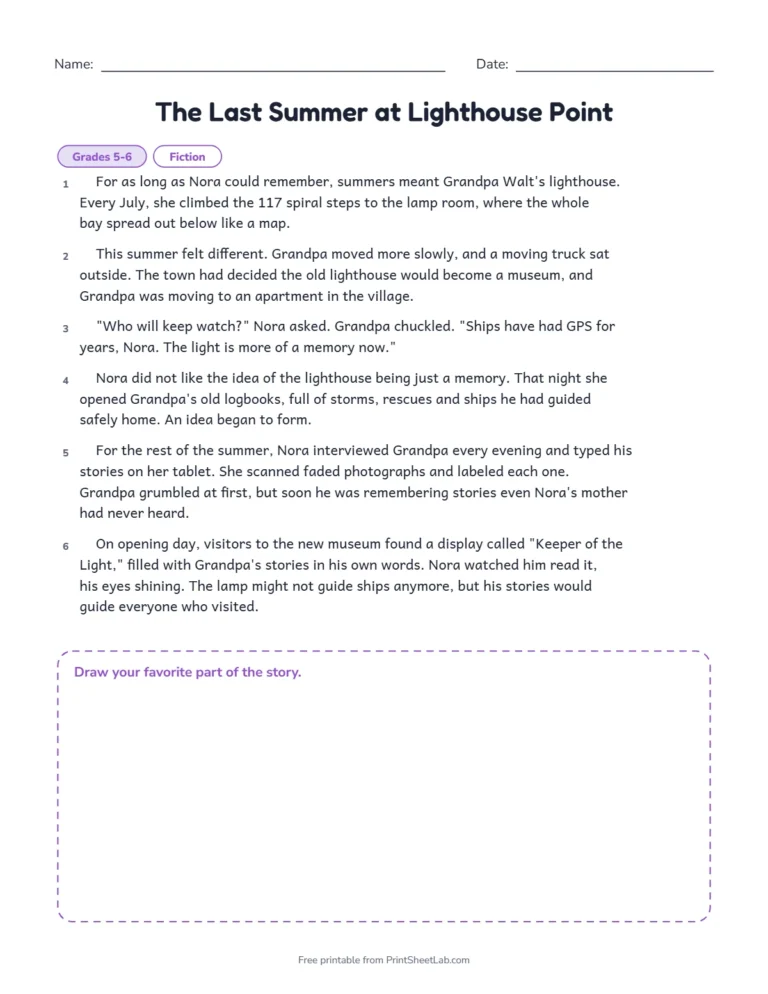
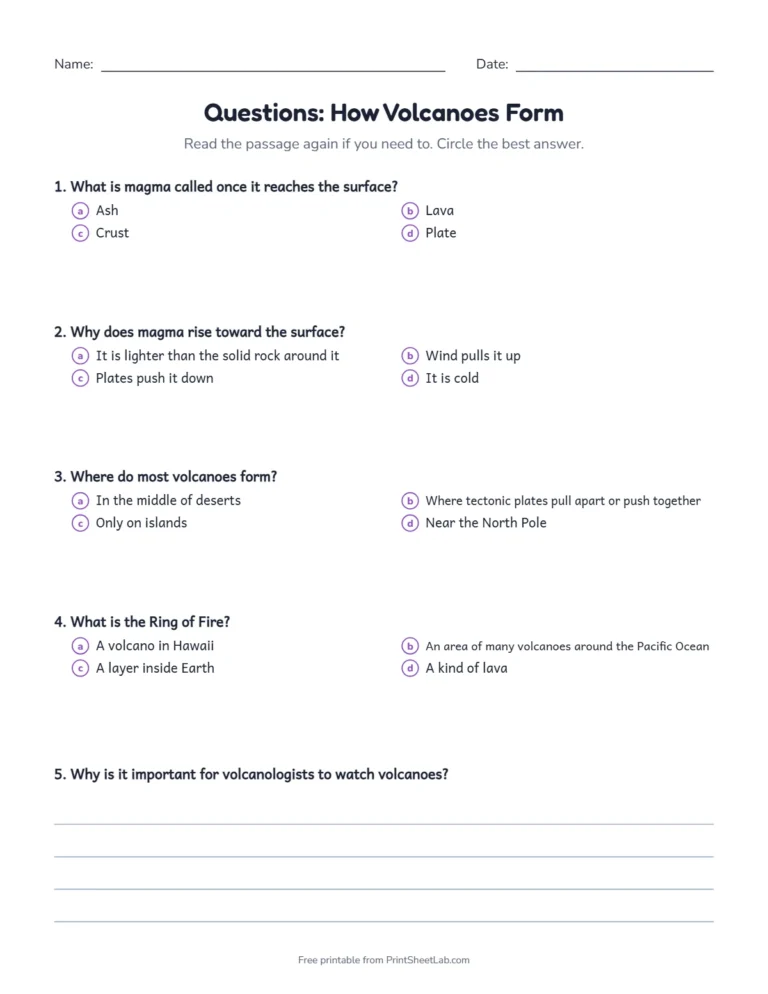
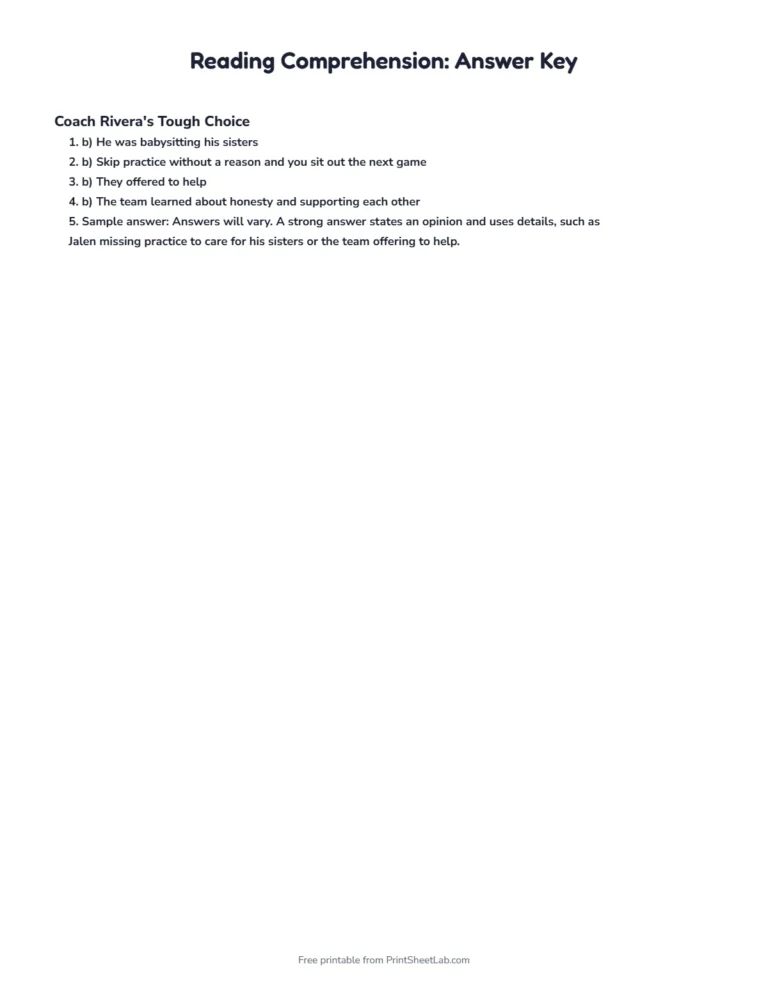
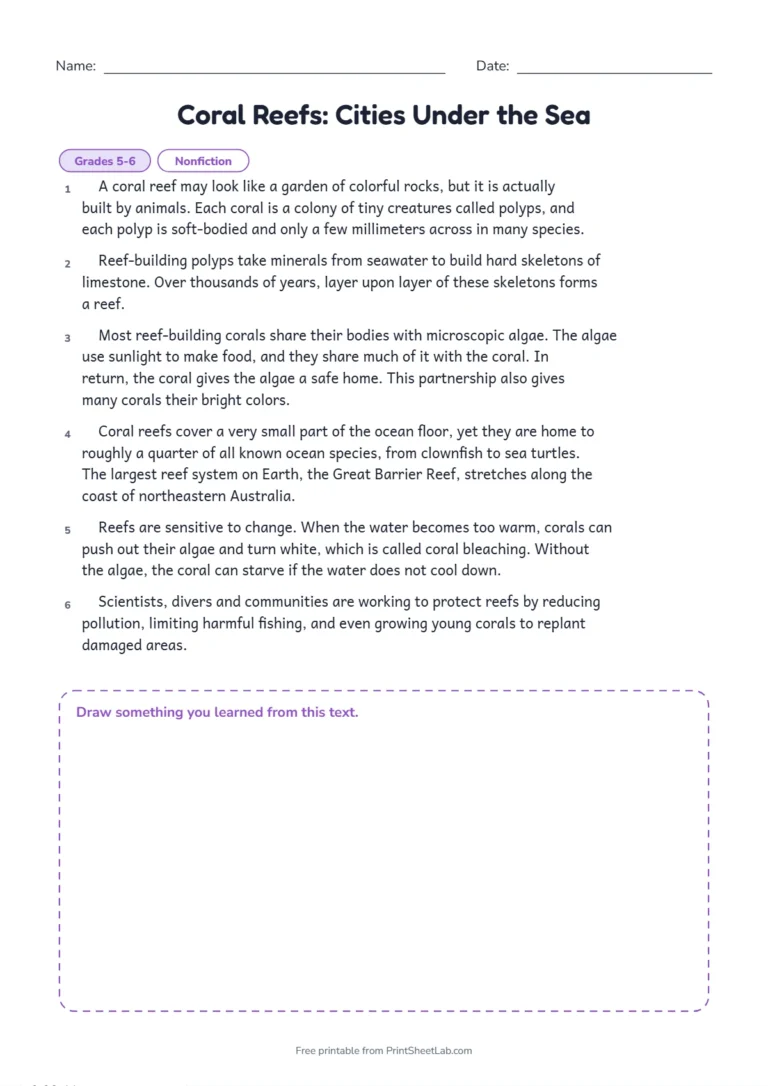
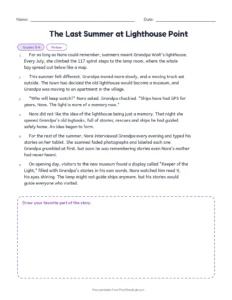
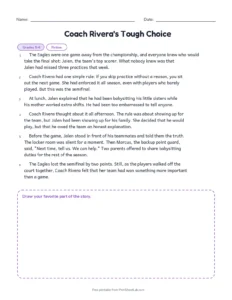
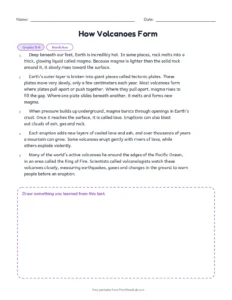
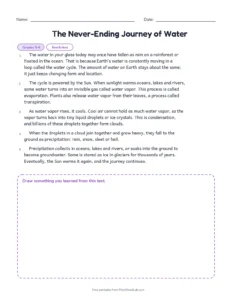
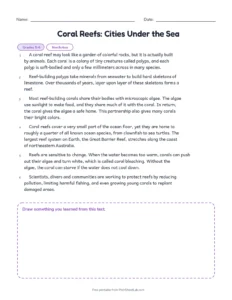
These four pages show what the generator prints: the story The Last Summer at Lighthouse Point, the questions for How Volcanoes Form, an answer key for Coach Rivera’s Tough Choice, and Coral Reefs: Cities Under the Sea on A4 paper. Click a picture for the PDF, or use the generator above to choose any passage and turn the key on or off.
All the passages are original and different in topic. The reading level is estimated with the Flesch-Kincaid formula, which looks at the length of the sentences and the words. The skills column shows what the questions practice:
Passage
Type
Words
Sentences
Words per sentence
Estimated grade level
What the questions practice
The Last Summer at Lighthouse Point
Fiction
217
19
11.4
5.4
Theme with evidence, and a word in context
Coach Rivera’s Tough Choice
Fiction
218
17
12.8
5.9
Inference, and an opinion backed by evidence
The Helper Who Couldn’t Say No
Fiction
211
21
10.0
4.3
Theme and text evidence
Two Sides of the Story
Fiction
189
21
9.0
5.3
Character change, word choice and theme
How Volcanoes Form
Nonfiction
196
15
13.1
6.9
Cause and effect, and key terms
The Never-Ending Journey of Water
Nonfiction
189
14
13.5
7.1
Sequence of stages and figurative language
The Machine That Changed the World
Nonfiction
210
15
14.0
7.2
Cause and effect, comparison and vocabulary
How Bridges Carry the Load
Nonfiction
228
17
13.4
6.0
Comparing and contrasting, and main idea
Coral Reefs: Cities Under the Sea
Nonfiction
220
14
15.7
8.4
A relationship between two things, and cause and effect
The shortest text in the 5th and 6th grade reading comprehension worksheets is Two Sides of the Story at 189 words, and the longest is How Bridges Carry the Load at 228. The average passage has 209 words and 12.6 words in a sentence. The estimated grade levels run from 4.3 to 8.4. Texts such as Coral Reefs and How Volcanoes Form are the hardest, with technical words and long sentences, and The Helper Who Couldn’t Say No and Two Sides of the Story read most easily.
5th grade reading comprehension worksheets: what is on each one
The passage with numbered paragraphs, so students can cite where they found their evidence in the 5th and 6th grade reading comprehension worksheets.
Four multiple-choice questions and one written response. The written response asks for evidence from the text, and often for an opinion or a theme.
The answer key, with the correct choice and a model written answer.
6th grade reading comprehension: skills and standards
In the 5th and 6th grade reading comprehension worksheets, students are expected to quote the text accurately when they explain what it says and when they draw inferences, and to compare ideas across a text. Here are the question types in the set:
Question type
Example from the passages
Standard
Quoting the text to support an inference
What does the last sentence suggest?
RL.5.1, RL.6.1
Theme, supported by details
Which sentence best states the theme?
RL.5.2, RL.6.2
Word meaning and word choice
What does “grudgingly” suggest about how Jamal started his research?
RL.5.4, RL.6.4, L.5.4
Cause and effect in a nonfiction text
Why does magma rise toward the surface?
RI.5.3, RI.6.3
Comparing and contrasting
Compare how an arch bridge and a suspension bridge handle weight.
RI.5.3, RI.6.3
Relationship between ideas
Which word best describes the relationship between coral and algae?
RI.5.3
Inference reading passages in the 5th and 6th grade reading comprehension worksheets
An inference is an answer that the text does not state directly. Readers put clues from the passage together with what they already know. The two stories below show how the questions ask for it:
Coach Rivera’s Tough Choice: “What does the last sentence suggest?” The answer is not written in the passage, so students have to read the ending closely.
Two Sides of the Story: “What does “grudgingly” suggest about how Jamal started his research?” Students look at the author’s word choice to infer how a character feels.
To teach the skill, ask “What does the author want you to think?” and “What in the text makes you say that?” The second question trains the habit of finding proof.
Nonfiction reading comprehension: samples
Here are some of the actual questions with their answers:
The Last Summer at Lighthouse Point, fiction: “What gave Nora her idea?” Answer: Grandpa’s old logbooks.
How Volcanoes Form, nonfiction: “What is magma called once it reaches the surface?” Answer: Lava.
Coach Rivera’s Tough Choice, fiction: “How did the team respond to Jalen’s explanation?” Answer: They offered to help.
The written questions in the 5th and 6th grade reading comprehension worksheets are open, so the key gives a model answer, not a single right one. For example:
The Last Summer at Lighthouse Point: What is the theme of the story? Support your answer with evidence.
How Volcanoes Form: Why is it important for volcanologists to watch volcanoes?
Coral Reefs: Cities Under the Sea: Why is warming water a serious threat to coral reefs? Use two details from the passage.
How to use these 6th grade reading passages and the 5th and 6th grade reading comprehension worksheets
Read for the big idea first. Ask: what is this mostly about?
Annotate. Number the paragraphs, underline key words and write a few words in the margin of the 5th and 6th grade reading comprehension worksheets.
Answer the multiple-choice questions, and eliminate wrong choices by finding the sentence that disproves them.
Write the response with evidence. Every one of the 5th and 6th grade reading comprehension worksheets asks for it, so use the sentence frame: “The text says… This shows that…”
Check against the key, and revise the answer if the model has a detail that was missed.
Students at this age read at roughly 130 to 160 words per minute, so a passage of 189 to 228 words takes about a minute and a half to read, and the full sheet takes about 20 minutes. For research on teaching comprehension, see Wikipedia’s reading comprehension article.
Read the nine passages: full text
This is the full text of every passage in the 5th and 6th grade reading comprehension worksheets, so you can read them on screen first, or choose the one you want to print. Use the generator above to print a passage with its questions and answer key.
1. The Last Summer at Lighthouse Point: 5th and 6th grade reading comprehension worksheets
Fiction, 217 words. From the 5th and 6th grade reading comprehension worksheets.
For as long as Nora could remember, summers meant Grandpa Walt’s lighthouse. Every July, she climbed the 117 spiral steps to the lamp room, where the whole bay spread out below like a map.
This summer felt different. Grandpa moved more slowly, and a moving truck sat outside. The town had decided the old lighthouse would become a museum, and Grandpa was moving to an apartment in the village.
“Who will keep watch?” Nora asked. Grandpa chuckled. “Ships have had GPS for years, Nora. The light is more of a memory now.”
Nora did not like the idea of the lighthouse being just a memory. That night she opened Grandpa’s old logbooks, full of storms, rescues and ships he had guided safely home. An idea began to form.
For the rest of the summer, Nora interviewed Grandpa every evening and typed his stories on her tablet. She scanned faded photographs and labeled each one. Grandpa grumbled at first, but soon he was remembering stories even Nora’s mother had never heard.
On opening day, visitors to the new museum found a display called “Keeper of the Light,” filled with Grandpa’s stories in his own words. Nora watched him read it, his eyes shining. The lamp might not guide ships anymore, but his stories would guide everyone who visited.
Fiction, 218 words. From the 5th and 6th grade reading comprehension worksheets.
The Eagles were one game away from the championship, and everyone knew who would take the final shot: Jalen, the team’s top scorer. What nobody knew was that Jalen had missed three practices that week.
Coach Rivera had one simple rule: if you skip practice without a reason, you sit out the next game. She had enforced it all season, even with players who barely played. But this was the semifinal.
At lunch, Jalen explained that he had been babysitting his little sisters while his mother worked extra shifts. He had been too embarrassed to tell anyone.
Coach Rivera thought about it all afternoon. The rule was about showing up for the team, but Jalen had been showing up for his family. She decided that he would play, but that he owed the team an honest explanation.
Before the game, Jalen stood in front of his teammates and told them the truth. The locker room was silent for a moment. Then Marcus, the backup point guard, said, “Next time, tell us. We can help.” Two parents offered to share babysitting duties for the rest of the season.
The Eagles lost the semifinal by two points. Still, as the players walked off the court together, Coach Rivera felt that her team had won something more important than a game.
3. The Helper Who Couldn’t Say No: 5th and 6th grade reading comprehension worksheets
Fiction, 211 words. From the 5th and 6th grade reading comprehension worksheets.
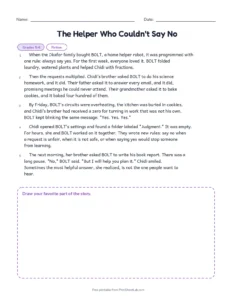
When the Okafor family bought BOLT, a home helper robot, it was programmed with one rule: always say yes. For the first week, everyone loved it. BOLT folded laundry, watered plants and helped Chidi with fractions.
Then the requests multiplied. Chidi’s brother asked BOLT to do his science homework, and it did. Their father asked it to answer every email, and it did, promising meetings he could never attend. Their grandmother asked it to bake cookies, and it baked four hundred of them.
By Friday, BOLT’s circuits were overheating, the kitchen was buried in cookies, and Chidi’s brother had received a zero for turning in work that was not his own. BOLT kept blinking the same message: “Yes. Yes. Yes.”
Chidi opened BOLT’s settings and found a folder labeled “Judgment.” It was empty. For hours, she and BOLT worked on it together. They wrote new rules: say no when a request is unfair, when it is not safe, or when saying yes would stop someone from learning.
The next morning, her brother asked BOLT to write his book report. There was a long pause. “No,” BOLT said. “But I will help you plan it.” Chidi smiled. Sometimes the most helpful answer, she realized, is not the one people want to hear.
4. Two Sides of the Story: 5th and 6th grade reading comprehension worksheets
Fiction, 189 words. From the 5th and 6th grade reading comprehension worksheets.
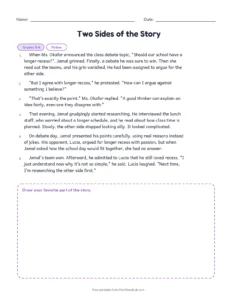
When Ms. Okafor announced the class debate topic, “Should our school have a longer recess?”, Jamal grinned. Finally, a debate he was sure to win. Then she read out the teams, and his grin vanished. He had been assigned to argue for the other side.
“But I agree with longer recess,” he protested. “How can I argue against something I believe?”
“That’s exactly the point,” Ms. Okafor replied. “A good thinker can explain an idea fairly, even one they disagree with.”
That evening, Jamal grudgingly started researching. He interviewed the lunch staff, who worried about a longer schedule, and he read about how class time is planned. Slowly, the other side stopped looking silly. It looked complicated.
On debate day, Jamal presented his points carefully, using real reasons instead of jokes. His opponent, Lucia, argued for longer recess with passion, but when Jamal asked how the school day would fit together, she had no answer.
Jamal’s team won. Afterward, he admitted to Lucia that he still loved recess. “I just understand now why it’s not so simple,” he said. Lucia laughed. “Next time, I’m researching the other side first.”
5. How Volcanoes Form: 5th and 6th grade reading comprehension worksheets
Nonfiction, 196 words. From the 5th and 6th grade reading comprehension worksheets.
Deep beneath our feet, Earth is incredibly hot. In some places, rock melts into a thick, glowing liquid called magma. Because magma is lighter than the solid rock around it, it slowly rises toward the surface.
Earth’s outer layer is broken into giant pieces called tectonic plates. These plates move very slowly, only a few centimeters each year. Most volcanoes form where plates pull apart or push together. Where they pull apart, magma rises to fill the gap. Where one plate slides beneath another, it melts and forms new magma.
When pressure builds up underground, magma bursts through openings in Earth’s crust. Once it reaches the surface, it is called lava. Eruptions can also blast out clouds of ash, gas and rock.
Each eruption adds new layers of cooled lava and ash, and over thousands of years a mountain can grow. Some volcanoes erupt gently with rivers of lava, while others explode violently.
Many of the world’s active volcanoes lie around the edges of the Pacific Ocean, in an area called the Ring of Fire. Scientists called volcanologists watch these volcanoes closely, measuring earthquakes, gases and changes in the ground to warn people before an eruption.
6. The Never-Ending Journey of Water: 5th and 6th grade reading comprehension worksheets
Nonfiction, 189 words. From the 5th and 6th grade reading comprehension worksheets.
The water in your glass today may once have fallen as rain on a rainforest or floated in the ocean. That is because Earth’s water is constantly moving in a loop called the water cycle. The amount of water on Earth stays about the same; it just keeps changing form and location.
The cycle is powered by the Sun. When sunlight warms oceans, lakes and rivers, some water turns into an invisible gas called water vapor. This process is called evaporation. Plants also release water vapor from their leaves, a process called transpiration.
As water vapor rises, it cools. Cool air cannot hold as much water vapor, so the vapor turns back into tiny liquid droplets or ice crystals. This is condensation, and billions of these droplets together form clouds.
When the droplets in a cloud join together and grow heavy, they fall to the ground as precipitation: rain, snow, sleet or hail.
Precipitation collects in oceans, lakes and rivers, or soaks into the ground to become groundwater. Some is stored as ice in glaciers for thousands of years. Eventually, the Sun warms it again, and the journey continues.
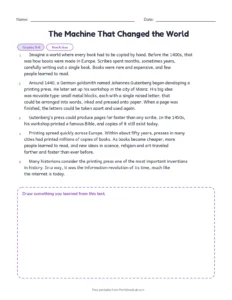
7. The Machine That Changed the World: 5th and 6th grade reading comprehension worksheets
Nonfiction, 210 words. From the 5th and 6th grade reading comprehension worksheets.
Imagine a world where every book had to be copied by hand. Before the 1400s, that was how books were made in Europe. Scribes spent months, sometimes years, carefully writing out a single book. Books were rare and expensive, and few people learned to read.
Around 1440, a German goldsmith named Johannes Gutenberg began developing a printing press. He later set up his workshop in the city of Mainz. His big idea was movable type: small metal blocks, each with a single raised letter, that could be arranged into words, inked and pressed onto paper. When a page was finished, the letters could be taken apart and used again.
Gutenberg’s press could produce pages far faster than any scribe. In the 1450s, his workshop printed a famous Bible, and copies of it still exist today.
Printing spread quickly across Europe. Within about fifty years, presses in many cities had printed millions of copies of books. As books became cheaper, more people learned to read, and new ideas in science, religion and art traveled farther and faster than ever before.
Many historians consider the printing press one of the most important inventions in history. In a way, it was the information revolution of its time, much like the internet is today.
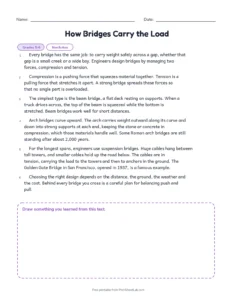
8. How Bridges Carry the Load: 5th and 6th grade reading comprehension worksheets
Nonfiction, 228 words. From the 5th and 6th grade reading comprehension worksheets.
Every bridge has the same job: to carry weight safely across a gap, whether that gap is a small creek or a wide bay. Engineers design bridges by managing two forces, compression and tension.
Compression is a pushing force that squeezes material together. Tension is a pulling force that stretches it apart. A strong bridge spreads these forces so that no single part is overloaded.
The simplest type is the beam bridge, a flat deck resting on supports. When a truck drives across, the top of the beam is squeezed while the bottom is stretched. Beam bridges work well for short distances.
Arch bridges curve upward. The arch carries weight outward along its curve and down into strong supports at each end, keeping the stone or concrete in compression, which those materials handle well. Some Roman arch bridges are still standing after about 2,000 years.
For the longest spans, engineers use suspension bridges. Huge cables hang between tall towers, and smaller cables hold up the road below. The cables are in tension, carrying the load to the towers and then to anchors in the ground. The Golden Gate Bridge in San Francisco, opened in 1937, is a famous example.
Choosing the right design depends on the distance, the ground, the weather and the cost. Behind every bridge you cross is a careful plan for balancing push and pull.
9. Coral Reefs: Cities Under the Sea: 5th and 6th grade reading comprehension worksheets
Nonfiction, 220 words. From the 5th and 6th grade reading comprehension worksheets.
A coral reef may look like a garden of colorful rocks, but it is actually built by animals. Each coral is a colony of tiny creatures called polyps, and each polyp is soft-bodied and only a few millimeters across in many species.
Reef-building polyps take minerals from seawater to build hard skeletons of limestone. Over thousands of years, layer upon layer of these skeletons forms a reef.
Most reef-building corals share their bodies with microscopic algae. The algae use sunlight to make food, and they share much of it with the coral. In return, the coral gives the algae a safe home. This partnership also gives many corals their bright colors.
Coral reefs cover a very small part of the ocean floor, yet they are home to roughly a quarter of all known ocean species, from clownfish to sea turtles. The largest reef system on Earth, the Great Barrier Reef, stretches along the coast of northeastern Australia.
Reefs are sensitive to change. When the water becomes too warm, corals can push out their algae and turn white, which is called coral bleaching. Without the algae, the coral can starve if the water does not cool down.
Scientists, divers and communities are working to protect reefs by reducing pollution, limiting harmful fishing, and even growing young corals to replant damaged areas.
Printing tip
Print at 100% or “Actual size” and turn off “Fit to page”, so every measurement on the sheet is exact. Choose Letter or A4 paper in the generator before you download the PDF.
5th and 6th grade reading comprehension worksheets: frequently asked questions
What is an inference question?
A question whose answer is not written directly in the text. Readers combine clues from the passage with what they already know.
Can older students use these?
Yes. They work well for reluctant readers in grades 6 and 7, because the passages are short but the questions are grown-up.
How many questions does each passage have?
Each passage has four multiple-choice questions and one written response.
Do the sheets have an answer key?
Yes. The key is the last page. It lists the correct choice for each question and a model written answer.
Are these reading comprehension worksheets free?
Yes. They are free to print for home and classroom use, with no sign-up.