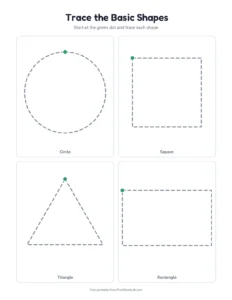
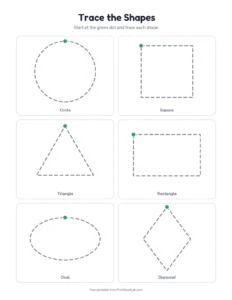
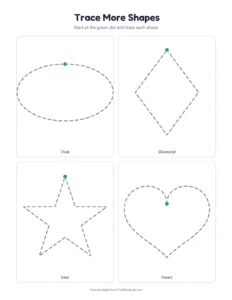
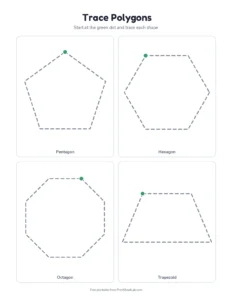
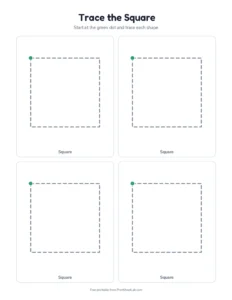
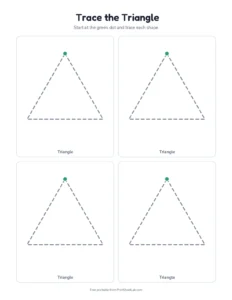
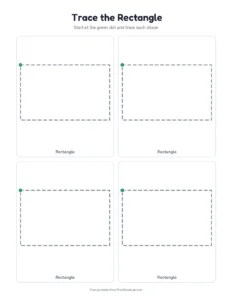
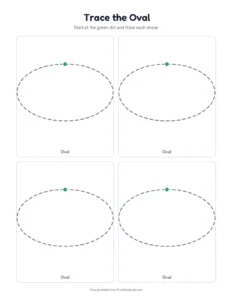
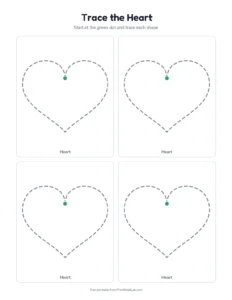
Shape tracing worksheets let young children practice tracing circles, squares, triangles, rectangles and more, which builds pencil control and teaches shape names at the same time. Each shape is a dashed outline with a green dot to start on. Make your own shape tracing sheet with the maker below, or print one of the ready PDFs.
Quick answer: Shape tracing worksheets are printable pages with dashed shape outlines for a child to trace, starting at a green dot. They build the pencil control needed for letters and teach shape names. This page has 11 free shape tracing worksheets (PDF): the basic shapes, more shapes, polygons, all 12 shapes and single-shape practice, plus a maker for your own. Updated October 2026.
Ready-to-print samples
A few of the ready PDFs on this page. The full list is under Ready-to-print worksheets.
Trace the basic shapesCircle, square, triangle, rectangle.PDFTrace the circleFour circles to a page.PDFTrace the starFour stars to a page.PDFTrace all 12 shapesTwelve shapes on two pages.PDF
Tracing shapes: the 12 shapes in our worksheets
These are the shapes you can trace on this page. The table gives the number of sides and corners, which are the facts children learn about each shape in kindergarten and grade 1 (see the Common Core kindergarten geometry standards):
Shape
Sides
Corners
What to say while tracing
Circle
0
0
Round, no corners
Triangle
3
3
Three straight sides
Square
4
4
Four equal sides
Rectangle
4
4
Four sides, opposite sides equal
Pentagon
5
5
Five sides
Hexagon
6
6
Six sides
Octagon
8
8
Eight sides
Diamond
4
4
Four equal sides, tilted
Trapezoid
4
4
One pair of parallel sides
How to trace shapes: a simple order
Trace shapes in the order that children can draw them. A circle is a single curved stroke, so it comes first. A square needs four straight strokes and turns at the corners, a triangle needs three slanting strokes, and shapes such as a star or a heart need the most control. The ready sheets follow this order: basic shapes first, then more shapes, then polygons.
Trace the shape with a finger, starting at the green dot.
Trace it with a crayon, saying the name and the number of sides.
Trace it again with a different color.
Draw the same shape alone on blank paper.
Tracing shapes worksheets and shape tracing sheets
This page is also searched as tracing shapes worksheets, tracing shapes worksheet, trace shapes worksheet, shapes tracing and shape tracing sheets. All are the free PDFs listed above: US Letter or A4, no sign-up. Choose large for toddlers and small for older children who want more shapes on a page. Switch between dashed, dotted and light solid lines in the maker, depending on how much guidance your child needs.
From tracing shapes to naming shapes
Children who trace shapes quickly learn their names, and the 2D shapes worksheets page is the next step: sheets that ask a child to name each shape and count its sides and vertices. The geometry worksheets sheets add 3D shapes. A shape hunt around the house, looking for circles on plates, rectangles on doors and triangles on roofs, links the worksheet to the real world.
A weekly plan for tracing shapes
Day
Focus
Suggested block
Monday
Trace circles, then squares
10 min
Tuesday
Trace triangles and rectangles
10 min
Wednesday
Trace an oval, a diamond or a star
10 min
Thursday
Shape hunt, then one tracing page
10 min
Weekly total
Four short sessions
40 min
How to trace each shape
Each shape has its own movement. Say the movement aloud while the child traces, because words help the hand remember. This table also lists the mistake to watch for:
Shape
How to trace it
A common mistake
Circle
One smooth curve, back to the start
Stopping halfway and making a flat side
Square
Down, across, up, back: stop and turn at each corner
Rounding the corners
Triangle
Three slanting strokes, one turn at each point
Making the base curved
Rectangle
Two long sides and two short sides
Making all four sides equal
Star
Follow the points one at a time
Skipping a point
Heart
Two curves meeting at the bottom point
Drawing a flat top
Games that go with shape tracing
Shape hunt: find a circle, a square and a triangle in the room, then trace each one.
Playdough shapes: roll a snake of playdough and make it into a circle, a square or a heart.
Chalk shapes: draw big shapes on the pavement and walk around them.
Shape picture: after tracing, cut out the shapes and glue them to make a house or a robot.
Window painting: trace shapes on a window with a wet brush for a big, easy movement.
Printing shape tracing sheets
Choose large for toddlers and children with shaky lines, medium for most preschoolers and small for older children who like more shapes on a page. Print on US Letter or A4, in black and white, and use a sheet protector with a dry-erase marker to reuse a page again and again. The single-shape sheets are useful when a child needs extra practice with one shape, such as the circle.
Shape tracing worksheets for different ages
Two year olds may only scribble over a circle, which is a good start. Three year olds can usually trace a circle and straight lines. By four, many children can trace a square and a cross, and by five, a triangle and more complex shapes such as the star and the heart. Use the large size for the youngest, the medium size for most preschoolers and the small size for older children.
Shape names in other words
Parents often want to link the shape to a word the child knows. A circle is a ball or a wheel, a square is a window or a box, a triangle is a roof or a slice of pizza, a rectangle is a door or a book, an oval is an egg, a diamond is a kite, a star is a star in the sky and a heart is a heart. Using everyday words helps children remember the names.
Frequently asked questions
8 quick answers
Where can I download free shape tracing worksheets?
Open any worksheet in the Ready-to-print list on this page, choose US Letter or A4, then print or save the PDF. They are free, and no account is needed.
Which shapes should a child trace first?
Start with the circle, then the square, triangle and rectangle. Add the oval, diamond, star and heart afterwards, and the polygons last.
What is the difference between tracing shapes and drawing shapes?
Tracing follows a printed outline, which guides the hand. Drawing makes the shape from memory. Children usually trace first and then draw.
Can I choose which shapes to trace?
Yes. Pick one of the shape sets in the maker, or use the single-shape sheets, which have four of the same shape on a page.
Which shapes are hardest to trace?
Shapes with many corners or sharp points, such as stars and hexagons, are the hardest, because the child must stop and turn at each corner. Circles and ovals are easier, though they need smooth control.
How many shapes should a child trace at once?
Four large shapes on a page is a good start for preschoolers. Older children can manage six or twelve smaller shapes on a page.
Why does the sheet have a green dot?
The dot shows where to start, so every tracing begins in the same place. Starting at the same place builds a consistent movement.
Do shape tracing worksheets teach shape names?
They help. Say the name of each shape while tracing it, and ask about sides and corners, so the child links the movement and the name.