2D shapes are flat shapes that have length and width but no thickness, such as a circle, a triangle or a rectangle. The five PDFs on this page ask children to name shapes from a word bank and to count the sides and vertices of each one, and every sheet has an answer key. They follow standards K.G.A.2, 1.G.A.1 and 2.G.A.1, which the Common Core standards for kindergarten geometry describe, and the notes below explain what to teach at each step.
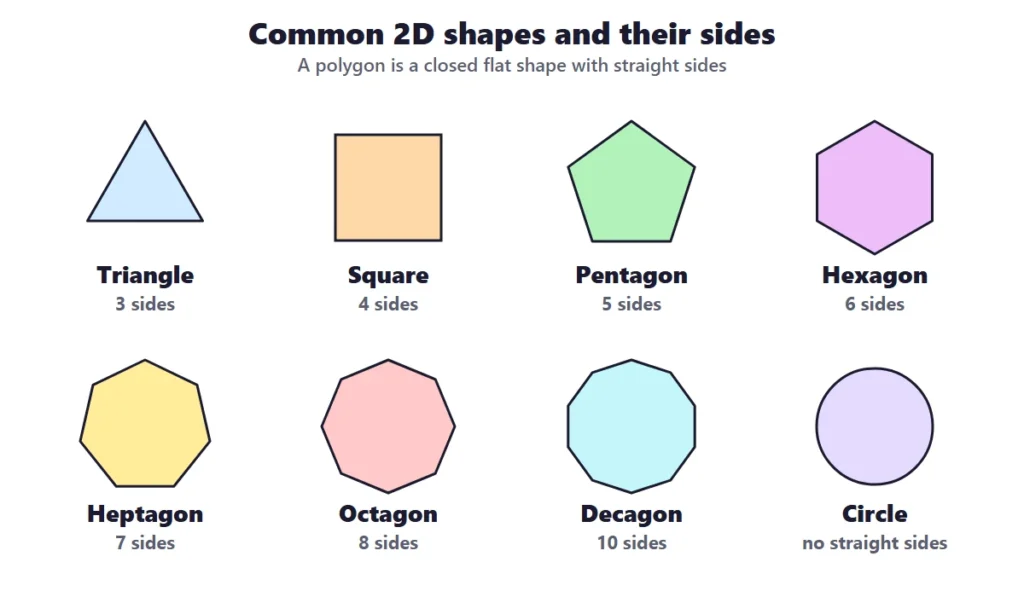
Names and sides. Triangle to decagon, and the circle.
Quick answer: 2D shapes are flat shapes, such as the circle, triangle, square, rectangle, pentagon, hexagon and octagon, that you can name by counting their sides and corners. This page has 5 free printable 2D shapes worksheets with answer keys for kindergarten to grade 2. Updated October 2026.
Naming shapes by their sides
Most shape names count sides: a pentagon has 5, a hexagon 6 and an octagon 8 (like an octopus has 8 legs). Four-sided shapes have special names depending on their sides and angles: square, rectangle, rhombus, trapezoid and parallelogram.
2D shapes chart
Shape
Sides
Vertices
Circle
0 (one curved line)
0
Triangle
3
3
Square
4 (all equal)
4
Rectangle
4
4
Rhombus
4 (all equal)
4
Trapezoid (trapezium)
4
4
Pentagon
5
5
Hexagon
6
6
Heptagon
7
7
Octagon
8
8
Decagon
10
10
A polygon is any closed flat shape with straight sides, so a circle is not a polygon. In a regular polygon all the sides and angles are equal; a stop sign is a regular octagon.
Shape activities for kindergarten and grade 1
Shape hunt: look for clocks (circles), windows (rectangles) and roof tops (triangles).
Sort shapes by the number of sides, then by color or size: the name depends only on the sides.
Draw shapes on a partner’s back and let them guess.
Build pictures (a house, a rocket) from paper shapes and count how many of each you used.
Common mistakes
Thinking only “upright” triangles are triangles. Any closed shape with 3 straight sides is a triangle.
Mixing up 2D and 3D names: a ball is a sphere, not a circle.
2d shapes worksheets: what is in the set
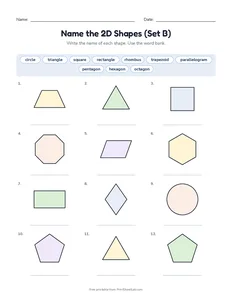
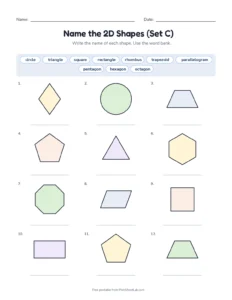
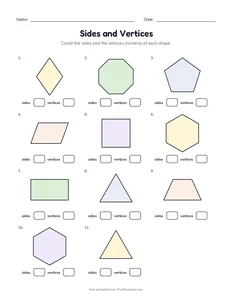
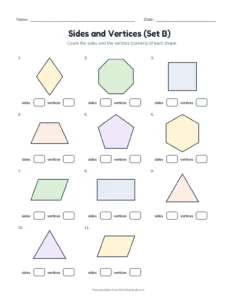
There are 5 2d shapes worksheets on this page, and every one has an answer key except for any cut-out games. Three sets ask children to name the shape, and two sets ask them to count the sides and the vertices.
Worksheet
What children do
Standard
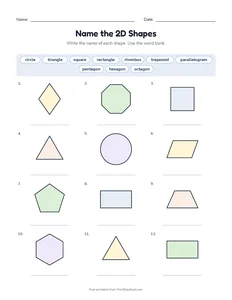
Name the 2D Shapes
Write the name of each shape using the word bank.
1.G.A.1
Name the 2D Shapes (Set B)
Twelve more shapes to name.
1.G.A.1
Name the 2D Shapes (Set C)
Another twelve shapes to name with the word bank.
1.G.A.1
Sides and Vertices
Count the sides and vertices of each shape.
1.G.A.1
Sides and Vertices (Set B)
Count the sides and vertices of twelve more shapes.
1.G.A.1
2D shapes: names, sides and vertices of the polygons
The names of the 2D shapes with straight sides come from Greek number words: a triangle has 3 angles, a pentagon has 5 sides, and a hexagon has 6. Children who know the prefixes can name any polygon they meet. The number of vertices is always the same as the number of sides, because every side ends at a vertex. This table lists the polygons from 3 to 12 sides, with the angle sum and the angle of each corner if all the sides and angles are equal. Wikipedia’s article on polygons has the full list of names:
Sides
Name
Where the name comes from
Vertices
Angle sum
Each angle if regular
3
triangle
tri means three
3
180°
60°
4
quadrilateral
quad means four, and “lateral” means side
4
360°
90°
5
pentagon
penta means five
5
540°
108°
6
hexagon
hexa means six
6
720°
120°
7
heptagon
hepta means seven
7
900°
128.6°
8
octagon
octa means eight
8
1080°
135°
9
nonagon
nona means nine
9
1260°
140°
10
decagon
deca means ten
10
1440°
144°
12
dodecagon
dodeca means twelve
12
1800°
150°
The angle sum goes up by 180° each time a side is added, since every extra side adds one more triangle inside the shape. This is an idea for older children, but the table shows that the shapes are connected: a hexagon is 4 triangles, and a square is 2.
Sides and vertices worksheets: how many diagonals?
The sides and vertices worksheets ask children to count the sides and the vertices of a shape, and an interesting fact is how many other lines can be drawn between the vertices. A line joining two vertices that are not neighbors is a diagonal. A polygon with n sides has n × (n − 3) ÷ 2 diagonals. This table shows how it grows:
Sides
Vertices
Diagonals from one vertex
Diagonals in all
Triangles inside
3
3
0
0
1
4
4
1
2
2
5
5
2
5
3
6
6
3
9
4
7
7
4
14
5
8
8
5
20
6
9
9
6
27
7
10
10
7
35
8
A triangle has no diagonals, because every vertex is joined to the other two by a side. A hexagon has 9, and a decagon has 35. Children can check these by drawing the shapes and counting, which is a good way to practice counting carefully.
Naming shapes worksheets: size and position do not matter
The naming shapes worksheets show shapes in different sizes and positions, because the standard K.G.A.2 says to name shapes “regardless of their orientations or overall size”. A triangle can be tall, wide, upside down or tilted, and it is still a triangle. A good question to ask is “what makes this a triangle?” and the answer should be the number of sides: three straight sides that make a closed shape. The three naming sets on this page use a word bank, and the shapes in every set are shown in different sizes and positions.
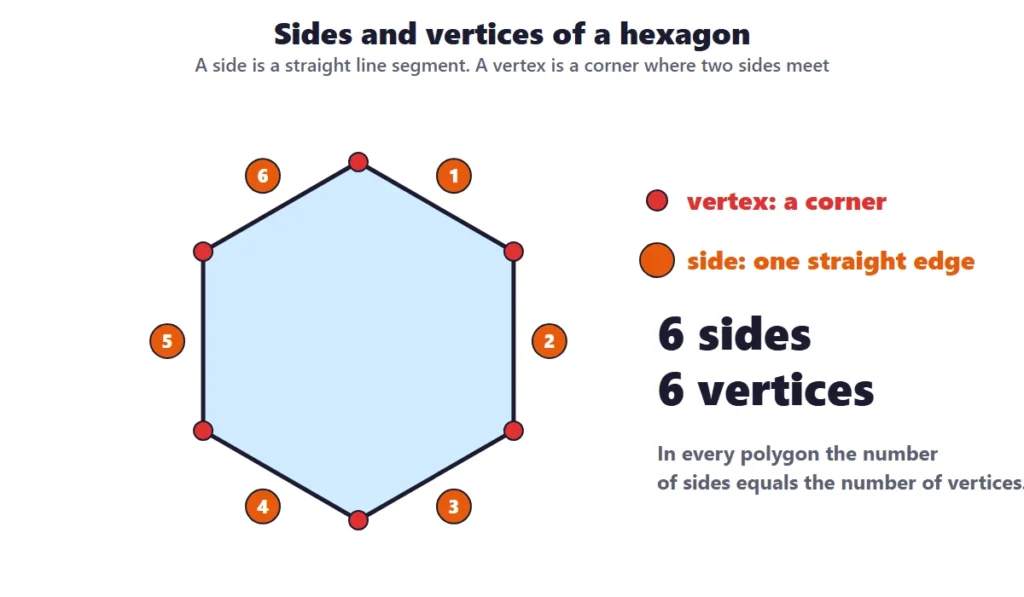
Sides and vertices. A hexagon has 6 of each.
Shapes worksheets for kindergarten: what children learn at each grade
Shapes worksheets for kindergarten start with a few shapes and grow in difficulty over the next few years. This table shows the order that the Common Core standards use, with the standard that goes with each step:
Grade
What children do
Standard
Kindergarten
Name shapes whatever their size or position
K.G.A.2
Kindergarten
Describe shapes by the number of sides and vertices
K.G.B.4
Grade 1
Tell defining features (sides) from non-defining ones (color, size)
1.G.A.1
Grade 1
Put shapes together to make bigger shapes
1.G.A.2
Grade 2
Draw shapes with a given number of angles or sides
2.G.A.1
Grade 3
Sort quadrilaterals into categories
3.G.A.1
The sheets on this page cover kindergarten to grade 2. The word bank on the naming sets shortens the task for the youngest children, and the sides and vertices sets are best for grade 1 and 2. The 3D shapes page is the next step, with solid shapes.
Polygon worksheets: regular polygons and their angles
A polygon is a closed flat shape made of straight sides. A regular polygon has all its sides and angles equal, such as a stop sign. Polygon worksheets for older children use the idea that the angles of a regular polygon can be calculated. Each interior angle is (n − 2) × 180° ÷ n, and each exterior angle is 360° ÷ n. This table gives six regular polygons that children know:
Polygon
Sides
Each interior angle
Each exterior angle
Everyday example
Triangle
3
60°
120°
a yield sign
Square
4
90°
90°
a floor tile
Pentagon
5
108°
72°
home plate in baseball
Hexagon
6
120°
60°
a honeycomb cell
Octagon
8
135°
45°
a stop sign
Dodecagon
12
150°
30°
the UK 12-sided pound coin
The angle of a square is 90°, and for a hexagon it is 120°. Three hexagons fit together around a point, since 3 × 120° = 360°, which is the reason why a honeycomb has no gaps. Squares and equilateral triangles also fit together with no gaps, and so can no other regular polygons on their own. The fractions worksheets use the same shapes when they cut a shape into equal parts.
Four-sided shapes: the quadrilateral family
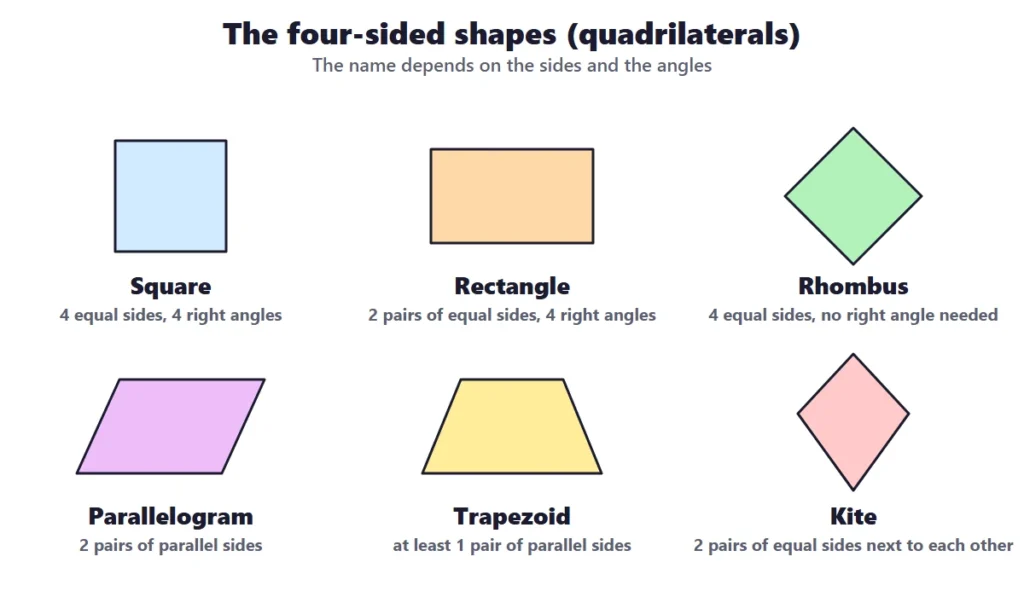
The quadrilaterals are a good example of how shapes belong to groups. All of them have 4 sides, but they have different properties. This table shows six of them, and the last column counts the lines of symmetry:
Shape
Sides
Parallel sides
Angles
Lines of symmetry
Square
4 equal sides
2 pairs
4 right angles
4
Rectangle
2 pairs of equal sides
2 pairs
4 right angles
2
Rhombus
4 equal sides
2 pairs
no right angle needed
2
Parallelogram
2 pairs of equal sides
2 pairs
no right angle needed
0
Trapezoid
no equal sides needed
at least 1 pair
no right angle needed
0
Kite
2 pairs of equal sides next to each other
none needed
no right angle needed
1
The shapes are also nested. A square is a special rectangle, and a rectangle is a special parallelogram. In US schools a trapezoid has at least one pair of parallel sides, so a parallelogram is also a trapezoid, though some books use a stricter definition. This table shows which shapes are also other shapes:
Shape
It is also a…
Why
Square
rectangle, rhombus, parallelogram, trapezoid
It has all the properties of each
Rectangle
parallelogram, trapezoid
Opposite sides are parallel and equal
Rhombus
parallelogram, trapezoid
Opposite sides are parallel
Parallelogram
trapezoid
It has at least one pair of parallel sides
Kite
none of the others
It has no parallel sides
Common mistakes with 2D shapes
Most mistakes come from a picture in the child’s mind that is too narrow, such as a triangle that always points up. This table shows six mistakes, what went wrong and the fix:
What the child says
What went wrong
The fix
A triangle that points down is not a triangle
thinks a shape must stand on its base
turn the shape: any closed shape with 3 straight sides is a triangle
A circle has 1 side
counts the curved line as a side
a side is a straight line segment, so a circle has none
A rectangle has 2 sides, one long and one short
counts pairs
count every side: a rectangle has 4
A hexagon has 5 vertices
misses one corner when counting
mark each vertex with a dot as you count
A square is not a rectangle
sees the shapes as two separate groups
a square has all the properties of a rectangle: 4 right angles
A ball is a circle
mixes 2D and 3D shapes
a circle is flat, and a ball is a sphere
2d shapes word problems
Story problems use the shapes of everyday objects. Ask children to draw the shape, to label the sides and vertices, and to say the answer in a sentence:
Word problem
Working
Answer
A stop sign is a regular octagon. How many sides and vertices does it have?
8 sides and 8 vertices
8 and 8
A pizza box top is a square and a slice of pizza is a triangle. How many sides do the two shapes have together?
4 + 3
7 sides
A honeycomb has 3 separate hexagon cells. How many vertices are there in all?
3 × 6
18 vertices
Mia draws a shape with 5 sides. What is it called?
penta means five
a pentagon
A pencil case is a rectangle and a ruler is a rectangle. How many right angles do the two have?
4 + 4
8 right angles
Leo makes a house from 1 square and 1 triangle. How many sides do the two shapes have?
4 + 3
7 sides
Games and activities for 2d shapes
Children learn 2d shapes best when they play with it. These games use things that are found at home or in a classroom:
Shape hunt: look for clocks (circles), windows (rectangles) and road signs (triangles and octagons)
Mystery shape: one child feels a cardboard shape in a bag, and says how many sides it has
Shape pictures: build a house or a rocket from paper shapes, and count how many of each shape you used
Geoboard shapes: make a triangle, a square and a hexagon with rubber bands on a geoboard
Straw shapes: use straws and clay to make shapes, and count the vertices
Shape bingo: a bingo card with shape names and calling cards with shape pictures
Extra support and extra challenge with 2d shapes
For children who need more support: start with the circle, the square, the triangle and the rectangle, with real objects in the hand. Trace around each shape, count the sides with a finger and mark each vertex with a dot. Practice only the first set of naming until the names are secure, and keep the word bank in sight.
For children who need more challenge: ask for the shape that has 5 sides and 5 vertices, to draw a shape with 6 sides that is not regular, and to find a shape that fits in a hexagon in different ways. The “Sides and Vertices (Set B)” worksheet and the diagonal table are good challenges.
How to tell that a child is ready to move on from 2d shapes
The child names the common 2D shapes in any size or position.
The child counts the sides and the vertices of a shape.
The child says why a shape is a triangle or a rectangle, using the sides.
The child knows that a circle has no sides and no vertices.
When all four are true, move on to the 3D shapes page, or to the symmetry page.
Four-sided shapes. Square, rectangle, rhombus, parallelogram, trapezoid and kite.
A 20-minute lesson on 2d shapes
A short lesson is the best way to introduce 2d shapes. This 20-minute plan can be used in a classroom, at a tutoring session or at home, and it uses the worksheets at the end:
Minutes
Activity
What to say or ask
0 to 3
Hold up a triangle, a square and a circle and ask children to name them
How do you know? What do they have in common?
3 to 8
Count the sides and vertices of each shape together, marking each vertex
How many sides? How many vertices?
8 to 13
Turn a triangle upside down and tilt it
Is it still a triangle? Why?
13 to 18
Name the pentagon, hexagon and octagon from a word bank
What does the prefix tell us?
18 to 20
Start a worksheet and check one answer
Count again to check.
Where 2d shapes fits across the grades
No skill stands alone. This table shows what children learn before and after 2d shapes, with the standard that goes with each step:
This page is the start of the geometry sequence. The whole sequence is on the geometry worksheets page.
Helping at home with 2d shapes
Parents do not need to be experts to help with 2d shapes. These suggestions work well, and each takes only a few minutes:
Go on a shape walk and name the shapes of signs, doors and windows.
Draw a shape in the air and ask the child to guess it.
Cut a sandwich into a triangle and a square, and count the sides.
Ask “how many corners?” and then call them vertices.
Praise “because it has three straight sides” as an answer.
How to check progress in 2d shapes
A teacher or parent can check progress with the answer key and a few questions. This table shows three common situations, what they mean and what to do next:
What you see
What it means
What to do next
The child names shapes only when they are upright
The picture in the child’s mind is too narrow
Rotate the shapes, and ask “what makes this a triangle?”
The child gets 9 of 10 right in every set
The skill is secure
Move on to 3D shapes
The child counts sides but forgets the vertices
The child sees sides as the only property
Mark the vertices with dots, and count both
A five-day plan for 2d shapes
Most children need about a week of short sessions for 2d shapes. This plan follows the order of the worksheets on this page:
Day
What to do
Practice
Day 1
Shape hunt: find circles, squares and triangles
Name the 2D Shapes
Day 2
Name rectangles, pentagons and hexagons
Name the 2D Shapes (Set B)
Day 3
Name shapes with the word bank, including the heptagon and octagon
Name the 2D Shapes (Set C)
Day 4
Count the sides and vertices of each shape
Sides and Vertices
Day 5
Count sides and vertices of twelve more shapes
Sides and Vertices (Set B)
When the plan is complete, move on to the 3D shapes page. The whole sequence is on the geometry worksheets page.
Shapes worksheets for kindergarten: free PDFs
This page is also searched as shapes worksheets for kindergarten, shapes worksheet kindergarten, shapes worksheets kindergarten, kindergarten shapes worksheets, kindergarten shapes worksheet, kindergarten worksheets shapes, shape worksheets kindergarten, shape worksheets for kindergarten and shapes for kindergarten worksheets. They are all the free PDFs above, each with an answer key. Free printable shapes worksheets for kindergarten, free kindergarten worksheets shapes and basic shapes kindergarten pages start with the circle, square, triangle and rectangle. Free printable shape worksheets for kindergarten need no sign-up.
Frequently asked questions
8 quick answers
How many sides does a trapezoid have?
Four. In US schools a trapezoid has at least one pair of parallel sides.
Does a circle have sides?
No. A circle is one curved line with no sides and no vertices.
Is a square a rhombus?
Yes. A rhombus has four equal sides, and so does a square. But not every rhombus is a square, because a rhombus does not need right angles.
What 2D shapes should a kindergartener know?
Circle, square, triangle, rectangle, and often hexagon, described by sides and corners (standard K.G.A.2).
What is the difference between a side and a vertex?
A side is a straight line segment that is part of the outline of a shape. A vertex is a corner, the point where two sides meet. A polygon always has the same number of sides and vertices.
Is a circle a polygon?
No. A polygon has only straight sides, and a circle has a curved line with no sides and no vertices. Its name, in geometry, is a closed curve.
How many 2D shapes should a child know before grade 1?
Most kindergarten classes teach the circle, square, triangle, rectangle and hexagon, and often the rhombus and trapezoid too. Children name them by their sides and corners, as in standard K.G.A.2.
Where can I download free shapes worksheets for kindergarten?
Open any worksheet in the gallery above, choose US Letter or A4, then print or save the PDF. They are free and each has an answer key.