Comparing large numbers uses the same rule as small ones: line up the places and compare from the left. With five or six digits, many pairs share their first few digits, so careful place-by-place checking matters. Grade 4 children compare multi-digit numbers using >, = and < (Common Core 4.NBT.A.2).
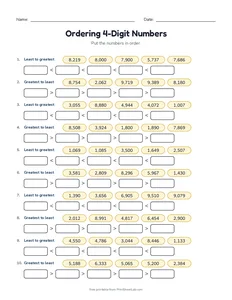
Comparing 4-digit numbers.
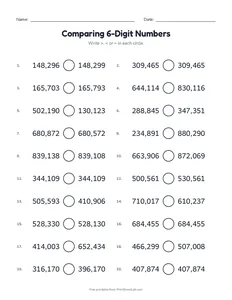
Comparing 6-digit numbers.
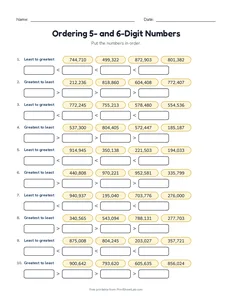
Ordering sets of five numbers.
Comparing large numbers worksheets: what is in the set
There are 5 comparing large numbers worksheets on this page, and every one has an answer key except for any cut-out games. The five sets compare 4-digit, 5-digit and 6-digit numbers, and the last two put four or five numbers in order.
Worksheet
What children do
Standard
Comparing 4-Digit Numbers
20 comparisons with 4-digit numbers.
4.NBT.A.2
Comparing 6-Digit Numbers
20 comparisons with 6-digit numbers.
4.NBT.A.2
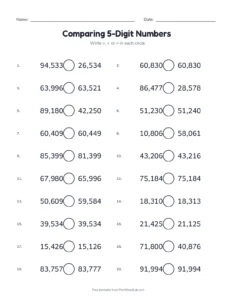
Comparing 5-Digit Numbers
Compare numbers in the ten thousands.
4.NBT.A.2
Ordering 4-Digit Numbers
Order five 4-digit numbers.
4.NBT.A.2
Ordering 5- and 6-Digit Numbers
Order four large numbers.
4.NBT.A.2
Comparing large numbers worksheets: how many digits do the numbers have?
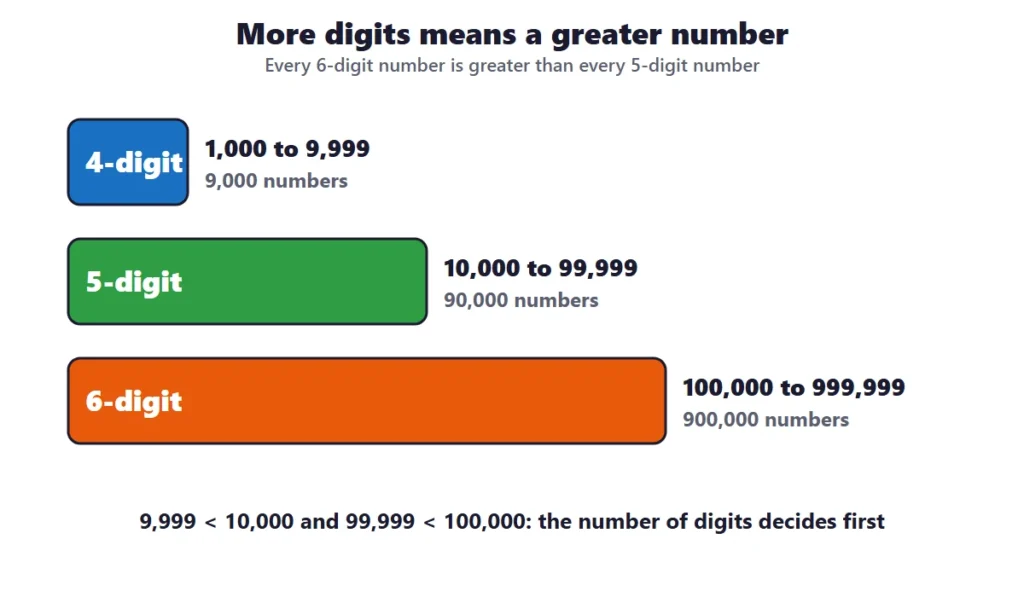
The first thing to check when comparing large numbers worksheets is the number of digits. A number with more digits is always greater, because its first digit is a higher place. This table shows the numbers with 4, 5, 6 and 7 digits, with the smallest and greatest in each group:
Digits
Greatest place
Least number
Greatest number
How many numbers
4
thousands
1,000
9,999
9,000
5
ten thousands
10,000
99,999
90,000
6
hundred thousands
100,000
999,999
900,000
7
millions
1,000,000
9,999,999
9,000,000
This means that 9,999 is less than 10,000, and 99,999 is less than 100,000. Children who compare digits one by one from the left will make mistakes, such as saying that 98,765 is greater than 100,000. The worksheets include such pairs on purpose. Wikipedia’s article on large numbers describes how numbers continue to grow.
Comparing 4 digit numbers: how often does the first digit decide?
When comparing 4 digit numbers, the first digit decides most of the time. If the numbers are chosen at random, the thousands digit gives the answer in 88.9% of the pairs. The next digit is needed in about 10%. The table shows the chance that each place decides for 4-digit, 5-digit and 6-digit pairs, and the average number of digits to look at:
Random pairs of
Decided by the first digit
by the second digit
by the third digit
Equal
Digits to look at (average)
4-digit pairs
88.9%
10.0%
1.00%
0.011%
1.12
5-digit pairs
88.9%
10.0%
1.00%
0.001%
1.12
6-digit pairs
88.9%
10.0%
1.00%
0.000%
1.12
So for random numbers one digit is enough nine times in ten. That is why many large number worksheets choose pairs that share their first digits, since random pairs do not test the skill. A good worksheet makes children look at the third or fourth digit.
Comparing numbers grade 4: the standard
For comparing numbers grade 4, the standard is to compare two multi-digit numbers based on the meanings of the digits in each place, using the signs for greater than, equal to and less than (4.NBT.A.2). The standard covers numbers up to 1,000,000. The Common Core standards for grade 4 number and operations in base ten describe it, and the worksheets on this page use 4-digit, 5-digit and 6-digit numbers. Children also read and write the numbers in words and in expanded form in the same standard, and the place value worksheets page has worksheets for that.
Comparing 6 digit numbers: commas and periods
Commas make comparing 6 digit numbers much easier. A comma separates the digits into groups of three, called periods. A 6-digit number has two periods, the thousands and the ones, so the group before the comma tells you how many thousands there are. Compare the groups on the left first. This table shows the periods:
Period
Digits
Places
Example number
ones period
3 digits
hundreds, tens, ones
346
thousands period
3 digits
hundred thousands, ten thousands, thousands
45,346
millions period
3 digits
hundred millions, ten millions, millions
12,345,346
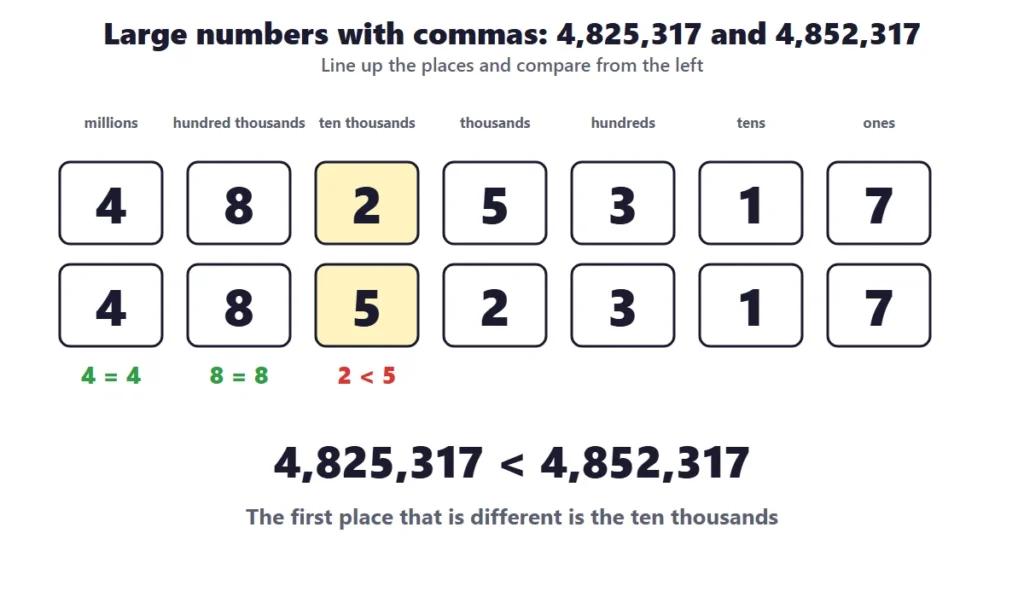
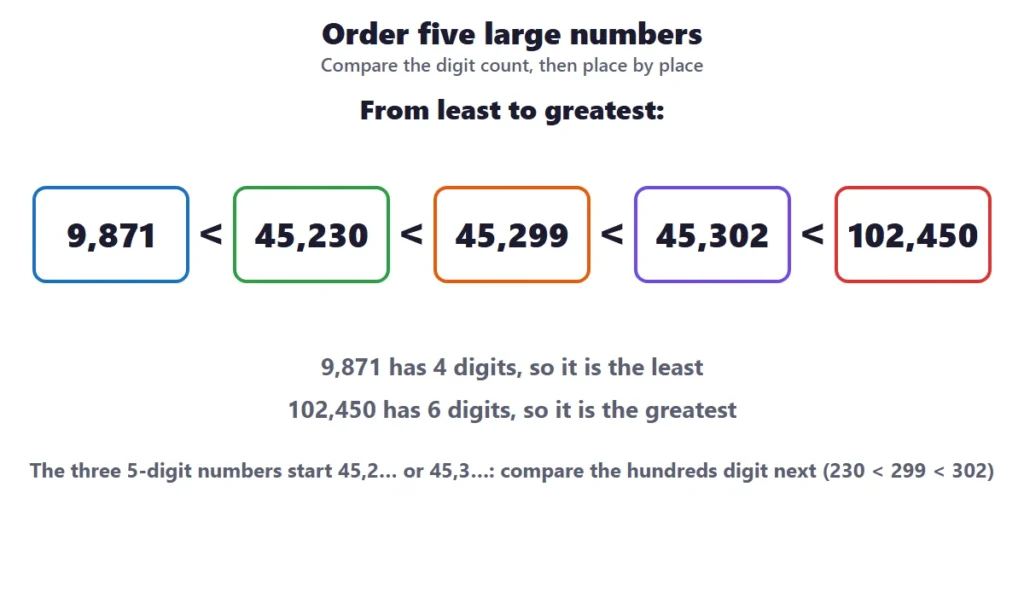
With 45,302 and 45,230, the thousands period is 45 in both, so look at the ones period: 302 is greater than 230. The place value chart tool prints a chart with the periods marked.
Ordering large numbers: five numbers, in order
Ordering large numbers is comparing several times. The method is to find the number with the fewest digits first, and then to compare the numbers with the same length. Here are six sets, three with 4-digit numbers and three with 6-digit numbers that share their first digits:
Numbers
Least to greatest
2,355, 2,520, 7,354, 4,594, 5,396
2,355 < 2,520 < 4,594 < 5,396 < 7,354
3,966, 8,687, 7,091, 4,341, 2,043
2,043 < 3,966 < 4,341 < 7,091 < 8,687
8,426, 1,048, 8,424, 6,875, 8,230
1,048 < 6,875 < 8,230 < 8,424 < 8,426
67,121, 67,115, 67,084, 67,090
67,084 < 67,090 < 67,115 < 67,121
31,306, 31,312, 31,379, 31,361
31,306 < 31,312 < 31,361 < 31,379
23,221, 23,287, 23,212, 23,242
23,212 < 23,221 < 23,242 < 23,287
Which place decides? Eight pairs
This table has eight pairs of large numbers and the place that decides each one. Some pairs are decided by the number of digits, some by the first digit, and some only by the last digit:
Number of digits. More digits is greater.
First number
Second number
Sign
What decides
4,825
4,852
<
the tens
45,302
45,230
>
the hundreds
7,019
7,109
<
the hundreds
123,456
123,465
<
the tens
98,765
100,000
<
the number of digits
500,000
499,999
>
the hundred thousands
234,567
234,576
<
the tens
3,050
3,005
>
the tens
Comparing 4 digit numbers and 6 digit numbers: the same rule at every size
The rule for comparing 4 digit numbers is the same as the rule for comparing 6 digit numbers: count the digits, then compare from the left. The only difference is the number of places to check. With 4-digit numbers there are four places, and with 6-digit numbers there are six, so a child who is careful with one is careful with the other. This is why the three worksheets on this page are written in order of size: 4-digit numbers first, then 5-digit numbers, and then 6-digit numbers. Children who find the 6-digit worksheet hard should go back to the 5-digit one and write each number in a place value chart.
When two numbers share their first three digits, such as 123,456 and 123,465, the answer depends on the tens and ones. These are the pairs that most children get wrong, because they have to look at the end of the number, and the worksheets for 6-digit numbers have several of them. A helpful habit is to draw a line under the first place that is different, and to say the two digits aloud before writing the sign.
Common mistakes when comparing large numbers
The most frequent mistakes are about the number of digits and about the order of the places. The table shows five of them:
Pair
Wrong answer
What the child did
Right answer
98,765 and 100,000
98,765 > 100,000
saw 9 and 1 as the first digits
98,765 < 100,000
45,302 and 45,230
45,302 < 45,230
compared the last digits: 2 and 0
45,302 > 45,230
7,019 and 7,109
7,019 > 7,109
looked at the ones digits: 9 is more than 9, so guessed
7,019 < 7,109
500,000 and 499,999
500,000 < 499,999
thought that more nines make a greater number
500,000 > 499,999
3,050 and 3,005
3,050 < 3,005
ignored the position of the zero
3,050 > 3,005
The last example shows that the position of a zero matters. In 3,050 there are 5 tens, and in 3,005 there are 5 ones, so 3,050 is greater.
Comparing large numbers word problems
Large numbers appear in real life, such as the numbers of seats, people or objects. These stories are fictional, and they ask children to compare two numbers:
Word problem
Working
Answer
A stadium has 45,302 seats and another has 45,230. Which has more seats?
45,302 > 45,230
the first stadium
A town has 4,825 people and another town has 4,852. Which has fewer people?
4,825 < 4,852
the first town
A farm sells 123,456 eggs in a year and another sells 123,465. Which sells more?
123,456 < 123,465
the second farm
A library has 98,765 books and a museum has 100,000 objects. Which has more?
98,765 < 100,000
the museum
A factory makes 500,000 bolts in one year and 499,999 in another. Which year is greater?
500,000 > 499,999
the first year
Two schools have 7,019 and 7,109 books. Which has fewer?
7,019 < 7,109
the first school
Games and activities for comparing large numbers
Children learn comparing large numbers best when they play with it. These games use things that are found at home or in a classroom:
Digit cards: draw six cards and make the greatest and the least 6-digit number
Place value war: each player makes a 4-digit number from cards, and the greater number wins
Spin and compare: spin a spinner for each digit, one at a time, and decide where to place it
Largest wins: players take turns to roll a die and place the digit, and the player with the greatest number wins
Number line to 10,000: mark numbers on a long line and place new numbers between them
Sorting cards: put ten large numbers in order, and check with a partner
Extra support and extra challenge with comparing large numbers
For children who need more support: use a place value chart with the periods marked, and write each number in the columns. Compare one column at a time, from the left. Keep to 4-digit numbers until the child is secure, and then add one more digit.
For children who need more challenge: ask for the number that is between two large numbers, for the greatest number less than 50,000, and for the least number you can make with six digits when the digits cannot repeat. Ask how many 5-digit numbers are greater than 99,000.
How to tell that a child is ready to move on from comparing large numbers
The child counts the digits before comparing.
The child compares from the left and stops at the first place that differs.
The child uses commas to read the periods of the number.
The child orders five large numbers without mistakes.
A short lesson is the best way to introduce comparing large numbers. This 20-minute plan can be used in a classroom, at a tutoring session or at home, and it uses the worksheets at the end:
Minutes
Activity
What to say or ask
0 to 3
Write 98,765 and 100,000 on the board
Which is greater? Count the digits first.
3 to 8
Put 4,825,317 and 4,852,317 in a place value chart with commas
Say the periods: “four million, eight hundred twenty-five thousand…”
8 to 13
Compare six pairs together and say which place decides
Which is the first place that differs?
13 to 18
Order five numbers on a line of string
Which has the fewest digits? Which is next?
18 to 20
Start a worksheet, and check one answer
Did you compare from the left?
Where comparing large numbers fits across the grades
No skill stands alone. This table shows what children learn before and after comparing large numbers, with the standard that goes with each step:
Parents do not need to be experts to help with comparing large numbers. These suggestions work well, and each takes only a few minutes:
Look at numbers in the news, such as populations or distances, and ask which is greater.
Write two large numbers on cards and ask the child to read them aloud with the periods.
Play a digit game with a die: roll six times and place each digit to make the greatest number.
Ask the child to explain how they compared two numbers with the same first digits.
Use the answer key at the end, and ask the child to find their own mistakes.
How to check progress in comparing large numbers
A teacher or parent can check progress with the answer key and a few questions. This table shows three common situations, what they mean and what to do next:
What you see
What it means
What to do next
The child gets pairs with different numbers of digits wrong
The child may compare the first digits only
Count the digits first, and use the table of digit counts
The child is correct with random pairs but wrong with pairs that share digits
The child stops at the first digit
Practice with pairs such as 45,302 and 45,230
The child gets 9 of 10 right in every set
The skill is secure
Move on to rounding and to adding large numbers
A five-day plan for comparing large numbers
Most children need about a week of short sessions for comparing large numbers. This plan follows the order of the worksheets on this page:
Day
What to do
Practice
Day 1
Read and write 4-digit and 5-digit numbers with commas
Commas split a number into groups of three digits, so it is easy to see how many thousands there are before comparing.
Which is greater, 45,302 or 45,230?
45,302. The ten thousands and thousands match, and 3 hundreds is more than 2 hundreds.
Why is 100,000 greater than 98,765?
Because 100,000 has six digits and 98,765 has only five. A number with more digits is always greater, since its first digit is a higher place value.
How do commas help when comparing large numbers?
Commas split a number into periods of three digits, so a child can see the thousands and the ones at once. Compare the period on the left first, and then the next one.
Do children need to compare numbers beyond 6 digits?
Grade 4 asks for numbers up to 1,000,000, and grade 5 and 6 go further. The same rule works for any number of digits: count the digits, and then compare from the left.