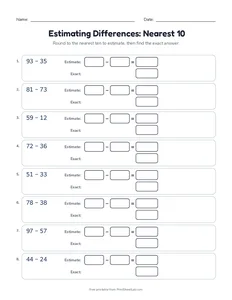
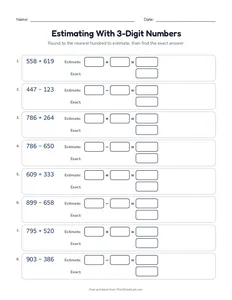
Estimating with rounding means finding a quick, close answer to a sum or difference by rounding the numbers first, such as 47 + 38 as 50 + 40. The three PDFs on this page have 2-digit sums, 2-digit differences and 3-digit problems, and every sheet has an answer key. They follow standards 3.OA.D.8 and 4.OA.A.3 of the Common Core standards for grade 3 operations and algebraic thinking, and the notes below show how to estimate, how far off an estimate can be, and how to use it to check an answer.
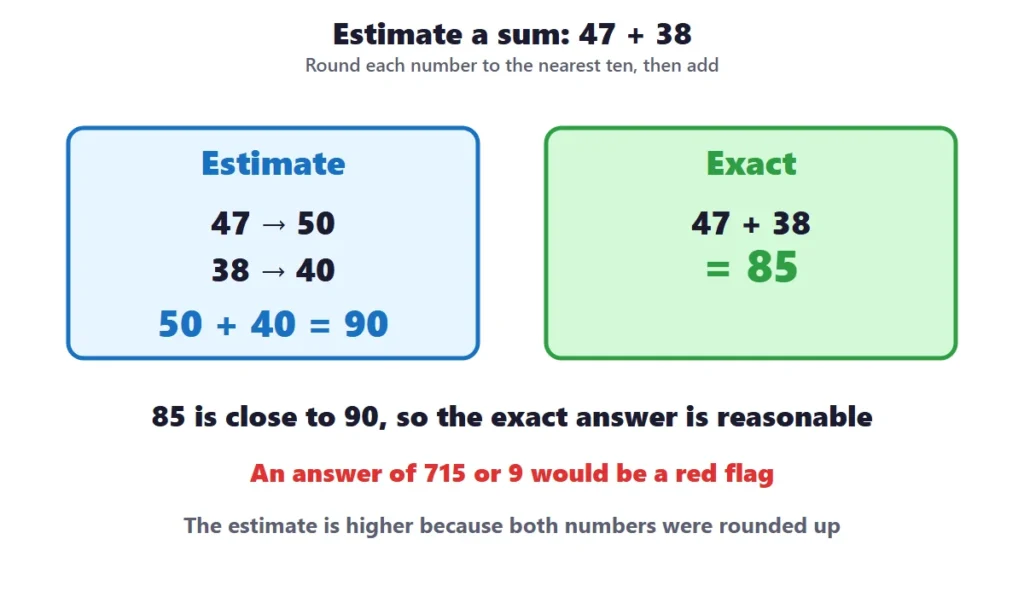
Estimate a sum. 50 + 40 = 90.
Why estimate?
An estimate is a quick, close answer. It is how we check that an exact answer makes sense: if 47 + 38 is about 90, an answer of 715 must be wrong. The Common Core standards ask children to judge whether answers are reasonable using estimation (3.OA.D.8 and 4.OA.A.3).
How these worksheets work
Round each number to the nearest ten or hundred.
Add or subtract the rounded numbers: that is the estimate.
Work out the exact answer.
Compare. A close estimate means the exact answer is probably right.
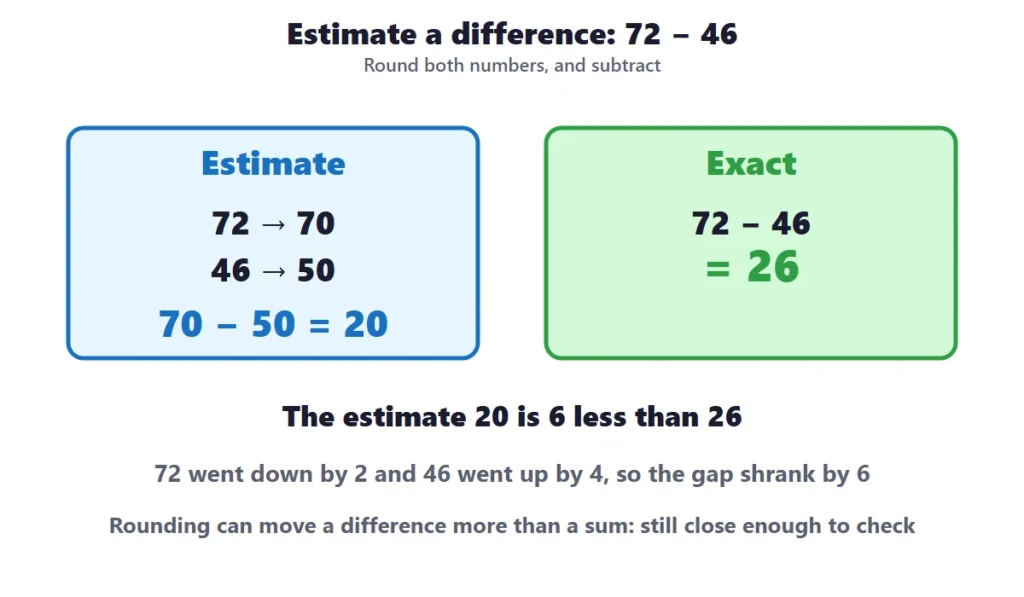
Rounding both numbers can push the estimate away from the exact answer, especially in subtraction. Talking about why 72 − 46 is estimated as 70 − 50 = 20 when the exact answer is 26 is a great discussion.
Estimating with rounding worksheets: what is in the set
There are 3 estimating with rounding worksheets on this page, and every one has an answer key except for any cut-out games. One sheet estimates sums, one estimates differences, and one uses 3-digit numbers rounded to the nearest 100.
Worksheet
What children do
Standard
Estimating Sums: Nearest 10
Round 2-digit numbers, estimate the sum, then check.
3.OA.D.8
Estimating Differences: Nearest 10
Round, estimate the difference, then check.
3.OA.D.8
Estimating With 3-Digit Numbers
Round to the nearest 100 to estimate sums and differences.
3.OA.D.8
Estimating sums worksheets: round, then add
The estimating sums worksheets use three steps: round each number, add the rounded numbers, and then compare with the exact sum. An estimate is a quick, close answer, and it is how people check that an exact answer makes sense. Wikipedia’s article on estimation describes how estimates are used in science and daily life. This table shows eight problems, four sums and four differences, with the estimate and the exact answer:
Problem
Round both to the nearest 10
Estimate
Exact answer
Difference
Reasonable?
47 + 38
50 + 40
90
85
5
yes
63 + 29
60 + 30
90
92
2
yes
52 + 45
50 + 50
100
97
3
yes
74 + 18
70 + 20
90
92
2
yes
72 − 46
70 − 50
20
26
6
yes
91 − 34
90 − 30
60
57
3
yes
85 − 57
90 − 60
30
28
2
yes
68 − 23
70 − 20
50
45
5
yes
The estimate is always within 10 of the exact answer for 2-digit numbers, since each rounding changes a number by at most 5. A child who gets an answer far from the estimate has made a mistake in one of the two calculations, and should do both again.
Estimating differences worksheets: why subtraction is trickier
The estimating differences worksheets use the same steps, but subtraction needs more care. Rounding one number up and the other down can move the difference by up to 10. For 72 − 46, the estimate is 70 − 50 = 20, but the exact answer is 26, since 72 went down by 2 and 46 went up by 4. Talking about why the estimate is lower than the exact answer is a good discussion for a class. The diagram above shows the two side by side.
The same problem as an addition would round the other way: if the question was 72 + 46, the estimate would be 70 + 50 = 120, and the exact answer is 118. In a subtraction, the rounding of the second number works against the first. The subtraction worksheets pages have the exact subtraction that the estimate checks.
Estimation using rounding: how far off can an estimate be?
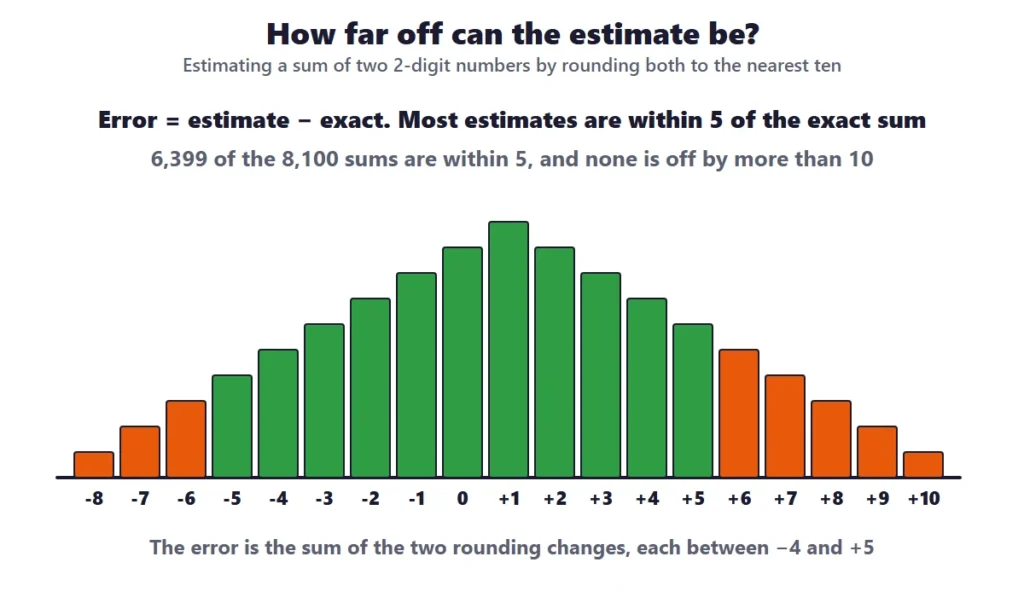
When children use estimation using rounding, they can ask how good the estimate is. For a sum of two 2-digit numbers, rounded to the nearest ten, the error is the sum of two rounding changes, each between −4 and +5. This table counts the 8,100 sums of two 2-digit numbers from 10 to 99 by the size and direction of the error:
Estimate of a sum of two 2-digit numbers
How many of the 8,100 pairs
Share
Exactly right
729
9.0%
Too high (an overestimate)
4455
55.0%
Too low (an underestimate)
2916
36.0%
Within 5 of the exact sum
6399
79.0%
Within 10 of the exact sum
8100
100.0%
Most estimates are close, and the biggest error is 10. About 55% of the estimates are too high, and 36% are too low. The estimates are a little more often high than low, because the halfway numbers round up. The diagram above shows the distribution.
Rounding to estimate: higher, lower or the same?
Rounding to estimate gives an answer that is higher than the exact sum when both numbers round up, and lower when both round down. When one rounds up and the other down, the two changes partly cancel. This table shows four sums:
Sum
First number rounds
Second number rounds
Estimate
Exact
Estimate is
47 + 38
up
up
90
85
higher
42 + 31
down
down
70
73
lower
47 + 31
up
down
80
78
higher
44 + 36
down
up
80
80
the same
Knowing this helps children to say whether an estimate is an overestimate or an underestimate, which is useful when they decide whether they have enough money or time. If both numbers round up and the estimate is still below what you can spend, there is enough.
Estimate and check worksheets: using the estimate to catch mistakes
The estimate and check worksheets ask children to estimate first, calculate second, and compare. The estimate catches big mistakes, such as writing two numbers side by side, but small ones can slip through, such as forgetting a carry. This table shows six wrong answers, and whether the estimate would catch each:
Estimate a difference. 70 − 50 = 20.
Problem
Estimate
Exact
A wrong answer
How far from the estimate
Does the estimate catch it?
47 + 38
90
85
715 (writes 47 and 38 side by side)
625
yes: far from the estimate
63 + 29
90
92
82 (forgets to carry)
8
no: close to the estimate, so the mistake is missed
83 − 47
30
36
44 (takes the smaller digit from the bigger)
14
yes: far from the estimate
91 − 34
60
57
67 (forgets to regroup the tens)
7
no: close to the estimate, so the mistake is missed
52 + 45
100
97
907 (writes the sums side by side)
807
yes: far from the estimate
74 + 18
90
92
82 (forgets to carry)
8
no: close to the estimate, so the mistake is missed
A forgotten carry or borrow changes the answer by exactly 10, which is as big as the biggest error of an estimate, so the estimate often misses it. For those mistakes, the check is the opposite operation. The 2-digit subtraction with regrouping page practices the borrowing, and the addition worksheets pages practice the carrying.
Estimating 3-digit numbers: rounding to the nearest 100
With 3-digit numbers, children round to the nearest hundred to estimate. The errors are bigger, as each rounding can change a number by up to 50. This table shows six problems:
Problem
Round both to the nearest 100
Estimate
Exact answer
Difference
347 + 289
300 + 300
600
636
36
612 + 195
600 + 200
800
807
7
528 − 374
500 − 400
100
154
54
803 − 456
800 − 500
300
347
47
749 + 238
700 + 200
900
987
87
905 − 612
900 − 600
300
293
7
The estimate is within 100 of the exact answer in each row. The rounding to the nearest 100 page has the rounding, and the rounding large numbers page extends it to bigger numbers. The standard 3.OA.D.8 asks children to assess the reasonableness of answers using estimation strategies including rounding.
Other ways to estimate
Rounding both numbers is not the only way to estimate. Children should also know a few others, which they can use to decide what is best for a problem. This table compares four:
Way to estimate
Example
Good for
Round both numbers
47 + 38 → 50 + 40 = 90
fast, and always possible
Compatible numbers
47 + 38 → 45 + 35 = 80 or 50 + 38 = 88
closer, but needs more thinking
Front-end estimation
47 + 38 → 40 + 30 = 70, then adjust
good for long lists
Round to the nearest 100
347 + 289 → 300 + 300 = 600
for 3-digit numbers
The worksheets on this page use rounding, since that is the way that is easiest to teach and to check. The two-step word problems page uses estimation to check two-step problems.
Common mistakes with estimating with rounding
The most common mistake is to cut off the ones instead of rounding. This table shows five mistakes, what went wrong and the fix:
What the child writes or says
What went wrong
The fix
47 + 38 ≈ 40 + 30 = 70
cuts off the ones instead of rounding
round to the nearest 10: 50 + 40 = 90
72 − 46 ≈ 70 − 40 = 30
rounds only one of the numbers, or rounds down both
round both to the nearest ten: 70 − 50 = 20
The exact answer is 715, and the estimate is 90, so it is fine
does not compare the estimate with the answer
a gap that big means a mistake
The estimate is 90 and the answer is 85, so the answer is wrong
expects an estimate to be exact
an estimate is close, not exact: 85 is reasonable
Rounds 47 + 38 to the nearest hundred, and gets 0 + 0
rounds to a place that is too big
round to the nearest 10 for 2-digit numbers
Estimating with rounding word problems
Estimates answer “about how many” questions. Ask children to round, calculate, and then say the answer with the word about:
Word problem
Working
Answer
A school has 47 girls and 38 boys in a club. About how many children is that?
50 + 40
about 90
A bakery sold 72 muffins in the morning and 46 in the afternoon. About how many more did it sell in the morning?
70 − 50
about 20
A trip is 347 miles one way and 289 miles the other way. About how far is the whole trip?
300 + 300
about 600 miles
Mia has 91 stickers and gives away 34. About how many are left?
90 − 30
about 60
A library has 528 picture books and 374 chapter books. About how many more picture books are there?
500 − 400
about 100 more
A shop has 63 red pens and 29 blue pens. About how many pens is that?
60 + 30
about 90 pens
Games and activities for estimating with rounding
Children learn estimating with rounding best when they play with it. These games use things that are found at home or in a classroom:
Estimate first: estimate each answer before using a calculator, and see who is closest
Over or under: say whether the estimate of a sum will be higher or lower than the exact answer
Estimation race: give a problem and have children estimate in ten seconds
Shopping estimate: estimate the total of three items from a catalog
Catch the mistake: give a worked sum with a wrong answer, and ask children to catch it with an estimate
Estimation bingo: a bingo card with estimates, and calling cards with problems
Extra support and extra challenge with estimating with rounding
For children who need more support: make sure that rounding to the nearest 10 is secure. Use a number line for each number, and write the rounded number beside it. Do the sums before the differences. Say the word “about” each time. Compare the estimate with the exact answer, and use the answer key to check both.
For children who need more challenge: ask for two numbers that give an estimate of 100 when rounded to the nearest ten, for a subtraction whose estimate is bigger than the exact answer, and for the biggest possible error in an estimate of a difference. Try to make up a problem where an estimate would not catch a mistake.
How to tell that a child is ready to move on from estimating with rounding
Before moving on from estimating with rounding, check that the child can do all four of these things:
How far off?. The error of rounding two numbers.
The child rounds both numbers to the nearest 10 or 100.
The child adds or subtracts the rounded numbers.
The child compares the estimate with the exact answer.
A short lesson is the best way to introduce estimating with rounding. This 20-minute plan can be used in a classroom, at a tutoring session or at home, and it uses the worksheets at the end:
Minutes
Activity
What to say or ask
0 to 3
Ask “about how many?” for 47 + 38
What could we do to make it easier?
3 to 8
Round 47 to 50 and 38 to 40, and add
What is the estimate?
8 to 13
Find the exact answer and compare
Is it close?
13 to 18
Estimate 72 − 46, and compare it with 26
Why is the estimate lower?
18 to 20
Start a worksheet and check one answer
Is the answer reasonable?
Where estimating with rounding fits across the grades
No skill stands alone. This table shows what children learn before and after estimating with rounding, with the standard that goes with each step:
This page puts rounding to use. The whole sequence is on the rounding worksheets page.
Helping at home with estimating with rounding
Parents do not need to be experts to help with estimating with rounding. These suggestions work well, and each takes only a few minutes:
Estimate the total at the store by rounding each price.
Ask “about how many?” instead of “exactly how many?”.
Compare the estimate with the real total on the receipt.
Ask whether the estimate is higher or lower than the exact answer.
Check the answers with the answer key, and ask the child to explain one.
How to check progress in estimating with rounding
A teacher or parent can check progress in estimating with rounding with the answer key and a few questions. This table shows three common situations, what they mean and what to do next:
What you see
What it means
What to do next
The child expects the estimate to be exact
The meaning of “about” is not yet clear
Say “an estimate is close, not exact”, and compare with the exact answer
The child gets 9 of 10 right in every set
Estimating with rounding is secure
Move on to two-step word problems
The child cuts off the ones instead of rounding
Rounding and truncating are mixed up
Return to the rounding hills, and round before adding
A five-day plan for estimating with rounding
Most children need about a week of short sessions for estimating with rounding. This plan follows the order of the worksheets on this page:
Day
What to do
Practice
Day 1
Round 2-digit numbers to the nearest ten, and add them
Estimating Sums: Nearest 10
Day 2
Estimate differences, and check with the exact answer
Estimating Differences: Nearest 10
Day 3
Estimate with 3-digit numbers, rounding to the nearest 100
No. An estimate is meant to be close, not exact. It is a tool for checking.
Should I round to the nearest 10 or 100?
Round 2-digit numbers to the nearest 10 and 3-digit numbers to the nearest 100 for quick mental estimates.
How do you estimate a sum?
Round each number to the nearest ten, or to the nearest hundred for 3-digit numbers, and then add the rounded numbers. For 47 + 38, round to 50 and 40, so the estimate is 90.
Is an estimate the same as a wrong answer?
No. An estimate is meant to be close and not exact. It is a tool for checking: if the exact answer is far from the estimate, there is probably a mistake in the exact calculation.
Should I round to the nearest 10 or 100?
Round 2-digit numbers to the nearest 10 and 3-digit numbers to the nearest 100 for quick mental estimates. The bigger the place, the quicker the estimate, but the less exact it is.