Make your own hundreds chart: any start number, skip counting, missing numbers, puzzles and mystery pictures.
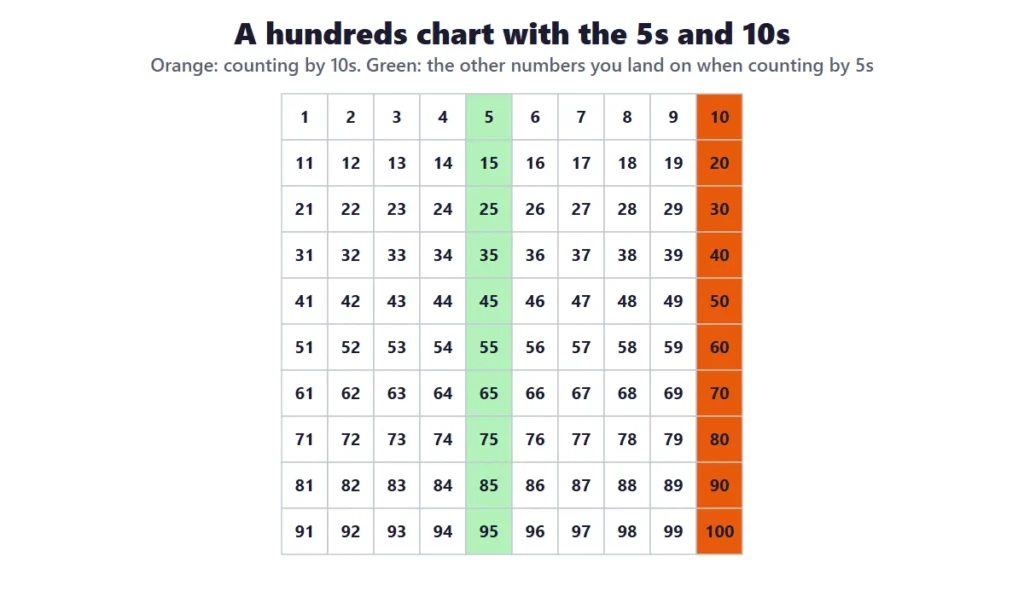
Hundreds chart. The 5s and 10s.
Quick answer: A 120 chart is a hundreds chart that continues to 120, with 12 rows of 10 numbers. First graders use it to count to 120 from any number (standard 1.NBT.A.1). This page has free printable 120 chart PDFs with missing numbers and a blank chart, each with an answer key. Updated October 2026.
Why use a hundreds chart?
A hundreds chart puts the numbers 1 to 100 in ten rows of ten. Moving right adds one, moving down adds ten. Children who fill in a chart start to notice these patterns on their own: every number in a column ends with the same digit, and each row starts one ten higher.
What is on this page
Missing numbers: two charts with gaps to fill.
Blank chart: only the first row and first column are given.
21 to 120 chart: grade 1 children count to 120 (1.NBT.A.1).
Counting to 120 sequences: fill the gaps forwards and backwards.
Hundreds chart worksheets: what is in the set
There are 6 hundreds chart worksheets on this page, and every one has an answer key except for any cut-out games. The first three sets are charts from 1 to 100 with different numbers of gaps, and the last three extend the count to 120 and go forwards and backwards.
Worksheet
What children do
Standard
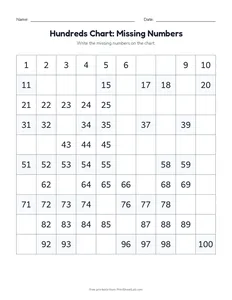
Hundreds Chart: Missing Numbers
A 1 to 100 chart with 40 numbers missing.
1.NBT.A.1
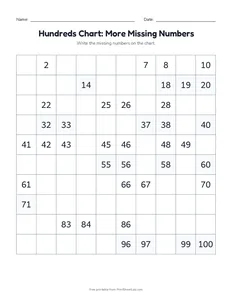
Hundreds Chart: More Missing Numbers
A harder chart with 60 numbers missing.
1.NBT.A.1
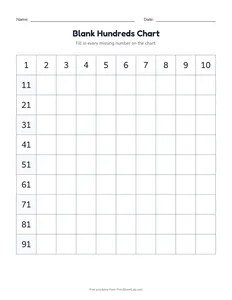
Blank Hundreds Chart
Only the first row and column are given: fill in the rest.
1.NBT.A.1
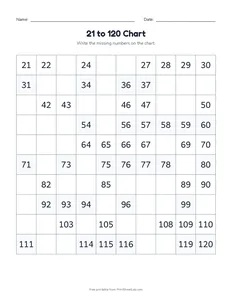
21 to 120 Chart
Fill in the missing numbers from 21 to 120.
1.NBT.A.1
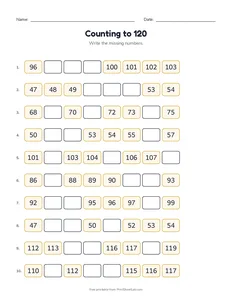
Counting to 120
Fill in the missing numbers up to 120.
1.NBT.A.1
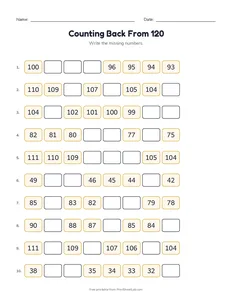
Counting Back From 120
Count backwards and fill in the gaps.
1.NBT.A.1
Hundreds chart patterns every child should see
A hundreds chart is more than a list of numbers. It is a picture of the number system, and children who fill in a hundreds chart start to notice patterns without being told. The first pattern is the rows. Each row starts one ten higher than the one before it, and the sum of each row goes up by 100:
Row
Numbers in the row
Sum of the row
Pattern
1
1 to 10
55
each row is 100 more than the one before
2
11 to 20
155
each row is 100 more than the one before
3
21 to 30
255
each row is 100 more than the one before
4
31 to 40
355
each row is 100 more than the one before
5
41 to 50
455
each row is 100 more than the one before
10
91 to 100
955
each row is 100 more than the one before
The total of all ten rows is 5,050. According to a well-known story, the young Carl Friedrich Gauss found this sum in a few seconds by noticing that 1 + 100, 2 + 99 and so on, all make 101, and there are 50 pairs. That makes 50 × 101 = 5,050.
Hundreds chart columns: the ones digit stays the same
Going down a column adds 10 each time, so the ones digit never changes. The table shows four columns with their sums. Children who see this pattern learn that adding 10 changes only the tens digit, which they use for mental addition:
Column
First numbers
What they have in common
Sum of the column
1
1, 11, 21, 31, …
every number ends in 1
460
2
2, 12, 22, 32, …
every number ends in 2
470
5
5, 15, 25, 35, …
every number ends in 5
500
9
9, 19, 29, 39, …
every number ends in 9
540
Hundreds chart worksheets: how to move on the chart
Hundreds chart worksheets teach children to add and subtract by moving. Right is +1, left is −1, down is +10 and up is −10. Moving down and to the right is +11, and moving down and to the left is +9. The table shows seven moves from the same starting square:
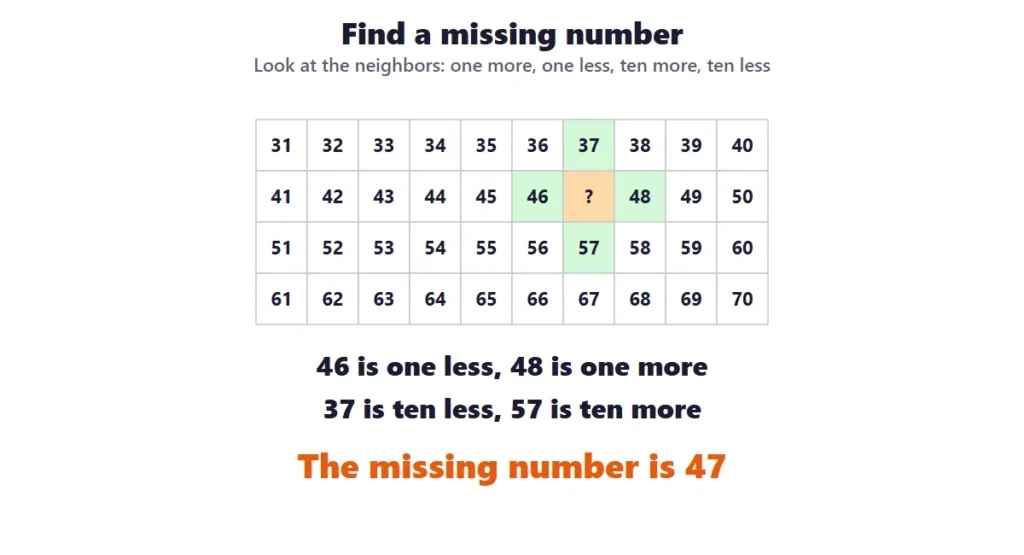
Missing number. Use the neighbors.
Question
Move on the chart
Start at
Land on
One more
move right 1
34
35
One less
move left 1
34
33
Ten more
move down 1 row
34
44
Ten less
move up 1 row
34
24
Eleven more
down and right
34
45
Nine more
down and left
34
43
Twenty more
down 2 rows
34
54
This is the same as the number line, but in two dimensions, so children also use it for problems such as 34 + 20. The hundreds chart tool makes charts that start at any number, so a teacher can start a chart at 0 or at 101.
Missing numbers hundreds chart: how hard is each worksheet?
A missing numbers hundreds chart gets harder as more numbers are missing. The table shows how many numbers children must fill in on each worksheet, which helps to choose the right one:
Worksheet
Numbers given
Numbers to fill in
Share to fill in
Missing Numbers
60
40
40%
More Missing Numbers
40
60
60%
Blank Hundreds Chart
19
81
81%
21 to 120 Chart
the rows 21 to 120
the gaps in the rows
see the sheet
On the blank chart only the first row and the first column are given, which is 19 numbers, and the child fills in the other 81. A child who can do this has understood the whole structure of the chart.
Blank hundreds chart: some facts to find
Once a chart is filled in, children can look for patterns. This table gives five facts about the numbers 1 to 100, and the numbers that match. The prime numbers can be found with the sieve of Eratosthenes, in which children cross out the multiples of 2, 3, 5 and 7 and the numbers left are prime:
A fact about the chart
Count
The numbers
Numbers with a 7 in them
19
7, 17, 27, 37, 47, 57, 67, 70 to 79, 87, 97
Double-digit numbers (11, 22, 33…)
9
11, 22, 33, 44, 55, 66, 77, 88, 99
Prime numbers
25
2, 3, 5, 7, 11, 13, 17, 19, 23, 29, 31, 37, …
Square numbers
10
1, 4, 9, 16, 25, 36, 49, 64, 81, 100
Multiples of 9
11
a diagonal from the top right to the bottom left, with digits that add to 9 or 18
Counting to 120 worksheets: the 120 chart
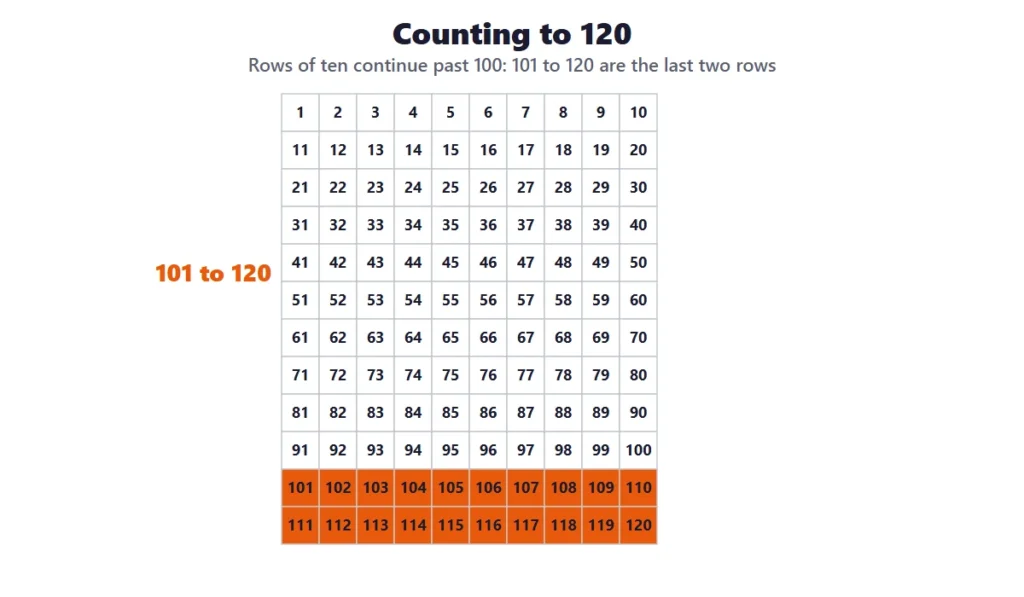
The Common Core asks grade 1 children to count to 120, starting at any number (1.NBT.A.1). The counting to 120 worksheets and the 120 chart worksheets add two rows to the hundreds chart. The pattern does not change, but children now meet three-digit numbers, so the last rows are:
Row
Numbers
What changes after 100
9
81 to 90
the same pattern: right is +1, down is +10
10
91 to 100
the same pattern: right is +1, down is +10
11
101 to 110
the hundreds digit 1 appears, and the tens and ones follow the same pattern
12
111 to 120
the hundreds digit 1 appears, and the tens and ones follow the same pattern
Hundreds chart worksheets can be used for story problems about moving along the chart. Ask children to find the starting number on the chart and to move to the answer:
Word problem
Working
Answer
Ana is on square 34. She moves one row down. What number is she on?
down 1 row is +10
44
Leo is on 58 and moves 3 squares to the left. Where is he?
left 3 is −3
55
Mia is on 27 and moves down 2 rows. Where does she land?
+20
47
Sam starts at 91 and moves up 4 rows. What number is he on?
−40
51
Which number is one row above 65?
−10
55
What number is just after 99 on the 120 chart?
next row starts
100
Games and activities for hundreds chart worksheets
Children learn hundreds chart worksheets best when they play with it. These games use things that are found at home or in a classroom:
Counting to 120. The last two rows.
Number hunt: call out a number and let the child point to it on the chart as fast as possible
Mystery number: cover a number with a counter and ask the child to find it from its neighbors
Chart race: roll a die and move that number of squares, the first to reach 100 wins
Color the pattern: color all the numbers that end in 5 or 0 and see the columns
Jigsaw chart: cut a filled chart into pieces and put them back in order
Roll and move: roll one die for the rows and one for the squares
Extra support and extra challenge with the hundreds chart
For children who need more support: start with a chart that has only a few gaps, and let children use their finger to move one square at a time. Count aloud in tens down the column. Do not use the blank chart until the child can fill in the chart with 60 gaps.
For children who need more challenge: ask the child to find a number that is 25 more, to color all the multiples of 3 and to find the sum of any row. The chart with the numbers 21 to 120 asks for the next ten and the next hundred.
How to tell that a child is ready to move on from the hundreds chart
The child fills in a chart with 60 gaps without counting from 1.
The child finds the number ten more or ten less than any number, using the chart.
The child counts to 120 starting at any number.
The child can explain why every number in a column ends in the same digit.
When all four are true, move on to skip counting, where the chart is used to find patterns of the multiples.
A five-day plan for the hundreds chart
Most children need about a week of short sessions for the hundreds chart. This plan follows the order of the worksheets on this page:
Day
What to do
Practice
Day 1
Fill in the missing numbers on a chart with 40 gaps
1 worksheet
Day 2
Find patterns in the columns and the rows
colored chart
Day 3
Fill in a chart with 60 gaps
1 worksheet
Day 4
Fill in the blank chart from the first row and column
If you were searching for a 120 chart printable, a free printable 120 chart, a 120 chart printable free, a printable 120 chart, a 120 chart pdf or just 120 charts, the PDFs on this page are what you want. Every one is free to print on US Letter or A4, with no sign-up. A 120 printable chart for first grade works best with 12 rows so that every row ends in a multiple of ten, which keeps the tens-and-ones pattern of the 100 chart.
Facts about the 120 chart
We counted some facts to help you plan activities. They are useful for questions such as how many even numbers are on the chart.
Fact about the 120 chart
Answer
Numbers on the chart
120
Rows of ten
12
Last number of row 12
120
Multiples of 10
12
Multiples of 5
24
Even numbers
60
Prime numbers
30
Three-digit numbers (100 to 120)
21
There are 30 primes on the 120 chart, five more than on a 1 to 100 chart: 101, 103, 107, 109 and 113. For more charts and a free interactive version, see the main hundreds chart page.
Frequently asked questions
7 quick answers
How do you find a missing number on a hundreds chart?
Look left and right (one less and one more) or up and down (ten less and ten more).
Why count to 120 and not 100?
The Common Core standards ask grade 1 children to count to 120 so they see that the pattern continues past 100.
Why does the hundreds chart have ten columns?
Ten columns make the chart match the base ten system. Each row is a ten, so moving down adds 10 and the ones digit stays in its column.
How do you use a hundreds chart to add?
To add 24 + 30, start on 24 and move down three rows, to 54. To add 24 + 6, move right 6 squares. For 24 + 35, move down three rows and right five squares, which lands on 59.
At what grade do children use a hundreds chart?
Kindergarten children use it to count to 100, grade 1 children use it for adding and subtracting tens and to count to 120, and grade 2 children use it for skip counting and number patterns.
Where can I download a free 120 chart?
Open a worksheet in the gallery above, choose US Letter or A4, then print or save the PDF. All of the 120 chart PDFs are free and need no account.
What grade uses a 120 chart?
Grade 1 uses a 120 chart, because the standard asks children to count to 120 starting at any number (1.NBT.A.1). Kindergarten uses a chart to 100.