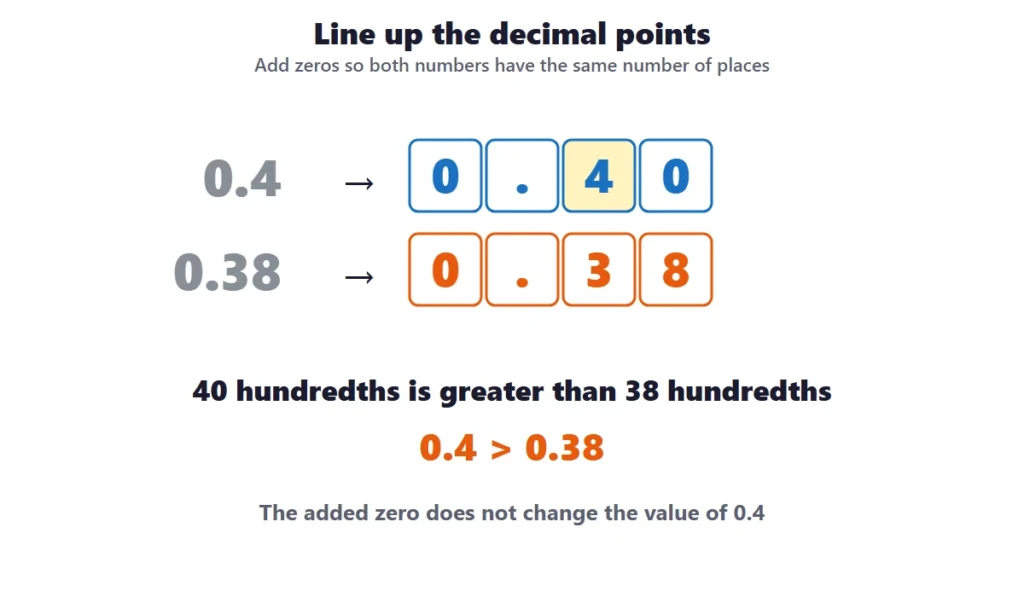
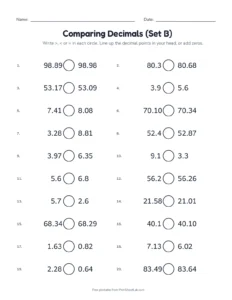
Line up the decimal points and compare place by place from the left, just like whole numbers. If the numbers have a different number of places, add zeros to the shorter one: 0.4 becomes 0.40, and 40 hundredths is clearly more than 38 hundredths.
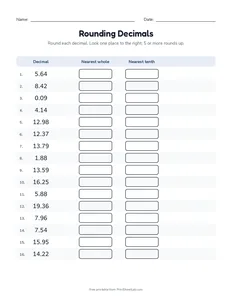
Rounding decimals
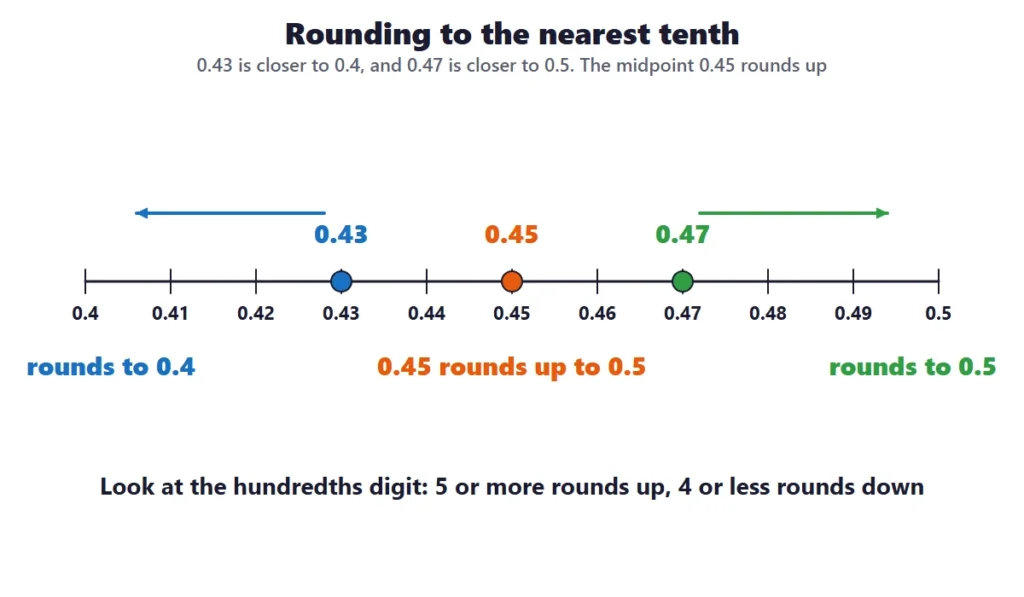
The rounding rule is the same one used for whole numbers on our rounding worksheets: look at the digit just after the place you are rounding to, and round up for 5 or more. 3.67 rounds to 4 (nearest whole) and 3.7 (nearest tenth).
Comparing and rounding decimals worksheets: what is in the set
There are 4 comparing and rounding decimals worksheets on this page, and every one has an answer key except for any cut-out games. The first two sets compare pairs of decimals, including tricky ones, and the last two round decimals to the nearest whole number and tenth.
Worksheet
What children do
Standard
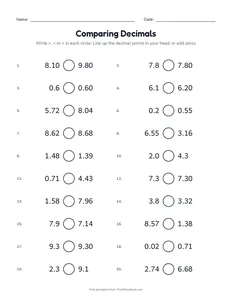
Comparing Decimals
20 pairs, including tricky ones like 0.4 and 0.38.
4.NF.C.7
Comparing Decimals (Set B)
Compare decimals with larger whole parts.
4.NF.C.7
Rounding Decimals
Round to the nearest whole number and tenth.
4.NF.C.7
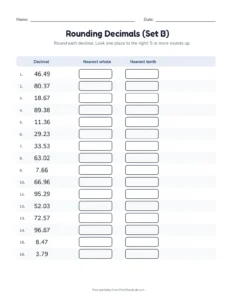
Rounding Decimals (Set B)
Round larger decimals.
4.NF.C.7
Comparing decimals worksheets: line up the places
The rule for comparing decimals worksheets is to line up the decimal points and compare place by place from the left, as with whole numbers. When one decimal has fewer places, add zeros at the end. The zeros do not change the value, but they make the comparison easy. The Common Core asks grade 4 children to compare decimals to hundredths (4.NF.C.7) and grade 5 children to compare them to thousandths (5.NBT.A.3b). The Common Core standards for grade 4 number and operations in fractions describe the first standard. This table shows eight pairs:
Pair
Add zeros to line up the places
Sign
Why
0.4 and 0.38
0.40 and 0.38
0.4 > 0.38
40 hundredths is more than 38 hundredths
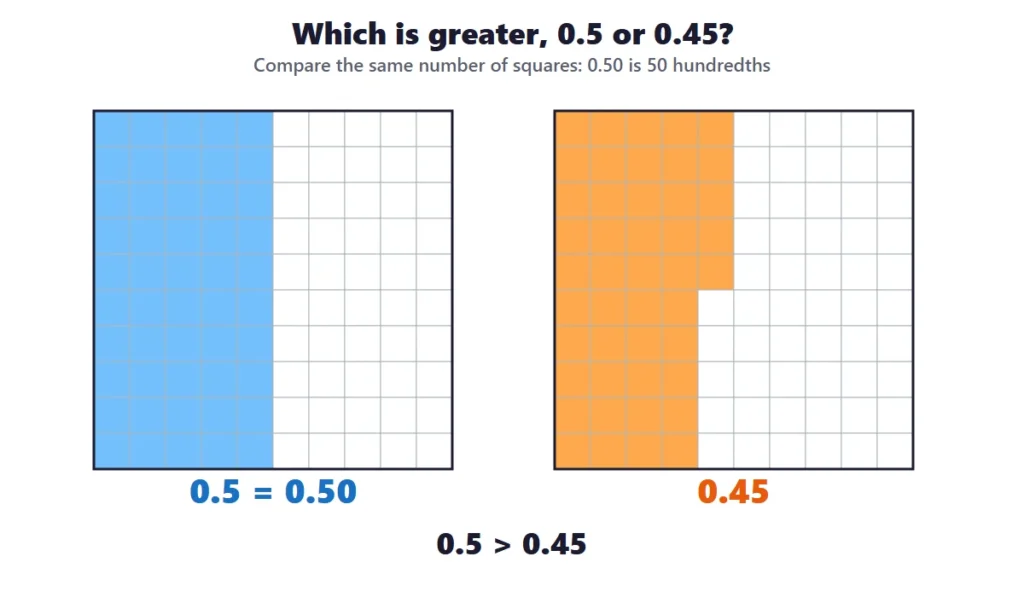
0.5 and 0.45
0.50 and 0.45
0.5 > 0.45
50 hundredths is more than 45 hundredths
0.7 and 0.07
0.70 and 0.07
0.7 > 0.07
70 hundredths is more than 07 hundredths
2.5 and 2.05
2.50 and 2.05
2.5 > 2.05
50 hundredths is more than 05 hundredths
0.09 and 0.1
0.09 and 0.10
0.09 < 0.1
09 hundredths is less than 10 hundredths
3.14 and 3.4
3.14 and 3.40
3.14 < 3.4
14 hundredths is less than 40 hundredths
0.6 and 0.60
0.60 and 0.60
0.6 = 0.60
60 hundredths is equal to 60 hundredths
1.25 and 1.3
1.25 and 1.30
1.25 < 1.3
25 hundredths is less than 30 hundredths
Decimals greater than less than: the “longer is bigger” trap
The most common mistake with decimals greater than less than is to think that the number with more digits is the greater. This comes from whole numbers, where 38 is greater than 4. For decimals the opposite can be true: 0.4 is greater than 0.38. Among the 810 pairs of a tenth and a hundredth where the longer decimal does not end in 0, the shorter decimal is greater in 405 of them:
Pairs from 0 to 1
Count
Share
A tenth against a hundredth with a digit after it (such as 0.4 and 0.38)
810
100%
The shorter decimal is the greater
405
50.0%
The longer decimal is the greater
405
50.0%
So the pairs are close to an even split, and a child who guesses by length is wrong about half of the time. That is why the first worksheet includes pairs such as 0.4 and 0.38: children must line up the places and not guess.
Rounding decimals worksheets: the rule
The rounding rule for rounding decimals worksheets is the same as for whole numbers. Look at the digit just after the place you are rounding to. If it is 5 or more, round up. If it is 4 or less, round down. Then drop the digits after that place. The standard is 5.NBT.A.4, described in the Common Core standards for grade 5 number and operations in base ten, and the rounding worksheets page has practice with whole numbers. This table shows eight numbers rounded to three places:
Number
Nearest whole number
Nearest tenth
Nearest hundredth
Digit that decides the tenths
3.67
4
3.7
3.67
the hundredths digit (7)
0.45
0
0.5
0.45
the hundredths digit (5)
2.96
3
3.0
2.96
the hundredths digit (6)
5.049
5
5.0
5.05
the hundredths digit (4)
7.5
8
7.5
7.50
already to the tenths
12.34
12
12.3
12.34
the hundredths digit (4)
0.999
1
1.0
1.00
the hundredths digit (9)
4.5
5
4.5
4.50
already to the tenths
Note that 2.96 rounded to the nearest tenth is 3.0, and the zero is kept to show that the number is rounded to tenths. In the same way 0.999 rounds to 1.0.
Rounding to the nearest tenth: which numbers round up?
When rounding to the nearest tenth, half of the numbers round up and half round down. In the 100 numbers from 0.00 to 0.99, 50 round up and 50 round down or stay the same. For the nearest whole number the split is the same, since 0.50 and above round to 1:
Comparing. 0.5 and 0.45.
The 100 numbers from 0.00 to 0.99
How many
Which ones
Round up to the nearest tenth
50
hundredths digit 5, 6, 7, 8 or 9
Round down or stay (nearest tenth)
50
hundredths digit 0, 1, 2, 3 or 4
Round to 0 (nearest whole number)
50
0.00 to 0.49
Round to 1 (nearest whole number)
50
0.50 to 0.99
Which decimals round to the same number?
A good question for rounding decimals is “which numbers round to this answer?”. Every number from 3.65 to 3.74 rounds to 3.7, which is 10 hundredths, and every number from 3.50 to 4.49 rounds to 4, which is 100 hundredths. The table shows four examples:
Rounds to
Smallest number
Greatest number
How many hundredths
3.7 (nearest tenth)
3.65
3.74
10
4 (nearest whole number)
3.50
4.49
100
0.5 (nearest tenth)
0.45
0.54
10
10 (nearest whole number)
9.50
10.49
100
When children round decimals they should also say what the rounded number means. 3.7 is not a different number from 3.67, but a simpler one that is close to it, and the difference is never more than half of the place that was rounded to. This is the idea behind estimation, and it explains why rounded answers are useful but not exact.
Ordering decimals: four numbers in order
Ordering decimals is comparing several times. A good method is to write all the decimals with the same number of places, and then to find the least one first. Here are six sets, as they might appear on a worksheet:
Decimals
Least to greatest
Greatest to least
1.75, 3.4, 0.2, 2.63
0.20 < 1.75 < 2.63 < 3.40
3.40 > 2.63 > 1.75 > 0.20
3.53, 3.86, 1.68, 3.63
1.68 < 3.53 < 3.63 < 3.86
3.86 > 3.63 > 3.53 > 1.68
0.06, 2.14, 2.4, 1.89
0.06 < 1.89 < 2.14 < 2.40
2.40 > 2.14 > 1.89 > 0.06
2.67, 3.25, 3.65, 0.59
0.59 < 2.67 < 3.25 < 3.65
3.65 > 3.25 > 2.67 > 0.59
1.06, 1.14, 3.41, 2.6
1.06 < 1.14 < 2.60 < 3.41
3.41 > 2.60 > 1.14 > 1.06
3.01, 3.49, 1.85, 3.67
1.85 < 3.01 < 3.49 < 3.67
3.67 > 3.49 > 3.01 > 1.85
Comparing and rounding decimals together: estimating with benchmarks
Comparing and rounding decimals are often used together. A good habit is to compare a decimal with a benchmark such as 0, 0.5 or 1, and to round it to the nearest benchmark. For example, 0.47 is close to 0.5, and 0.93 is close to 1. This kind of thinking is useful for estimating the answers to problems and for checking that a calculator result is reasonable. Children who use benchmarks also find it easier to place decimals on a number line, since they know which half of the line a number is in.
Teachers can check this understanding by asking two questions after every rounding problem: is the answer close to the original number, and is it a number that has the right number of decimal places? A child who rounds 3.67 to the nearest tenth and writes 3.8 has made a mistake that these questions will catch, since 3.8 is farther from 3.67 than 3.7 is. Habits like this turn rounding from a rule to follow into a way of thinking about numbers.
Common mistakes when comparing and rounding decimals
These are the mistakes that teachers see most often, with what the child thinks and the right answer:
Question
Wrong answer
What the child thinks
Right answer
0.4 and 0.38
says 0.38 is greater
thinks 38 is more than 4
0.4 > 0.38
0.7 and 0.07
says they are equal
ignores the zero
0.7 > 0.07
2.96 to the nearest tenth
writes 2.9
forgets to round the 9 up
3.0
0.45 to the nearest tenth
writes 0.4
rounds 5 down
0.5
3.049 to the nearest hundredth
writes 3.04
rounds the thousandths 9 down
3.05
Comparing and rounding decimals word problems
Word problems show where comparing and rounding decimals are useful. Ask children to line up the decimals before they compare, and to say which place decides the rounding:
Word problem
Working
Answer
Maya runs 0.4 of a mile and Leo runs 0.38 of a mile. Who runs farther?
0.40 > 0.38
Maya
A pencil costs $0.75 and a pen costs $0.57. Which costs less?
0.57 < 0.75
the pen
A plant is 2.96 meters tall. Round the height to the nearest tenth.
2.96 → 3.0
3.0 meters
A race time is 12.34 seconds. Round it to the nearest whole second.
12.34 → 12
12 seconds
Three trails are 1.25 km, 1.3 km and 1.2 km. Which is the longest?
1.25, 1.30, 1.20
1.3 km
A box weighs 0.999 kg. Round it to the nearest tenth.
0.999 → 1.0
1.0 kg
Games and activities for comparing and rounding decimals
Children learn comparing and rounding decimals best when they play with it. These games use things that are found at home or in a classroom:
Decimal war: each player makes a decimal from three digit cards, and the greater decimal wins
Closest to: roll dice to make a decimal and find who is closest to 0.5
Round the race times: round athletes’ times to the nearest tenth and rank them
Number line walk: put decimals on a number line from 0 to 1 and order them
Price check: compare the unit prices of two products, such as $0.49 and $0.5
Sorting cards: put ten decimals in order from least to greatest and check with a partner
A 20-minute lesson on comparing and rounding decimals
A short lesson is the best way to introduce comparing and rounding decimals. This 20-minute plan can be used in a classroom, at a tutoring session or at home, and it uses the worksheets at the end:
Add a zero. 0.4 and 0.38.
Minutes
Activity
What to say or ask
0 to 3
Write 0.4 and 0.38 on the board
Which is greater? Add a zero to line up the places.
3 to 8
Show 0.5 and 0.45 on two hundred grids
Count the shaded squares. Which has more?
8 to 13
Place 0.43, 0.45 and 0.47 on a number line between 0.4 and 0.5
Which are closer to 0.4? Which to 0.5?
13 to 18
Round six numbers to the nearest tenth together
Which digit decides?
18 to 20
Start a worksheet and check one answer
Did you line up the decimal points?
Where comparing and rounding decimals fits across the grades
No skill stands alone. This table shows what children learn before and after comparing and rounding decimals, with the standard that goes with each step:
This page covers the middle of the decimal sequence. When children can compare and round, they can add and subtract decimals on the page for adding and subtracting decimals.
Helping at home with comparing and rounding decimals
Parents do not need to be experts to help with comparing and rounding decimals. These suggestions work well, and each takes only a few minutes:
Compare prices at the shop, such as $0.75 and $0.57, and ask which is less.
Look at sports times or distances in the news, and round them to the nearest tenth.
Ask the child to explain why 0.4 is greater than 0.38, using money: 40 cents and 38 cents.
Use a number line and let the child mark where 0.45 is.
Check the answers together, and look for the “longer is bigger” mistake.
How to check progress in comparing and rounding decimals
A teacher or parent can check progress with the answer key and a few questions. This table shows three common situations, what they mean and what to do next:
What you see
What it means
What to do next
The child compares correctly when the decimals have the same length
The child understands place value but does not add zeros
Practice adding zeros on a grid until it is automatic
The child gets 9 of 10 right on all four sets
The skill is secure
Move on to adding and subtracting decimals
The child rounds 2.96 to 2.9
The child forgets to round the 9 up
Use the number line, and show that 2.96 is closer to 3.0
A five-day plan for comparing and rounding decimals
Most children need about a week of short sessions for comparing and rounding decimals. This plan follows the order of the worksheets on this page:
0.5. Write it as 0.50: 50 hundredths is more than 45 hundredths.
What is 2.96 rounded to the nearest tenth?
3.0. The hundredths digit is 6, so the 9 tenths round up to 10 tenths, which makes the next whole number.
Why is 0.4 greater than 0.38?
Add a zero to 0.4 to make 0.40. Then compare 40 hundredths with 38 hundredths. 40 is more than 38, so 0.4 is greater. The same is true with money: 40 cents is more than 38 cents.
What is 0.45 rounded to the nearest tenth?
It is 0.5. The hundredths digit is 5, so the number is exactly halfway between 0.4 and 0.5, and the rule is to round up.
Do the zeros at the end of a decimal matter?
Zeros at the end do not change the value, so 0.4 = 0.40 = 0.400. They are useful to compare decimals, and to show how many places a number was rounded to.