Change the numbers, layout and number of problems, then download a new PDF with its answer key.
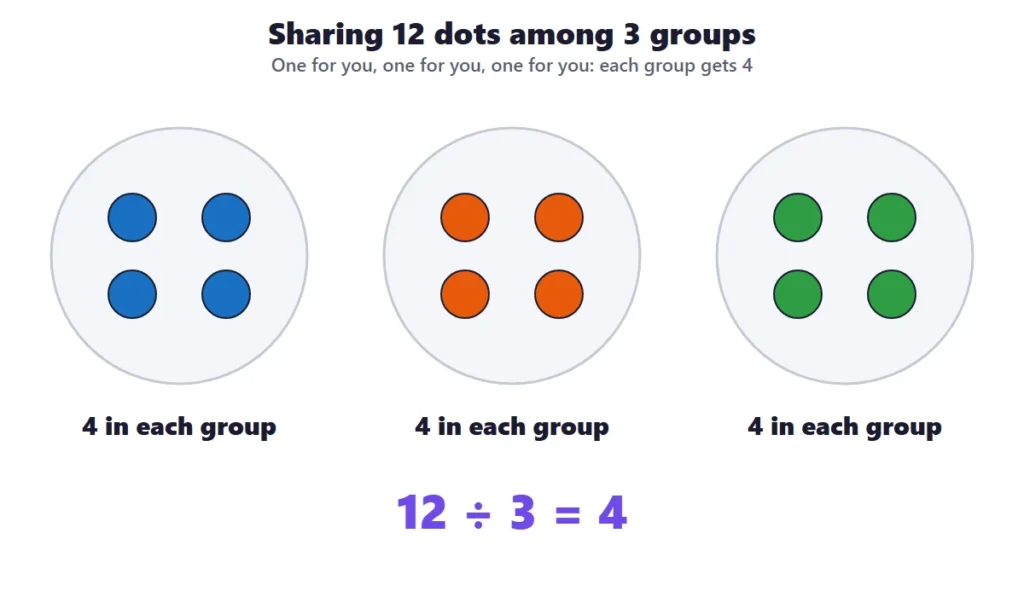
Sharing. 12 shared by 3.
Quick answer: Division as sharing means splitting a number into equal groups, such as 12 cookies shared among 3 children, and division as equal groups means counting how many groups you can make. This page has 5 free printable worksheets with answer keys for grades 2 and 3. Updated October 2026.
What division means
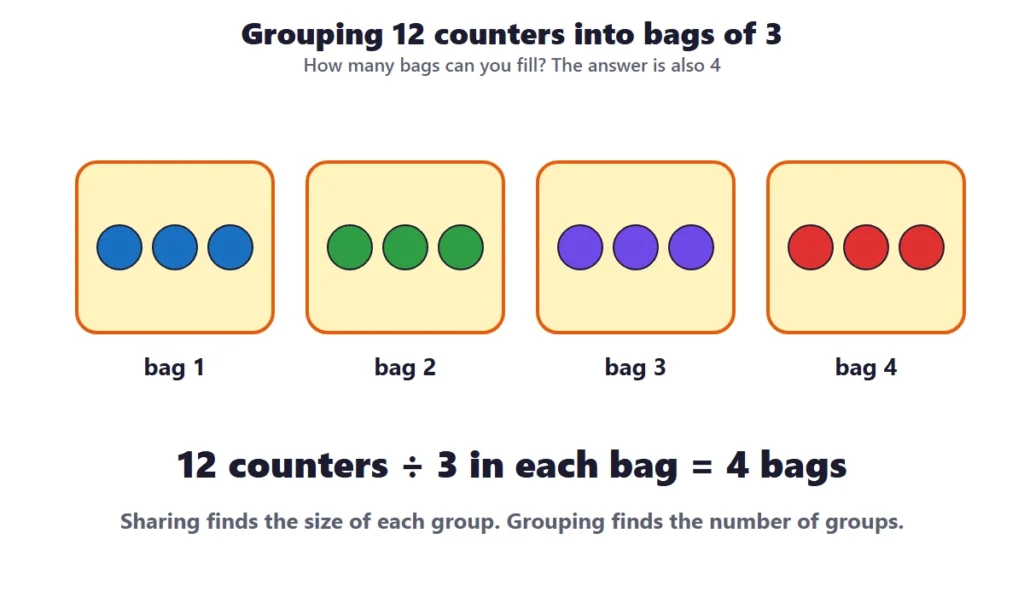
Division answers two kinds of question. Sharing: 12 cookies shared by 3 children, how many each? Grouping: 12 cookies in bags of 3, how many bags? Both are written 12 ÷ 3 = 4. These worksheets use pictures so children see both ideas before they learn division facts.
What is on this page
Equal groups: the dots are already shared into groups. Children write the total, the number of groups and how many are in each.
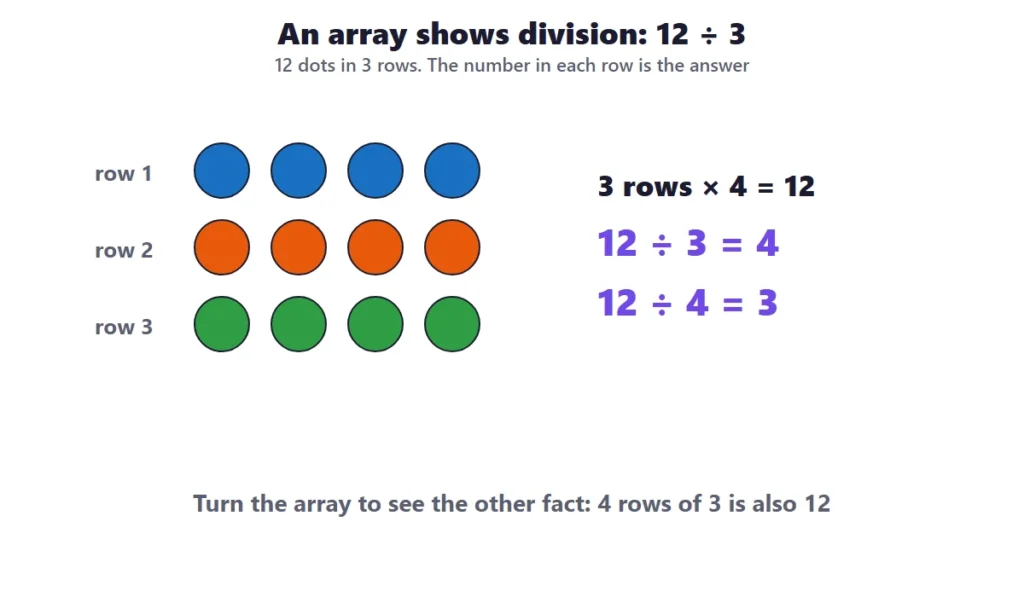
Arrays: a total arranged in rows. The number in each row is the answer.
Easy division facts dividing by 2, 3, 4 and 5.
Sharing stories to draw and solve.
Teaching tips
Share real objects first, one at a time into each group, “one for you, one for you”.
Link to multiplication: 3 groups of 4 is 12, so 12 ÷ 3 = 4.
Say both readings: “12 divided by 3” and “12 shared into 3 groups”.
Division as sharing and equal groups worksheets: what is in the set
There are 5 division as sharing and equal groups worksheets on this page, and every one has an answer key except for any cut-out games. The first two sets use pictures of groups, the next ones use arrays and the first facts, and the last one has story problems.
Worksheet
What children do
Standard
Division With Equal Groups
The dots are shared into groups: write the division sentence.
3.OA.A.2
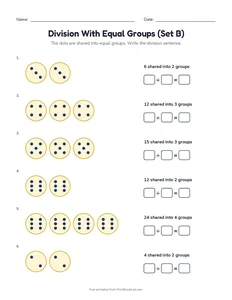
Division With Equal Groups (Set B)
Six more sharing pictures.
3.OA.A.2
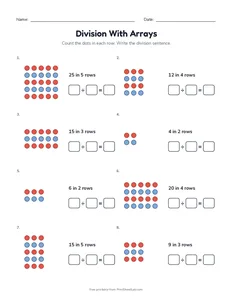
Division With Arrays
Use the rows of dots to divide.
3.OA.A.2
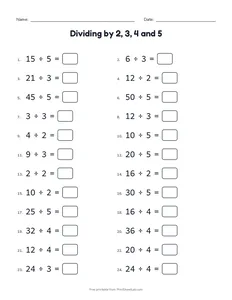
Dividing by 2, 3, 4 and 5
24 easy division facts.
3.OA.A.2
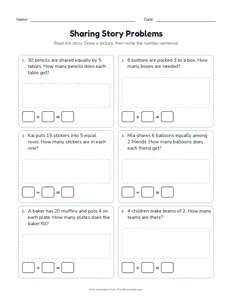
Sharing Story Problems
Six sharing and grouping stories to draw and solve.
3.OA.A.2
Division as sharing and equal groups: the two meanings
Division as sharing and equal groups has two meanings, and children need both. In sharing, the number of groups is known and the question is how many are in each. In grouping, the size of each group is known and the question is how many groups can be made. Both are written with the same division, and both have the same answer. This table shows four problems, each as a sharing story and as a grouping story:
Division
Sharing: how many in each group?
Grouping: how many groups?
Answer
12 ÷ 3
12 cookies shared by 3 children: how many each?
12 cookies in bags of 3: how many bags?
4
15 ÷ 5
15 stickers shared by 5 friends: how many each?
15 stickers in bags of 5: how many bags?
3
20 ÷ 4
20 pencils shared by 4 boxes: how many each?
20 pencils in bags of 4: how many bags?
5
18 ÷ 6
18 apples shared by 6 baskets: how many each?
18 apples in bags of 6: how many bags?
3
The Common Core standard for this idea is 3.OA.A.2, which asks children to interpret a quotient as the number of objects in each share or as the number of shares. The Common Core standards for grade 3 operations and algebraic thinking describe it, and Wikipedia’s article on division explains how the two meanings are related.
Division equal groups worksheets: how many ways can you share?
Division equal groups worksheets use totals that can be shared equally. Some totals can be shared in many ways, and others in only a few. A total can be shared equally among any number of groups that is a factor of the total. The table lists eight totals, with the groups that work:
Total
Number of equal groups that work
How many in each group
Ways
6
1, 2, 3, 6
6, 3, 2, 1
4
8
1, 2, 4, 8
8, 4, 2, 1
4
12
1, 2, 3, 4, 6, 12
12, 6, 4, 3, 2, 1
6
16
1, 2, 4, 8, 16
16, 8, 4, 2, 1
5
18
1, 2, 3, 6, 9, 18
18, 9, 6, 3, 2, 1
6
20
1, 2, 4, 5, 10, 20
20, 10, 5, 4, 2, 1
6
24
1, 2, 3, 4, 6, 8, 12, 24
24, 12, 8, 6, 4, 3, 2, 1
8
30
1, 2, 3, 5, 6, 10, 15, 30
30, 15, 10, 6, 5, 3, 2, 1
8
Twelve is a popular number for teaching because it has six ways. A total such as 7 or 13 can only be shared among 1 group or among itself, which is why it is called a prime number. The division facts to 100 page uses the same ideas for the division facts.
Totals that share equally among 2, 3, 4 and 5 groups
When children share among 2, 3, 4 or 5 groups, only some totals work. This table shows the totals from 1 to 30 that share equally with each number of groups:
Half of the totals can be shared among 2, because they are the even numbers, and one in five can be shared among 5. This is a good first look at the idea of a multiple, and it shows why sharing among 2 is easy: the answer is half.
Division arrays worksheets: the shapes of a number
Division arrays worksheets show a total as rows of dots. Each way to arrange the dots in equal rows gives a division, and turning the array gives another. For example, 12 dots can be 3 rows of 4 or 4 rows of 3. The table shows the arrays for six totals:
Dots
Arrays with equal rows
Number of different arrays
Type
12
1 × 12, 2 × 6, 3 × 4
3
composite
16
1 × 16, 2 × 8, 4 × 4
3
composite
18
1 × 18, 2 × 9, 3 × 6
3
composite
24
1 × 24, 2 × 12, 3 × 8, 4 × 6
4
composite
7
1 × 7
1
prime: only one array
13
1 × 13
1
prime: only one array
A prime number has only one array, a single row, so it cannot be divided equally in any other way. The primes below 30 are 2, 3, 5, 7, 11, 13, 17, 19, 23, 29. The array worksheet asks children to write both divisions for each picture.
Introduction to division worksheets: dealing out the objects
An introduction to division worksheets should begin with dealing. Children share objects one at a time, “one for you, one for you, one for you”, until the objects are used up. The number of rounds of dealing is the answer, because each round gives one object to every group. The table shows six examples:
Array. 3 rows of 4.
Total
Players
Cards dealt one at a time
Rounds of dealing
Cards each
6
2
“one for you, one for you…”
3
3
12
3
“one for you, one for you…”
4
4
15
5
“one for you, one for you…”
3
3
20
4
“one for you, one for you…”
5
5
24
6
“one for you, one for you…”
4
4
30
5
“one for you, one for you…”
6
6
3rd grade division worksheets: the first facts
The first facts in 3rd grade division worksheets are the divisions by 2, 3, 4 and 5. There are 10 facts for each divisor, so 40 in all. The easy facts worksheet uses 24 of them. This table lists the first five facts for each divisor:
These are the same as the 2, 3, 4 and 5 times tables, in reverse. A child who knows 4 × 6 = 24 also knows 24 ÷ 4 = 6, so the times tables worksheets help with division.
The words of division
Children also need the language of division. These words are used on the worksheets and in textbooks, and they should be used in conversation with children as soon as they are ready:
Word
Meaning
Example
dividend
the number being shared or divided
12 in 12 ÷ 3 = 4
divisor
the number of groups, or the size of each group
3 in 12 ÷ 3 = 4
quotient
the answer to the division
4 in 12 ÷ 3 = 4
equal groups
groups with the same number of objects in each
3 groups of 4
array
objects in rows and columns
3 rows of 4
When the groups are not equal: a first look at leftovers
Not every total can be shared equally. When 13 objects are shared among 3 groups, each group gets 4 and 1 is left over. Of the totals from 1 to 20, 14 do not share equally among 3. These leftovers lead to the page on division with remainders. For a first look, here are six totals:
Sharing among 3
Total
Each gets
Left over
10 objects
10
3
1
13 objects
13
4
1
14 objects
14
4
2
17 objects
17
5
2
19 objects
19
6
1
20 objects
20
6
2
Common mistakes with division as sharing and equal groups
These are the mistakes that teachers see most often with the first division worksheets:
What the child does
Why
The fix
Makes groups of different sizes
The groups are not equal, so the answer is wrong
Count each group, and make them match
Writes 3 ÷ 12 for 12 shared by 3
Writes the numbers in the order they are said
The total goes first, then the number of groups
Counts the groups, not the objects in each
Mixes up sharing and grouping
Ask: what are we finding, the groups or the size?
Says 12 ÷ 3 = 9
Subtracts instead of dividing
Draw the groups, and count the objects in one group
Division as sharing and equal groups word problems
Story problems are the main way to teach division as sharing and equal groups. Ask children to say whether they are sharing or grouping, and to draw the groups:
Word problem
Working
Answer
12 cookies are shared equally among 3 children. How many cookies does each child get?
12 ÷ 3 (sharing)
4 cookies
There are 20 pencils in boxes of 4. How many boxes are there?
20 ÷ 4 (grouping)
5 boxes
15 stickers are shared by 5 friends. How many does each friend get?
15 ÷ 5 (sharing)
3 stickers
A baker puts 18 rolls in bags of 6. How many bags does he fill?
18 ÷ 6 (grouping)
3 bags
24 marbles are shared among 4 players. How many does each get?
24 ÷ 4 (sharing)
6 marbles
16 children make teams of 2. How many teams are there?
16 ÷ 2 (grouping)
8 teams
Games and activities for division as sharing and equal groups
Children learn division as sharing and equal groups best when they play with it. These games use things that are found at home or in a classroom:
Fair shares: give two children 8 crackers and let them find a way to share them equally
Dealing cards: deal a pack of cards among 2, 3 or 4 players and see if any are left
Make teams: divide a class into equal teams of 2, 3 or 4, and say the division sentence
Egg carton arrays: put counters in an egg carton and say the arrays that can be made
Bags of treats: put 12 treats into bags of 3, and then into bags of 4
Division stories: let children make up a sharing story and a grouping story for 12 ÷ 3
Extra support and extra challenge with division as sharing and equal groups
For children who need more support: use real objects and let the child share them. Do not use the sign ÷ until the child can explain what is happening. Start with 2 groups, which is the easiest, and then 3 and 4. Use the picture worksheets before the fact worksheets.
Grouping. Bags of 3.
For children who need more challenge: ask the child to find all the ways to share 24 equally, to explain why 13 cannot be shared equally, and to make up a story for 20 ÷ 5. The array worksheet can be extended by asking for both divisions for each array.
How to tell that a child is ready to move on from division as sharing and equal groups
The child shares objects equally among 2, 3, 4 and 5 groups.
The child can say whether a story is sharing or grouping.
The child writes the division sentence from an array.
The child knows the division facts for 2 and 5 from memory.
When all four are true, move on to division facts to 100, where the facts are extended to 10 × 10.
A 20-minute lesson on division as sharing and equal groups
A short lesson is the best way to introduce division as sharing and equal groups. This 20-minute plan can be used in a classroom, at a tutoring session or at home, and it uses the worksheets at the end:
Minutes
Activity
What to say or ask
0 to 3
Deal 12 counters among 3 plates, one at a time
How many on each plate? How many rounds did we need?
3 to 8
Make bags of 3 from 12 counters
How many bags? Is the answer the same?
8 to 13
Build an array of 12 dots in 3 rows
Write two division sentences from this array.
13 to 18
Do three picture problems together
Is this sharing or grouping?
18 to 20
Start a worksheet and check one answer
How can you check with multiplication?
Where division as sharing and equal groups fits across the grades
No skill stands alone. This table shows what children learn before and after division as sharing and equal groups, with the standard that goes with each step:
This page is the first step. The whole sequence is on the division worksheets page.
Helping at home with division as sharing and equal groups
Parents do not need to be experts to help with division as sharing and equal groups. These suggestions work well, and each takes only a few minutes:
Share snacks equally and ask “how many does each person get?” before eating.
Set the table: 12 forks for 4 plates means 3 forks each.
Deal a deck of cards and say the division, such as 52 cards among 4 players.
Ask the child to make groups of 2, 3 or 5 from a handful of coins.
Check the answers with multiplication, and praise the drawing as well as the number.
How to check progress in division as sharing and equal groups
A teacher or parent can check progress with the answer key and a few questions. This table shows three common situations, what they mean and what to do next:
What you see
What it means
What to do next
The child can share objects but cannot write the division
The child understands the idea but not the notation
Write the sentence together, and read it aloud as “twelve shared among three is four”
The child gets 9 of 10 right on the picture sheets
The skill is secure
Move on to the facts within 100
The child confuses sharing and grouping
The child may not see that they have the same answer
Use the same numbers in both stories and compare
A five-day plan for division as sharing and equal groups
Most children need about a week of short sessions for division as sharing and equal groups. This plan follows the order of the worksheets on this page:
Interpret a quotient as sharing equally (how many in each group) or as grouping (how many groups)
3.OA.A.3
Use multiplication and division within 100 to solve word problems
3.OA.B.6
Understand division as an unknown-factor problem: 32 ÷ 8 means 8 × ? = 32
This page is also searched as grade 3 division worksheets, division practice 3rd grade, free division worksheets grade 3, division 3rd grade worksheet and division worksheet grade 3. All are the free PDFs above. Long division worksheets grade 3 are not part of third grade: long division starts in grade 4, so use our long division worksheets page when your child is ready.
Frequently asked questions
6 quick answers
What grade learns division?
Grade 3. Children learn to see division as sharing or grouping (3.OA.A.2) and to divide within 100 (3.OA.C.7).
What is the difference between sharing and grouping?
In sharing you know the number of groups and find how many in each. In grouping you know the size of each group and find how many groups. Both give the same answer.
What grade learns division as sharing?
Division is introduced in grade 3, as sharing and grouping (3.OA.A.2). In grade 2 children get ready with equal groups and arrays, which are the pictures used for division.
Is 12 ÷ 3 the same as 12 ÷ 4?
No. 12 ÷ 3 = 4 means 12 shared among 3 groups gives 4 in each, and 12 ÷ 4 = 3 means 12 shared among 4 groups gives 3 in each. They are the two divisions in the same fact family, so they are related, but not equal.
How do you check a division?
Multiply the answer by the number of groups. If 12 ÷ 3 = 4, then 3 groups of 4 should be 12. This check works for every division with no remainder.
Where can I download free division worksheets for grade 3?
Open any worksheet in the gallery above, choose US Letter or A4, then print or save the PDF. They are free and each has an answer key.