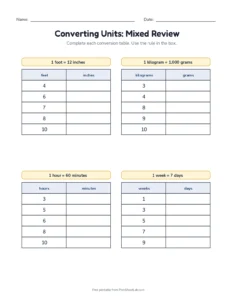
Converting units means writing the same measurement with a different unit, such as 3 feet as 36 inches. The six PDFs on this page have conversion tables for length, weight, capacity and time, in customary and metric units, and every sheet has an answer key. They follow standard 4.MD.A.1 of the Common Core standards for grade 4 measurement and data, and the notes below show when to multiply, when to divide and how the units connect.
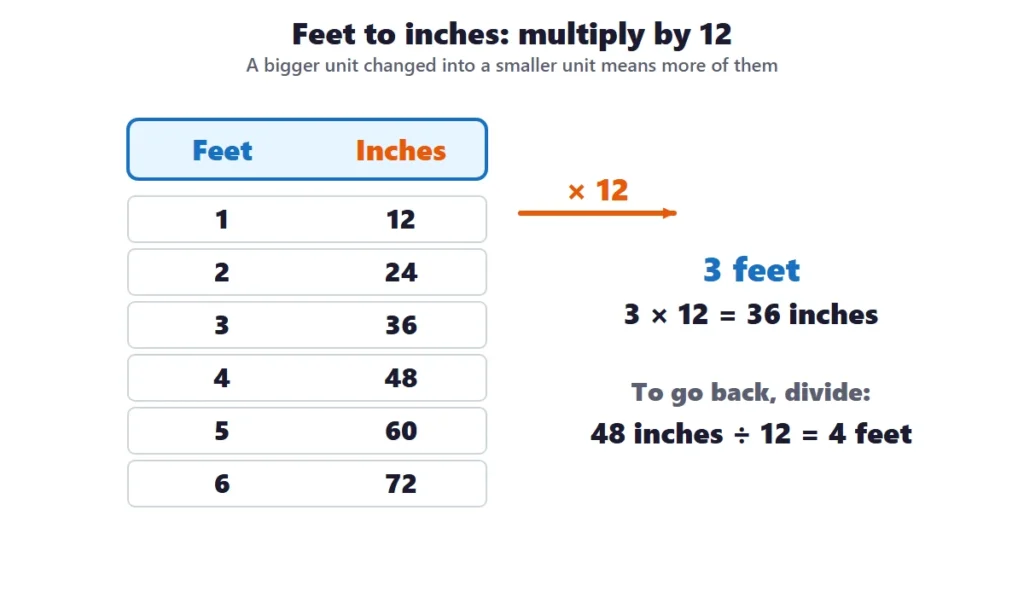
Feet to inches. Multiply by 12.
Big units to small units
When you change a big unit into a smaller one, you need more of them, so you multiply. 1 foot is 12 inches, so 3 feet is 3 × 12 = 36 inches. Grade 4 children express measurements in a larger unit in terms of a smaller unit and record them in two-column tables (Common Core 4.MD.A.1), which is exactly what these worksheets practice.
Length
Weight and capacity
Time
1 ft = 12 in 1 yd = 3 ft 1 m = 100 cm 1 km = 1,000 m
1 lb = 16 oz 1 kg = 1,000 g 1 gal = 4 qt 1 L = 1,000 mL
1 hr = 60 min 1 min = 60 sec 1 day = 24 hr 1 week = 7 days
Converting units worksheets: what is in the set
There are 6 converting units worksheets on this page, and every one has an answer key except for any cut-out games. The first three sheets cover length, weight and capacity, and time. The next two split metric from customary, and the last is a mixed review.
Worksheet
What children do
Standard
Converting Units of Length
Feet to inches, yards to feet, meters to centimeters, kilometers to meters.
4.MD.A.1
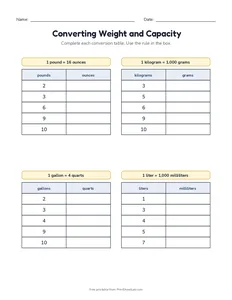
Converting Weight and Capacity
Pounds, kilograms, gallons and liters.
4.MD.A.1
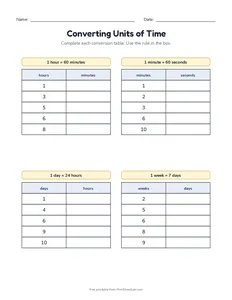
Converting Units of Time
Hours, minutes, days and weeks.
4.MD.A.1
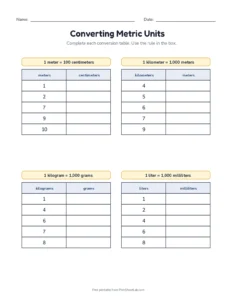
Converting Metric Units
Meters, kilometers, kilograms and liters.
4.MD.A.1
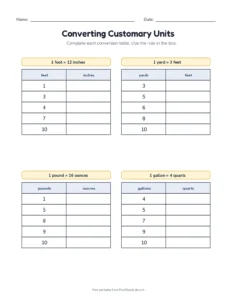
Converting Customary Units
Feet, yards, pounds and gallons.
4.MD.A.1
Converting Units: Mixed Review
Length, weight and time conversion tables together.
4.MD.A.1
Converting units worksheets: big units to small units and back
The converting units worksheets have one rule that does all the work: when you change a big unit into a smaller one, you need more of them, so you multiply. When you change a small unit into a bigger one, you need fewer, so you divide. Wikipedia’s article on unit conversion shows how the same rule works for all kinds of units. This table shows twelve conversions, eight that multiply and four that divide:
Start
What to do
Working
Answer
3 ft
multiply by 12
3 × 12 = 36
36 in
5 yd
multiply by 3
5 × 3 = 15
15 ft
4 kg
multiply by 1,000
4 × 1,000 = 4,000
4,000 g
2 L
multiply by 1,000
2 × 1,000 = 2,000
2,000 mL
3 gal
multiply by 4
3 × 4 = 12
12 qt
5 lb
multiply by 16
5 × 16 = 80
80 oz
4 hr
multiply by 60
4 × 60 = 240
240 min
2 days
multiply by 24
2 × 24 = 48
48 hr
48 in
divide by 12
48 ÷ 12 = 4
4 ft
3,000 g
divide by 1,000
3,000 ÷ 1,000 = 3
3 kg
180 min
divide by 60
180 ÷ 60 = 3
3 hr
24 qt
divide by 4
24 ÷ 4 = 6
6 gal
The factor is always the same as the “1 big = ? small” fact: 1 ft = 12 in, 1 yd = 3 ft, 1 kg = 1,000 g and 1 hr = 60 min. A child who knows the fact knows both ways to convert. The times tables worksheets and multiplication worksheets pages help with the products.
Customary units conversion: feet, yards, pounds and gallons
The customary units conversion sheets are harder than the metric ones, since the factors are 12, 3, 16, 4 and 2, and not powers of ten. This table shows the main facts, with the chain that joins the units:
Kind of unit
Unit
Equals
Chain
Length
1 foot
12 inches
1 yard = 3 feet = 36 inches
Length
1 mile
5,280 feet
1 mile = 1,760 yards
Weight
1 pound
16 ounces
1 ton = 2,000 pounds
Capacity
1 gallon
4 quarts
1 gallon = 8 pints = 16 cups
Capacity
1 quart
2 pints
1 pint = 2 cups
Time
1 week
7 days
1 week = 168 hours
Many conversions use two steps. For 5 yards in inches, 5 yards is 15 feet, and 15 feet is 180 inches. This table shows three examples of the chain from yards to feet to inches:
Start with
In feet
In inches
Working
2 yards
6
72
2 × 3 = 6 and 6 × 12 = 72
5 yards
15
180
5 × 3 = 15 and 15 × 12 = 180
10 yards
30
360
10 × 3 = 30 and 30 × 12 = 360
The numbers in the last column are all multiples of 36, since 1 yard is 36 inches. A child who knows that 1 yard is 36 inches can do the conversion in one step.
Metric conversion worksheets: moving between kilo and milli
The metric conversion worksheets use the prefixes of the metric system. Every prefix is a power of ten, so converting means multiplying or dividing by 10, 100 or 1,000, and for whole numbers the digits only need new zeros. This table shows the seven prefixes and the units that use them:
Prefix
Times the base unit
Examples
Fact
kilo-
1,000
kilometer (km), kilogram (kg)
1 km = 1,000 m
hecto-
100
hectare (area)
1 hectare = 100 ares
deca-
10
decameter (rarely used)
1 dam = 10 m
base unit
1
meter (m), gram (g), liter (L)
1 m
deci-
1/10
deciliter (dL)
1 L = 10 dL
centi-
1/100
centimeter (cm)
1 m = 100 cm
milli-
1/1,000
millimeter (mm), milliliter (mL)
1 m = 1,000 mm
Here are six conversions that grade 4 children make with whole numbers:
Start
Times
Working
Answer
3 m
100
3 × 100 = 300
300 cm
7 km
1,000
7 × 1,000 = 7,000
7,000 m
5 L
1,000
5 × 1,000 = 5,000
5,000 mL
2 kg
1,000
2 × 1,000 = 2,000
2,000 g
9 cm
10
9 × 10 = 90
90 mm
4 m
1,000
4 × 1,000 = 4,000
4,000 mm
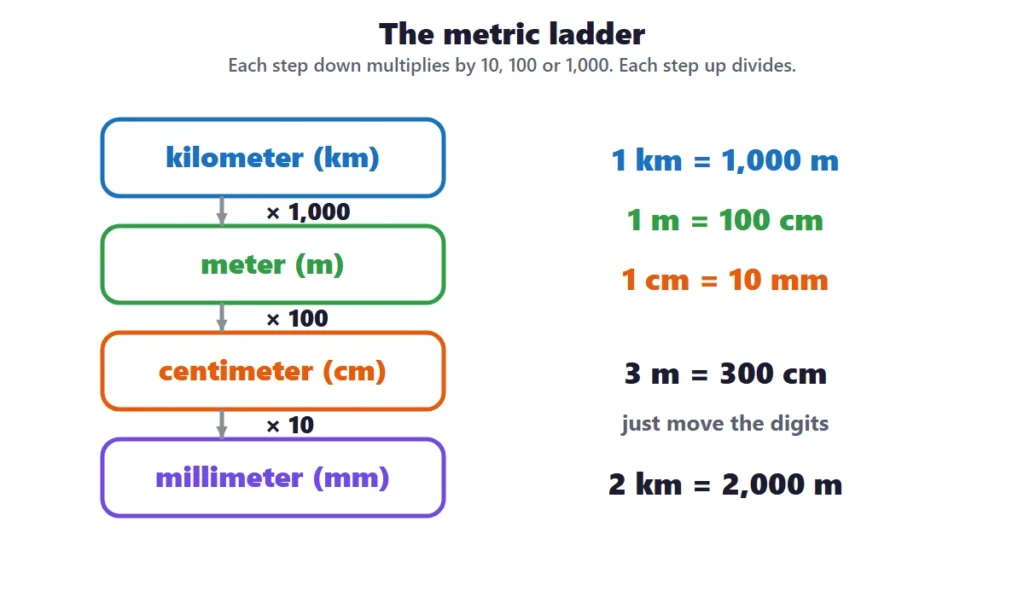
The metric ladder diagram above shows the same idea. Each step down the ladder from kilometer to meter, to centimeter and to millimeter multiplies by 1,000, 100 and 10. Grade 5 children extend this to decimals, as the Common Core standards for grade 5 measurement and data describe, and the decimals worksheets pages have the decimal work.
Measurement conversion worksheets: units of time
The measurement conversion worksheets with time are different from the others, because the factors are 60, 24 and 7, which are not powers of ten. Children have to learn them as facts. This table shows how many seconds there are in five units of time:
Time
Seconds
How to find it
1 minute
60
60
1 hour
3,600
60 × 60
1 day
86,400
24 × 60 × 60
1 week
604,800
7 × 24 × 60 × 60
1 year of 365 days
31,536,000
365 × 24 × 60 × 60
There are 86,400 seconds in a day and 604,800 in a week. These numbers show why seconds are not used for long times. A year of 365 days has 31,536,000 seconds. The telling time worksheets pages teach the hours and minutes on a clock, and the time calculator adds and subtracts times.
Conversion tables grade 4: two-column tables
The conversion tables grade 4 use are two-column tables, where the first column has the big unit and the second the small unit, in order. The standard 4.MD.A.1 asks children to record measurements in a two-column table, and to see the pattern. Each row goes up by the same number, which is the conversion factor. The diagram of feet and inches above is the example, with 12, 24, 36, 48, 60 and 72 inches for 1 to 6 feet.
The metric ladder. Kilometers, meters, centimeters, millimeters.
A good activity is to make a table for a different pair of units. For gallons and quarts, the second column goes 4, 8, 12, 16 and 20, and for hours and minutes it goes 60, 120, 180 and 240. Children can then use the table to answer a question without calculating again. This table shows mixed measurements, and how to change each to the small unit:
Mixed measurement
Big unit changed to the small unit
Add the extra
Total
2 ft 5 in
2 × 12 = 24
24 + 5 = 29
29 in
4 yd 2 ft
4 × 3 = 12
12 + 2 = 14
14 ft
3 hr 15 min
3 × 60 = 180
180 + 15 = 195
195 min
1 kg 250 g
1 × 1,000 = 1,000
1,000 + 250 = 1,250
1,250 g
5 lb 9 oz
5 × 16 = 80
80 + 9 = 89
89 oz
2 gal 3 qt
2 × 4 = 8
8 + 3 = 11
11 qt
Customary and metric: comparing the two systems
Children in the United States use both systems, so it is useful to know how big a metric unit is in customary units. This table gives six approximate facts. They are not exact, and they are not part of the grade 4 standard, but they help with a sense of size:
Customary unit
Equals about
Example
1 inch
2.54 centimeters
10 in is about 25.4 cm
1 mile
1.609 kilometers
5 miles is about 8 km
1 pound
0.454 kilograms
10 lb is about 4.5 kg
1 gallon
3.785 liters
2 gal is about 7.6 L
1 ounce
28.35 grams
4 oz is about 113 g
1 foot
30.48 centimeters
3 ft is about 91 cm
An inch is exactly 2.54 centimeters. The other values are rounded, and the real conversion is more precise. A child who knows that a meter is a little more than a yard has a good start.
Common mistakes with converting units
The biggest mistake is to multiply when the problem needs division, or the other way round. This table shows five mistakes, what went wrong and the fix:
What the child writes or says
What went wrong
The fix
3 ft = 3 ÷ 12 = 0.25 in
divides to change a big unit to a small unit
a big unit changed to a small unit means more of them: multiply, 3 × 12 = 36 in
48 in = 48 × 12 = 576 ft
multiplies to change a small unit to a big unit
divide: 48 ÷ 12 = 4 ft
2 kg = 200 g
uses 100 instead of 1,000
kilo means 1,000: 2 kg = 2,000 g
1 hr 30 min = 130 min
writes the numbers side by side
1 × 60 + 30 = 90 min
1 gal = 8 qt
mixes up quarts and pints
1 gal = 4 qt = 8 pints
Converting units word problems
Converting units comes up in cooking, building and travel. Ask children to decide whether the unit gets bigger or smaller, and then multiply or divide:
Word problem
Working
Answer
A ribbon is 3 feet long. How many inches long is it?
3 × 12
36 inches
A bag of flour weighs 2 kg. How many grams is that?
2 × 1,000
2,000 grams
A movie lasts 2 hours 15 minutes. How many minutes is that?
2 × 60 + 15
135 minutes
A fence is 15 feet long. How many yards is that?
15 ÷ 3
5 yards
A bottle holds 3 L. How many milliliters can it hold?
3 × 1,000
3,000 mL
A runner runs 4,000 meters. How many kilometers is that?
4,000 ÷ 1,000
4 km
Games and activities for converting units
Children learn converting units best when they play with it. These games use things that are found at home or in a classroom:
Unit hunt: find objects that are about 1 foot, 1 meter and 1 inch long, and measure them
Conversion bingo: a bingo card with the answers, and calling cards with the conversions
Human ladder: make a ladder of units on the floor, and step up or down for each conversion
Recipe conversion: change a recipe from cups to quarts or from ounces to pounds
Time race: say how many minutes are in 3 hours as fast as you can
Table builder: make a two-column table for any pair of units, and ask a friend to use it
Extra support and extra challenge with converting units
For children who need more support: start with units that the child knows, such as feet and inches, and use a real ruler. Make a two-column table and find the pattern. Always ask “is the new unit bigger or smaller?” before multiplying or dividing. Do the sheets with one kind of unit at a time, and use the answer key to check.
For children who need more challenge: ask for the number of seconds in 2 hours, for a conversion with two steps, such as yards to inches, and for the sum of 2 ft 9 in and 1 ft 8 in. The sheet that mixes all the units, and the problems with mixed measurements, are good challenges.
How to tell that a child is ready to move on from converting units
Before moving on from converting units, check that the child can do all four of these things:
The child knows the main facts for length, weight, capacity and time.
The child decides to multiply or divide from the sizes of the units.
The child makes a two-column conversion table.
The child changes a mixed measurement to a single unit.
A short lesson is the best way to introduce converting units. This 20-minute plan can be used in a classroom, at a tutoring session or at home, and it uses the worksheets at the end:
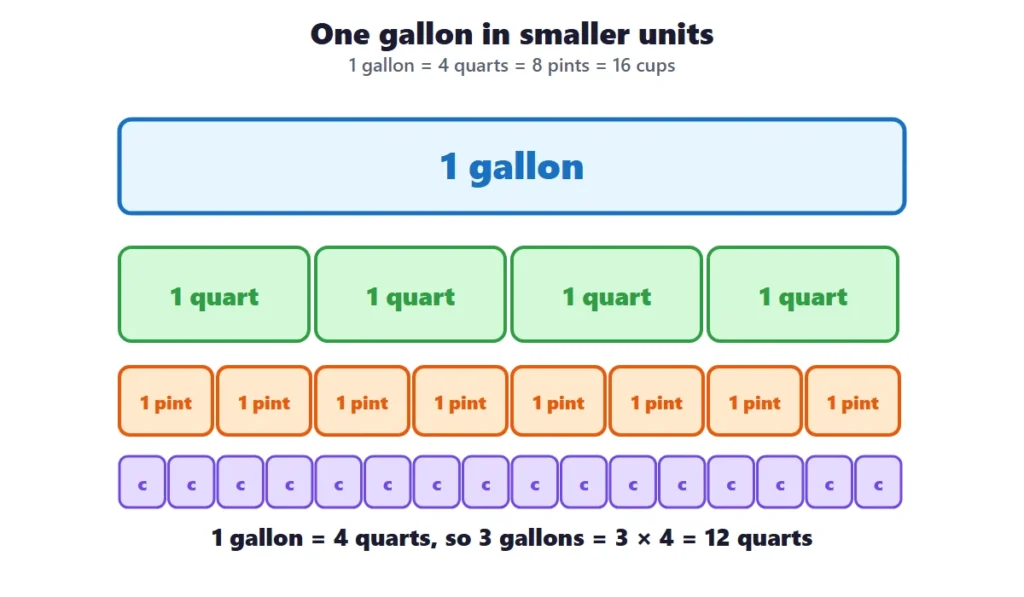
A gallon. 4 quarts, 8 pints, 16 cups.
Minutes
Activity
What to say or ask
0 to 3
Show a ruler and ask how many inches are in a foot
How many inches in 2 feet? In 3 feet?
3 to 8
Make a table of feet and inches from 1 to 6
What is the pattern?
8 to 13
Convert 48 inches to feet, and discuss which way to go
Do we multiply or divide? Why?
13 to 18
Convert 2 kg to grams and 3 m to centimeters
What does kilo mean? What does centi mean?
18 to 20
Start a worksheet and check one answer
Is the answer bigger or smaller than the start?
Where converting units fits across the grades
No skill stands alone. This table shows what children learn before and after converting units, with the standard that goes with each step:
This page is the main page for unit conversion. The whole sequence is on the measurement worksheets page.
Helping at home with converting units
Parents do not need to be experts to help with converting units. These suggestions work well, and each takes only a few minutes:
Cook together and change cups to pints or ounces to pounds.
Ask “how many minutes in 2 hours?” while waiting.
Use a ruler and a tape measure to find how many inches are in a foot.
Look at labels, which show both customary and metric units.
Say “bigger to smaller means multiply” until it is automatic.
How to check progress in converting units
A teacher or parent can check progress in converting units with the answer key and a few questions. This table shows three common situations, what they mean and what to do next:
What you see
What it means
What to do next
The child multiplies when the problem needs division
The sizes of the units are not yet linked to the operation
Ask “is the new unit bigger or smaller?” before choosing
The child gets 9 of 10 right in every set
The skill is secure
Move on to measuring length and perimeter
The child knows the metric facts but not the customary ones
The factors 12, 3, 16 and 4 need more practice
Make cards for the customary facts and practice them each day
A five-day plan for converting units
Most children need about a week of short sessions for converting units. This plan follows the order of the worksheets on this page:
Day
What to do
Practice
Day 1
Find units in the kitchen and the classroom, and sort them by size
Multiply to go from a bigger unit to a smaller one (feet to inches). Divide to go from a smaller unit to a bigger one.
Why are metric conversions easier?
Metric units go up in tens, hundreds and thousands, so converting is just moving digits, like 3 m = 300 cm.
How do you know whether to multiply or divide when converting units?
Think about the sizes of the units. If you change a big unit to a smaller one, such as feet to inches, there will be more of the small units, so you multiply. If you change a small unit to a bigger one, you divide.
How many seconds are in a day?
There are 86,400 seconds in a day. A minute has 60 seconds, an hour has 60 minutes and a day has 24 hours, so 24 × 60 × 60 = 86,400.
What grade learns converting units?
Grade 4 converts units within one system with whole numbers (4.MD.A.1), and grade 5 extends this to decimals and to all the units (5.MD.A.1).