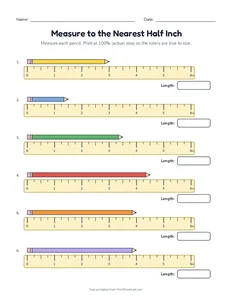
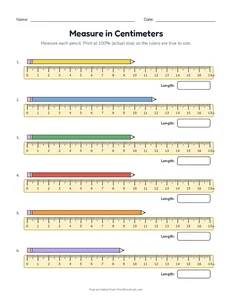
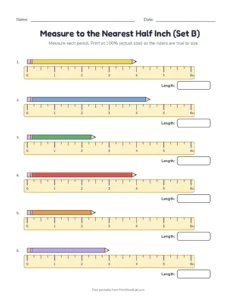
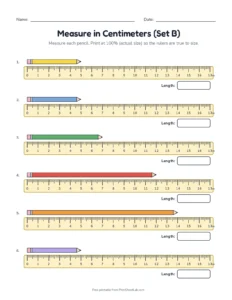
Measuring length means finding how long something is with a ruler, and saying the answer with a unit. The six PDFs on this page have true-size rulers in inches, half inches and centimeters, and children measure six pencils on each sheet, with answer keys. They follow standard 2.MD.A.1 and 3.MD.B.4 of the Common Core standards for grade 2 measurement and data, and the notes below explain how a ruler works and how to read it.
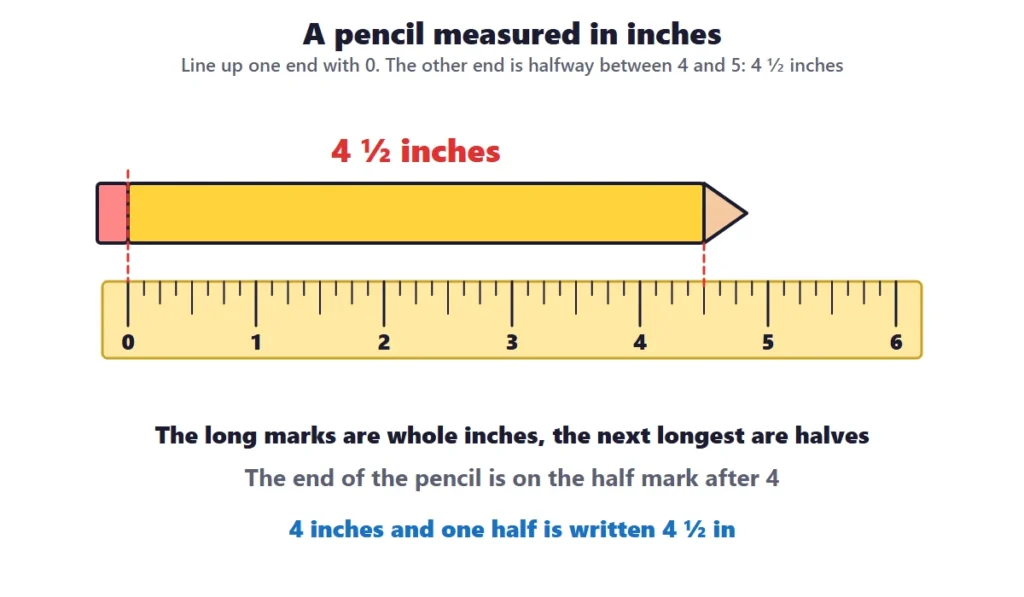
An inch ruler. A pencil of 4 ½ inches.
How to measure with a ruler
Line up one end of the object with the 0 mark, not the edge of the ruler.
Look at where the other end reaches.
Read the number, and say the unit: 5 inches, not just 5.
On the half-inch worksheets, the longer marks between numbers are halves. A pencil that ends on the half mark after 4 is 4 ½ inches long. Grade 3 children measure to the nearest half and quarter inch (3.MD.B.4).
Measuring length worksheets: what is in the set
There are 6 measuring length worksheets on this page, and every one has an answer key except for any cut-out games. Two sheets measure to the nearest inch, two to the nearest half inch, and two in centimeters, each with a second set for more practice.
Worksheet
What children do
Standard
Measure to the Nearest Inch
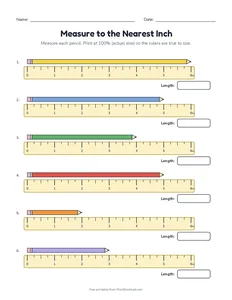
Measure six pencils with true-size inch rulers.
2.MD.A.1
Measure to the Nearest Half Inch
Pencils that end on whole and half inches.
2.MD.A.1
Measure in Centimeters
Measure six pencils with centimeter rulers.
2.MD.A.1
Measure to the Nearest Inch (Set B)
Six more pencils to measure in inches.
2.MD.A.1
Measure to the Nearest Half Inch (Set B)
Six more pencils ending on whole and half inches.
2.MD.A.1
Measure in Centimeters (Set B)
Six more pencils to measure in centimeters.
2.MD.A.1
Measuring length worksheets: the marks on a ruler
The measuring length worksheets use rulers that are printed at actual size, so they can be checked with a real ruler. Wikipedia’s article on rulers explains how the marks are made. On an inch ruler, the marks have different lengths: the longest are whole inches, and each shorter size shows half an inch, a quarter, an eighth or a sixteenth. This table shows how many marks a 12-inch ruler has for each way of dividing an inch:
Ruler marked in
Spaces in each inch
Smallest unit
Marks on a 12-inch ruler
Length of the marks
Whole inches
1
the inch
13
the longest marks
Halves
2
1/2 inch
25
the next longest
Quarters
4
1/4 inch
49
medium marks
Eighths
8
1/8 inch
97
short marks
Sixteenths
16
1/16 inch
193
the shortest marks
The worksheets on this page use whole inches and half inches, and the centimeter rulers have a mark for every millimeter. The fractions worksheets pages explain halves, quarters and eighths, and the fractions on a number line page shows that a ruler is a number line.
Ruler worksheets: how to read a ruler
The ruler worksheets teach three steps. First, put the 0 mark at one end of the object. Second, find the other end. Third, read the number, and say the unit. When the other end is between two numbers, the length is a whole number plus a part, and the part is read from the shorter marks. This table shows what to use for different measuring jobs:
What to measure
Best unit
Tool
Pencil, eraser, paper clip
inches or centimeters
ruler
Desk, book, table
inches or centimeters
12-inch ruler or 30 cm ruler
Classroom, playground
feet, yards or meters
yardstick, meter stick or tape
A long walk
miles or kilometers
a map or a trip counter
Thickness of a coin
millimeters
a metric ruler
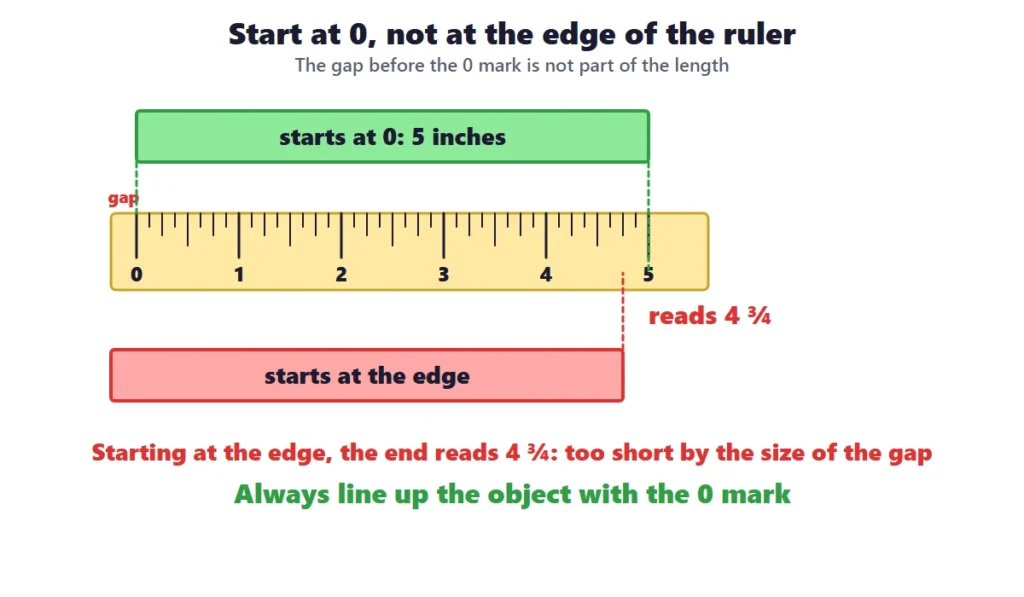
Most mistakes come from the first step. The diagram above shows a pencil that starts at the edge of the ruler, and not at the 0 mark. It reads 4 ¾, but its real length is 5 inches. Putting the pencil on the 0 mark is the most important habit in this pack.
Measuring inches worksheets: whole inches and half inches
The measuring inches worksheets ask for the nearest inch on the first sheets, and for the nearest half inch on the next ones. The nearest inch is the whole number the end of the pencil is closest to, and the nearest half inch is the closest of the marks that are a half apart. This table shows eight lengths, in eighths of an inch, and how each is measured to the nearest inch and the nearest half inch:
Length of the pencil
Nearest inch
Nearest half inch
3 1/8 in
3
3
3 3/8 in
3
3 1/2
4 1/4 in
4
4 1/2
4 5/8 in
5
4 1/2
5 1/2 in
6
5 1/2
6 7/8 in
7
7
2 1/2 in
3
2 1/2
7 1/8 in
7
7
A length of 4 5/8 inches is closer to 4 1/2 than to 5, but to the nearest whole inch it is 5. Because the answer depends on which unit is chosen, it is a good idea to say “to the nearest inch” or “to the nearest half inch” each time.
Measure to the nearest half inch: the rule
To measure to the nearest half inch, look at where the end of the object is between two whole numbers. If it is closer to a whole number than to the half, use the whole number. If it is closer to the half, use the half. When it is exactly in the middle, round up. This table shows where the end lies for each sixteenth of an inch:
Part of an inch past a whole number
Nearest half inch
0/16 up to 3/16
the whole number
4/16 up to 11/16
the half inch
12/16 up to 16/16
the next whole number
Because a half inch has 8 sixteenths, the boundaries are at 4/16 and 12/16. The worksheets on this page use pencils that end on whole and half inches, so the question is easy to answer, and the next step in grade 3 is to measure to the nearest quarter inch.
Measuring centimeters worksheets: centimeters and millimeters
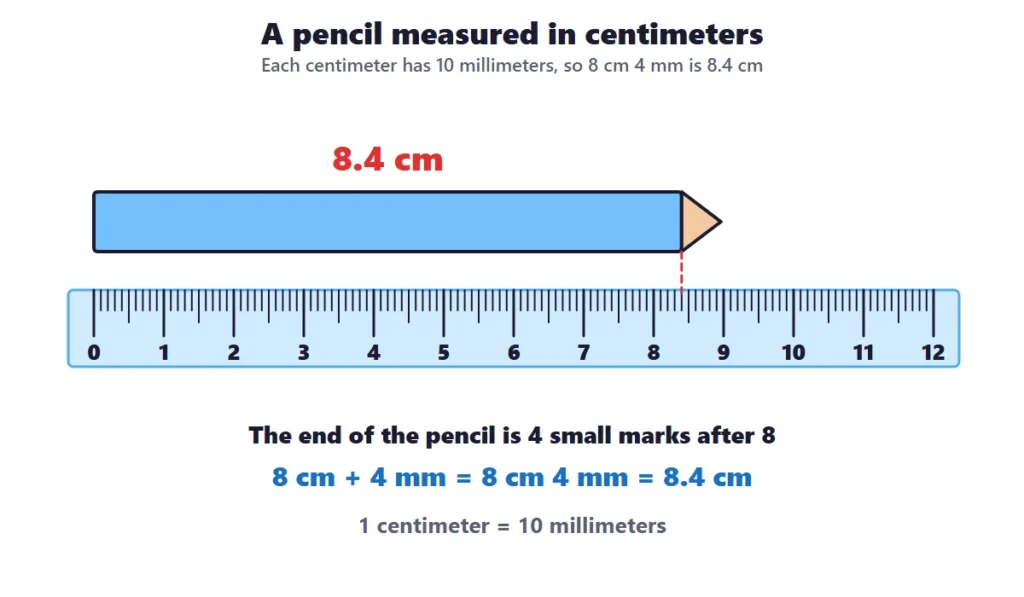
The measuring centimeters worksheets use a ruler with a long mark at each centimeter and a short mark at each millimeter. Each centimeter has 10 millimeters. A length of 8 cm 4 mm is written 8.4 cm as a decimal, and 84 mm in millimeters. This table shows six lengths in three forms:
A centimeter ruler. A pencil of 8.4 cm.
Length
In centimeters and millimeters
In millimeters
As a decimal
8 cm 4 mm
8 cm and 4 mm
84
8.4 cm
12 cm 7 mm
12 cm and 7 mm
127
12.7 cm
5 cm 0 mm
5 cm and 0 mm
50
5.0 cm
3 cm 6 mm
3 cm and 6 mm
36
3.6 cm
9 cm 9 mm
9 cm and 9 mm
99
9.9 cm
14 cm 2 mm
14 cm and 2 mm
142
14.2 cm
Centimeters are easier to use than inches for children who know the place value of tens, since the marks follow the same pattern as the base-ten system. The decimals worksheets pages continue this idea. An inch is 2.54 cm, so the two rulers can be compared, as this table shows for 1 to 12 inches:
Inches
Centimeters (× 2.54)
Inches
Centimeters (× 2.54)
1
2.54
7
17.78
2
5.08
8
20.32
3
7.62
9
22.86
4
10.16
10
25.40
5
12.70
11
27.94
6
15.24
12
30.48
Estimating length: body and object benchmarks
Before children measure, they should estimate, because an estimate helps them to catch mistakes, such as a pencil that is 70 cm long. A benchmark is something whose length is known. This table gives six everyday benchmarks in inches and centimeters:
Object
Length in inches
Length in centimeters
Thumb width, near the nail
about 1 in
about 2.5 cm
A new unsharpened pencil
7 1/2 in
19 cm
A dollar bill
6 1/8 in
15.6 cm
A credit card
3 3/8 in
8.6 cm
A sheet of letter paper, long side
11 in
27.9 cm
A quarter coin across
just under 1 in
2.4 cm
Children can make their own benchmarks: the width of a finger, the span of a hand or the length of a footstep. They measure each with a ruler and write the length in a table. Next time they need an estimate, they use the table.
Common mistakes with measuring length
The most common mistake is not to start at 0. This table shows five mistakes, what went wrong and the fix:
What the child writes or says
What went wrong
The fix
A pencil that ends at the 5 is 5 even if it starts at 1
starts at 1 and does not subtract
start at 0, or subtract: 5 − 1 = 4
A pencil measured from the edge of the ruler is longer
forgets the gap before the 0 mark
line up with the 0 mark, not the edge
The pencil is 4 ½ cm
reads the half mark of an inch ruler as centimeters
check the unit written on the ruler
The pencil is 5 long
does not write the unit
say the unit, as in 5 inches
Counts the marks, and not the spaces
the first mark is 0, so one too many is counted
count the spaces between the marks, or read the number
Measuring length word problems
Measuring length is used to compare, to add and to find differences. Ask children to measure first, write the unit, and then answer the question:
Word problem
Working
Answer
A pencil starts at 0 and ends at the 7 on an inch ruler. How long is the pencil?
read the end mark
7 inches
A ribbon ends halfway between 5 and 6 inches. How long is it?
5 and one half
5 ½ inches
A crayon is 9 cm long and a pencil is 17 cm long. How much longer is the pencil?
17 − 9
8 cm
A worm is 3 ½ inches long and a snail is 2 inches long. How much longer is the worm?
3 ½ − 2
1 ½ inches
Two pencils of 8 cm and 6 cm are laid end to end. How long are they together?
8 + 6
14 cm
A ruler is 30 cm long. How many millimeters is that?
30 × 10
300 mm
Games and activities for measuring length
Children learn measuring length best when they play with it. These games use things that are found at home or in a classroom:
Measure the room: measure ten objects in the room in inches or centimeters, and put them in order
Estimate then measure: estimate the length of an object, measure it, and see who is closest
Pencil gallery: sort pencils by length with a ruler, from the shortest to the longest
Ruler hunt: find a ruler, a yardstick, a meter stick and a tape measure, and say what each is used for
Make a ruler: make a paper ruler with a mark at each centimeter and use it
Measuring bingo: a bingo card with lengths, and calling cards with pictures of objects on a ruler
Extra support and extra challenge with measuring length
For children who need more support: start with an inch ruler that has only whole inch marks, and use a real ruler beside the worksheet. Always line up the 0 mark with one end, and say the unit aloud. Do the sheet with whole inches first, then the half inches, and keep a pencil on the 0 mark while reading the other end.
For children who need more challenge: ask for the nearest quarter inch, for the difference between two pencils, for a pencil that is 8 cm 6 mm long in millimeters, and for an estimate of the length of a room in feet. Try measuring the same object in inches and in centimeters and finding how many centimeters are in an inch.
How to tell that a child is ready to move on from measuring length
Before moving on from measuring length, check that the child can do all four of these things:
The child starts at the 0 mark and not at the edge.
The child reads a length to the nearest inch and to the nearest half inch.
The child measures in centimeters, and knows that a centimeter has 10 millimeters.
A short lesson is the best way to introduce measuring length. This 20-minute plan can be used in a classroom, at a tutoring session or at home, and it uses the worksheets at the end:
Start at 0. The gap changes the length.
Minutes
Activity
What to say or ask
0 to 3
Show a ruler and a pencil and ask how long the pencil is
Where do we start? What is the unit?
3 to 8
Measure a pencil with the 0 mark, and read the end
Which mark is the end closest to?
8 to 13
Measure a pencil that ends on a half inch mark
What do the longer marks between the numbers show?
13 to 18
Measure the same pencil in centimeters
Which number is bigger, and why?
18 to 20
Start a worksheet and check one answer with a real ruler
Did we start at 0?
Where measuring length fits across the grades
No skill stands alone. This table shows what children learn before and after measuring length, with the standard that goes with each step:
This page is the first page of the measurement sequence. The whole sequence is on the measurement worksheets page.
Helping at home with measuring length
Parents do not need to be experts to help with measuring length. These suggestions work well, and each takes only a few minutes:
Measure the child’s height each month on a door frame.
Ask “how long do you think it is?” before measuring anything.
Use a tape measure to find the length of a table or a room.
Check that the child starts at the 0 mark.
Find a ruler in the kitchen, and compare its inch and centimeter marks.
How to check progress in measuring length
A teacher or parent can check progress in measuring length with the answer key and a few questions. This table shows three common situations, what they mean and what to do next:
What you see
What it means
What to do next
The child reads the wrong number because the object does not start at 0
The 0 mark is not yet the habit
Put a finger on the 0 mark and slide the object to it
The child gets 9 of 10 right in every set
The skill is secure
Move on to quarter inches, or to converting units
The child forgets the unit
The number is thought of as the whole answer
Say “5 inches, not just 5”, and write the unit every time
A five-day plan for measuring length
Most children need about a week of short sessions for measuring length. This plan follows the order of the worksheets on this page:
Day
What to do
Practice
Day 1
Measure with a ruler, starting at 0
Measure to the Nearest Inch
Day 2
Read the half inch marks
Measure to the Nearest Half Inch
Day 3
Measure in centimeters
Measure in Centimeters
Day 4
Measure more pencils in inches and half inches
Set B sheets in inches
Day 5
Measure in centimeters, and compare the two rulers
Many rulers have a small gap before the 0 mark. Starting at the end leaves the gap out of the count, so the number at the other end is too small by the size of the gap.
How many centimeters are in an inch?
About 2.5 centimeters (exactly 2.54). That is why the centimeter rulers on these sheets are longer in numbers.
Why do you start at 0 and not at the edge of the ruler?
The 0 mark is where the measuring starts. Many rulers have a small gap between the edge and the 0 mark, so if you line up with the edge, the number at the other end is too small by the size of the gap.
How many centimeters are in an inch?
There are 2.54 centimeters in an inch, so an inch is a little more than 2 ½ centimeters. A centimeter ruler has more numbers than an inch ruler of the same length.
What does “to the nearest half inch” mean?
It means that the length is rounded to the closest whole or half inch mark. A pencil that ends a little after the 4 is 4 inches to the nearest half inch, and one that ends near the half mark is 4 ½ inches.