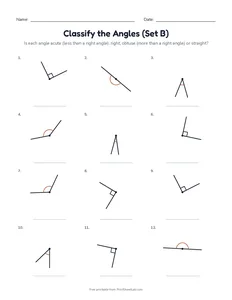
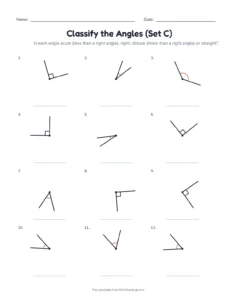
An angle is the amount of turn between two lines that meet at a point, and it is measured in degrees. The three PDFs on this page ask children to sort angles as acute, right, obtuse or straight, and every sheet has an answer key. They follow standard 4.G.A.1 of the Common Core standards for grade 4 geometry, and the notes below explain the types, how to compare an angle with a right angle, and how to measure with a protractor.
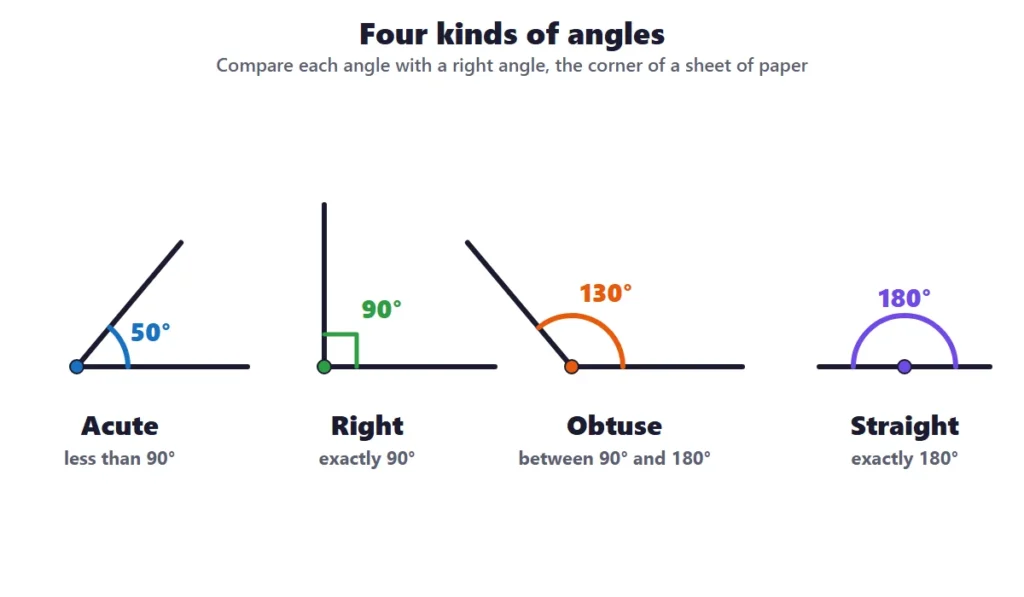
Four kinds of angles. Acute, right, obtuse and straight.
Quick answer: An angle is the amount of turn between two lines that meet at a point. An acute angle is less than 90°, a right angle is exactly 90°, an obtuse angle is more than 90° and less than 180°, and a straight angle is 180°. This page has 3 free printable angles worksheets with answer keys. Updated October 2026.
Compare with a right angle
A right angle is a square corner, like the corner of a sheet of paper. Use it to compare: an acute angle is smaller (sharper), an obtuse angle is bigger (more open) and a straight angle is a straight line. Children can hold the corner of a card against each angle on the worksheet to check.
Angles worksheets: what is in the set
There are 3 angles worksheets on this page, and every one has an answer key except for any cut-out games. Each set has 12 to sort, and the first set also includes straight ones.
Worksheet
What children do
Standard
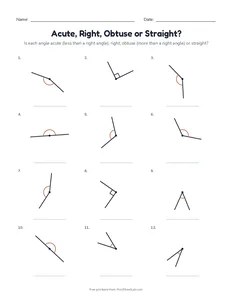
Acute, Right, Obtuse or Straight?
Sort 12 angles.
4.G.A.1
Classify the Angles (Set B)
Twelve more angles to sort.
4.G.A.1
Classify the Angles (Set C)
Sort twelve more angles as acute, right, obtuse or straight.
4.G.A.1
Angles: parts, units and types
An angle is made of two arms that meet at a vertex. The size of an angle is the amount that one arm turns to reach the other, and it is measured in degrees, with 360 degrees in a full turn. Wikipedia’s article on angles gives the history of the degree. This table shows the types of angle that children meet, with the size, a way to remember it and an example:
Type
Size
How to remember it
Example
Acute
less than 90°
a sharp point: “a cute little angle”
the tip of a pencil
Right
exactly 90°
a square corner
the corner of a book
Obtuse
more than 90° and less than 180°
wide and open
a door open wide
Straight
exactly 180°
a straight line
the edge of a ruler
Reflex
more than 180° and less than 360°
bends back on itself
the outside of a corner
Full turn
exactly 360°
a complete circle
a spinning top
The worksheets on this page use the first four types: acute, right, obtuse and straight. Reflex and full turns appear in grade 5 and 6.
Acute obtuse right angles worksheet: sorting by size
The acute obtuse right angles worksheet asks children to compare each angle with a right angle. A right angle is the corner of a sheet of paper, and it is exactly 90°. An angle that fits inside the corner is acute, and an angle that is wider than the corner is obtuse. This table shows twelve angles that are like those on the first sheet, with the comparison and the type:
Angle
Compared with 90°
Type
15°
less than
acute
45°
less than
acute
60°
less than
acute
75°
less than
acute
89°
less than
acute
90°
equal to
right
91°
more than
obtuse
120°
more than
obtuse
135°
more than
obtuse
150°
more than
obtuse
179°
more than
obtuse
180°
more than
straight
The angles 89° and 91° are very close to 90°, and children cannot tell them from a right angle by eye, so a right-angle tester or a protractor is needed for angles like these.
Types of angles worksheet: angles in everyday life
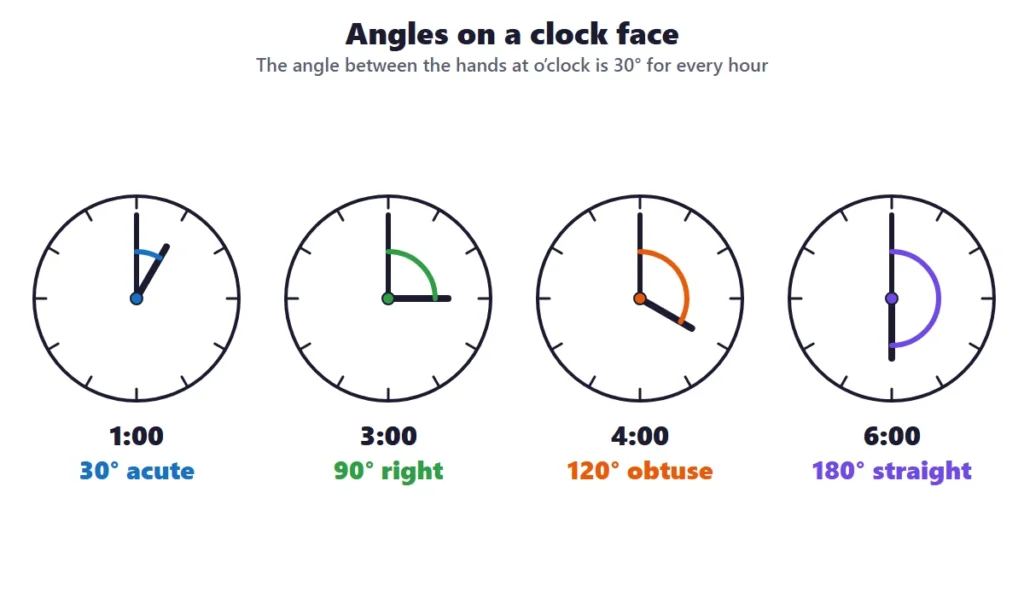
A types of angles worksheet is easier when children can link each type to something they know. A corner of a book is a right angle, the tip of a slice of pizza is acute, a laptop that is open wide is obtuse, and the edge of a ruler is straight. The clock is the best everyday example, because the angle between the hands is a multiple of 30° at every hour. This table shows the angle at each o’clock time:
Hour
Time
Angle between the hands
Type
1
1:00
30°
acute
2
2:00
60°
acute
3
3:00
90°
right
4
4:00
120°
obtuse
5
5:00
150°
obtuse
6
6:00
180°
straight
7
7:00
150°
obtuse
8
8:00
120°
obtuse
9
9:00
90°
right
10
10:00
60°
acute
11
11:00
30°
acute
12
12:00
0°
the hands overlap
At 3:00 and 9:00 the hands make a right angle. At 6:00 they make a straight line. At 12:00 the hands lie on top of each other, so there is no angle between them. The telling time worksheets page uses the same clock faces.
Classifying angles: using the right angle as a benchmark
When classifying angles, the best tool is a right-angle tester: fold a sheet of paper twice to make a square corner. To use it, place the corner on the vertex, and line up one edge with one arm of the angle. If the other arm is inside the corner, the angle is acute. If it is on the edge, the angle is a right angle. If it is outside, the angle is obtuse. Children can also use the fractions of a turn, which this table shows:
Part of a full turn
Angle
Type
Where you see it
1/12
30°
acute
one hour on a clock
1/8
45°
acute
a slice of an 8-slice pizza
1/6
60°
acute
a corner of an equilateral triangle
1/4
90°
right
a corner of a square
1/3
120°
obtuse
a corner of a regular hexagon
1/2
180°
straight
a straight line
3/4
270°
reflex
three quarters of a turn
Each of these is a fraction of 360°, so classifying angles is also a use of fractions. The identifying fractions page has the same fractions on shapes, and the fractions worksheets cover the arithmetic.
Angles grade 4: the standards
For angles grade 4, there are four standards, two in geometry and two in measurement. The first, 4.G.A.1, is about drawing and identifying angles, and it is the one that the worksheets on this page practice. The next three are about measuring. This table lists them, and the Common Core standards for grade 4 measurement and data list the rest of the measurement standards:
Standard
What children learn
Where on this page
4.G.A.1
Draw and identify points, lines, rays and angles (right, acute, obtuse), and perpendicular and parallel lines
sorting worksheets on this page
4.MD.C.5
An angle is measured with reference to a circle: one degree is 1/360 of a turn
full turn table
4.MD.C.6
Measure angles in whole-number degrees with a protractor
measuring section
4.MD.C.7
Angle measures add: a big angle is the sum of smaller ones
triangle table
The additive idea in 4.MD.C.7 is used to find a missing angle. The three corners of a triangle always add up to 180°, and the table below shows six triangles with their types:
Triangle
Angle 1
Angle 2
Angle 3
Sum
Type by angles
Acute triangle
60°
60°
60°
180°
acute
Right triangle
90°
45°
45°
180°
right
Obtuse triangle
120°
30°
30°
180°
obtuse
Scalene triangle
50°
60°
70°
180°
acute
Right triangle
90°
30°
60°
180°
right
Obtuse triangle
110°
40°
30°
180°
obtuse
Drawing an angle with a set square
Standard 4.MD.C.6 also asks children to draw an angle of a given size, and a set square is a quick way to do it. A set square is a plastic triangle with fixed corners. The two common kinds have the corners 45°, 45° and 90°, and 30°, 60° and 90°. Every corner of both is a size that can be traced. By putting two corners next to each other, or by taking one from another, children can make more sizes. This table shows what can be made from the four sizes 30°, 45°, 60° and 90°:
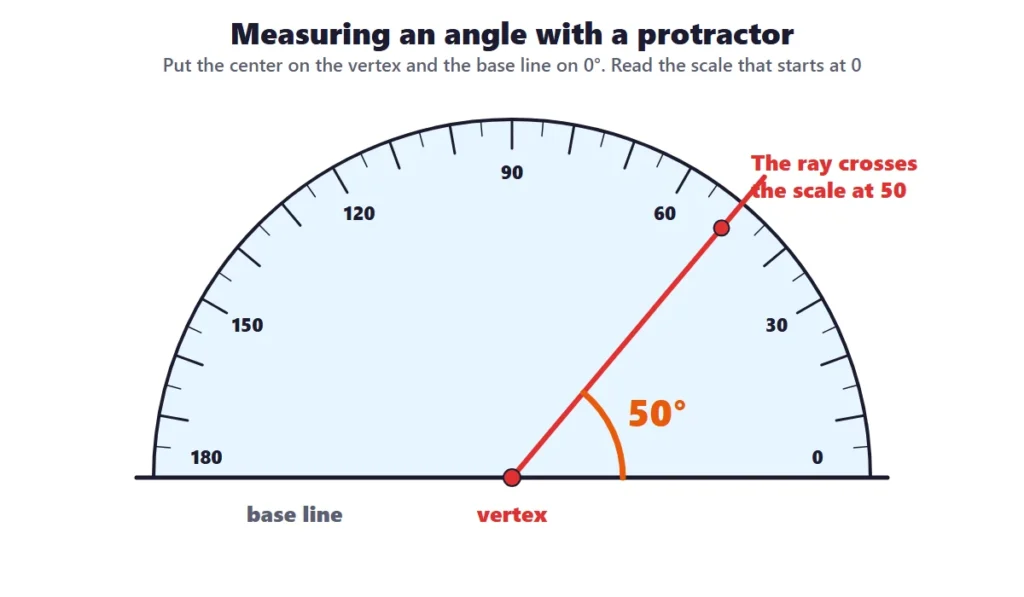
Protractor. Read the scale that starts at 0.
Angle
Type
How to make it
15°
acute
45° − 30°
30°
acute
a corner of a set square
45°
acute
a corner of a set square
60°
acute
a corner of a set square
75°
acute
30° + 45°
90°
right
a corner of a set square
105°
obtuse
45° + 60°
120°
obtuse
30° + 90°
135°
obtuse
45° + 90°
150°
obtuse
60° + 90°
180°
straight
90° + 90°
The sums give the obtuse sizes, such as 105° and 135°, and the differences give the small sizes, such as 15°. A child who has a set square and a pencil can draw all of these without a protractor, and can check a protractor reading against them.
Measuring angles with a protractor: step by step
A protractor is a half circle with a scale of 0° to 180°, and most have two scales, one that starts at 0 on the right and one that starts at 0 on the left. Children follow these steps:
Put the center hole of the protractor on the vertex of the angle.
Line up the base line of the protractor with one arm of the angle, so that the arm points to 0.
Find the scale that starts at 0 on that arm.
Follow the other arm to the scale, and read the number.
Check with the type: an acute angle must be less than 90°, and an obtuse angle must be more than 90°.
The last step stops the most common error, which is reading the wrong scale. If the angle is 50°, the other scale reads 130°, and a child who checks that the angle is acute knows that 130° cannot be right. This table shows six angles, with the right reading and the wrong one:
Angle to measure
Type
Right reading
Wrong reading (other scale)
How to tell the right one
30°
acute
30°
150°
the angle is acute, so it is less than 90°
50°
acute
50°
130°
the angle is acute, so it is less than 90°
65°
acute
65°
115°
the angle is acute, so it is less than 90°
110°
obtuse
110°
70°
the angle is obtuse, so it is more than 90°
130°
obtuse
130°
50°
the angle is obtuse, so it is more than 90°
155°
obtuse
155°
25°
the angle is obtuse, so it is more than 90°
Common mistakes with angles
The most common mistake is to think that longer arms make a bigger angle. This table shows five mistakes, what went wrong and the fix:
What the child says
What went wrong
The fix
An angle with long arms is bigger
confuses the length of the lines with the opening
the size of an angle is the opening, not the length of the arms
A 120° angle is acute
thinks that bigger numbers are sharper
compare with a right angle: 120° is wider than the corner, so it is obtuse
The angle in this picture is 130°, but it looks small
reads the wrong scale of the protractor
check: if the angle is acute, the reading must be under 90°
A straight line is not an angle
sees an angle only as a corner
a straight angle is exactly 180°
A right angle is any corner
does not check the square
put the corner of a card on the angle to test it
Angles word problems
Angles appear in pizza, clocks, doors and triangles. Ask children to draw each angle, to compare it with a right angle, and to name the type:
Word problem
Working
Answer
A pizza slice has a tip of 45°. Is the angle acute, right or obtuse?
45° is less than 90°
acute
The hands of a clock at 2:00 make an angle of 60°. What type of angle is it?
60° is less than 90°
acute
A door opens to 120°. What type of angle is it?
120° is more than 90°
obtuse
Two angles of a triangle are 50° and 60°. What is the third angle?
180° − 50° − 60°
70°
A straight line is split into two parts. One part is 135°. What is the other?
180° − 135°
45°
A square corner is split into two equal parts. How big is each one?
90° ÷ 2
45°
Games and activities for angle measure
Children learn angle measure best when they play with it. These games use things that are found at home or in a classroom:
Right-angle hunt: find right angles in the room with a paper tester, and write down where they are
Human arms: two children are the arms, and a third child says whether the angle is acute, right or obtuse
Clock angles: set a clock to a time, and ask what type of angle the hands make
Angle bingo: a bingo card with angle types, and calling cards with drawings
Straw hinge: make an angle with two straws and a pin, and open it to match a type
Angle sort: sort a pack of angle cards into acute, right and obtuse
Extra support and extra challenge with angle measure
For children who need more support: make a right-angle tester from a folded sheet of paper, and use it on every angle. Do the first set only, and sort the angles into two groups: smaller than the corner, and bigger than the corner. Add the right angle and the straight angle once the child is sure of the two groups.
For children who need more challenge: ask for the angle between the hands of a clock at 4:30, for three angles that make a straight line, and for the third angle of a triangle with angles of 35° and 80°. Measuring with a protractor, and drawing an angle of 70°, are good challenges.
How to tell that a child is ready to move on from angle measure
The child compares an angle with a right angle using a tester.
The child names acute, right, obtuse and straight angles.
The child links each type to the size in degrees.
The child measures an angle with a protractor and checks the type.
When all four are true, move on to the symmetry page, or go back to the 2D shapes page to find the angles in shapes.
Clock angles. 30° for every hour.
A 20-minute lesson on angle measure
A short lesson is the best way to introduce angle measure. This 20-minute plan can be used in a classroom, at a tutoring session or at home, and it uses the worksheets at the end:
Minutes
Activity
What to say or ask
0 to 3
Make a right-angle tester from a folded sheet of paper
Where can you find a right angle in the room?
3 to 8
Use the tester on four angles on the board
Is the angle smaller, equal to or bigger than the corner?
8 to 13
Name the types: acute, right, obtuse and straight
Which type is the sharpest?
13 to 18
Show a clock at 4:00 and ask for the angle
Is it more or less than a right angle?
18 to 20
Start a worksheet and check one answer with the tester
Check with the corner.
Where angle measure fits across the grades
No skill stands alone. This table shows what children learn before and after angle measure, with the standard that goes with each step:
This page is the last in the geometry sequence for grade 4. The whole sequence is on the geometry worksheets page.
Helping at home with angle measure
Parents do not need to be experts to help with angle measure. These suggestions work well, and each takes only a few minutes:
Look for right angles at home: books, doors, windows, tables.
Open a laptop to different angles and name each.
Use a clock: “what type of angle do the hands make at 4:00?”
Make a right-angle tester together from a sheet of paper.
Praise “I checked with the corner”.
How to check progress in angle measure
A teacher or parent can check progress with the answer key and a few questions. This table shows three common situations, what they mean and what to do next:
What you see
What it means
What to do next
The child sorts angles by the length of the lines
The child has not understood that the opening is the angle
Draw two angles with long and short arms, and compare them
The child gets 9 of 10 right in every set
The skill is secure
Move on to measuring with a protractor
The child reads the wrong scale on the protractor
The child has not checked the type
Ask “is the angle acute or obtuse?” before reading
A five-day plan for angle measure
Most children need about a week of short sessions for angle measure. This plan follows the order of the worksheets on this page:
Day
What to do
Practice
Day 1
Make a right-angle tester from a sheet of paper, and find right angles in the room
right-angle tester
Day 2
Sort by comparing each with a right angle
set A
Day 3
Classify twelve more, and give examples of each type
set B
Day 4
Classify twelve more, and find the angle on a clock
set C
Day 5
Measure angles with a protractor, and check with the type
protractor practice
When the plan is complete, the child is ready for the grade 4 measurement standards. The whole sequence is on the geometry worksheets page.
Angles worksheet: classify these angles
Here is a short angles worksheet with the answers shown, which also works as an angle classification worksheet or an angle identification worksheet. Cover the second column and name each type of angle, then check:
Angle
Type
30°
acute
90°
right
120°
obtuse
180°
straight
45°
acute
150°
obtuse
89°
acute
91°
obtuse
This page is also searched as angle worksheets, worksheets on angles, measure of angles worksheet, measuring angles sheet, names of angles worksheet, classification of angles worksheet, kinds of angles worksheet, measure angles worksheet and triangle angles worksheet. All are the free PDFs above. For triangle angles, remember that the three angles add up to 180°. An angles activity sheet can be a hunt around the room for right angles in doors, books and windows.
Frequently asked questions
7 quick answers
How many degrees is a right angle?
90 degrees. Acute angles are less than 90 degrees and obtuse angles are between 90 and 180 degrees.
Does the length of the lines change the angle?
No. The angle is how far apart the two lines open, not how long they are.
How do you tell if an angle is acute, right or obtuse?
Compare it with a right angle, such as the corner of a sheet of paper. If it fits inside the corner, it is acute. If it matches the corner exactly, it is a right angle. If it is wider than the corner, it is obtuse.
What is a straight angle?
A straight angle is exactly 180°, which is half a full turn. It looks like a straight line, with the vertex in the middle. Two right angles next to each other make a straight angle.
Why do the angles of a triangle add up to 180°?
If you cut the corners of any paper triangle and put them side by side, they make a straight line, which is 180°. This works for every triangle, and it is used to find a missing angle.
Where can I download free angles worksheets?
Open any worksheet in the gallery above, choose US Letter or A4, then print or save the PDF. They are free and each has an answer key.
What are the types of angles?
An acute angle is less than 90 degrees, a right angle is exactly 90, an obtuse angle is between 90 and 180, and a straight angle is exactly 180.