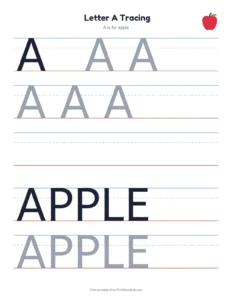
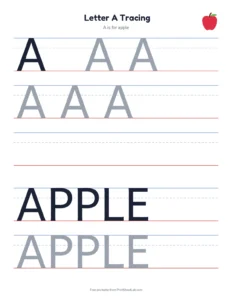
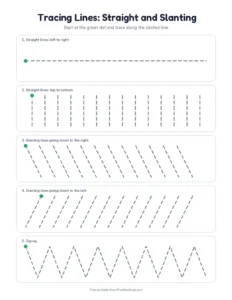
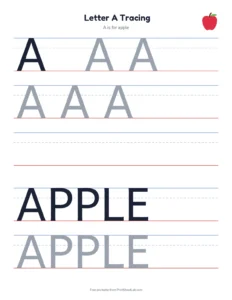
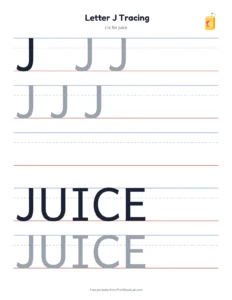
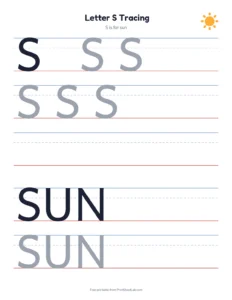
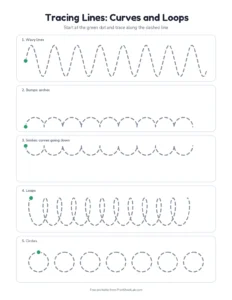
Preschool letter tracing sheets use extra large uppercase letters, so that three and four year olds can trace them with a thick crayon. Each page has a dark model to copy, gray letters to trace, and a picture word, such as A is for apple. These preschool letter tracing worksheets also include pre-writing lines, because straight lines and curves come before letters.
Quick answer: Preschool letter tracing sheets are printable pages with large letters for ages 3 to 5 to trace. Start with uppercase letters, which use simpler strokes, and with letters from your child’s name. This page has 7 free preschool letter tracing PDFs (big uppercase letters A to Z in three sets, the vowels, popular first letters, and two pre-writing line sheets). Updated October 2026.
Ready-to-print samples
A few of the ready PDFs on this page. The full list is under Ready-to-print worksheets.
Big letters A to IExtra large capitals.PDFBig vowelsA E I O U.PDFStraight lines firstPre-writing lines.PDFPopular first lettersA C E J L M S T.PDF
Preschool letter tracing: lines first, then letters
Before a child traces a letter, they should be able to trace the lines it is made of. The CDC lists drawing and copying shapes among the developmental milestones for ages 3 to 5. Each group of letters needs a pre-writing line. This table shows which line to practice first for each group:
Letters
Strokes
Pre-writing line to practice first
L, T, I, H, E, F
Straight lines only
Straight lines
C, O, Q, G, S
Curves
Circles and loops
V, W, X, Y, Z, A, K, N, M
Slanting lines
Slanting lines and zigzag
The two pre-writing sheets on this page, straight lines and curves, match these groups. Print them first if a child finds letters hard.
Preschool letter tracing worksheets: big letters
This page is also searched as preschool letter tracing, preschool letter tracing worksheets, letter tracing worksheets for preschool, preschool tracing letters, preschool traceable letters and preschool letter tracing printables. All of them are the free PDFs above, in extra large print. Free printable preschool worksheets tracing letters should be short: one letter a day is enough. Children trace the dark model first, then the fading gray rows, and finish with an empty row to write the letter alone.
Which letters should a preschooler trace first?
Many teachers start with the letters in a child’s own name, because those are the letters the child cares about. The popular first letters sheet has A, C, E, J, L, M, S and T, which start many common first names. After that, the vowels are useful, because they appear in every word. Leave the harder letters, such as Q, X and Z, for later.
A weekly plan for preschool letter tracing
Day
Focus
Suggested block
Monday
Pre-writing lines: straight lines
8 min
Tuesday
Pre-writing lines: curves
8 min
Wednesday
One big letter from the child’s name
8 min
Thursday
A vowel or another letter, then play
8 min
Weekly total
Four short sessions
32 min
Pencil grip and letter tracing in preschool
Writing needs a comfortable grip, and grips develop in stages. The ages are approximate, and every child is different. This table shows what to expect and what helps at each stage:
Grip stage
Typical age (approximate)
What helps
Fist (palmar grasp)
1 to 2
Chunky crayons, big scribbles
Fingers and thumb pointing down
2 to 3
Short crayons, finger painting
Static tripod (thumb and two fingers)
3 to 4
Short pencils, tongs, playdough
Dynamic tripod (fingers move the pencil)
4 to 6
Tracing, drawing, cutting practice
Activities that prepare a preschooler for letters
Sensory letters: trace letters in sand, salt or shaving foam.
Playdough letters: roll snakes and shape them into letters.
Sky letters: write a big letter in the air with a whole arm.
Letter hunt: find the first letter of the child’s name on signs and packages.
Chalk letters: write big letters outside and walk along them.
Printing preschool letter tracing sheets
The sheets use extra large print, so one letter takes a whole page. Print on US Letter or A4 at 100% scale, and use a short, thick crayon. For a letter the child loves, print it twice: once to trace in color and once to trace with a dry-erase marker in a sheet protector.
When to check with a professional
Every child develops at their own pace, and a wide range is normal. If your child is five and still cannot hold a crayon, avoids drawing completely, or has a very weak or very tight grip, it is reasonable to mention it to your pediatrician or an occupational therapist. Most children, however, simply need more time, more play and short regular practice.
Preschool letter tracing: how many letters a day?
One letter a day is plenty for most three and four year olds, and some will only want one letter a week. The letter pages are large, so each one can be traced several times in different colors. A good routine is to say the letter name and sound, trace it with a finger, trace it with a crayon, and finish by finding the letter in a picture book.
Frequently asked questions
7 quick answers
Where can I download free preschool letter tracing sheets?
Open any worksheet in the Ready-to-print list on this page, choose US Letter or A4, then print or save the PDF. They are free, and no account is needed.
At what age should a preschooler trace letters?
Many children begin tracing simple letters around age three or four, once they can trace lines and circles. Writing letters without a guide usually comes in kindergarten.
Should a preschooler trace uppercase or lowercase letters?
Start with uppercase letters, which use simpler strokes, then add lowercase letters as the child gains control.
Why are the letters extra large?
Large letters need big movements, which are easier for small hands. As control improves, move to the medium size.
At what age should I start letter tracing?
Many children start around three or four, once they can trace lines and circles. There is no need to hurry; some children are ready later.
Should I correct a child who traces wrongly?
Gently show the starting point and the direction, and let the child try again. Praise the effort first, and fix one thing at a time.
What should come after letter tracing?
Name tracing, then number tracing, then short words. Kindergarten tracing worksheets bring letters, numbers, words and sentences together.