Symmetry means that one half of a shape is the mirror image of the other half. The four PDFs on this page give children a colored half on a grid and ask them to color the matching half on the other side of the dashed line, and every sheet has an answer key. They follow standard 4.G.A.3 of the Common Core standards for grade 4 geometry, and the notes below explain mirror lines, rotational symmetry and the symmetry of letters.
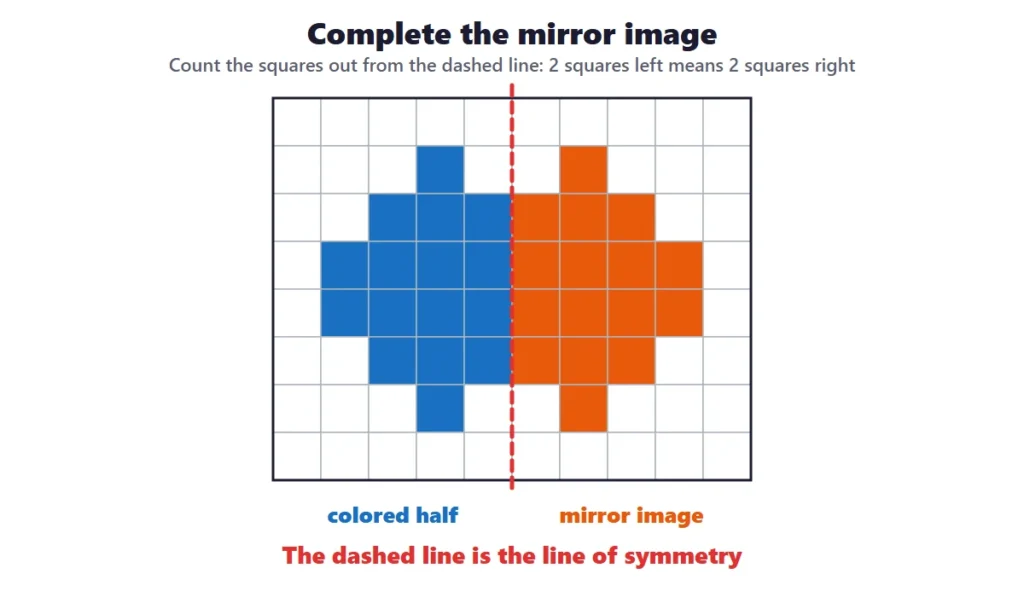
Mirror image. Count squares out from the line.
Mirror, mirror
A shape is symmetrical if you can fold it along a line and both halves match. On these grids, the left half is colored and children color the right half as its mirror image. The trick: count squares out from the dashed line. A square one step left of the line needs a partner one step right of it.
Symmetry worksheets: what is in the set
There are 4 symmetry worksheets on this page, and every one has an answer key except for any cut-out games. Each set has four grids, and the left half is colored, so children color the right half as its mirror image.
Worksheet
What children do
Standard
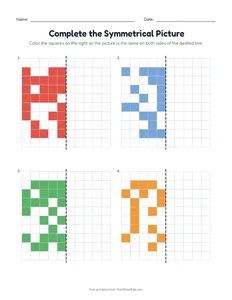
Complete the Symmetrical Picture
Color the mirror image on four grids.
4.G.A.3
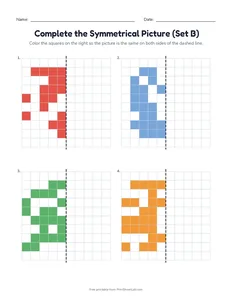
Complete the Symmetrical Picture (Set B)
Four more grids to complete.
4.G.A.3
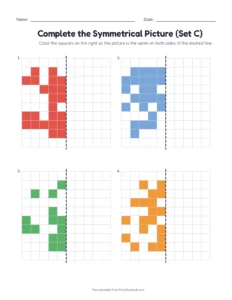
Complete the Symmetrical Picture (Set C)
Four new grid pictures to mirror.
4.G.A.3
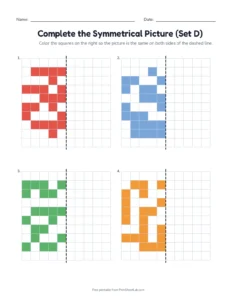
Complete the Symmetrical Picture (Set D)
Four more grid pictures to finish.
4.G.A.3
Symmetry: what it means and how to test it
A shape has symmetry if it can be changed in some way and still look exactly the same. The simplest kind is line symmetry: fold the shape along a line, and if both halves match exactly, the line is a mirror line. Wikipedia’s article on symmetry explains that there are other kinds, such as turning a shape around a point. This table shows the three cases that children meet in primary school:
Kind of symmetry
What it means
How to test it
Example
Line symmetry
one half is the mirror image of the other half
fold along the line, or use a mirror
a butterfly, the letter A
Rotational symmetry
the shape looks the same after a turn of less than a full turn
turn the shape around its center
a windmill, a pinwheel
No symmetry
no fold and no turn makes it match
try both
the letter F, a shoe print
The worksheets on this page use line symmetry only. A small mirror is the best test, since children can put it on the dashed line and see whether the reflection matches the other half of the picture.
Line of symmetry worksheets: counting the lines
Line of symmetry worksheets ask for a shape’s lines of symmetry, and the answer depends on the shape. A regular polygon with n sides has n mirror lines, and the same number of turns that match, which is called the order of rotational symmetry. The smallest turn is 360° divided by n. This table shows five regular shapes and the circle:
Regular shape
Mirror lines
Order of rotation
Smallest turn that matches
Triangle
3
3
120°
Square
4
4
90°
Pentagon
5
5
72°
Hexagon
6
6
60°
Octagon
8
8
45°
Circle
infinitely many
infinitely many
any turn
Other shapes have fewer lines. This table shows seven shapes that are not regular, and compares their lines with their order of rotation:
Shape
Mirror lines
Order of rotation
Rectangle
2
2
Rhombus
2
2
Parallelogram
0
2
Isosceles triangle
1
1
Isosceles trapezoid
1
1
Kite
1
1
Scalene triangle
0
1
The parallelogram is the one that surprises children. It looks symmetrical, but it has no mirror line. It does have rotational symmetry, since a half turn takes it onto itself. The 2D shapes page has all the quadrilaterals.
Mirror image worksheets: reflecting on a grid
The mirror image worksheets use a grid with a dashed line down the middle. Each colored square on the left has a partner on the right at the same distance from the line. If a square is 2 steps to the left of the line, its mirror image is 2 steps to the right, in the same row. This table shows the rule for a grid that is 10 squares wide, with columns numbered from 0:
Squares from the dashed line
Column of the colored square (0 to 4)
Column of its mirror image (5 to 9)
Check
1
4
5
1 squares on each side of the line
2
3
6
2 squares on each side of the line
3
2
7
3 squares on each side of the line
4
1
8
4 squares on each side of the line
5
0
9
5 squares on each side of the line
The rule is that a square in column c is matched by a square in column 9 − c, in the same row. Children do not need the rule, since they count the squares, but it shows how reflection can be written as arithmetic. The same idea comes back in grade 6 with coordinates, in the graphing worksheets.
Complete the symmetrical picture: step by step
To complete the symmetrical picture on a worksheet, children can follow the same five steps every time. Writing them on a card helps children who rush:
Find the dashed line, the mirror line.
Pick a colored square next to the line and find its row.
Count how many squares it is from the line.
Count the same number on the other side of the line, in the same row, and color that square.
Do the same for every colored square, row by row, and check with a mirror.
It is easier to go row by row from the top, and to color a whole row before moving down. A child who colors from the middle outward is more likely to lose their place.
Symmetry grade 4: the 4.G.A.3 standard
For symmetry grade 4, the standard is 4.G.A.3. It asks children to recognize a line of symmetry as a line across a figure so that the figure can be folded along it into matching parts, to identify figures that have line symmetry, and to draw the lines. The standard has two parts: recognizing a mirror line, and drawing one. The worksheets on this page practice the first part, and a good follow-up is to give children a shape and ask them to draw all its lines. The Common Core standards for grade 4 geometry list the other grade 4 geometry standards, and the angles page covers the next one, 4.G.A.1.
Symmetry in letters and words
The letters of the alphabet are a good way to find mirror lines. The result depends a little on the font, but in a simple capital-letter font the sorting is as follows:
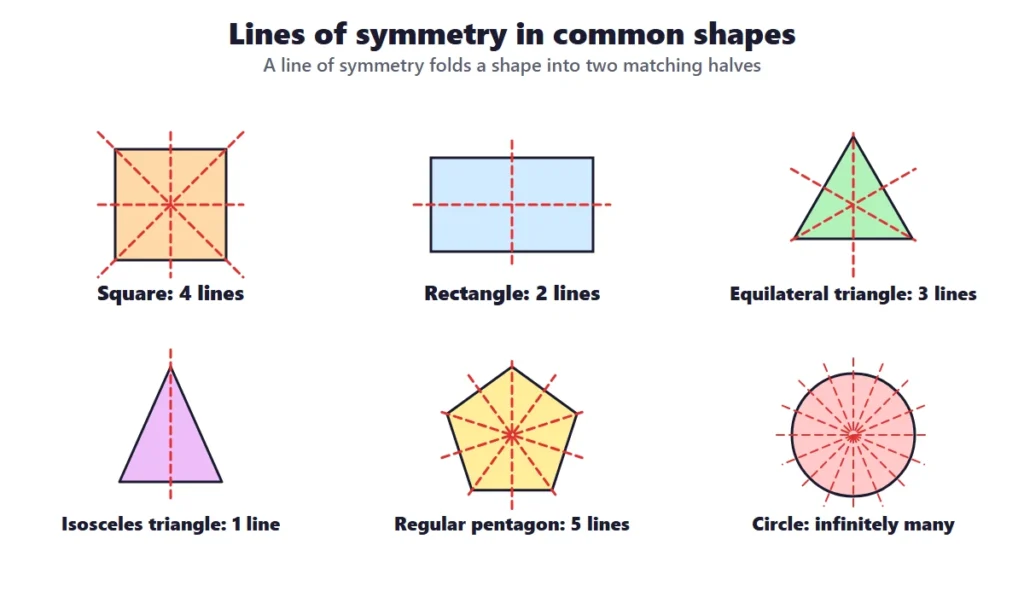
Lines of symmetry. Square, rectangle, triangles, pentagon, circle.
Kind of symmetry
Capital letters
How many
Vertical line only
A, M, T, U, V, W, Y
7
Horizontal line only
B, C, D, E, K
5
Both lines
H, I, O, X
4
No mirror line
F, G, J, L, N, P, Q, R, S, Z
10
Any mirror line
A, B, C, D, E, H, I, K, M, O, T, U, V, W, X, Y
16
Letters with a horizontal mirror line make a famous trick. A word written only with those letters, such as BOOK, COOK, DICE, CODE, HIDE, ECHO, can be read in a mirror that is held under the line of text, because every letter reflects onto itself. Words made of letters with a vertical mirror line, such as MOM, WOW, TOT, AHA, look the same in a mirror beside them if the word also reads the same backwards. Children can try to find more of both kinds.
Symmetry in nature and design
Symmetry is everywhere, and children can look for it in nature, in flags and in signs. This table gives eight examples, with the number of mirror lines:
Where you see it
Mirror lines
Note
Butterfly
1
vertical line down the body
Snowflake
6
six arms
Starfish
5
five arms
Swiss flag
4
a square with a plus sign
Japanese flag
2
a rectangle with a centered circle
Stop sign
8
a regular octagon
Human face
1
nearly symmetrical, but not perfectly
Plus sign
4
vertical, horizontal and two diagonals
A butterfly has one line, and a snowflake has six. Folding paper and cutting a shape gives the same result: fold a sheet once and cut half a heart, and the unfolded heart has one mirror line. Fold it twice and the cut shape has two lines, and so on. The fractions worksheets use the same idea when they cut a shape into halves.
Common mistakes with symmetry
The most common mistake is to see a diagonal as a mirror line in a rectangle. This table shows five mistakes, what went wrong and the fix:
What the child says
What went wrong
The fix
A rectangle has 4 mirror lines
draws the diagonals as mirror lines
fold along a diagonal and the corners do not match: a rectangle has 2 lines
A parallelogram has 2 mirror lines
thinks that opposite sides being equal is enough
a parallelogram that is not a rhombus has no mirror line
The mirror image starts at the edge of the grid
counts from the wrong place
count the squares from the dashed line, not from the edge
The letter F has a mirror line
thinks the upright stem is the line
the arms are only on one side: F has no mirror line
A mirror line can be a diagonal in any shape
treats every line as a fold line
test each line with a fold or a mirror
Symmetry word problems
Symmetry questions come up in art, signs and letters. Ask children to draw the shape and the lines, and to check with a fold:
Word problem
Working
Answer
A square tile is cut from paper. How many mirror lines does it have?
vertical, horizontal and 2 diagonals
4 lines
A poster is a rectangle that is not a square. How many mirror lines does it have?
vertical and horizontal
2 lines
The letter H is written on a card. How many mirror lines does it have?
vertical and horizontal
2 lines
A heart shape is folded in half. How many mirror lines does it have?
one vertical line
1 line
A snowflake has 6 arms. How many mirror lines does it have?
one for each arm
6 lines
A square is 3 squares to the left of the dashed line. Where is its mirror image?
the same distance on the other side
3 squares to the right
Games and activities for mirror reflection
Children learn mirror reflection best when they play with it. These games use things that are found at home or in a classroom:
Paper cutting: fold a sheet of paper, cut a shape from the folded edge, and unfold it
Mirror writing: write a word with a mirror next to it, and see what changes
Ink blots: put paint on one half of a folded sheet, press, and open it to see the symmetrical pattern
Pattern blocks: build a symmetrical design on one side of a line, and ask a friend to complete the other side
Symmetry hunt: look for symmetrical objects in the room: a chair, a book, a door
Geoboard reflections: make a shape on one side of a rubber band and its reflection on the other
Extra support and extra challenge with mirror reflection
For children who need more support: start with a folded paper and a small mirror, and use simple pictures with few squares. Count the squares from the line with a finger. Color one row at a time, and check each row with the mirror. Do the first set only, with the answer key, before moving on.
For children who need more challenge: ask for the mirror lines of a regular hexagon, for a shape with exactly two lines, and for a design that has both line and rotational symmetry. A grid with a diagonal mirror line is also a good challenge.
How to tell that a child is ready to move on from mirror reflection
The child finds a mirror line by folding.
The child colors the mirror image of a picture on a grid.
The child counts the mirror lines in a square and a rectangle.
The child says when a shape has no mirror line.
When all four are true, move on to the angles page.
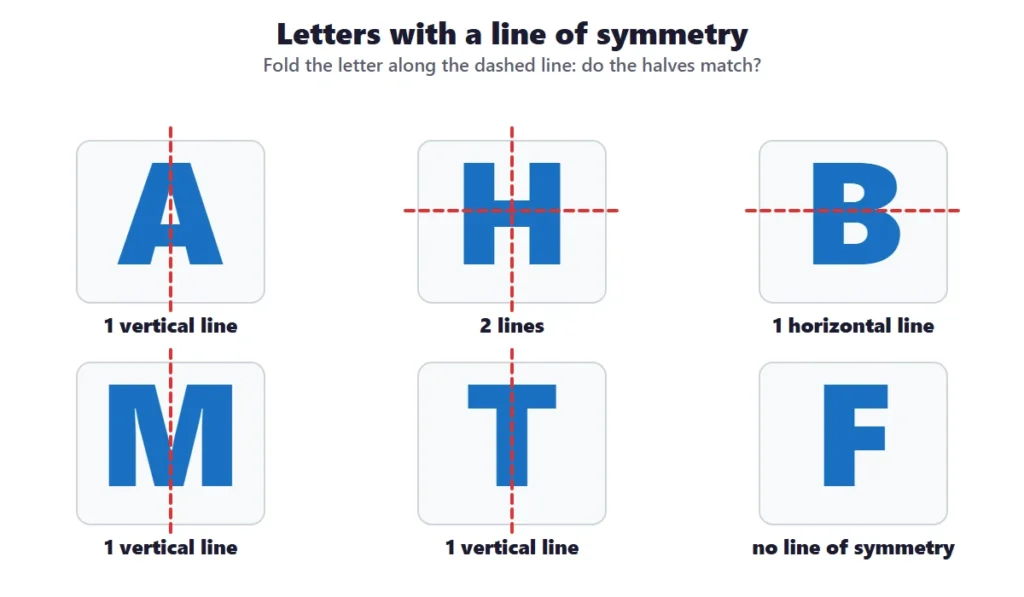
Letters. A, H, B, M, T and F.
A 20-minute lesson on mirror reflection
A short lesson is the best way to introduce mirror reflection. This 20-minute plan can be used in a classroom, at a tutoring session or at home, and it uses the worksheets at the end:
Minutes
Activity
What to say or ask
0 to 3
Fold a paper heart in half and open it
What do you see on each side of the fold?
3 to 8
Show a shape with a dashed line and ask whether the line is a mirror line
How can we check? Use the mirror.
8 to 13
Complete a mirror image together on the board, counting from the line
How far is this square from the line?
13 to 18
Find the mirror lines in a square and a rectangle
Do the diagonals work?
18 to 20
Start a worksheet and check one square with the mirror
Check with the mirror.
Where mirror reflection fits across the grades
No skill stands alone. This table shows what children learn before and after mirror reflection, with the standard that goes with each step:
This page is part of the geometry sequence. The whole sequence is on the geometry worksheets page.
Helping at home with mirror reflection
Parents do not need to be experts to help with mirror reflection. These suggestions work well, and each takes only a few minutes:
Fold a napkin in half and look for symmetry in the pattern.
Look for mirror lines in leaves, flowers and flags.
Use a small mirror on a picture to check the answer.
Ask the child to draw half a butterfly and to complete it.
Praise the child who counts squares from the line.
How to check progress in mirror reflection
A teacher or parent can check progress with the answer key and a few questions. This table shows three common situations, what they mean and what to do next:
What you see
What it means
What to do next
The child colors the mirror image the wrong distance from the line
The child counts from the edge, not from the line
Count from the dashed line, and use a mirror to check
The child gets 9 of 10 right in every set
The skill is secure
Move on to angles
The child says a rectangle has 4 mirror lines
The child counts the diagonals
Fold a paper rectangle along the diagonal
A five-day plan for mirror reflection
Most children need about a week of short sessions for mirror reflection. This plan follows the order of the worksheets on this page:
Day
What to do
Practice
Day 1
Fold paper shapes, and find the mirror line
folded paper shapes
Day 2
Complete the symmetrical picture on four grids
Complete the Symmetrical Picture
Day 3
Complete four more grids, counting squares from the line
Complete the Symmetrical Picture (Set B)
Day 4
Check with a mirror, and find lines in letters and shapes
Complete the Symmetrical Picture (Set C)
Day 5
Finish the last four grids, and make a symmetrical design
Complete the Symmetrical Picture (Set D)
When the plan is complete, move on to the angles page. The whole sequence is on the geometry worksheets page.
Frequently asked questions
5 quick answers
What is a line of symmetry?
A line that splits a shape into two halves that are mirror images of each other.
How can children check their answer?
Hold a small mirror on the dashed line. The reflection should look exactly like the right half.
How many lines of symmetry does a rectangle have?
A rectangle that is not a square has 2 mirror lines: one vertical and one horizontal. The diagonals are not mirror lines, because folding along a diagonal does not make the corners match.
Does every shape have a mirror line?
No. A parallelogram that is not a rhombus, a scalene triangle and the letter F have no mirror line. A circle has infinitely many.
What is the difference between line symmetry and rotational symmetry?
Line symmetry means that a fold along a line makes two matching halves. Rotational symmetry means that the shape looks the same after it is turned around its center by less than a full turn.