3D shapes, or solids, have length, width and height, so they take up space: a box, a ball and a can are all 3D shapes. The four PDFs on this page ask children to name solids from a word bank and to count the faces, edges and vertices of prisms and pyramids, and every sheet has an answer key. They follow standards K.G.A.3, 1.G.A.1 and 2.G.A.1 of the Common Core standards for kindergarten geometry, and the notes below show how the counts work.
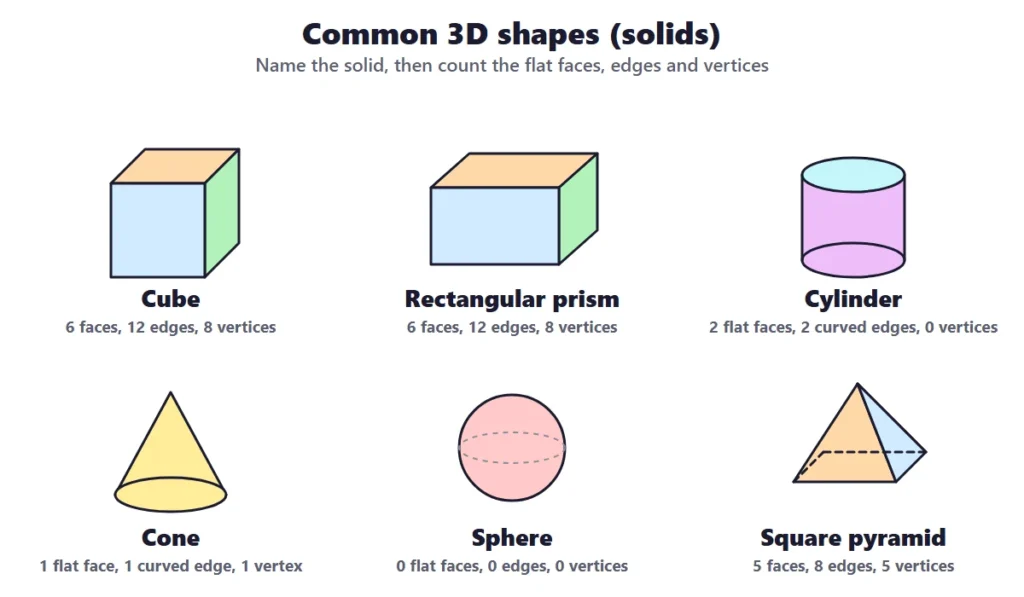
Common solids. Faces, edges and vertices of six solids.
Faces, edges and vertices
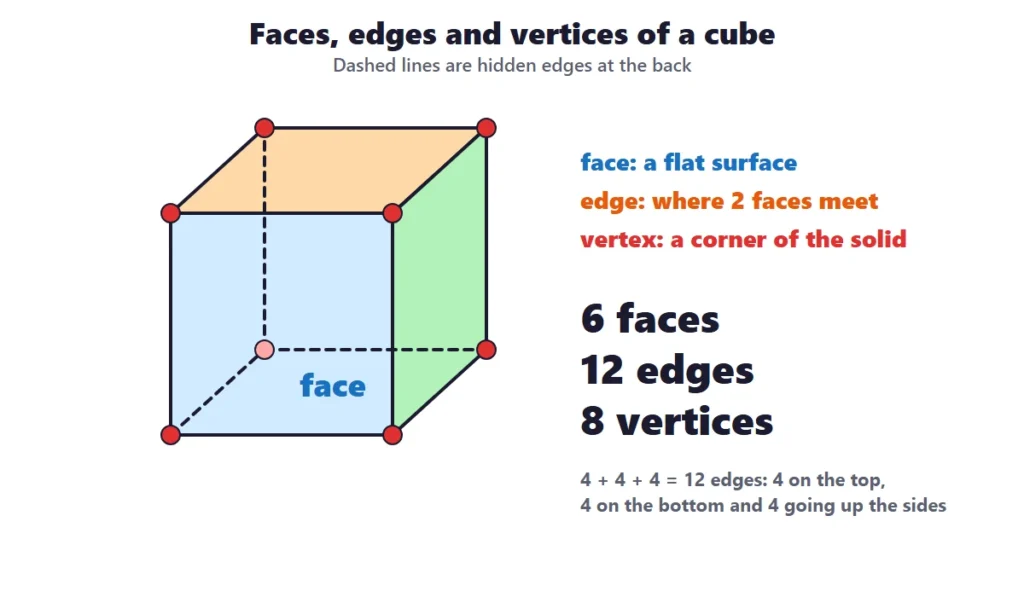
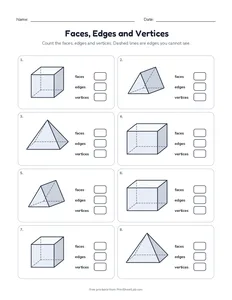
A face is a flat surface, an edge is where two faces meet, and a vertex is a corner where edges meet. A cube has 6 faces, 12 edges and 8 vertices. The drawings on these worksheets show hidden edges as dashed lines, so children can count the ones at the back too.
3d shapes worksheets: what is in the set
There are 4 3d shapes worksheets on this page, and every one has an answer key except for any cut-out games. Two sets ask children to name the solid, and two sets ask them to count the faces, edges and vertices.
Worksheet
What children do
Standard
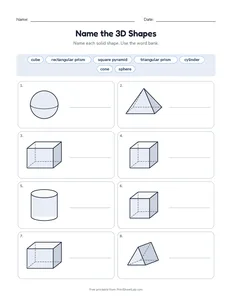
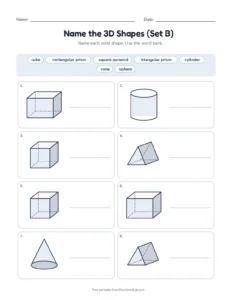
Name the 3D Shapes
Name each solid using the word bank.
1.G.A.1
Faces, Edges and Vertices
Count faces, edges and vertices of prisms and pyramids.
1.G.A.1
Name the 3D Shapes (Set B)
Name more cubes, prisms, pyramids, cylinders, cones and spheres.
1.G.A.1
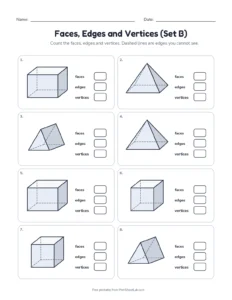
Faces, Edges and Vertices (Set B)
Count faces, edges and vertices of more solids.
1.G.A.1
3D shapes: faces, edges and vertices of the solids
A face is a flat surface of a solid, an edge is a line where two faces meet, and a vertex is a corner where edges meet. Solids with only flat faces are called polyhedra, and Wikipedia’s article on polyhedra lists them. Solids with curved surfaces, such as a cylinder, a cone and a sphere, have different counts. This table gives the numbers for the eight solids on the worksheets:
Solid
Faces
Edges
Vertices
Example
Cube
6
12
8
a die
Rectangular prism
6
12
8
a cereal box
Triangular prism
5
9
6
a tent
Square pyramid
5
8
5
the Great Pyramid
Triangular pyramid
4
6
4
a tetrahedron die
Cylinder
2 flat + 1 curved
2 curved
0
a can
Cone
1 flat + 1 curved
1 curved
1
a party hat
Sphere
1 curved
0
0
a ball
The cylinder and the cone have curved edges, where a flat face meets a curved surface, and the sphere has no edges at all. This is the reason why the counting worksheets use only prisms and pyramids, and why the naming worksheets use all eight solids.
Faces edges and vertices worksheets: counting rules for prisms and pyramids
The faces edges and vertices worksheets use prisms and pyramids, and for these there are simple rules. If the base has n sides, a prism has n + 2 faces, 3n edges and 2n vertices, and a pyramid has n + 1 faces, 2n edges and n + 1 vertices. The table shows both for bases from 3 to 8 sides:
Base shape
Prism: faces (n + 2)
Prism: edges (3n)
Prism: vertices (2n)
Pyramid: faces (n + 1)
Pyramid: edges (2n)
Pyramid: vertices (n + 1)
triangular base, n = 3
5
9
6
4
6
4
square base, n = 4
6
12
8
5
8
5
pentagonal base, n = 5
7
15
10
6
10
6
hexagonal base, n = 6
8
18
12
7
12
7
heptagonal base, n = 7
9
21
14
8
14
8
octagonal base, n = 8
10
24
16
9
16
9
A cube is a prism with a square base, so n = 4, and the rule gives 6 faces, 12 edges and 8 vertices. Children do not need the rules in grade 1 or 2, but they help to check a count: a pyramid always has twice as many edges as its base has sides.
Euler’s formula for solids
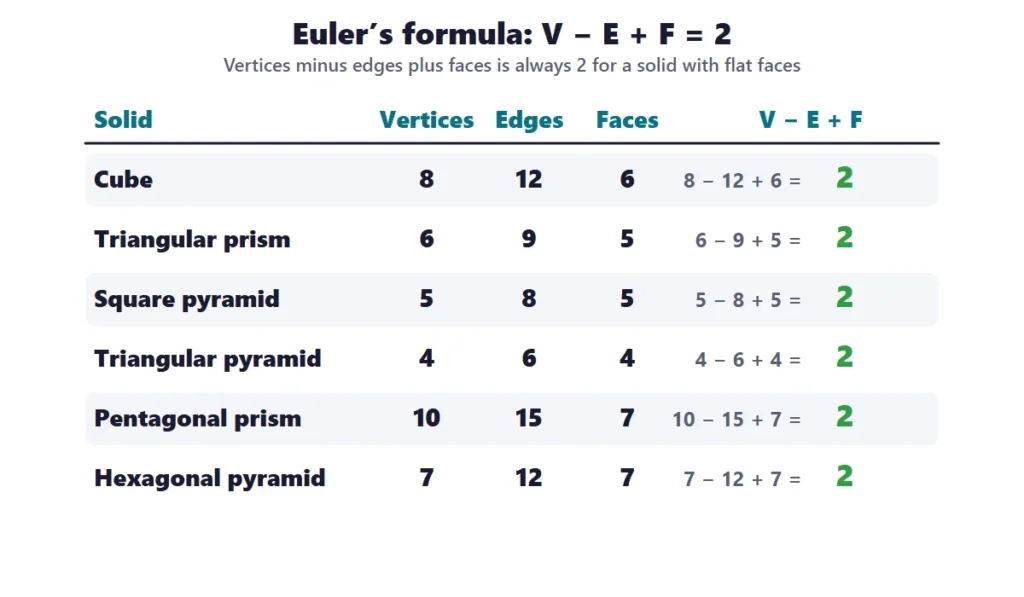
For every solid with flat faces and no holes, the number of vertices minus the number of edges plus the number of faces is 2. The formula was found by Leonhard Euler in the 1750s. It is a good way to check a count, and to find a missing number. This table tests it for seven solids:
Solid
Vertices (V)
Edges (E)
Faces (F)
V − E + F
Cube
8
12
6
2
Triangular prism
6
9
5
2
Square pyramid
5
8
5
2
Triangular pyramid
4
6
4
2
Pentagonal prism
10
15
7
2
Hexagonal pyramid
7
12
7
2
Octagonal prism
16
24
10
2
If a child counts 8 vertices and 12 edges for a cube, then the formula gives 8 − 12 + F = 2, so F = 6. This is also a way to see if a count is wrong. The rule does not work for a cylinder, a cone or a sphere, which have curved surfaces.
Solid shapes worksheets: nets and flat faces
The solid shapes worksheets show solids in drawings, but children also meet them as nets, which are the flat patterns that fold up to make a solid. A net shows the flat faces of the solid, and counting them is another way to count faces. This table shows six solids, with the shapes in each net:
Solid
Shapes in the net
Pieces
How many nets
Cube
6 squares
6
11 different nets
Rectangular prism
3 pairs of rectangles
6
several nets
Triangular prism
2 triangles and 3 rectangles
5
several nets
Square pyramid
1 square and 4 triangles
5
several nets
Cylinder
2 circles and 1 rectangle
3
one main net
Cone
1 circle and 1 sector
2
one main net
There are exactly 11 different nets for a cube, which makes a good puzzle for a class: cut out six squares and try all the ways to join them. The same idea comes back in grade 6 (6.G.A.4), when children use nets to find surface area. The volume calculator works out the volume of the same solids.
3D shapes grade 2: solids in the real world
For 3D shapes grade 2, it helps to link every solid to an object that children know. A die is a cube, a can is a cylinder, and a party hat is a cone. This table gives seven examples with the standard that is linked to each:
A cube. 6 faces, 12 edges, 8 vertices.
Everyday object
Solid
Standard
Dice, sugar cube
cube
K.G.A.3
Cereal box, brick
rectangular prism
1.G.A.1
Can of beans, drum
cylinder
K.G.A.3
Party hat, ice cream cone
cone
K.G.A.3
Basketball, globe
sphere
K.G.A.3
Tent, roof, Toblerone box
triangular prism
2.G.A.1
Pyramid in Egypt
square pyramid
1.G.A.2
Children can build a 3D shapes collection from objects in a classroom or at home, and sort them by the shape of their faces. A good game is to find an object for every solid in the table in a week.
Naming 3D shapes: the 2D shapes on the faces
When naming 3D shapes, children sometimes mix them up with the flat shapes, such as saying that a ball is a circle. A good way to teach the difference is to look at the faces of a solid, because each flat face is a 2D shape. This table shows the 2D shapes that make up each solid:
Solid
Flat faces
2D shapes found on it
Cube
6 squares
square
Rectangular prism
6 rectangles
rectangle
Triangular prism
2 triangles and 3 rectangles
triangle and rectangle
Square pyramid
1 square and 4 triangles
square and triangle
Cylinder
2 circles
circle
Cone
1 circle
circle
Sphere
none
—
The 2D shapes page has the flat shapes. A circle is a flat shape on a page, and a sphere is a solid that can be held in the hand.
Common mistakes with 3D shapes
The mistakes are about the difference between faces, edges and vertices, and between 2D and 3D. This table shows five mistakes, what went wrong and the fix:
What the child says
What went wrong
The fix
A sphere has 1 face, a circle
confuses the 3D shape with the 2D one
a circle is flat; a sphere is a solid with a curved surface
A square pyramid has 4 faces
forgets the base
count the 4 triangles and the square: 5 faces
A cube has 8 edges
confuses the number of vertices with edges
a cube has 8 vertices, 12 edges and 6 faces
A cylinder has 3 flat faces
counts the curved side as flat
a cylinder has 2 flat faces and 1 curved surface
A vertex is a line
mixes up an edge and a vertex
a vertex is a corner point, and an edge is a line
3d shapes word problems
Story problems use the solids that children know. Ask them to draw the solid first, and to say whether they are counting faces, edges or vertices:
Word problem
Working
Answer
A cereal box is a rectangular prism. How many faces does it have?
3 pairs of faces
6 faces
A square pyramid has a square base. How many triangle faces does it have?
one for each side of the square
4 faces
A die is a cube. How many edges does it have?
4 + 4 + 4
12 edges
A party hat is a cone. How many flat faces does it have?
the base
1 flat face
A tent is a triangular prism. How many faces does it have in all?
2 triangles + 3 rectangles
5 faces
A solid has 8 vertices and 12 edges. How many faces does it have?
F = 2 − 8 + 12
6 faces
Games and activities for 3d shapes
Children learn 3d shapes best when they play with it. These games use things that are found at home or in a classroom:
Solid sort: sort household objects into cubes, cylinders, cones, spheres and prisms
Mystery solid: one child feels a solid in a bag and describes its faces
Clay and straws: build a cube and a pyramid with straws and clay balls, and count the vertices
Net puzzle: cut out six squares and find all the nets that fold into a cube
Shape detectives: find an object that is a cube, a cylinder or a sphere in the kitchen
3D shape bingo: a bingo card with solid names and calling cards with pictures
Extra support and extra challenge with 3d shapes
For children who need more support: start with objects the child can hold, such as a die, a can and a ball, and ask “how many flat faces?”. Put a sticker on each face as it is counted. Practice the naming sets before the counting sets, and use a solid in the hand for every counting problem.
For children who need more challenge: ask for a solid that has 6 faces and 8 vertices, to explain why a pyramid always has twice as many edges as its base has sides, and to use Euler’s formula to find a missing number. The “Faces, Edges and Vertices (Set B)” worksheet is a good challenge.
How to tell that a child is ready to move on from 3d shapes
The child names the cube, prism, pyramid, cylinder, cone and sphere.
The child counts the faces, edges and vertices of a cube.
The child says which solids have curved surfaces.
The child finds the 2D shapes on the faces of a solid.
When all four are true, move on to the symmetry page or the angles page.
A 20-minute lesson on 3d shapes
A short lesson is the best way to introduce 3d shapes. This 20-minute plan can be used in a classroom, at a tutoring session or at home, and it uses the worksheets at the end:
Euler’s formula. V − E + F = 2.
Minutes
Activity
What to say or ask
0 to 3
Show a cube, a ball, a can and a cone and ask children to name them
Which can roll? Which can stack?
3 to 8
Count the faces of a box together, with a sticker on each face
How many faces are there? How many are the same?
8 to 13
Count the edges and vertices of a cube with a finger
Which edges are at the back?
13 to 18
Compare a pyramid with a prism
How do their faces differ?
18 to 20
Start a worksheet and check one answer
Do the dashed lines count?
Where 3d shapes fits across the grades
No skill stands alone. This table shows what children learn before and after 3d shapes, with the standard that goes with each step:
Grade
What children do
Standard or page
Kindergarten
Name solids and say whether they are flat or solid
K.G.A.3
Grade 1
Compose 3D shapes
1.G.A.1 and 1.G.A.2, this page
Grade 2
Identify cubes, and shapes with a given number of faces
This page leads from flat shapes to measuring solids. The whole sequence is on the geometry worksheets page.
Helping at home with 3d shapes
Parents do not need to be experts to help with 3d shapes. These suggestions work well, and each takes only a few minutes:
Look for cubes, cylinders and spheres in the kitchen.
Build a house out of boxes and name each solid.
Ask “how many faces does this box have?” and let the child count them.
Use clay to build a cube and a pyramid.
Check the counts with the answer key.
How to check progress in 3d shapes
A teacher or parent can check progress with the answer key and a few questions. This table shows three common situations, what they mean and what to do next:
What you see
What it means
What to do next
The child names solids but not their faces
The child sees only the whole object
Count the faces together, with a sticker on each
The child gets 9 of 10 right in every set
The skill is secure
Move on to symmetry and angles
The child forgets the hidden edges
The drawing shows only what can be seen
Show a solid, and point to the dashed lines
A five-day plan for 3d shapes
Most children need about a week of short sessions for 3d shapes. This plan follows the order of the worksheets on this page:
Day
What to do
Practice
Day 1
Sort objects into cubes, balls, cans and cones
Name the 3D Shapes
Day 2
Count the faces of boxes and pyramids
Faces, Edges and Vertices
Day 3
Name more solids, including prisms
Name the 3D Shapes (Set B)
Day 4
Count the edges and vertices, and use dashed lines for hidden edges
Faces, Edges and Vertices (Set B)
Day 5
Build solids with clay and straws, and check the counts
all four sets
When the plan is complete, move on to the symmetry page. The whole sequence is on the geometry worksheets page.
Frequently asked questions
5 quick answers
How many faces does a square pyramid have?
Five: one square base and four triangles.
Does a cylinder have edges?
A cylinder has two flat faces and one curved surface. The places where they meet are curved edges, which is why our counting worksheet uses only shapes with flat faces.
What is the difference between 2D shapes and 3D shapes?
2D shapes are flat and have only length and width, such as a circle or a square. 3D shapes are solids with length, width and height, such as a ball or a box. The faces of a 3D shape are 2D shapes.
How many edges and vertices does a cube have?
A cube has 12 edges and 8 vertices, and 6 faces. There are 4 edges around the top, 4 around the bottom and 4 that go up the sides.
Does a cone have a vertex?
Yes. A cone has one vertex, at the tip, and one flat face, the circular base. It also has one curved surface and one curved edge, where the base meets the side.