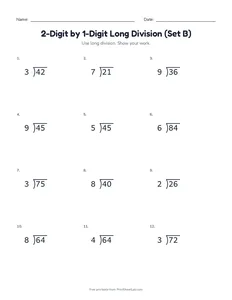
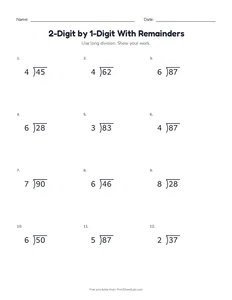
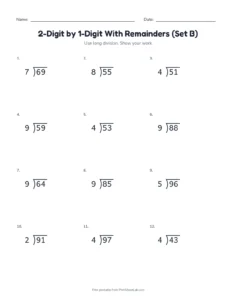
Change the numbers, layout and number of problems, then download a new PDF with its answer key.
Long division 2-digit by 1-digit is the first time that children write out every step of a division, and it is the starting point for all the long division worksheets that follow. The four PDFs on this page have problems that divide evenly and problems that leave a remainder, and every answer key shows each step. They follow standard 4.NBT.B.6 of the Common Core standards for grade 4 number and operations in base ten, and the notes below explain the steps, the first digit and the check.
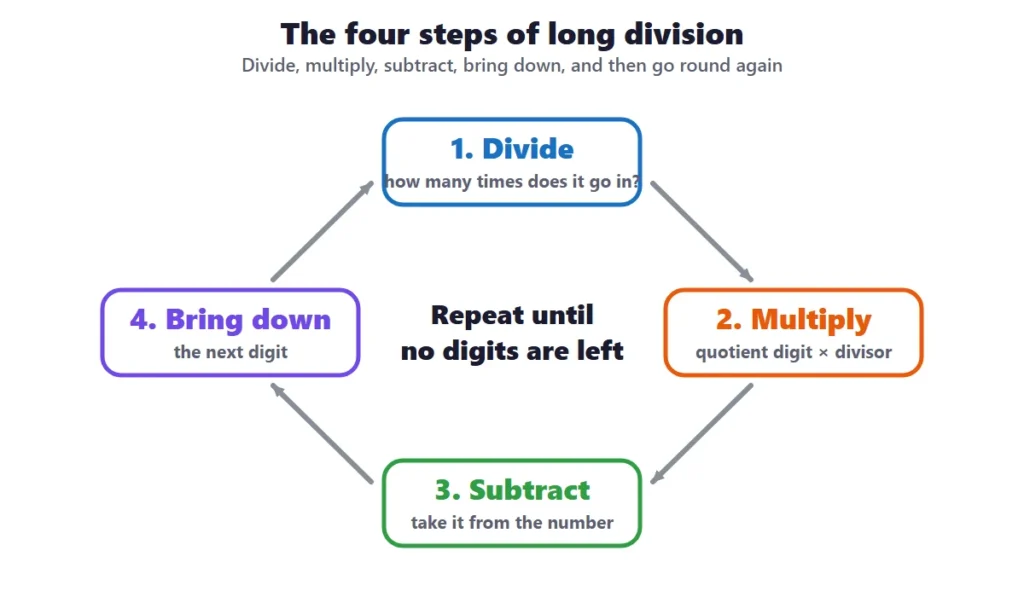
The four steps. Divide, multiply, subtract, bring down.
Quick answer: Long division 2-digit by 1-digit divides a two-digit number by a single digit with the long division steps (divide, multiply, subtract, bring down), such as 84 ÷ 4 = 21. This page has 4 free printable worksheets with answer keys for grade 4. Updated October 2026.
Long division step by step
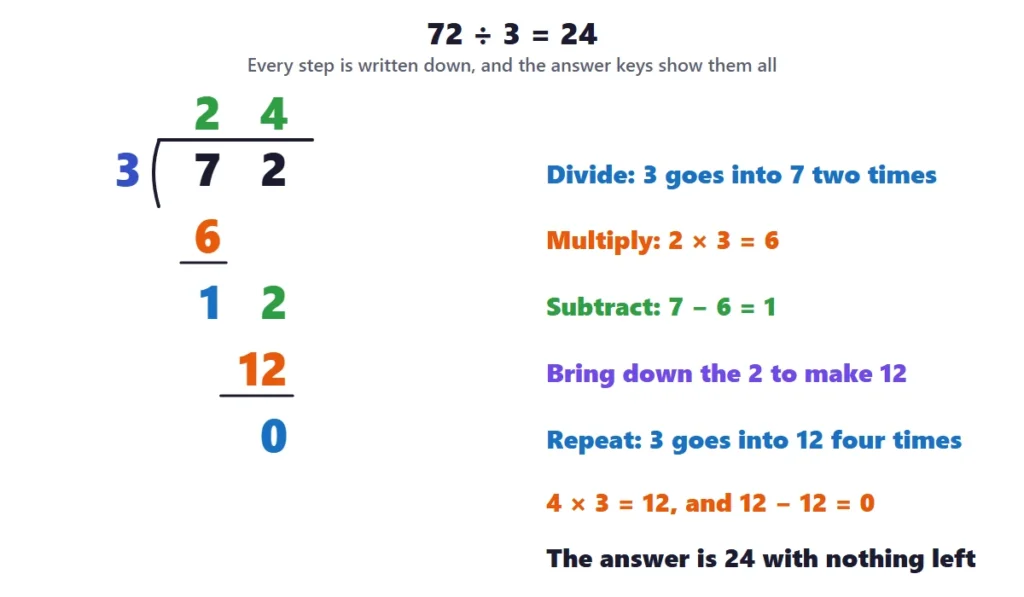
Long division repeats four steps: divide, multiply, subtract, bring down. Take 72 ÷ 3:
Divide: 3 goes into 7 two times. Write 2 above the 7.
Multiply: 2 × 3 = 6. Write 6 under the 7.
Subtract: 7 − 6 = 1.
Bring down the 2 to make 12.
Repeat: 3 goes into 12 four times. 4 × 3 = 12, and 12 − 12 = 0. The answer is 24.
The answer keys on these worksheets show every one of these steps, so children can compare their work line by line.
What is on this page
Two sets of problems that divide evenly.
A set where every problem has a remainder.
Long division 2-digit by 1-digit worksheets: what is in the set
There are 4 long division 2-digit by 1-digit worksheets on this page, and every one has an answer key except for any cut-out games. Two sets have problems that divide evenly, and two sets have problems that all leave a remainder.
Worksheet
What children do
Standard
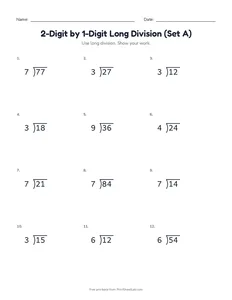
2-Digit by 1-Digit Long Division (Set A)
12 problems that divide evenly.
4.NBT.B.6
2-Digit by 1-Digit Long Division (Set B)
Another 12 problems with no remainder.
4.NBT.B.6
2-Digit by 1-Digit With Remainders
12 problems that all have a remainder.
4.NBT.B.6
2-Digit by 1-Digit With Remainders (Set B)
Twelve more problems with remainders.
4.NBT.B.6
Long division worksheets 2 digit by 1 digit: how the sets are built
The long division worksheets 2 digit by 1 digit in this pack are built in two groups. The first two sets use dividends that are multiples of the divisor, so every problem divides evenly and children can concentrate on the four steps. The last two sets leave a remainder in every problem, which is the new idea. Both kinds use divisors from 2 to 9 and dividends from 10 to 99, and every answer key shows each round of the division.
Long division 2-digit by 1-digit: the four steps
Every long division repeats four steps: divide, multiply, subtract and bring down. In the first round of 72 ÷ 3 the number we divide is 7, since 3 does not go into 7 more than twice. Wikipedia’s article on long division describes the method. These tables show the steps for three problems, with the digit of the answer, the multiplication and the subtraction in each round:
72 ÷ 3 = 24
Round
Number we divide
Digit of the answer
Multiply
Subtract
Next
1
7
2
2 × 3 = 6
7 − 6 = 1
bring down the 2
2
12
4
4 × 3 = 12
12 − 12 = 0
done
95 ÷ 4 = 23 R3
Round
Number we divide
Digit of the answer
Multiply
Subtract
Next
1
9
2
2 × 4 = 8
9 − 8 = 1
bring down the 5
2
15
3
3 × 4 = 12
15 − 12 = 3
done
84 ÷ 6 = 14
Round
Number we divide
Digit of the answer
Multiply
Subtract
Next
1
8
1
1 × 6 = 6
8 − 6 = 2
bring down the 4
2
24
4
4 × 6 = 24
24 − 24 = 0
done
In 84 ÷ 6, the first digit 8 is bigger than 6, so the answer has two digits. After the first round, 8 − 6 = 2, and the 4 is brought down to make 24, which is 4 × 6.
Long division for beginners: where the first digit goes
For long division for beginners, the hardest question is where to write the first digit of the answer. If the first digit of the dividend is as big as the divisor, the answer starts above that digit and has two digits. If it is smaller, the first digit has to be joined to the second, and the answer has only one digit. This table shows how this works for each divisor from 2 to 9, among the 90 two-digit numbers from 10 to 99:
Divisor
Dividends with a 1-digit answer
Dividends with a 2-digit answer
Share with a 1-digit answer
Divide evenly
Leave a remainder
2
10
80
11%
45
45
3
20
70
22%
30
60
4
30
60
33%
22
68
5
40
50
44%
18
72
6
50
40
56%
15
75
7
60
30
67%
13
77
8
70
20
78%
11
79
9
80
10
89%
10
80
With a divisor of 2 only the 10 numbers from 10 to 19 have a one-digit answer, but with a divisor of 9 only the numbers from 90 to 99 have a two-digit answer. This is the reason why children should always compare the first digit with the divisor before writing anything. The same idea comes back in the long division 3-digit by 1-digit page, where the answer can have two or three digits.
Simple long division worksheets: dividing evenly
Simple long division worksheets start with problems that divide evenly, so that the last subtraction is 0. These are the problems where the dividend is a multiple of the divisor, and the times tables worksheets page has the multiples. This table shows how many numbers from 10 to 99 divide evenly for each divisor, with the first five:
Divisor
First dividends that divide evenly
How many from 10 to 99
Biggest one
2
10, 12, 14, 16, 18, …
45
2 × 49 = 98
3
12, 15, 18, 21, 24, …
30
3 × 33 = 99
4
12, 16, 20, 24, 28, …
22
4 × 24 = 96
5
10, 15, 20, 25, 30, …
18
5 × 19 = 95
6
12, 18, 24, 30, 36, …
15
6 × 16 = 96
7
14, 21, 28, 35, 42, …
13
7 × 14 = 98
8
16, 24, 32, 40, 48, …
11
8 × 12 = 96
9
18, 27, 36, 45, 54, …
10
9 × 11 = 99
Of the 90 two-digit numbers, 45 divide evenly by 2, but only 10 by 9. The first two worksheets on this page use dividends that are chosen from these multiples, so that children can see the pattern of a complete division before they meet remainders.
2 digit division worksheets: the same number with different divisors
The 2 digit division worksheets with remainders show that the remainder depends on the divisor. If we keep the dividend at 95 and change the divisor, we get a different answer each time. This table shows 95 divided by every divisor from 2 to 9, with the check:
72 ÷ 3. Every step is written down.
Divisor
Answer for 95
Quotient
Remainder
Check
2
95 ÷ 2
47
1
2 × 47 + 1 = 95
3
95 ÷ 3
31
2
3 × 31 + 2 = 95
4
95 ÷ 4
23
3
4 × 23 + 3 = 95
5
95 ÷ 5
19
0
5 × 19 + 0 = 95
6
95 ÷ 6
15
5
6 × 15 + 5 = 95
7
95 ÷ 7
13
4
7 × 13 + 4 = 95
8
95 ÷ 8
11
7
8 × 11 + 7 = 95
9
95 ÷ 9
10
5
9 × 10 + 5 = 95
The remainder is always smaller than the divisor, and 95 divides evenly only by 5. The division with remainders page explains what a remainder means in a story, and the division facts to 144 page has the facts that long division uses.
Partial quotients: another way to see the steps
The partial quotients method does the same division in two big pieces, tens and then ones. For 84 ÷ 4, 20 × 4 = 80, and the 4 that is left is 1 × 4, so the answer is 20 + 1 = 21. The steps of the long division are this idea written in a short way. This table shows six problems:
Problem
Tens part of the answer
Ones part of the answer
Add the parts
Remainder
84 ÷ 4
20 × 4 = 80
1 × 4 = 4
20 + 1 = 21
0
72 ÷ 3
20 × 3 = 60
4 × 3 = 12
20 + 4 = 24
0
95 ÷ 4
20 × 4 = 80
3 × 4 = 12
20 + 3 = 23
3
78 ÷ 6
10 × 6 = 60
3 × 6 = 18
10 + 3 = 13
0
91 ÷ 7
10 × 7 = 70
3 × 7 = 21
10 + 3 = 13
0
87 ÷ 5
10 × 5 = 50
7 × 5 = 35
10 + 7 = 17
2
Children who can do the partial quotients method understand why the steps of long division work, which is what standard 4.NBT.B.6 asks for when it says that children should explain the calculation with equations, arrays or area models.
Checking a long division answer
The check for a long division is to multiply the answer by the divisor and add the remainder. The result must be the number we started with, and the remainder must be smaller than the divisor. This table checks six answers:
Problem
Answer
Check: divisor × quotient + remainder
Equals the start?
72 ÷ 3
24
3 × 24 = 72
yes
95 ÷ 4
23 R3
4 × 23 + 3 = 95
yes
84 ÷ 6
14
6 × 14 = 84
yes
91 ÷ 7
13
7 × 13 = 91
yes
58 ÷ 9
6 R4
9 × 6 + 4 = 58
yes
87 ÷ 5
17 R2
5 × 17 + 2 = 87
yes
A child who checks every answer finds many mistakes without help. It is also a use of the 2-digit by 1-digit multiplication skills, which is a good reason to practice the two together.
4th grade long division: the standard and what comes next
In 4th grade long division is limited to one-digit divisors, and the standard 4.NBT.B.6 allows dividends of up to four digits. The worksheets on this page cover the smallest case, with 2-digit dividends. This table shows the sizes of long division problem in the pack, with an example of each and where to practice:
Common mistakes with long division 2-digit by 1-digit
Most mistakes come from the place of the first digit, the remainder, or the order of the subtraction. This table shows five mistakes, what went wrong and the fix:
What the child writes or says
What went wrong
The fix
72 ÷ 3 = 42
divides the bigger digit by the divisor in the wrong place
start from the left: 3 goes into 7 two times, so write 2 above the 7
95 ÷ 4 = 23 with 3 left, written above the line
puts the remainder in the answer line
write the remainder after the answer: 23 R3
84 ÷ 6 = 104
forgets that 6 does not go into 4 as a new digit
the answer has two digits, since 6 goes into 8 only once
91 ÷ 7 = 12 with a remainder of 7
the remainder is as big as the divisor
another 7 fits: 91 ÷ 7 = 13
Subtracts the smaller from the bigger digit
forgets the order of the subtraction
always take the product from the number on top
Long division 2-digit by 1-digit word problems
Story problems use sharing and packing. Ask children to write the division, solve it with the four steps and say what the remainder means:
Word problem
Working
Answer
A teacher has 72 pencils to share equally among 3 tables. How many does each table get?
72 ÷ 3
24 pencils
A baker puts 95 rolls in boxes of 4. How many full boxes, and how many rolls are left?
95 ÷ 4
23 boxes, 3 rolls left
84 children go on a trip in 6 equal groups. How many children are in each group?
84 ÷ 6
14 children
A rope 91 meters long is cut into pieces of 7 meters. How many pieces are there?
91 ÷ 7
13 pieces
58 cookies are packed into bags of 9. How many full bags can be made?
58 ÷ 9
6 bags, with 4 cookies left
A book of 87 pages is read in 5 equal parts, and what is left is read on the last day. How many pages in each part?
87 ÷ 5
17 pages, with 2 left
Games and activities for long division 2-digit by 1-digit
Children learn long division 2-digit by 1-digit best when they play with it. These games use things that are found at home or in a classroom:
Four-step song: say “divide, multiply, subtract, bring down” together while you solve a problem on the board
Remainder race: roll two dice for a 2-digit number and one die for the divisor, then divide
Sharing cards: share a pack of 52 cards among 3, 4, 5, 6 and 7 players and say what is left
Check it: swap worksheets with a partner and check each answer with multiplication
Mistake hunt: give a worked example with one wrong step and ask children to find it
Long division bingo: a bingo card with answers, and calling cards with the problems
Extra support and extra challenge with long division 2-digit by 1-digit
For children who need more support: make sure the division facts to 100 are secure, and write the multiples of the divisor next to the problem. Use grid paper so every digit sits in its own box. Start with the sheets that divide evenly, say each step aloud, and use the answer key to compare every line with the child’s work.
For children who need more challenge: ask for the largest remainder possible when dividing by 7, for a dividend that gives the answer 23 R5 when divided by 6, and for the partial quotients of 95 ÷ 4. Try a problem where the answer has a zero, such as 63 ÷ 6, which has the answer 10 R3, as a first look at the next page.
How to tell that a child is ready to move on from long division 2-digit by 1-digit
The child writes the four steps in the right order.
The child puts the first digit of the answer in the right place.
The child writes a remainder that is smaller than the divisor.
The child checks the answer by multiplying and adding the remainder.
A 20-minute lesson on long division 2-digit by 1-digit
A short lesson is the best way to introduce long division 2-digit by 1-digit. This 20-minute plan can be used in a classroom, at a tutoring session or at home, and it uses the worksheets at the end:
Minutes
Activity
What to say or ask
0 to 3
Share 72 counters among 3 plates, and write the answer
How many on each plate?
3 to 8
Write 72 ÷ 3 as long division and name the four steps
What is the first step? What is the second?
8 to 13
Do 95 ÷ 4 together, and find the remainder
Is the remainder smaller than 4?
13 to 18
Check both answers by multiplying
What do we add back?
18 to 20
Start a worksheet and check one answer
Check with multiplication.
Where long division 2-digit by 1-digit fits across the grades
No skill stands alone. This table shows what children learn before and after long division 2-digit by 1-digit, with the standard that goes with each step:
This page is the start of the long division sequence. The whole sequence is on the long division worksheets page.
Helping at home with long division 2-digit by 1-digit
Parents do not need to be experts to help with long division 2-digit by 1-digit. These suggestions work well, and each takes only a few minutes:
Share snacks and ask what is left over, then write it as a division.
Keep a card with the four steps of long division 2-digit by 1-digit on the table during homework.
Ask the child to explain each step aloud, and check with multiplication.
Use grid paper, so the digits stay in the right columns.
Praise a correct check as much as a correct answer.
How to check progress in long division 2-digit by 1-digit
A teacher or parent can check progress with the answer key and a few questions. This table shows three common situations, what they mean and what to do next:
What you see
What it means
What to do next
The child writes the first digit in the wrong place
The child has not compared the first digit with the divisor
Ask “does the divisor go into this digit?” before writing
The child gets 9 of 10 right in every set
Long division 2-digit by 1-digit is secure
Move on to 3-digit by 1-digit long division
The child forgets to bring down the next digit
The four steps are not yet automatic
Use a card with the steps and tick each one
A five-day plan for long division 2-digit by 1-digit
Most children need about a week of short sessions for long division 2-digit by 1-digit. This plan follows the order of the worksheets on this page:
Day
What to do
Practice
Day 1
Share objects, and write the four steps on a card
Set A, problems that divide evenly
Day 2
Practice dividing evenly, and check with multiplication
Set B, problems with no remainder
Day 3
Divide with a remainder, and write R after the answer
With remainders
Day 4
More remainders, and checking the remainder is less than the divisor
Long division with remainders: how often is there one?
Children often ask whether a long division answer will come out even. For two-digit numbers divided by a single digit, the answer is: usually not. We counted all the dividends from 10 to 99 for each divisor:
Divisor
Dividends 10 to 99
Divide exactly
Leave a remainder
Share with a remainder
2
90
45
45
50%
3
90
30
60
67%
4
90
22
68
76%
5
90
18
72
80%
6
90
15
75
83%
7
90
13
77
86%
8
90
11
79
88%
9
90
10
80
89%
Divisors 2 and 5 leave a remainder about half the time or more, and larger divisors leave one in most problems. A long division with remainders worksheet is therefore not a harder topic: it is the most common kind of problem.
Long division practice sheets, pdf and free printable pages
This page is also searched as long division practice sheets, long division practice pages, long division worksheets pdf, free long division worksheets, long division sheets, long division pdf, a long division worksheet pdf, free printable long division worksheets and a long division template pdf. All of these are the free PDFs above, with answer keys. Use sample long division problems from the sheets as warm-ups; for the next step, try division worksheets long division with 2-digit divisors on the long division hub page.
Frequently asked questions
7 quick answers
How do I remember the steps?
Many children use a phrase for Divide, Multiply, Subtract, Bring down, such as “Does McDonald’s Sell Burgers?”
What grade learns long division?
Grade 4 divides up to 4-digit numbers by 1-digit numbers (4.NBT.B.6). 2-digit problems are where most children start.
What are the four steps of long division?
Divide, multiply, subtract and bring down. Then repeat the four steps until there are no digits left to bring down. The number that is left at the end is the remainder.
How do you do long division with a remainder?
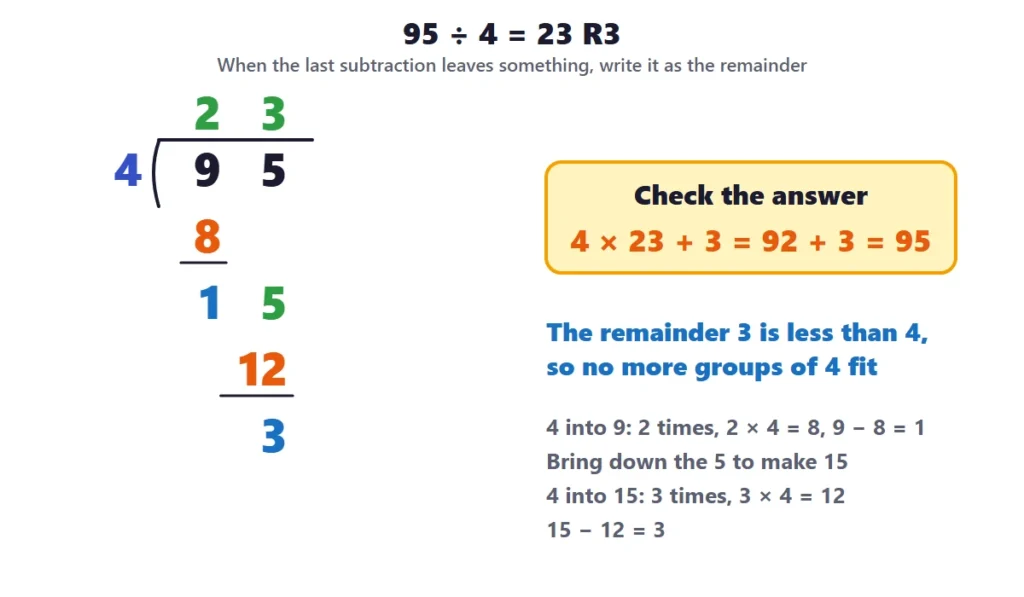
Do the four steps until all the digits are used. If the last subtraction does not give 0, the number that is left is the remainder. Write it after the answer, as in 95 ÷ 4 = 23 R3.
How can you check a long division answer?
Multiply the answer by the divisor and add the remainder. If you get the number you started with, the answer is right. For 95 ÷ 4 = 23 R3, 4 × 23 + 3 = 95.
Is long division 2-digit by 1-digit hard for children?
Long division 2-digit by 1-digit is the first long division that children meet, and it is easier than the later steps because there are only two rounds of the four steps. Most children need a week or two of short sessions, and the problems that divide evenly come first.
Where can I download free long division worksheets?
Open any worksheet in the gallery above, choose US Letter or A4, then print or save the PDF. They are free and each has an answer key.