Change the numbers, layout and number of problems, then download a new PDF with its answer key.
3-digit subtraction uses the same steps as 2-digit subtraction with one more column, and a borrow can now happen twice. The eight PDFs on this page have problems with no borrowing, mixed problems and problems that always borrow, plus grid paper, 3-digit minus 2-digit, a riddle, match-up cards and story problems. Every sheet has an answer key.
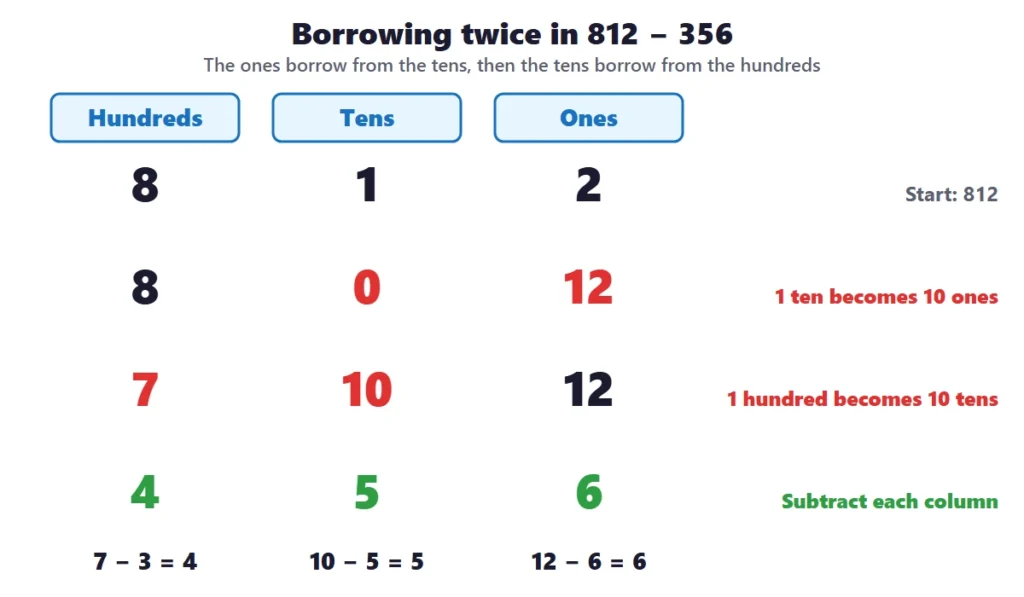
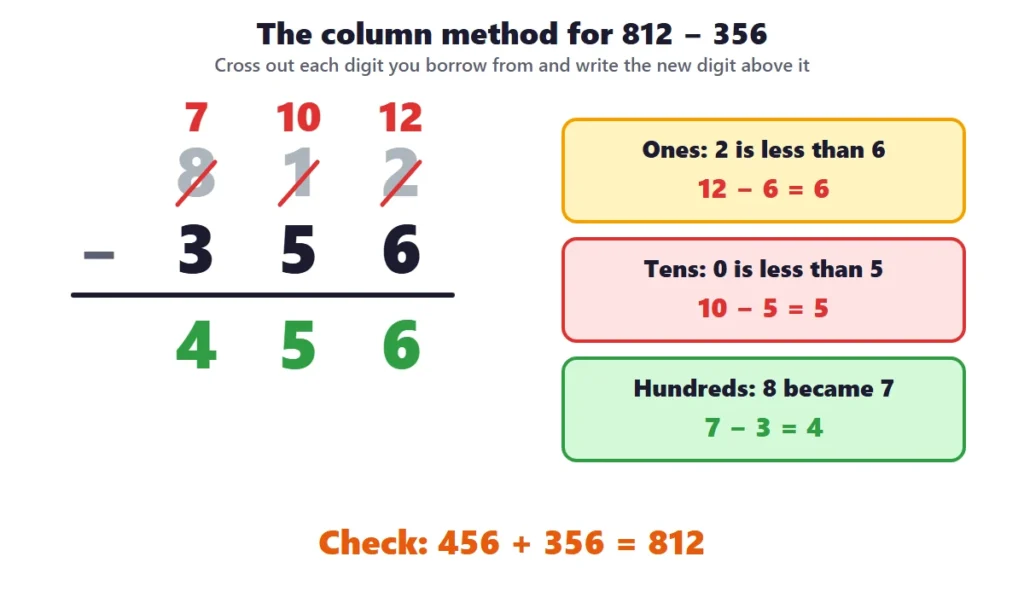
Three-digit subtraction uses the same steps as 2-digit subtraction with one more column. Borrowing can now happen twice: once from the tens and once from the hundreds. In 812 − 356, the ones borrow from the tens, then the tens borrow from the hundreds, giving 456.
The steps
Line up hundreds, tens and ones.
Work from right to left, borrowing whenever the top digit is too small.
Remember that a digit you borrowed from is now one less.
Check: answer + bottom number = top number.
What is on this page
No borrowing, mixed and always borrowing: three sets that increase in difficulty.
Grid paper: for neat columns.
3-digit minus 2-digit: children must line up numbers of different lengths.
A riddle and match-up cards for review.
Story problems with 3-digit numbers.
Problems with zeros in the top number, such as 500 − 267, have their own page: subtracting across zeros.
3-digit subtraction worksheets: what is in the set
There are 8 3-digit subtraction worksheets on this page, and every one has an answer key except for any cut-out games. There are three sets of column problems that increase in difficulty, one on grid paper, one with a 2-digit number taken from a 3-digit number, a riddle, match-up cards and story problems.
Worksheet
What children do
Standard
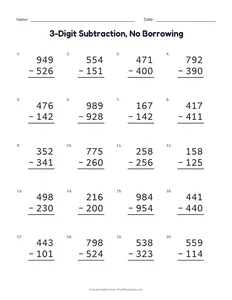
3-Digit Subtraction, No Borrowing
20 column problems with no borrowing.
3.NBT.A.2
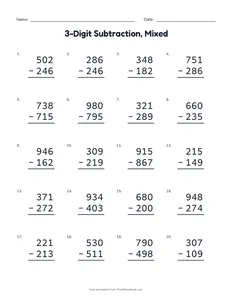
3-Digit Subtraction, Mixed
20 problems, some with borrowing.
3.NBT.A.2
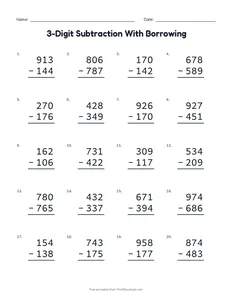
3-Digit Subtraction With Borrowing
20 problems that all need borrowing.
3.NBT.A.2
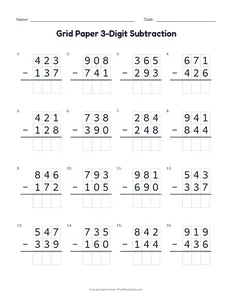
Grid Paper 3-Digit Subtraction
Digits in boxes for neat columns.
3.NBT.A.2
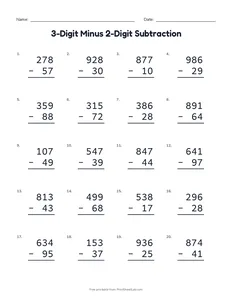
3-Digit Minus 2-Digit Subtraction
20 problems taking a 2-digit number from a 3-digit number.
3.NBT.A.2
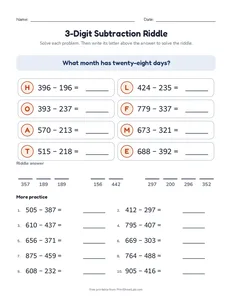
3-Digit Subtraction Riddle
Solve the problems to decode a riddle.
3.NBT.A.2
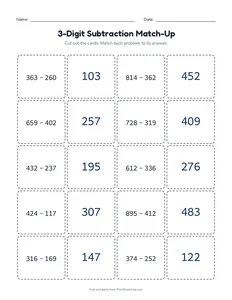
3-Digit Subtraction Match-Up
Match 10 problems to their differences.
3.NBT.A.2
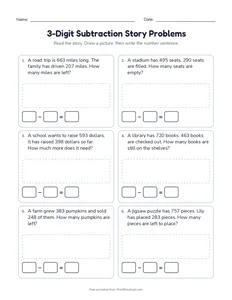
3-Digit Subtraction Story Problems
Six story problems with 3-digit numbers.
3.NBT.A.2
3-digit subtraction: the steps column by column
3-digit subtraction has three columns, ones, tens and hundreds, and the steps are the same as in 2-digit subtraction with regrouping. Work from right to left, borrow when the top digit is too small, and remember that a digit you borrowed from is now one less. This table shows 812 − 356, where the ones borrow from the tens and the tens then borrow from the hundreds:
Column
Top digit
Bottom digit
What happens
Subtract
Ones
2
6
2 is less than 6, so borrow: 2 becomes 12
12 − 6 = 6
Tens
1
5
0 is less than 5, so borrow again: it becomes 10
10 − 5 = 5
Hundreds
8
3
lent 1 to the right, so 8 is now 7
7 − 3 = 4
The picture above shows the same trades on a place-value board. The second borrow is the one that children find hard, because the tens digit has already lent a ten to the ones and may be left with too little. In 812 − 356 the 1 ten became 0 tens, and 0 is less than 5, so the tens must borrow again. The base ten blocks tool lets children trade a flat for ten rods on the screen.
3 digit subtraction worksheets: how many borrows does a problem need?
The three sets in the 3 digit subtraction worksheets are called no borrowing, mixed and always borrowing, so it helps to know how common each kind is. This table counts every subtraction of two 3-digit numbers where the top number is the same as or bigger than the bottom number, which is 405,450 problems:
Borrows needed
Subtractions
Share
Example
0
136,125
33.6%
745 − 620 = 125
1
180,225
44.5%
746 − 528 = 218
2
89,100
22.0%
812 − 356 = 456
All
405,450
100%
larger number on top
Only a third of all 3-digit subtractions need no borrowing, and more than a fifth need two. That is a much higher share of borrowing than in 2-digit subtraction, where 60% of problems need none. The table below splits the same problems by the columns that borrow, which explains why the second borrow is trickier than the first:
Which columns borrow
Subtractions
Share
Example
What happens
None
136,125
33.6%
745 − 620
every top digit is big enough
Ones only
91,125
22.5%
746 − 528
the ones borrow from the tens, and the tens still have enough
Tens only
89,100
22.0%
728 − 586
the ones are fine, but the tens borrow from the hundreds
Ones and tens
89,100
22.0%
730 − 341
the borrow from the tens leaves too little, so the tens borrow again
Ones-only and tens-only borrows are both common, and about one problem in five has both. A child who has met all four patterns has met every kind of 3-digit subtraction. The mixed worksheet contains all four.
3 digit subtraction with regrouping: the 3-digit minus 2-digit problems
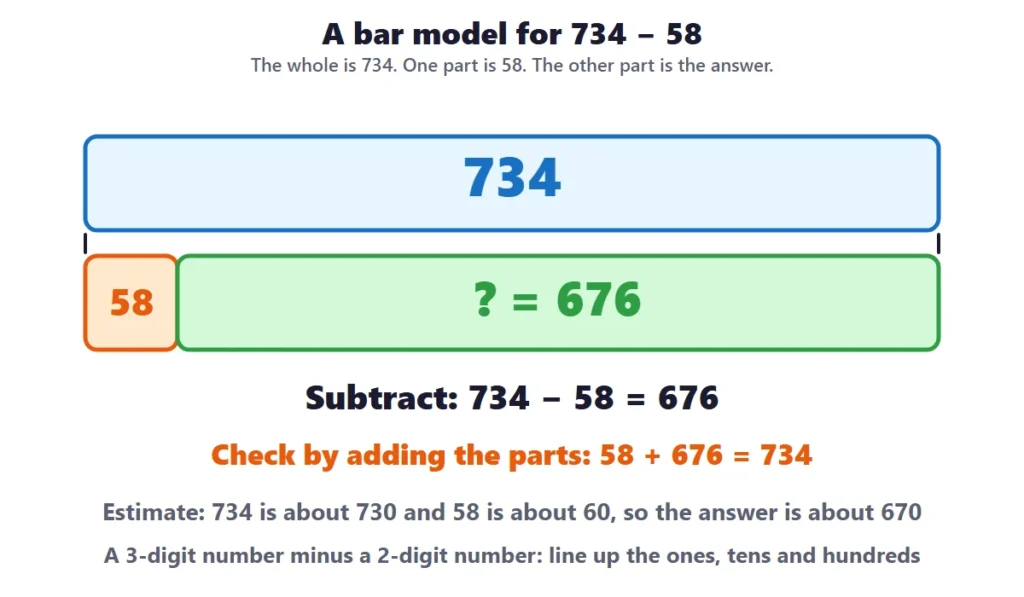
3 digit subtraction with regrouping is hardest when the second number has only two digits, as in 734 − 58, because children must line up numbers of different lengths. This table shows the steps:
Column
Top digit
Bottom digit
What happens
Subtract
Ones
4
8
4 is less than 8, so borrow: 4 becomes 14
14 − 8 = 6
Tens
3
5
2 is less than 5, so borrow again: it becomes 12
12 − 5 = 7
Hundreds
7
0
lent 1 to the right, so 7 is now 6
6 − 0 = 6
The hundreds column has no digit to subtract, so the 7 simply becomes 6 after lending, and the answer is 676. The most common mistake is to write the 58 under the tens and hundreds, which gives a very different answer. This table shows how far off the answer is for four problems when the second number is shifted one place to the left:
Problem
Correct answer
If the 2-digit number is shifted one place left
How far off
734 − 58
676
734 − 580 = 154
522
812 − 56
756
812 − 560 = 252
504
605 − 47
558
605 − 470 = 135
423
900 − 85
815
900 − 850 = 50
765
The wrong answers are hundreds too small, which is easy to see with an estimate: 734 − 58 is about 730 − 60 = 670, not 154. The hundreds tens and ones page and the grid paper sheet both help children keep the ones under the ones.
Triple digit subtraction: other ways to find the answer
Triple digit subtraction does not always need the column method. Counting up from the smaller number is quick when the two numbers are close, and rounding the second number up to a multiple of ten and adding back is quick when it ends in 8 or 9. This table shows both for six problems, next to the number of borrows in the column method:
Problem
Borrows in the column method
Counting up from the smaller number
Round up, subtract, then add back
Answer
812 − 356
2
356 + 4 + 40 + 400 + 12 = 812
812 − 360 = 452, then + 4 = 456
456
734 − 58
2
58 + 2 + 40 + 600 + 34 = 734
734 − 60 = 674, then + 2 = 676
676
645 − 287
2
287 + 3 + 10 + 300 + 45 = 645
645 − 290 = 355, then + 3 = 358
358
903 − 468
2
468 + 2 + 30 + 400 + 3 = 903
903 − 470 = 433, then + 2 = 435
435
527 − 198
2
198 + 2 + 300 + 27 = 527
527 − 200 = 327, then + 2 = 329
329
760 − 342
1
342 + 8 + 50 + 300 + 60 = 760
760 − 350 = 410, then + 8 = 418
418
The column method. Cross out and write the new digit.
For 812 − 356, counting up goes from 356 to 360 (4), to 400 (40), to 800 (400) and to 812 (12), a total of 456. Children who know these methods can check an answer found by columns, and the number line tool shows the same jumps. The standard 2.NBT.B.9 asks children to explain why these strategies work, using place value.
Subtraction within 1000: estimate first, then check
Subtraction within 1000 is where an estimate becomes a useful check, since a slip in one column changes the answer by 10 or 100. Round both numbers to the nearest hundred and subtract. This table shows five problems with the estimate beside the exact answer:
Problem
Rounded to the nearest 100
Estimate
Exact answer
Difference from the estimate
812 − 356
800 − 400
400
456
56
734 − 58
700 − 100
600
676
76
645 − 287
600 − 300
300
358
58
903 − 468
900 − 500
400
435
35
527 − 198
500 − 200
300
329
29
The estimate is never more than 100 away from the exact answer when both numbers are rounded to the nearest hundred, so an answer that is far from the estimate has an error. The estimating with rounding page explains how to round, and the rounding to the nearest 100 pages give practice. A second check is to add the answer to the number taken away:
Problem
Answer
Check: add the answer to the number taken away
Gives the start?
812 − 356
456
456 + 356 = 812
yes
734 − 58
676
676 + 58 = 734
yes
645 − 287
358
358 + 287 = 645
yes
903 − 468
435
435 + 468 = 903
yes
527 − 198
329
329 + 198 = 527
yes
760 − 342
418
418 + 342 = 760
yes
3rd grade subtraction worksheets: where this fits
These are 3rd grade subtraction worksheets in the sense that the Common Core standard 3.NBT.A.2 asks grade 3 children to subtract within 1,000 fluently, using strategies and algorithms based on place value. In grade 2, the standard 2.NBT.B.7 asks for the same work with concrete models and drawings, so children who still need blocks can use the base ten blocks tool and move to the column method when they are ready.
Common mistakes with 3-digit subtraction
The most common mistake is to subtract the smaller digit from the bigger in each column. This table shows five mistakes, what went wrong and the fix:
What the child writes
What went wrong
The fix
812 − 356 = 544
subtracts the smaller digit from the larger in each column
always take the bottom from the top, and borrow when the top is smaller: 12 − 6, 10 − 5, 7 − 3 give 456
812 − 356 = 466
borrows for the ones but forgets to reduce the tens
cross out the tens digit and write one less, so that the tens column reads 0, then borrow again
734 − 58 = 154
writes the 58 under the tens and hundreds
line up the ones under the ones: 8 goes under the 4
305 − 148 = 247
cannot take 4 from the 0 in the tens column, so turns it around to 4 − 0
the 3 hundreds lend to the tens, which pass 1 to the ones: 2 hundreds, 9 tens and 15 ones give 157
900 − 85 = 820
subtracts 85 as 80 and forgets the 5
work out both columns, and check by adding: 815 + 85 = 900
3-digit subtraction word problems
Three-digit numbers come up in counts of books, seats and kilometers. Ask children to write the subtraction, to solve it in columns and to check by adding:
Word problem
Working
Answer
There are 812 books in a library and 356 are taken out. How many are left on the shelves?
812 − 356
456 books
A shop has 734 pencils and sells 58. How many pencils are left?
734 − 58
676 pencils
A school has 645 students. 287 are in the juniors. How many are not?
645 − 287
358 students
A farmer picks 903 apples and sells 468. How many does he keep?
903 − 468
435 apples
A bike race is 527 km. Ana has gone 198 km. How far is left?
527 − 198
329 km
A cinema has 760 seats and 342 are taken. How many seats are free?
760 − 342
418 seats
Games and activities for 3-digit subtraction
Children learn 3-digit subtraction best when they play with it. These games use things that are found at home or in a classroom:
Trade a flat: build 812 with 8 flats, 1 rod and 2 cubes, trade a flat for ten rods and a rod for ten cubes, and take away 356
Borrow bingo: call problems that borrow once or twice, and mark the answers
Match-up cards: match 10 problems to their differences, and sort them by the number of borrows
Beat the borrow: roll six dice, make two 3-digit numbers, and subtract the smaller from the bigger; the player with the smaller difference wins
Counting up race: find the difference by counting up, and then check in columns
The riddle: solve the problems and use the answers to decode a riddle
Extra support and extra challenge with 3-digit subtraction
For children who need more support: build the numbers with flats, rods and cubes first, and write each trade beside the column. Use the grid paper sheet, so that every digit has its own box, and cross out each digit you borrow from. Start with the no-borrowing set, then the set where the ones borrow, then the set where the tens borrow, before the mixed set.
For children who need more challenge: ask for the missing digit in 8☐2 − 356 = 456, for the biggest answer from two 3-digit numbers that use the digits 1 to 6 once each, and for a subtraction where both columns borrow and the answer is 456. Move on to subtracting across zeros and to 4-digit numbers.
How to tell that a child is ready to move on from 3-digit subtraction
Before moving on from 3-digit subtraction, check that the child can do all four of these things:
A bar model. 734 − 58 = 676.
The child can say how many borrows a problem needs by looking at the digits.
The child borrows twice, and writes the new digits correctly.
The child lines up a 2-digit number under a 3-digit number.
The child estimates and then checks the answer by adding.
A short lesson is the best way to introduce 3-digit subtraction. This 20-minute plan can be used in a classroom, at a tutoring session or at home, and it uses the worksheets at the end:
Minutes
Activity
What to say or ask
0 to 4
Show 812 with flats, rods and cubes, and ask for 812 − 356
Can we take 6 cubes from 2?
4 to 9
Trade a rod for ten cubes, then a flat for ten rods, and take away
What do we have in each place now?
9 to 14
Write the problem in columns, cross out and write the new digits
Why is the 8 now a 7?
14 to 18
Check by adding the answer, and estimate with hundreds
Is 456 close to 800 − 400?
18 to 20
Start a worksheet and check one answer
How many borrows does this one need?
Where 3-digit subtraction fits across the grades
No skill stands alone. This table shows what children learn before and after 3-digit subtraction, with the standard that goes with each step:
This page is the main page for 3-digit subtraction. The whole sequence is on the subtraction worksheets page.
Helping at home with 3-digit subtraction
Parents do not need to be experts to help with 3-digit subtraction. These suggestions work well, and each takes only a few minutes:
Use real coins: 8 dollars, 1 dime and 2 pennies, to show how to trade a dollar for ten dimes.
Ask “how many borrows?” before each problem.
Check every answer by adding it back.
Use graph paper, so each digit has a box.
Praise the estimate as much as the answer.
How to check progress in 3-digit subtraction
A teacher or parent can check progress in 3-digit subtraction with the answer key and a few questions. This table shows three common situations, what they mean and what to do next:
What you see
What it means
What to do next
The child subtracts the smaller digit from the bigger
The order of the subtraction is not yet fixed
Always take the bottom from the top, and borrow when needed
Grade 2 children subtract within 1,000 using models and strategies (2.NBT.B.7), and grade 3 children do it fluently (3.NBT.A.2).
How do I check a 3-digit subtraction answer?
Add the answer to the number you took away. If you get the top number, the answer is right.
How do you do 3-digit subtraction with borrowing?
Start with the ones. If the top digit is smaller than the bottom digit, borrow one ten from the tens column, so the ones digit gets ten more and the tens digit goes down by one. Repeat for the tens, borrowing from the hundreds if needed, and then subtract the hundreds.
What grade learns 3-digit subtraction?
Grade 2 children subtract within 1,000 using models and strategies (Common Core 2.NBT.B.7), and grade 3 children subtract within 1,000 fluently (3.NBT.A.2).
How long does it take to learn 3-digit subtraction?
Most children need two to three weeks of short sessions for 3-digit subtraction, if 2-digit subtraction with regrouping is secure. The sets on this page go from no borrowing to always borrowing, so a child can practice for as long as they need.