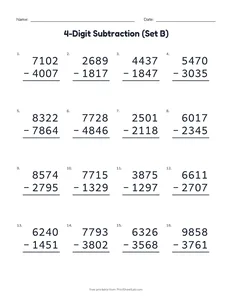
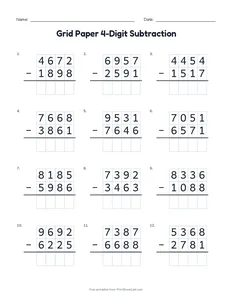
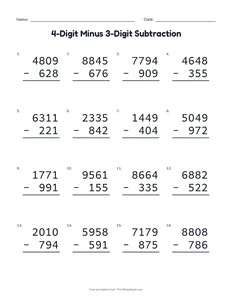
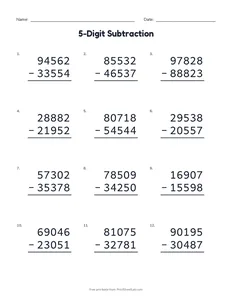
Change the numbers, layout and number of problems, then download a new PDF with its answer key.
4 and 5-digit subtraction uses the standard algorithm that children learn in grade 4, with up to five columns and up to four borrows. The eight PDFs on this page have 4-digit problems with borrowing, 4-digit minus 3-digit, 5-digit problems and grid paper for long numbers, plus a riddle and story problems, and every sheet has an answer key.
By grade 4, children subtract multi-digit numbers with the standard algorithm (Common Core 4.NBT.B.4). The steps do not change from 2-digit subtraction, but there are more places where a borrow can happen, so neat columns and careful checking matter more.
Tips for long subtraction
Write each digit clearly in its own column; the grid paper sheets help.
Cross out a digit you borrow from and write the new digit above it.
Estimate first: 7,352 − 4,869 is about 7,000 − 5,000 = 2,000, so an answer near 2,500 makes sense.
Check by adding the answer to the number taken away.
What is on this page
4-digit subtraction: two sets of 16 problems with regrouping.
4-digit minus 3-digit: numbers of different lengths.
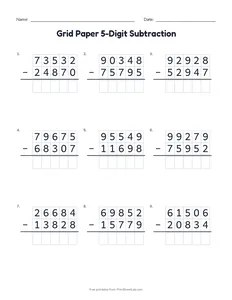
5-digit subtraction: 12 problems, plus a grid paper version.
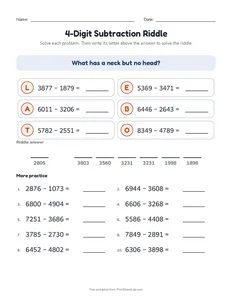
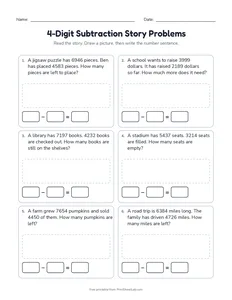
A riddle and story problems with 4-digit numbers.
4 and 5-digit subtraction worksheets: what is in the set
There are 8 4 and 5-digit subtraction worksheets on this page, and every one has an answer key except for any cut-out games. There are two sets of 4-digit problems, one with numbers of different lengths, two with 5-digit numbers, grid paper for both lengths, a riddle and story problems.
Worksheet
What children do
Standard
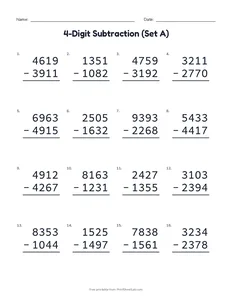
4-Digit Subtraction (Set A)
16 column problems with borrowing.
4.NBT.B.4
4-Digit Subtraction (Set B)
Another 16 problems with borrowing.
4.NBT.B.4
Grid Paper 4-Digit Subtraction
Digits in boxes for neat columns.
4.NBT.B.4
4-Digit Minus 3-Digit Subtraction
16 problems with numbers of different lengths.
4.NBT.B.4
5-Digit Subtraction
12 column problems with 5-digit numbers.
4.NBT.B.4
Grid Paper 5-Digit Subtraction
Digits in boxes for long numbers.
4.NBT.B.4
4-Digit Subtraction Riddle
Solve the problems to decode a riddle.
4.NBT.B.4
4-Digit Subtraction Story Problems
Six story problems with 4-digit numbers.
4.NBT.B.4
4 and 5-digit subtraction: the steps column by column
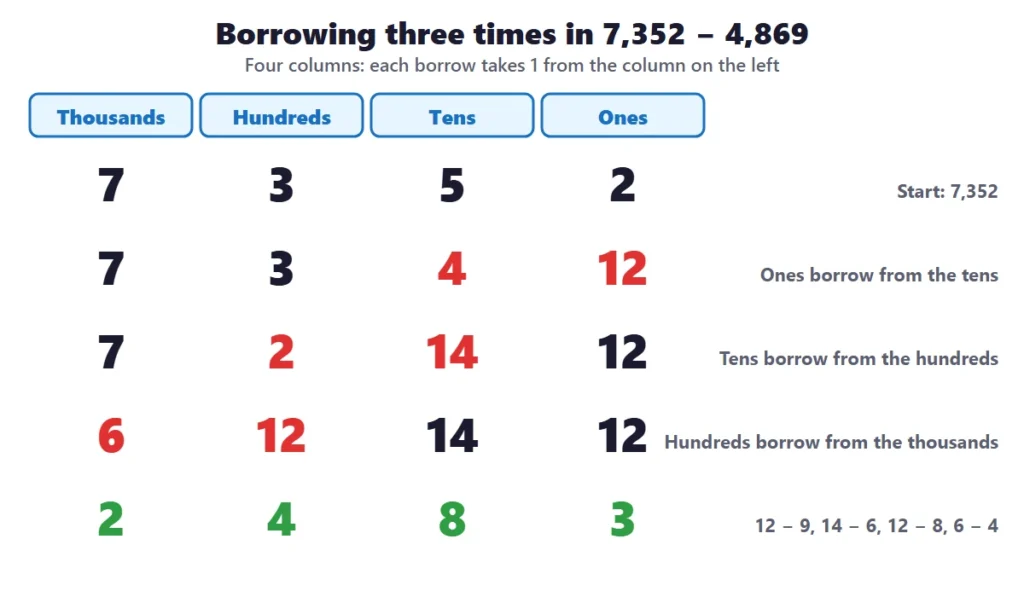
4 and 5-digit subtraction follows the same steps as every other column subtraction: start at the ones, borrow when the top digit is too small, and remember that a digit you borrowed from is now one less. This table shows 7,352 − 4,869, where three columns borrow in a row:
Column
Top digit
Bottom digit
What happens
Subtract
Ones
2
9
2 is less than 9, so borrow: 2 becomes 12
12 − 9 = 3
Tens
5
6
4 is less than 6, so borrow again: it becomes 14
14 − 6 = 8
Hundreds
3
8
2 is less than 8, so borrow again: it becomes 12
12 − 8 = 4
Thousands
7
4
lent 1 to the right, so 7 is now 6
6 − 4 = 2
The picture above shows the same four steps on a place-value board. Each borrow adds ten to the column on its right and takes one from the column on its left, so the number does not change: after all three borrows the columns hold 6 thousands, 12 hundreds, 14 tens and 12 ones, which is still 7,352. For 5-digit numbers, there is one more column and one more chance to borrow, as this table for 62,015 − 38,476 shows:
Column
Top digit
Bottom digit
What happens
Subtract
Ones
5
6
5 is less than 6, so borrow: 5 becomes 15
15 − 6 = 9
Tens
1
7
0 is less than 7, so borrow again: it becomes 10
10 − 7 = 3
Hundreds
0
4
the 0 became 10 and lent 1, so it is now 9
9 − 4 = 5
Thousands
2
8
1 is less than 8, so borrow again: it becomes 11
11 − 8 = 3
Ten thousands
6
3
lent 1 to the right, so 6 is now 5
5 − 3 = 2
In this problem the 0 in the hundreds has to pass a borrow along, and the last borrow comes from the ten thousands, so the 6 becomes 5. The answer is 23,539. The large numbers place value page explains the names and values of the five columns.
4 digit subtraction worksheets: how many borrows to expect
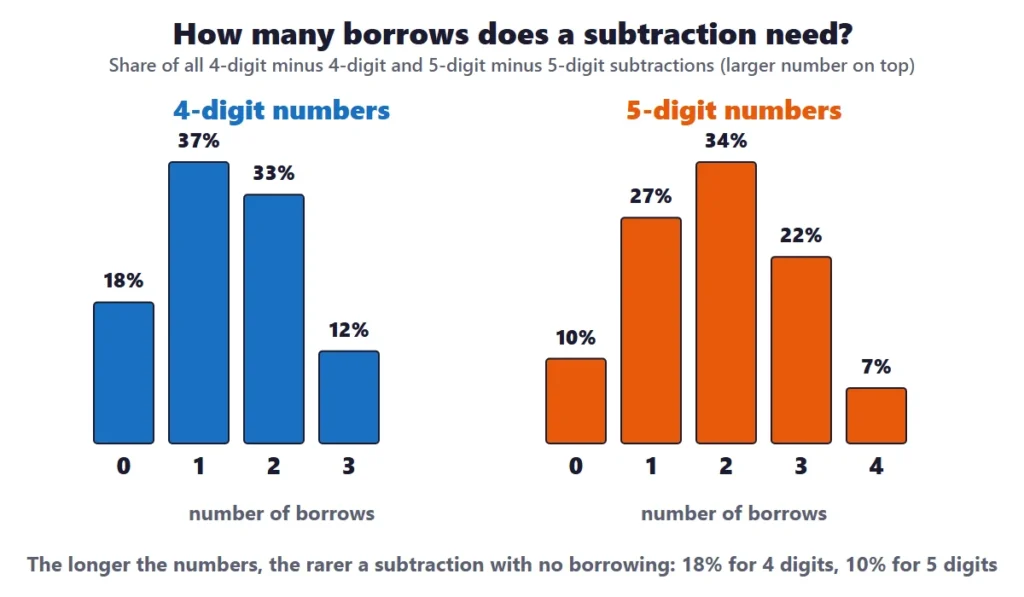
The 4 digit subtraction worksheets use problems that borrow, so it is worth knowing how many borrows a typical problem needs. This table counts every subtraction of two numbers with the same number of digits, where the top number is the same as or bigger than the bottom number, for 4 and 5 digits:
Borrows
4-digit minus 4-digit
Share
5-digit minus 5-digit
Share
0
7,486,875
18.5%
411,778,125
10.2%
1
14,924,250
36.8%
1,096,486,875
27.1%
2
13,192,875
32.6%
1,366,216,875
33.7%
3
4,900,500
12.1%
906,035,625
22.4%
4
–
–
269,527,500
6.7%
Average
1.38
1.88
All
40,504,500
100%
4,050,045,000
100%
A 4-digit subtraction needs 1.38 borrows on average, and a 5-digit subtraction needs 1.88. Only 18% of 4-digit subtractions and 10% of 5-digit subtractions need no borrowing at all, so a child who does these problems well is practicing the borrow itself, not just the subtraction facts. The more columns there are, the more important it is to cross out each digit and write the new one.
5 digit subtraction: how many problems are there?
5 digit subtraction has more problems than a person could ever do. There are 4,050,045,000 subtractions of two 5-digit numbers where the top number is the same as or bigger than the bottom number. A child who solved one every minute, day and night, would need about 7,706 years to finish them. That is why the worksheet engine makes new problems each time, and why the answer keys are made for every sheet.
The worksheets on this page, then, are not a list of problems to memorize. They are a way to practice the same steps with different numbers. Five columns need careful writing, so the grid paper sheet gives each digit its own box, and children can cross out and write the new digits in the margins.
How long is the answer to a 4-digit subtraction?
The answer to a 4-digit subtraction does not always have four digits. This table counts the answers by their length, using the fact that exactly 9,000 − d pairs of 4-digit numbers have a difference of d:
The answer has
Subtractions
Share
Example
1 digit (0 to 9)
89,955
0.2%
5,423 − 5,418 = 5
2 digits (10 to 99)
805,095
2.0%
7,201 − 7,150 = 51
3 digits (100 to 999)
7,605,450
18.8%
6,000 − 5,478 = 522
4 digits (1,000 to 8,999)
32,004,000
79.0%
7,352 − 4,869 = 2,483
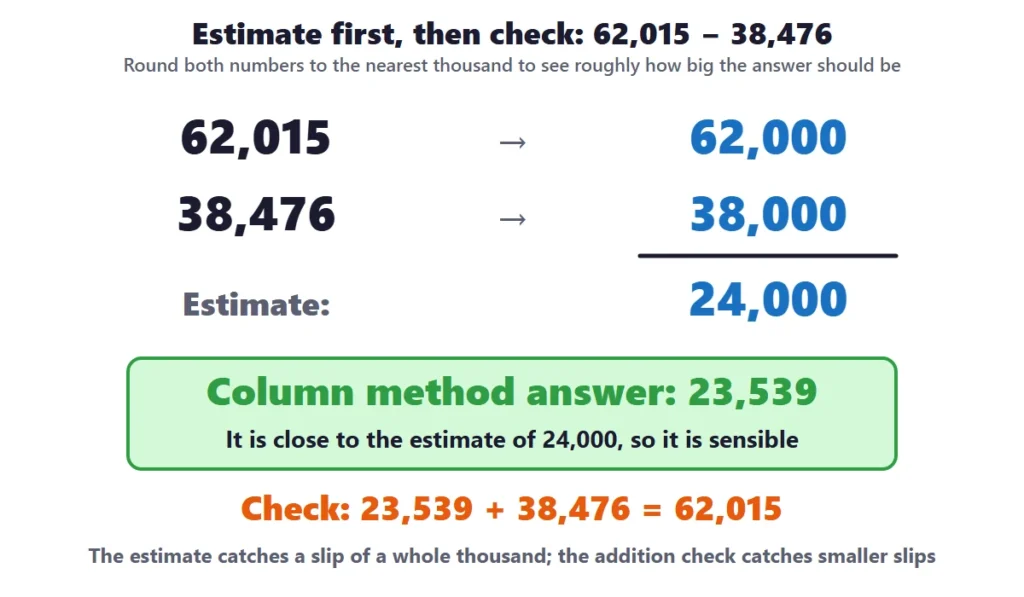
Estimate, then check. 62,015 − 38,476 = 23,539.
About one answer in five has fewer than four digits, so a child who always writes four digits in the answer will sometimes write zeros at the front. When the two numbers are close, such as 7,201 − 7,150, the thousands column gives 0 and the answer is 51. Teach children to estimate first, because 7,200 − 7,150 is clearly small.
Multi digit subtraction worksheets: estimate first, then check
Multi digit subtraction worksheets are easier to check when children estimate by rounding to the nearest thousand. This table shows six problems with the estimate beside the exact answer:
Problem
Rounded to the nearest 1,000
Estimate
Exact answer
Difference from the estimate
7,352 − 4,869
7,000 − 5,000
2,000
2,483
483
62,015 − 38,476
62,000 − 38,000
24,000
23,539
461
8,004 − 2,967
8,000 − 3,000
5,000
5,037
37
45,310 − 27,854
45,000 − 28,000
17,000
17,456
456
9,120 − 6,745
9,000 − 7,000
2,000
2,375
375
80,000 − 36,218
80,000 − 36,000
44,000
43,782
218
The estimate is never more than 1,000 away from the exact answer, since each rounding moves a number by at most 500. An answer that is far from the estimate has an error, and in practice the wrong answers are often 10, 100 or 1,000 away because a borrow was missed. The estimating with rounding page explains the method, and the rounding to the nearest 10 and rounding to the nearest 100 pages give practice. A second check is to add the answer to the number taken away:
Problem
Answer
Check: add the answer to the number taken away
Gives the start?
7,352 − 4,869
2,483
2,483 + 4,869 = 7,352
yes
62,015 − 38,476
23,539
23,539 + 38,476 = 62,015
yes
8,004 − 2,967
5,037
5,037 + 2,967 = 8,004
yes
45,310 − 27,854
17,456
17,456 + 27,854 = 45,310
yes
9,120 − 6,745
2,375
2,375 + 6,745 = 9,120
yes
80,000 − 36,218
43,782
43,782 + 36,218 = 80,000
yes
Subtraction with regrouping 4 digit: zeros in the top number
Subtraction with regrouping 4 digit problems are hardest when the top number contains zeros, since the borrow has to pass through them. About 8% of 4-digit subtractions and 13% of 5-digit subtractions have a borrow that passes through a zero. This table shows four of them:
Problem
Borrows
Steps that involve a zero
Answer
7,003 − 2,586
3
the 0 became 10 and lent 1, so it is now 9; the 0 became 10 and lent 1, so it is now 9
4,417
6,000 − 1,427
3
0 is less than 7, so borrow: 0 becomes 10; the 0 became 10 and lent 1, so it is now 9; the 0 became 10 and lent 1, so it is now 9
4,573
50,004 − 21,739
4
the 0 became 10 and lent 1, so it is now 9; the 0 became 10 and lent 1, so it is now 9; the 0 became 10 and lent 1, so it is now 9
28,265
9,100 − 4,376
3
0 is less than 6, so borrow: 0 becomes 10; the 0 became 10 and lent 1, so it is now 9; 0 is less than 3, so borrow again: it becomes 10
4,724
When a zero lends, it first becomes 10 and then gives 1 to the column on its right, so it ends up as 9. There is a whole page on this skill, subtracting across zeros, and the 3-digit subtraction page has the same idea with one zero.
4th grade subtraction worksheets: what the standard asks for
These 4th grade subtraction worksheets match standard 4.NBT.B.4, which asks children to fluently add and subtract multi-digit whole numbers using the standard algorithm. The standard names numbers up to 1,000,000. In grade 3, children subtract within 1,000, so the new work in grade 4 is the longer columns, and the idea that a borrow can pass along many places.
Common mistakes with 4 and 5-digit subtraction
The most common mistake is to subtract the smaller digit from the bigger in each column. This table shows five mistakes, what went wrong and the fix:
What the child writes
What went wrong
The fix
7,352 − 4,869 = 3,517
subtracts the smaller digit from the larger in every column
always take the bottom from the top, and borrow when the top is smaller: 12 − 9, 14 − 6, 12 − 8 and 6 − 4 give 2,483
7,352 − 4,869 = 2,583
borrows in the ones and tens but forgets to reduce the hundreds digit after it lent to the tens
after each borrow cross out the digit and write one less; the hundreds are now 2, so the hundreds column is 12 − 8 = 4
62,015 − 38,476 = 24,539
forgets that the thousands digit already lent 1 to the hundreds
the thousands are now 1, so 1 − 8 needs a borrow from the ten thousands: 11 − 8 = 3
8,004 − 2,967 = 6,147
borrows from the zeros without changing them to 9
each 0 that lends becomes 9, and the thousands become 7: 7 − 2, 9 − 9, 9 − 6 and 14 − 7 give 5,037
9,120 − 6,745 = 3,375
forgets to reduce the thousands digit after it lent to the hundreds
cross out the 9 and write 8, so the thousands column is 8 − 6 = 2; estimate first: 9,000 − 7,000 is about 2,000
4 and 5-digit subtraction word problems
Large numbers come up in the sizes of stadiums, towns, libraries and journeys. Ask children to estimate first, to solve in columns and to check by adding:
Word problem
Working
Answer
A stadium holds 62,015 seats and 38,476 are sold. How many seats are not sold?
62,015 − 38,476
23,539 seats
A town has 7,352 people and 4,869 are adults. How many are children?
7,352 − 4,869
2,483 children
A library has 8,004 books. 2,967 are loaned. How many are on the shelves?
8,004 − 2,967
5,037 books
A factory makes 45,310 bolts and ships 27,854. How many are left?
45,310 − 27,854
17,456 bolts
A trip is 9,120 km. A plane has flown 6,745 km. How far is left?
9,120 − 6,745
2,375 km
A bank has 80,000 dollars and pays out 36,218. How much is left?
80,000 − 36,218
43,782 dollars
Games and activities for 4 and 5-digit subtraction
Children learn 4 and 5-digit subtraction best when they play with it. These games use things that are found at home or in a classroom:
Bank of place value: use coins and bills worth 1, 10, 100 and 1,000 to show 7,352, and trade as you take 4,869 away
Borrow bingo: call problems that borrow once, twice or three times, and mark the answers
Estimate race: find the estimate first, and score a point if the exact answer is within 1,000 of it
Biggest difference: roll eight dice, make two 4-digit numbers, and try to make the biggest difference
Check it: swap worksheets and check each answer by adding
The riddle: solve the problems and use the answers to decode a riddle
Extra support and extra challenge with 4 and 5-digit subtraction
For children who need more support: use graph paper or the grid paper sheet, so that every digit has its own box and the columns stay straight. Start with 4-digit numbers that need one borrow, then two, then three, and then use the sheets with 5 digits. Cross out each digit you borrow from and write the new digit above it. Say the place of each digit aloud.
For children who need more challenge: ask for a missing digit in 7,☐52 − 4,869 = 2,483, for the number that makes the biggest answer from two 5-digit numbers that use the digits 0 to 9 once each, and for the difference between the biggest and smallest 5-digit numbers that can be made with 3, 8, 1, 9 and 4. Move on to subtracting across zeros and to 6-digit numbers.
How to tell that a child is ready to move on from 4 and 5-digit subtraction
Before moving on from 4 and 5-digit subtraction, check that the child can do all four of these things:
How many borrows?. Counted exactly.
The child writes the digits of long numbers in the right columns.
The child borrows in several columns in a row, and writes the new digits.
The child estimates by rounding before solving.
The child checks the answer by adding it to the number taken away.
A short lesson is the best way to introduce 4 and 5-digit subtraction. This 20-minute plan can be used in a classroom, at a tutoring session or at home, and it uses the worksheets at the end:
Minutes
Activity
What to say or ask
0 to 4
Show 7,352 with coins and bills, and ask for 7,352 − 4,869
Can we take 9 ones from 2?
4 to 9
Trade one coin for ten at a time, and take away
How many are in each place after the trades?
9 to 14
Write the problem in columns, cross out and write the new digits
What is the new thousands digit?
14 to 18
Estimate with thousands, and check by adding
Is 2,483 close to 7,000 − 5,000?
18 to 20
Start a worksheet and check one answer
How many borrows does this one need?
Where 4 and 5-digit subtraction fits across the grades
No skill stands alone. This table shows what children learn before and after 4 and 5-digit subtraction, with the standard that goes with each step:
This page is the main page for long subtraction. The whole sequence is on the subtraction worksheets page.
Helping at home with 4 and 5-digit subtraction
Parents do not need to be experts to help with 4 and 5-digit subtraction. These suggestions work well, and each takes only a few minutes:
Use a calculator only to check, after the child has done the problem by hand.
Ask “how many borrows?” before each problem.
Check every answer by adding it back, and estimate first.
Use graph paper, so each digit has a box.
Praise the neat columns as much as the answer.
How to check progress in 4 and 5-digit subtraction
A teacher or parent can check progress in 4 and 5-digit subtraction with the answer key and a few questions. This table shows three common situations, what they mean and what to do next:
What you see
What it means
What to do next
The child gets the right digits in the wrong columns
Long numbers are not yet lined up
Use the grid paper sheets and say the place of each digit
Grade 4, when children become fluent with the standard algorithm for multi-digit subtraction.
How can I stop careless mistakes?
Estimate before you start and check by adding when you finish. If the check does not match, look for a column where a borrow was missed.
How do you subtract 5-digit numbers?
Line up the digits by place, start at the ones and borrow from the next column when the top digit is too small. Cross out each digit you borrow from and write one less. After the last column, check by adding the answer to the number taken away.
How many borrows can a 4-digit subtraction need?
Up to three, because the thousands column cannot borrow when the top number is bigger. About 12% of 4-digit subtractions need all three, and about 37% need exactly one.
How long does it take to learn 4 and 5-digit subtraction?
Most children need about two weeks of short sessions for 4 and 5-digit subtraction, if 3-digit subtraction is secure. The sets on this page go from 4-digit to 5-digit numbers and from plain columns to grid paper, so a child can practice for as long as they need.