Change the numbers, layout and number of problems, then download a new PDF with its answer key.
2-digit subtraction without regrouping means that every digit on top is at least as big as the digit below it, so the ones and the tens can be subtracted on their own and nothing is borrowed. The nine PDFs on this page have column, grid paper and horizontal problems, a riddle, a caterpillar, match-up cards and story problems, and every sheet has an answer key.
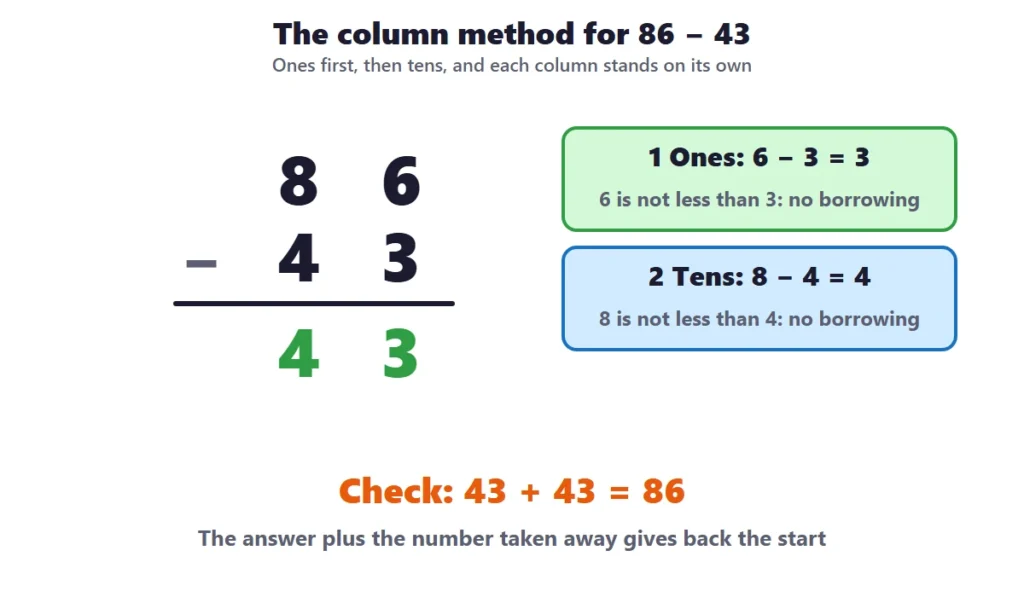
In subtraction without regrouping, every digit on top is at least as big as the digit below it, so each column can be subtracted on its own. In 86 − 43, take 3 from 6 in the ones and 4 from 8 in the tens: 43. These problems let children learn the column method before borrowing is added.
How to subtract 2-digit numbers
Line up the numbers so ones are under ones and tens under tens.
Subtract the ones first: top digit minus bottom digit.
Subtract the tens.
Check by adding: the answer plus the bottom number should equal the top number.
What is on this page
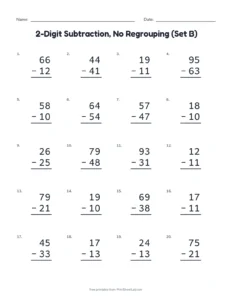
Column subtraction: two sets of 20 problems, and a set that takes a 1-digit number from a 2-digit number.
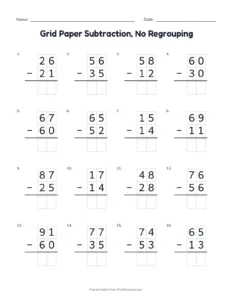
Grid paper subtraction: every digit sits in its own box to keep the columns straight.
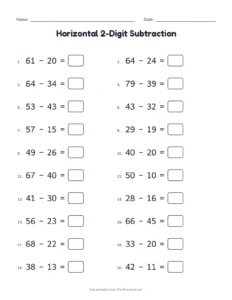
Horizontal subtraction: the same skill written across the page, good for mental math.
Games: a riddle, a caterpillar path and match-up cards.
Story problems with 2-digit numbers.
2-digit subtraction without regrouping worksheets: what is in the set
There are 9 2-digit subtraction without regrouping worksheets on this page, and every one has an answer key except for any cut-out games. There are two sets of column problems, one on grid paper, one that takes a 1-digit number from a 2-digit number, one across the page, a riddle, a caterpillar, match-up cards and story problems.
Worksheet
What children do
Standard
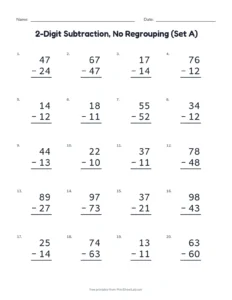
2-Digit Subtraction, No Regrouping (Set A)
20 column problems with no borrowing.
2.NBT.B.5
2-Digit Subtraction, No Regrouping (Set B)
Another 20 problems with no borrowing.
2.NBT.B.5
Grid Paper Subtraction, No Regrouping
Each digit in its own box to keep the columns straight.
2.NBT.B.5
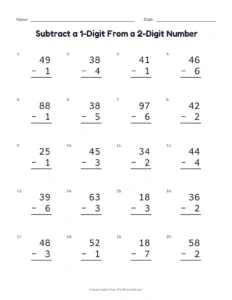
Subtract a 1-Digit From a 2-Digit Number
20 problems like 47 − 5 with no borrowing.
2.NBT.B.5
Horizontal 2-Digit Subtraction
20 problems written across the page, no borrowing.
2.NBT.B.5
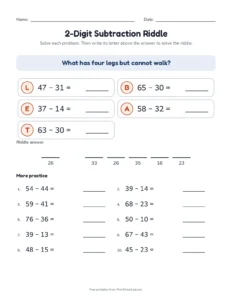
2-Digit Subtraction Riddle
Solve the problems to decode a riddle.
2.NBT.B.5
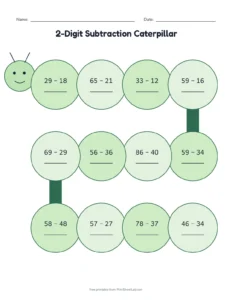
2-Digit Subtraction Caterpillar
12 problems along the caterpillar, no borrowing.
2.NBT.B.5
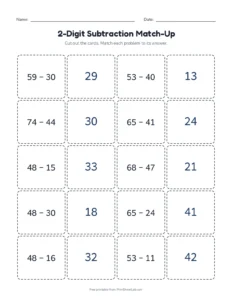
2-Digit Subtraction Match-Up
Match 10 problems to their differences.
2.NBT.B.5
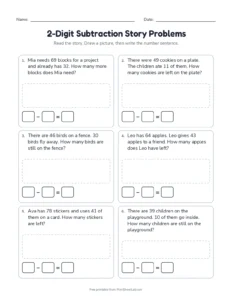
2-Digit Subtraction Story Problems
Six story problems with no borrowing.
2.NBT.B.5
2 digit subtraction without regrouping: the steps column by column
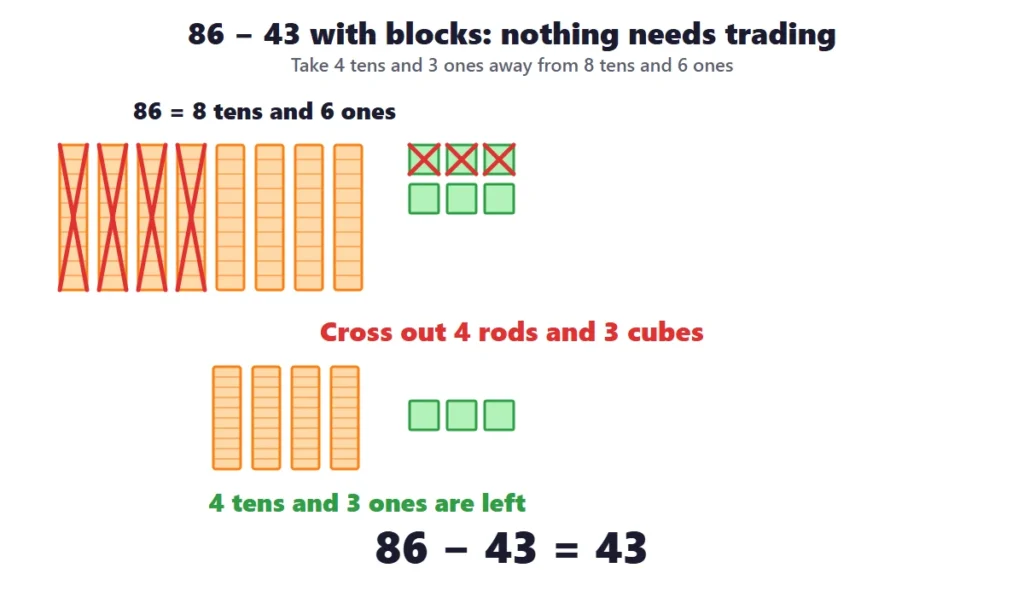
2 digit subtraction without regrouping always follows the same two steps. Subtract the ones, then subtract the tens, and write each answer under its own column. Because each top digit is big enough, the digits never change. This table shows six problems, and the picture above shows 86 − 43 with blocks, where 4 rods and 3 cubes are crossed out:
Problem
Ones column
Tens column
Answer
Why nothing is borrowed
86 − 43
6 − 3 = 3
8 − 4 = 4
43
the top ones digit 6 is not less than 3
97 − 54
7 − 4 = 3
9 − 5 = 4
43
the top ones digit 7 is not less than 4
68 − 25
8 − 5 = 3
6 − 2 = 4
43
the top ones digit 8 is not less than 5
79 − 36
9 − 6 = 3
7 − 3 = 4
43
the top ones digit 9 is not less than 6
58 − 52
8 − 2 = 6
5 − 5 = 0
6
the top ones digit 8 is not less than 2
45 − 3
5 − 3 = 2
4 − 0 = 4
42
the top ones digit 5 is not less than 3
The answers to the first three problems are all 43, which is a good thing to point out. 86 − 43, 97 − 54 and 68 − 25 have different digits but the same difference, because each pair is the same distance apart on a number line tool. The tens and ones page shows why the tens and the ones can be treated separately: 86 is 8 tens and 6 ones, so taking away 4 tens and 3 ones leaves 4 tens and 3 ones.
Double digit subtraction no borrowing: how many problems are there?
Double digit subtraction no borrowing sounds like a small topic, but there are a great many problems. If both numbers are 2-digit numbers and the top number is bigger, there are 4,005 possible subtractions. Of these, 2,385 need no borrowing, which is 60%. This table groups them by how far apart the tens digits are:
The tens digits differ by
No-regrouping problems
Share of the 2,385
Example
0 (answer under 10)
405
17.0%
57 − 51 = 6
1
440
18.4%
60 − 50 = 10
2
385
16.1%
66 − 46 = 20
3
330
13.8%
70 − 40 = 30
4
275
11.5%
76 − 36 = 40
5
220
9.2%
80 − 30 = 50
6
165
6.9%
86 − 26 = 60
7
110
4.6%
90 − 20 = 70
8
55
2.3%
96 − 16 = 80
The first row is special. When the tens digits are the same, as in 57 − 52, the tens column gives 0 and the answer is a 1-digit number. That is true of 405 of the problems, or 17% of the total, and children are often surprised by a 0 in the tens place. Taking a 1-digit number from a 2-digit number is a smaller family: of the 810 such problems, 405 need no regrouping, which is exactly half.
Subtraction without borrowing worksheets: the ones facts behind them
The subtraction without borrowing worksheets use only the ones facts in which the top digit is at least as big as the bottom digit. There are 55 of them, from 0 − 0 up to 9 − 9, and they are the same facts as in subtraction within 10. A child who knows these 55 facts can solve every problem on this page, because each column needs only one of them.
In practice, children need fewer than 55 facts. The 19 facts that take away 0 or take away the same number are easy, and the 8 further facts that take away 1 are nearly as easy. Only the facts with a middle-sized difference need careful practice, and the subtraction within 10 pages give that.
2 digit subtraction worksheets: telling whether a problem needs regrouping
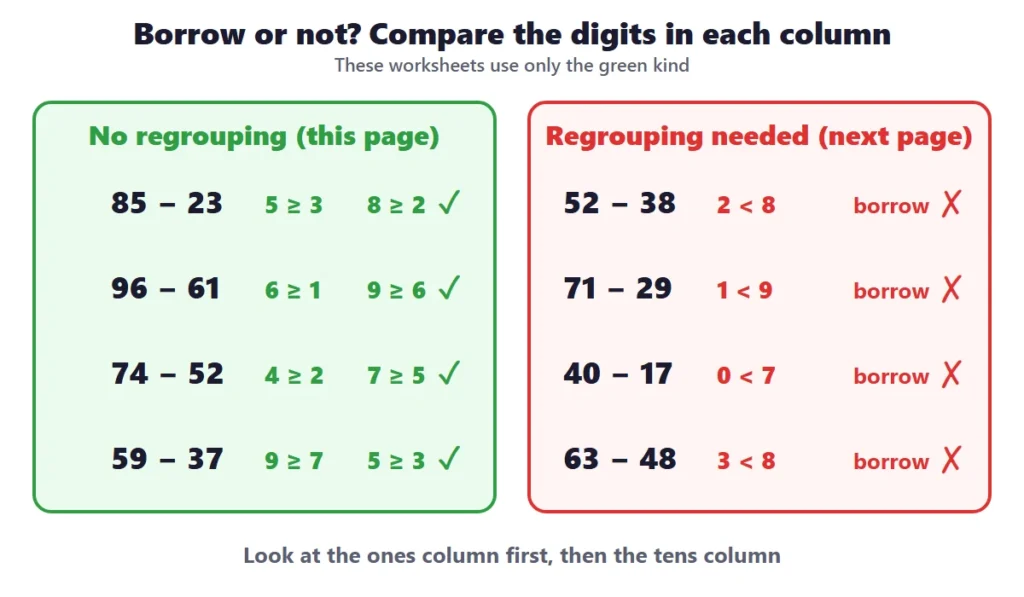
Among 2 digit subtraction worksheets, the ones on this page can be recognized by one test: look at the ones column, and check that the top digit is not less than the bottom digit. The tens column never causes a problem, because the top number is bigger. This table applies the test to eight problems, so children can sort them into those that belong here and those that need the next page:
Problem
Ones: top is not less than bottom?
Tens: top is not less than bottom?
Does it belong on this page?
85 − 23
5 and 3: yes
8 and 2: yes
yes
52 − 38
2 and 8: no
5 and 3: yes
no, it needs regrouping
96 − 61
6 and 1: yes
9 and 6: yes
yes
71 − 29
1 and 9: no
7 and 2: yes
no, it needs regrouping
47 − 5
7 and 5: yes
4 and 0: yes
yes
60 − 30
0 and 0: yes
6 and 3: yes
yes
83 − 36
3 and 6: no
8 and 3: yes
no, it needs regrouping
74 − 52
4 and 2: yes
7 and 5: yes
yes
The column method. Ones first, then tens.
Sorting problems before solving them is a quick, useful exercise. A child who can say “this one needs regrouping” is ready for the 2-digit subtraction with regrouping page, which uses the same layout with a borrowed ten.
Two digit subtraction: tens first or ones first?
Two digit subtraction can be done in either order, and children who can do both understand the idea better than those who know only the column method. Written across the page, as in the horizontal worksheet, the problem is easier to see as a take-away of tens and ones. This table shows both orders for five problems:
Problem
Ones first
Tens first
Answer
86 − 43
86 − 3 = 83, then 83 − 40 = 43
86 − 40 = 46, then 46 − 3 = 43
43
97 − 54
97 − 4 = 93, then 93 − 50 = 43
97 − 50 = 47, then 47 − 4 = 43
43
68 − 25
68 − 5 = 63, then 63 − 20 = 43
68 − 20 = 48, then 48 − 5 = 43
43
79 − 36
79 − 6 = 73, then 73 − 30 = 43
79 − 30 = 49, then 49 − 6 = 43
43
58 − 52
58 − 2 = 56, then 56 − 50 = 6
58 − 50 = 8, then 8 − 2 = 6
6
Both orders give the same answer, because 86 − 43 = 86 − 3 − 40 = 86 − 40 − 3. Teachers call this “partitioning” the second number. For mental math it is often quicker to take the tens first, since the tens give a bigger change and make an estimate: 86 − 40 is 46, so the answer is a little less.
Checking 2-digit subtraction without regrouping with addition
Every subtraction can be checked by adding the answer to the number taken away. If the sum is the starting number, the answer is right. This table checks six problems:
Problem
Answer
Add the answer to the number taken away
Gives the start?
86 − 43
43
43 + 43 = 86
yes
97 − 54
43
43 + 54 = 97
yes
68 − 25
43
43 + 25 = 68
yes
79 − 36
43
43 + 36 = 79
yes
58 − 52
6
6 + 52 = 58
yes
45 − 3
42
42 + 3 = 45
yes
This check uses the fact families on the fact families and missing numbers page: 43 + 43 = 86 means that 86 − 43 = 43. It is quick, because the addition has no regrouping either. Ask children to check at least one problem on each worksheet.
Common mistakes with 2-digit subtraction without regrouping
Even without borrowing, there are a few mistakes that come up often. This table lists five of them, with what went wrong and the fix:
What the child writes
What went wrong
The fix
86 − 43 = 4
writes only the tens answer and forgets the ones
estimate first: 86 − 43 is about 80 − 40 = 40, so a 1-digit answer is too small
45 − 3 = 15
writes the 3 under the tens digit instead of the ones digit
line up ones under ones: 5 − 3 = 2 and the 4 tens stay, so 42
97 − 54 = 3
stops after the ones column and forgets the tens
finish both columns: 7 − 4 = 3 and 9 − 5 = 4 give 43
68 − 25 = 83
adds the tens (6 + 2 = 8) instead of subtracting them
circle the minus sign and read it as “take away” in each column
70 − 30 = 4
subtracts the tens (7 − 3 = 4) and leaves out the 0 in the ones place
the 0 in the ones column must be written: 70 − 30 = 40
2-digit subtraction without regrouping word problems
Subtracting without regrouping shows up whenever a group is split. Ask children to write the subtraction, to solve it in columns and to check by adding:
Word problem
Working
Answer
There are 86 children at a school fair and 43 are girls. How many are boys?
86 − 43
43 boys
A farmer has 97 eggs and sells 54. How many are left?
97 − 54
43 eggs
Ravi has 68 stickers and gives away 25. How many stickers does he keep?
68 − 25
43 stickers
A bus has 79 seats and 36 are taken. How many seats are free?
79 − 36
43 seats
A baker has 58 rolls. He sells 52. How many are left?
58 − 52
6 rolls
There are 45 pages in a book and Mia has read 3. How many pages are left?
45 − 3
42 pages
Games and activities for 2-digit subtraction without regrouping
Children learn 2-digit subtraction without regrouping best when they play with it. These games use things that are found at home or in a classroom:
Trade tens and ones: build 86 with rods and cubes, take away 4 rods and 3 cubes, and read the answer
Caterpillar race: two children solve the 12 problems along the caterpillar, and the first to finish checks the other’s answers
Match-up cards: match 10 problems to their differences, and sort them by the tens digit of the answer
Dice subtraction: roll four dice to make two 2-digit numbers, and subtract only if the ones digit on top is big enough, otherwise roll again
The riddle: solve the problems and use the answers to decode a riddle
Beat the 43: find as many pairs of 2-digit numbers as you can with a difference of 43
Extra support and extra challenge with 2-digit subtraction without regrouping
For children who need more support: build the number with rods and cubes first, and take away the second number from the pile. Use the grid paper sheet, so that every digit has its own box and the ones stay under the ones. Start with the sheet that takes a 1-digit number from a 2-digit number, then move to the 2-digit sets. Say each column aloud: “6 take away 3 is 3”.
For children who need more challenge: ask for the missing digit in 8☐ − 43 = 41, for two numbers with a difference of 25 and no borrowing, or for the most and the fewest answers there can be for 2-digit numbers with the same tens digit. Try 3-digit numbers with no borrowing, such as 675 − 243, to see that the steps are the same.
How to tell that a child is ready to move on from 2-digit subtraction without regrouping
Before moving on from 2-digit subtraction without regrouping, check that the child can do all four of these things:
Borrow or not?. Compare each column.
The child can say which digits are the tens and which are the ones.
The child subtracts the ones column first and writes the answer under the ones.
The child gets the same answer when the problem is written across the page.
The child checks an answer by adding it to the number taken away.
When all four are true, 2-digit subtraction without regrouping is secure, so move on to the 2-digit subtraction with regrouping page, where the ones digit on top can be smaller.
A 20-minute lesson on 2-digit subtraction without regrouping
A short lesson is the best way to introduce 2-digit subtraction without regrouping. This 20-minute plan can be used in a classroom, at a tutoring session or at home, and it uses the worksheets at the end:
Minutes
Activity
What to say or ask
0 to 4
Show 86 with 8 rods and 6 cubes and ask for 86 − 43
How many rods and cubes do we take away?
4 to 8
Cross out 4 rods and 3 cubes, and say what is left
What number is 4 rods and 3 cubes?
8 to 12
Write 86 − 43 in columns, and subtract the ones first
Is the top digit big enough in each column?
12 to 17
Solve three problems with a partner, and check by adding
Does 43 + 43 give 86?
17 to 20
Start a worksheet and check one answer
Which column did you do first?
Where 2-digit subtraction without regrouping fits across the grades
No skill stands alone. This table shows what children learn before and after 2-digit subtraction without regrouping, with the standard that goes with each step:
This page is the first step in the written method. The whole sequence is on the subtraction worksheets page.
Helping at home with 2-digit subtraction without regrouping
Parents do not need to be experts to help with 2-digit subtraction without regrouping. These suggestions work well, and each takes only a few minutes:
Use coins: a child with 8 dimes and 6 pennies gives you 4 dimes and 3 pennies, and counts what is left.
Ask “which column first?” before each problem.
Check each answer by adding it back.
Use graph paper, so each digit has a box and the ones stay under the ones.
Praise the check as much as the answer.
How to check progress in 2-digit subtraction without regrouping
A teacher or parent can check progress in 2-digit subtraction without regrouping with the answer key and a few questions. This table shows three common situations, what they mean and what to do next:
A five-day plan for 2-digit subtraction without regrouping
Most children need about a week of short sessions for 2-digit subtraction without regrouping. This plan follows the order of the worksheets on this page:
Day
What to do
Practice
Day 1
Review tens and ones, and subtract multiples of 10
How do you do 2-digit subtraction without regrouping?
Line up the ones under the ones and the tens under the tens. Subtract the ones, then subtract the tens, and write each answer below its column. No borrowing is needed because each top digit is at least as big as the digit below it.
How can I tell if a subtraction needs regrouping?
Look at the ones column. If the top digit is smaller than the bottom digit, as in the 2 and the 8 in 52 − 38, the problem needs regrouping. If it is not smaller, the problem can be done without regrouping.
How long does it take to learn 2-digit subtraction without regrouping?
Most children need about a week of short sessions for 2-digit subtraction without regrouping, if they already know the facts within 10. The sheets on this page go from columns to grid paper and games, so a child can practice for as long as they need.