Change the numbers, layout and number of problems, then download a new PDF with its answer key.
Subtraction within 20 covers every fact that starts at 20 or less and takes away a number up to 10, and its hardest part is the teen facts such as 13 − 7 or 16 − 9, where the ones digit on top is smaller than the number taken away.
Quick answer: Subtraction within 20 means subtracting from numbers up to 20, such as 15 – 8 = 7. This page has 11 free printable subtraction within 20 worksheets with answer keys for grades 1 and 2. Updated October 2026.
About these subtraction within 20 worksheets
These worksheets cover every subtraction fact that starts at 20 or less and takes away a number up to 10. The hardest of them are the “teen” facts such as 13 − 7 or 16 − 9, where the ones digit on top is smaller than the number taken away. Children in the US are expected to subtract within 20 using strategies in grade 1 and fluently by the end of grade 2.
Strategies for teen facts
Back to 10: 14 − 6 is 14 − 4 − 2, which is 10 − 2 = 8. The double ten frame sheets show this.
Think addition: for 15 − 8, ask “8 plus what makes 15?” The answer, 7, is the difference.
Take away 10: 17 − 10 = 7, and 17 − 9 is one more, 8.
Doubles: 16 − 8 = 8 because 8 + 8 = 16.
Using the worksheets
Start with double ten frames and number lines so children see the numbers.
Move to fact practice, then the “Teen Subtraction Facts” page for the tricky ones.
Use the mystery picture, riddle, match-up cards and bingo for review.
Finish with story problems that compare, take away and find a missing part.
Subtraction within 20 worksheets: what is in the set
There are 11 subtraction within 20 worksheets on this page, and every one has an answer key except for any cut-out games. The sheets go from double ten frames and number lines to facts in columns and across the page, then teen facts, games and story problems.
Worksheet
What children do
Standard
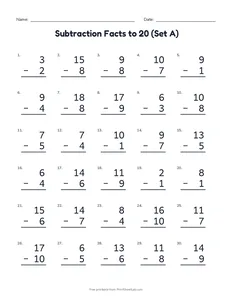
Subtraction Facts to 20 (Set A)
30 vertical facts starting at 20 or less.
1.OA.C.6
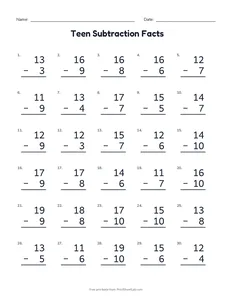
Teen Subtraction Facts
30 facts that start from 11 to 20, like 14 − 6.
1.OA.C.6
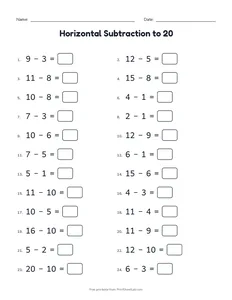
Horizontal Subtraction to 20
24 facts written across the page.
1.OA.C.6
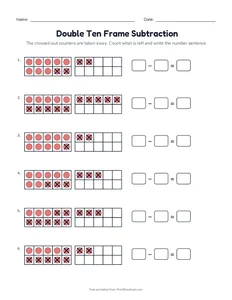
Double Ten Frame Subtraction
Numbers from 11 to 20 in two ten frames, with the take-away part crossed out.
1.OA.C.6
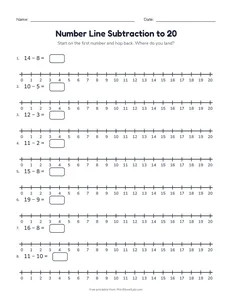
Number Line Subtraction to 20
Hop back on a number line from 0 to 20.
1.OA.C.6
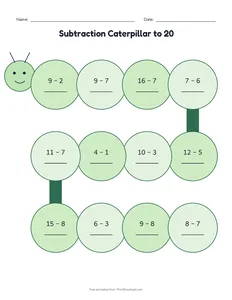
Subtraction Caterpillar to 20
Solve 12 facts along the caterpillar.
1.OA.C.6
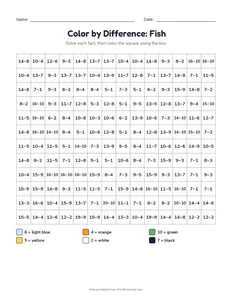
Color by Difference: Fish
Solve the facts and color by the key to reveal a fish.
1.OA.C.6
Subtraction Riddle to 20
Solve the facts to decode a riddle answer.
1.OA.C.6
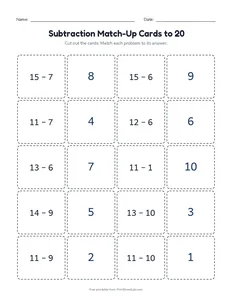
Subtraction Match-Up Cards to 20
Match 10 teen facts to their differences.
1.OA.C.6
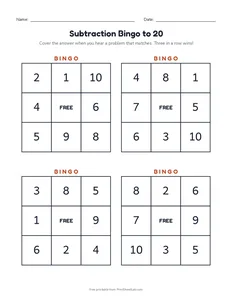
Subtraction Bingo to 20
Bingo boards and calling cards within 20.
1.OA.C.6
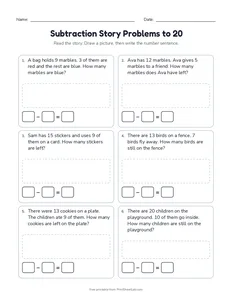
Subtraction Story Problems to 20
Six take-away, compare and missing-part stories.
1.OA.C.6
Subtraction within 20 worksheets: the facts, counted
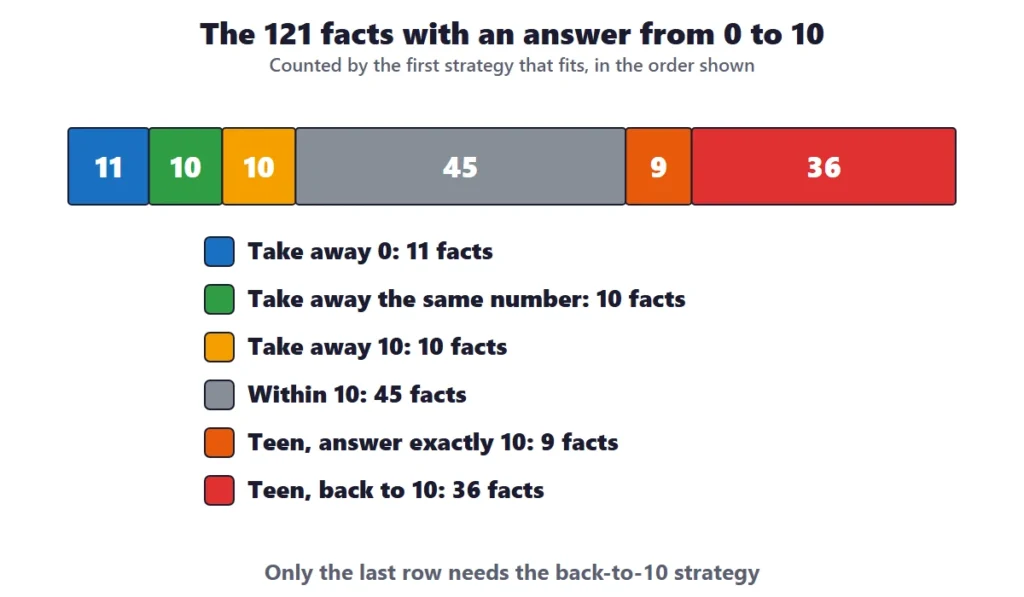
The subtraction within 20 worksheets use the 121 facts where the number taken away and the answer are both from 0 to 10. That is one subtraction for every addition fact from 0 + 0 to 10 + 10. They look like a big number, but most are not new. This table sorts the 121 facts by the first strategy that fits, in the order shown:
First strategy that fits
Facts
Share of the 121
Example
Take away 0
11
9%
15 − 0 = 15
Take away the same number
10
8%
9 − 9 = 0
Take away 10
10
8%
17 − 10 = 7
Within 10
45
37%
9 − 4 = 5
Teen, answer exactly 10
9
7%
17 − 7 = 10
Teen, back to 10
36
30%
15 − 8 = 7
All
121
100%
The first three rows are easy, and the 45 facts that start at 10 or less and take away a different number are the facts that children already know from subtraction within 10. The picture above shows the same counts as a bar. Only 9 facts give an answer of exactly 10, such as 17 − 7, and 36 facts, the last row, cross ten and need the back-to-10 strategy.
Teen subtraction facts: where back to 10 is needed
The teen subtraction facts are those that start with a number from 11 to 20. A teen fact needs “back to 10” when the number taken away is bigger than the ones digit of the start, so the subtraction goes across ten. The first step takes away the ones digit to land on 10, and the second step takes away the rest. This table counts the back-to-10 facts for each starting number, with an example for each:
Start
Ones digit
Back-to-10 facts
Example
Steps
11
1
8
11 − 9
11 − 1 = 10, then 10 − 8 = 2
12
2
7
12 − 9
12 − 2 = 10, then 10 − 7 = 3
13
3
6
13 − 9
13 − 3 = 10, then 10 − 6 = 4
14
4
5
14 − 9
14 − 4 = 10, then 10 − 5 = 5
15
5
4
15 − 9
15 − 5 = 10, then 10 − 4 = 6
16
6
3
16 − 9
16 − 6 = 10, then 10 − 3 = 7
17
7
2
17 − 9
17 − 7 = 10, then 10 − 2 = 8
18
8
1
18 − 9
18 − 8 = 10, then 10 − 1 = 9
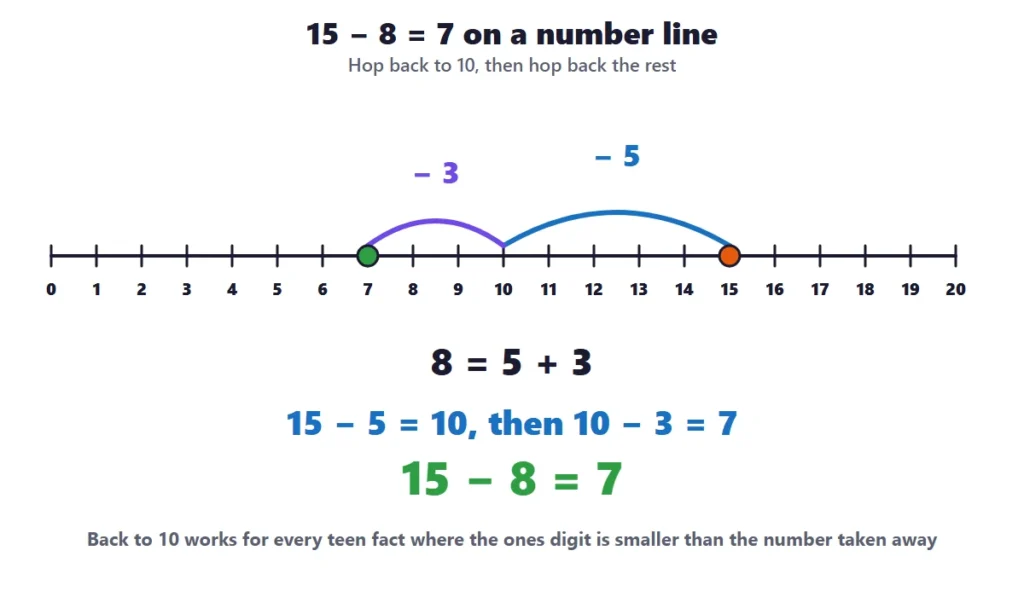
The lower the start, the more back-to-10 facts there are: eight for 11, seven for 12, and so on down to one for 18. There are none for 19 or 20: the only facts that start there are 19 − 9, 19 − 10 and 20 − 10. The picture above shows 15 − 8 on a number line, where the hop of 5 lands on 10 and the hop of 3 lands on 7. The ten frame and the double ten frame sheets show the same steps with counters.
Subtraction facts to 20: strategies compared
There is more than one way to find each of the subtraction facts to 20, and children should try several. Going back to 10 uses the ten as a landmark. Thinking addition uses a fact that the child already knows. Taking away 10 and adding back is quick when the number taken away is 8 or 9. This table shows all three for six facts:
Fact
Back to 10
Think addition
Take away 10, add back
Answer
15 − 8
15 − 5 = 10, then 10 − 3 = 7
8 + ☐ = 15, so ☐ = 7
15 − 10 = 5, then + 2 = 7
7
14 − 6
14 − 4 = 10, then 10 − 2 = 8
6 + ☐ = 14, so ☐ = 8
14 − 10 = 4, then + 4 = 8
8
17 − 9
17 − 7 = 10, then 10 − 2 = 8
9 + ☐ = 17, so ☐ = 8
17 − 10 = 7, then + 1 = 8
8
16 − 8
16 − 6 = 10, then 10 − 2 = 8
8 + ☐ = 16, so ☐ = 8
16 − 10 = 6, then + 2 = 8
8
13 − 7
13 − 3 = 10, then 10 − 4 = 6
7 + ☐ = 13, so ☐ = 6
13 − 10 = 3, then + 3 = 6
6
12 − 5
12 − 2 = 10, then 10 − 3 = 7
5 + ☐ = 12, so ☐ = 7
12 − 10 = 2, then + 5 = 7
7
All three always work for teen facts, so the best choice is the one that the child finds easiest. The addition within 20 and making 10 pages build the facts that the second and the first methods use, and the standard 1.OA.C.6 names “making ten” and “decomposing a number leading to a ten” as strategies.
Teen subtraction facts and doubles
Doubles help with the teen subtraction facts in the same way that they help with addition. If a child knows that 8 + 8 = 16, then 16 − 8 = 8 follows, and 15 − 8 and 17 − 8 are one fact away. This table counts the doubles and near doubles in the 121 facts:
Pattern
Facts
Examples
A double: the start is twice the number taken away
10
12 − 6 = 6, 16 − 8 = 8, 20 − 10 = 10
One more than a double
9
13 − 6 = 7, 15 − 7 = 8, 19 − 9 = 10
One less than a double
9
13 − 7 = 6, 15 − 8 = 7, 17 − 9 = 8
Doubles and near doubles together
28
nearly one fact in four
Number line hops. 15 − 8 = 7.
Nearly one fact in four is a double or a near double, so this is a useful strategy even though it does not cover everything. The fact families and missing numbers page shows why 16 − 8 = 8 is in the same family as 8 + 8 = 16.
First grade subtraction: how many new facts and how fast?
First grade subtraction is about learning facts and strategies, not about speed. Children already know the 66 facts within 10 from the page on subtraction within 10, so there are 55 new facts to learn. This table gives a three-week schedule that spreads the new facts across the weeks:
When
Facts to learn
New facts
Week 1
Take away 10, and teen facts with an answer of 10
19
Week 2
Back to 10 for starts of 11, 12 and 13
21
Week 3
Back to 10 for starts of 14 to 18
15
Total
new facts beyond the 66 within 10
55
That is about 18 new facts a week, or fewer than 4 a day, which is a sensible rate for a first-grade child. The standard 1.OA.C.6 asks children to be fluent within 10 by the end of grade 1 and to use strategies within 20. Fluency within 20 comes in grade 2 (2.OA.B.2), so there is time.
Subtraction worksheets grade 1: three kinds of story problem
The story problems on the subtraction worksheets grade 1 children meet come in three kinds, take away, compare and missing part, and children should meet all three. In a take-away story something is removed. In a compare story two amounts are set side by side and the difference is asked. In a missing-part story a total and one part are known. This table shows two of each kind:
Type
Problem
Number sentence
Answer
Take away
Ravi has 15 stickers and gives 8 away. How many does he have left?
15 − 8
7 stickers
Compare
Mia has 14 marbles and Sam has 6. How many more does Mia have?
14 − 6
8 more
Missing part
There are 17 apples. 9 are red and the rest are green. How many are green?
17 − 9 or 9 + ☐ = 17
8 green apples
Take away
There are 16 children on the bus. 8 get off. How many are on the bus now?
16 − 8
8 children
Compare
A cat is 13 inches tall and a dog is 7 inches tall. How much taller is the cat?
13 − 7
6 inches taller
Missing part
A book has 12 pages. Lin has read 5. How many pages are left?
12 − 5 or 5 + ☐ = 12
7 pages
The same subtraction answers all three, but the stories sound different, so children need to see that 14 − 6 means “how many more” as well as “how many are left”. The addition and subtraction word problems page has more of these stories, and the fact families and missing numbers page shows why missing-part stories can be solved by adding.
Common mistakes with subtraction within 20
Most mistakes come from the teen facts. This table shows five mistakes, what went wrong and the fix:
What the child writes
What went wrong
The fix
15 − 8 = 8
counts back from 15 and loses count of the hops
break the 8 into 5 and 3: 15 − 5 = 10, then 10 − 3 = 7
13 − 7 = 20
adds the numbers instead of subtracting
circle the minus sign, and check by adding: 6 + 7 = 13
14 − 6 = 12
turns the problem around and takes 4 from 6 to get 2 in the ones place, then keeps the 1 ten
think back to 10: 14 − 4 = 10, then 10 − 2 = 8
16 − 9 = 3
takes the ones digit 6 from 9 to get 3
ask whether the answer is smaller than 16 by a lot: take away 10 and add 1 back: 16 − 10 = 6, then 6 + 1 = 7
11 − 10 = 10
does not see that 10 is a ten
take away a whole ten, which leaves 1
Subtraction within 20 word problems
Teen numbers come up in counts of stickers, marbles and pages. Ask children to say which kind of story it is, to write the number sentence and to solve it:
Word problem
Working
Answer
Ravi has 15 stickers and gives 8 away. How many does he have left?
15 − 8
7 stickers
Mia has 14 marbles and Sam has 6. How many more does Mia have?
14 − 6
8 more
There are 17 apples. 9 are red and the rest are green. How many are green?
17 − 9 or 9 + ☐ = 17
8 green apples
There are 16 children on the bus. 8 get off. How many are on the bus now?
16 − 8
8 children
A cat is 13 inches tall and a dog is 7 inches tall. How much taller is the cat?
13 − 7
6 inches taller
A book has 12 pages. Lin has read 5. How many pages are left?
12 − 5 or 5 + ☐ = 12
7 pages
Games and activities for subtraction within 20
Children learn subtraction within 20 best when they play with it. These games use things that are found at home or in a classroom:
Back to ten: show 14 in two ten frames, cross out 4 to reach 10, then cross out the rest
Teen bingo: call a teen fact, and children mark its answer on their board
Fact war: each player turns over a number card from 11 to 20 and a card from 1 to 9, and subtracts; the bigger answer wins
Number line hop: draw a number line from 0 to 20 on the floor and hop back to 10, then back the rest
Color by difference: solve each fact and color by the key to reveal a fish
Match-up cards: match 10 teen facts to their differences
Extra support and extra challenge with subtraction within 20
For children who need more support: use two ten frames and counters, and cross out the counters to show each fact. Always go back to 10 first, and say the two steps aloud. Practice the bonds to 10 until they are quick. Use the number line sheet beside the frames, so that the hops match the crossed-out counters.
For children who need more challenge: ask for all the facts with an answer of 7 (there are 11), for a missing number in 16 − ☐ = 9, and for two different ways to find 17 − 9. Move on to 2-digit subtraction and to the facts within 100.
How to tell that a child is ready to move on from subtraction within 20
Before moving on from subtraction within 20, check that the child can do all four of these things:
The 121 facts. Counted by strategy.
The child knows the subtraction facts within 10 without counting.
The child goes back to 10 to solve a teen fact, and says both steps.
The child can solve a teen fact in a second way and compare the answers.
The child can solve take-away, compare and missing-part stories.
A short lesson is the best way to introduce subtraction within 20. This 20-minute plan can be used in a classroom, at a tutoring session or at home, and it uses the worksheets at the end:
Minutes
Activity
What to say or ask
0 to 4
Show 14 in two ten frames and ask for 14 − 6
How many do we take from the ones first?
4 to 9
Cross out 4 to reach 10, then cross out 2 more
What is left in the full frame?
9 to 14
Show the same hops on a number line
Where do we land first?
14 to 18
Check by adding: 8 + 6
Do we get 14?
18 to 20
Start a worksheet and say one fact aloud
Which strategy did you use?
Where subtraction within 20 fits across the grades
No skill stands alone. This table shows what children learn before and after subtraction within 20, with the standard that goes with each step:
This page is the second page of the subtraction sequence. The whole sequence is on the subtraction worksheets page.
Helping at home with subtraction within 20
Parents do not need to be experts to help with subtraction within 20. These suggestions work well, and each takes only a few minutes:
Use a ten-egg carton and 14 buttons: fill it, then take away from the loose buttons first.
Ask “can you go back to 10?” for each teen fact.
Check each answer by adding it back.
Play a short fact game in the car.
Praise a child who finds a second way.
How to check progress in subtraction within 20
A teacher or parent can check progress in subtraction within 20 with the answer key and a few questions. This table shows three common situations, what they mean and what to do next:
What you see
What it means
What to do next
The child counts back one by one for teen facts
The back-to-10 idea is new
Use the double ten frame and say the two steps
The child answers 9 of 10 teen facts without counting
1st grade subtraction worksheets and first grade subtraction
This page is also searched as subtraction worksheets for grade 1, 1st grade subtraction worksheets, subtraction worksheets for 1st graders, subtraction worksheet 1st grade, subtraction worksheets for grade 1 pdf and free subtraction worksheets for grade 1. All of these are the free PDFs above, each with an answer key on the last page. The subtraction hub has the 2nd grade two-digit sets.
Frequently asked questions
8 quick answers
How many subtraction facts are there within 20?
If the number taken away and the answer are both from 0 to 10, there are 121 subtraction facts, one for every addition fact from 0 + 0 to 10 + 10.
What is a teen subtraction fact?
A fact that starts with a number from 11 to 19, such as 12 − 5. When the number taken away is bigger than the ones digit, children use strategies like “back to 10”.
Which grade learns subtraction within 20?
Grade 1 children subtract within 20 using strategies, and grade 2 children are expected to do it fluently using mental strategies.
Can I make more subtraction facts?
Yes. Use the maker further down this page to make new facts and choose how many problems you want.
How do you teach subtraction within 20?
Teach the strategies, not just the facts. Start with the double ten frame so that children can see the numbers, then teach going back to 10, thinking addition and taking away 10 and adding back. Keep the bonds to 10 sharp, since each strategy uses them.
How many subtraction facts are there within 20?
If the number taken away and the answer are both from 0 to 10, there are 121 facts. 66 of them are within 10, and 55 are teen facts or take away 10. Only 36 of the teen facts cross ten.
How long does it take to learn subtraction within 20?
Most children need about a month of short sessions for subtraction within 20, if the facts within 10 are secure. The sheets on this page go from double ten frames to plain facts and games, so a child can practice for as long as they need.
Where can I download free 1st grade subtraction worksheets?
Open any worksheet in the gallery above, choose US Letter or A4, then print or save the PDF. They are free and each has an answer key.