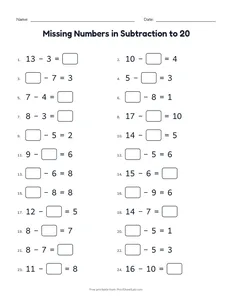
Change the numbers, layout and number of problems, then download a new PDF with its answer key.
Fact families and missing numbers go together: a fact family is a group of facts that use the same three numbers, and a missing-number problem asks which of the three is hidden. The six PDFs on this page have fact family triangles to 10 and to 20, number bonds to 20, missing numbers in subtraction to 10 and to 20, and missing addends to 20.
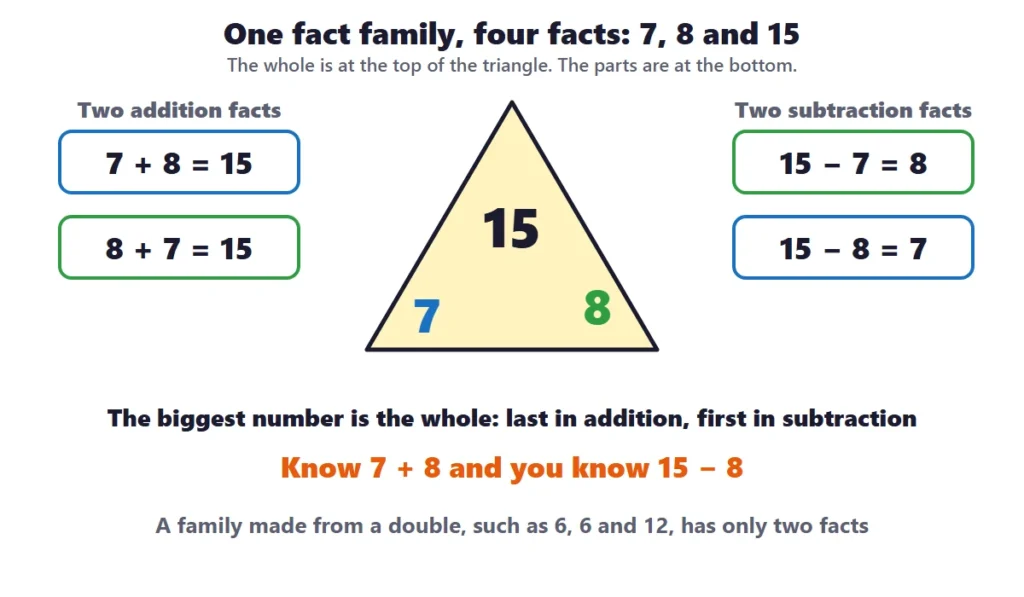
A fact family is a group of facts that use the same three numbers. The numbers 4, 6 and 10 make two addition facts and two subtraction facts:
4 + 6 = 10 and 6 + 4 = 10
10 − 6 = 4 and 10 − 4 = 6
Knowing one fact means knowing the whole family. That is the main reason fact families matter: a child who knows 7 + 8 = 15 can solve 15 − 8 without counting.
What is on these worksheets
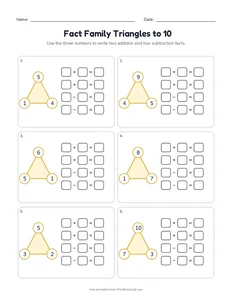
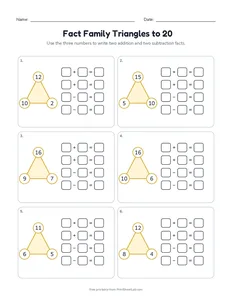
Fact family triangles: the whole sits at the top and the two parts at the bottom corners. Children write all four facts beside each triangle.
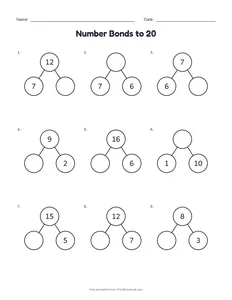
Number bonds: find the missing part or whole.
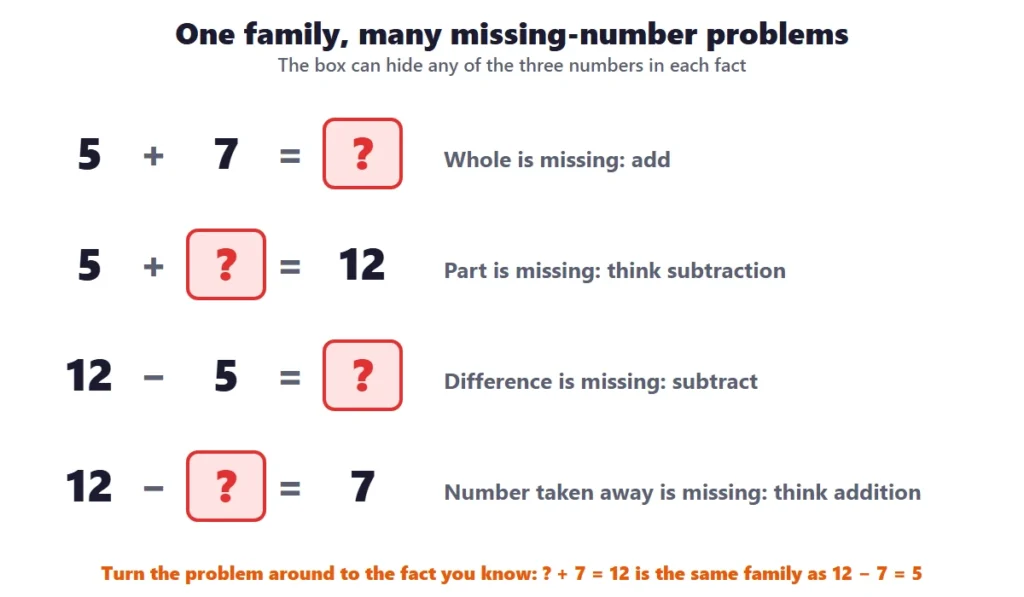
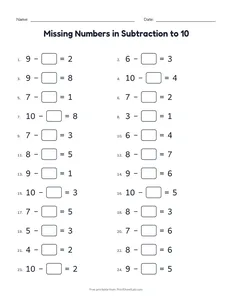
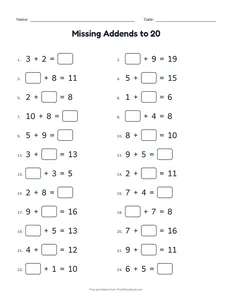
Missing numbers: problems like 13 − ☐ = 6 or ☐ + 5 = 12, where children use the related fact to find the unknown.
Teaching tips
Point out that the biggest number is always the whole: it comes last in addition and first in subtraction.
For a missing number in subtraction, turn it around: 13 − ☐ = 6 becomes 6 + ☐ = 13.
Doubles such as 5 + 5 = 10 only make two facts, so the triangles on these sheets always use two different parts.
Fact families and missing numbers worksheets: what is in the set
There are 6 fact families and missing numbers worksheets on this page, and every one has an answer key except for any cut-out games. Two sheets of triangles, one of bonds, and three of missing numbers make a path from writing the four facts to finding a box that can be anywhere.
Worksheet
What children do
Standard
Fact Family Triangles to 10
Six triangles: write two addition and two subtraction facts for each.
1.OA.B.4
Fact Family Triangles to 20
Six fact families with wholes from 11 to 20.
1.OA.B.4
Number Bonds to 20
Find the missing part or whole in each bond.
1.OA.B.4
Missing Numbers in Subtraction to 10
Find the number taken away: 9 − ☐ = 4.
1.OA.B.4
Missing Addends to 20
Find the missing part: 8 + ☐ = 13 or ☐ + 6 = 11.
1.OA.B.4
Missing Numbers in Subtraction to 20
The box can be anywhere: ☐ − 7 = 8, 15 − ☐ = 9.
1.OA.B.4
Fact families and missing numbers: how many families are there?
Fact families and missing numbers are easiest when children know how big the topic is. A family is made from a whole and two parts, so for every whole there is one family for each way of splitting it into two different parts, and one more if the whole is even (the double). This table lists the families for five wholes, with the smaller part first:
Each family has four facts, two additions and two subtractions, except for the double, which has two. The picture above shows the family for 7, 8 and 15. Counted over all the wholes, this is the whole of the work:
Wholes from 2 up to
Fact families
Of which doubles
Addition and subtraction facts in all
10
25
5
90
20
100
10
380
All the addition and subtraction facts within 20 come from just 100 families, and the facts within 10 from 25. A child who learns the family together does not need to learn 380 separate facts. The families with a part of 0 are left out, since they have only a trivial fact (0 + 7 = 7).
Fact families addition and subtraction: how the triangle works
Fact families addition and subtraction can be shown in a triangle with the whole on top and the two parts at the bottom. The worksheets use this picture because it shows that the whole is special: it is the sum in the addition facts and the starting number in the subtraction facts. This table shows five triangles, to 10 and to 20, with the four facts, or two for a double:
Triangle (parts and whole)
Addition facts
Subtraction facts
3, 7 and 10
3 + 7 = 10 and 7 + 3 = 10
10 − 3 = 7 and 10 − 7 = 3
4, 5 and 9
4 + 5 = 9 and 5 + 4 = 9
9 − 4 = 5 and 9 − 5 = 4
6, 9 and 15
6 + 9 = 15 and 9 + 6 = 15
15 − 6 = 9 and 15 − 9 = 6
8, 8 and 16
8 + 8 = 16
16 − 8 = 8
7, 12 and 19
7 + 12 = 19 and 12 + 7 = 19
19 − 7 = 12 and 19 − 12 = 7
Fact family worksheets: the two triangle sheets
The fact family worksheets with triangles come in two levels. The first has six triangles with wholes up to 10, and the second has six with wholes from 11 to 20. Each triangle shows the three numbers, and children write two addition facts and two subtraction facts beside it. Together the two sheets give twelve families to practice.
When children write the facts, ask them to say the family aloud: “seven, eight, fifteen”. Then they can say any of the facts, and see that they all use the same three numbers. The addition worksheets and subtraction worksheets pages use the same facts in different orders.
Missing number subtraction worksheets: where the box can hide
The missing number subtraction worksheets put a box in a fact, and the box can be in three places. One fact family gives 12 different missing-number problems, since each of its four facts can hide one of three numbers. A double gives only 6. This table shows how the problems divide by the place of the box, and how to think about each one:
Where the box is
Example
Problems to 20
How to think
At the end: the answer
8 + 5 = ☐ or 13 − 5 = ☐
380
add or subtract as usual
In the middle: the second number
8 + ☐ = 13 or 13 − ☐ = 8
380
turn it around: 13 − 8, or count up from 8 to 13
At the start: the first number
☐ + 5 = 13 or ☐ − 5 = 8
380
use the other two numbers: 13 − 5, or 8 + 5
Counted over all the families, there are 270 different missing-number problems to 10 and 1,140 to 20. The table below shows how a family multiplies into problems:
Fact family
Number of different missing-number problems
5, 7 and 12 (two different parts)
12
6, 6 and 12 (a double)
6
All the families with wholes up to 10
270
All the families with wholes up to 20
1,140
The hardest of the three kinds is the box at the start of a subtraction, as in ☐ − 7 = 8, because the answer to the question is bigger than both of the numbers that can be seen. Children who think of the family 7, 8 and 15 see at once that the whole is the missing number. The subtraction within 10 and subtraction within 20 pages have the plain facts, and the same fact families are used for the missing numbers.
Missing addend worksheets: three ways to find the box
The missing addend worksheets ask for the part that goes with a given part to make a whole, as in 8 + ☐ = 13. A missing addend is just a subtraction in disguise, and children can find it in three ways. They can think addition (“what goes with 8 to make 13?”), count up from the first number, or subtract. This table shows the three ways for five problems:
Problem
Think addition
Count up
Subtract
Answer
8 + ☐ = 13
what goes with 8 to make 13?
8, then 2 + 3
13 − 8 = 5
5
6 + ☐ = 15
what goes with 6 to make 15?
6, then 4 + 5
15 − 6 = 9
9
9 + ☐ = 17
what goes with 9 to make 17?
9, then 1 + 7
17 − 9 = 8
8
7 + ☐ = 12
what goes with 7 to make 12?
7, then 3 + 2
12 − 7 = 5
5
5 + ☐ = 14
what goes with 5 to make 14?
5, then 5 + 4
14 − 5 = 9
9
Where the box can hide. Four missing-number problems.
The count-up way uses the make-ten idea: to go from 8 to 13, first go to 10 (2) and then to 13 (3), so the missing number is 2 + 3 = 5. This connects to the making 10 page and the ten frame tool. The standard 1.OA.B.4 describes this: children understand subtraction as an unknown-addend problem.
Related facts worksheets: number bonds to 20
The related facts worksheets use number bonds to show how the parts of a number fit together. A number bond to 20 shows a whole and its two parts, and it is another way to draw the same family. This table shows how many ways there are to split five numbers into two parts:
Number
Ways to split it in two parts (order matters)
Different splits (order does not matter)
Example
10
11
6
10 = 3 + 7
12
13
7
12 = 4 + 8
15
16
8
15 = 5 + 10
18
19
10
18 = 6 + 12
20
21
11
20 = 6 + 14
For 10 there are 11 ordered splits, from 0 + 10 to 10 + 0, and 6 splits if the order is ignored. For 20 there are 21 ordered splits and 11 unordered ones. The sheet of bonds to 20 asks for the missing part or whole, so the child must decide which of the three numbers is hidden and which fact family to use.
Common mistakes with fact families and missing numbers
Most mistakes come from not being sure which number is the whole. This table lists five of them, with what went wrong and the fix:
What the child writes
What went wrong
The fix
7 + 5 = 12 and 12 − 5 = 7, but writes 5 − 12 = 7
does not see that the whole must come first in a subtraction
the biggest number is the whole: it goes first in a subtraction and last in an addition
Writes 7 + 5 = 12 and 5 + 7 = 12 as one fact
thinks the order does not matter, so one family has only two facts
both are facts: they are different problems, and a family has four, unless the parts are equal
13 − ☐ = 6 solved as 13 + 6 = 19
adds the numbers that are there
ask which number is the whole: 13 is, so the missing part is 13 − 6 = 7
Triangle 8, 8 and 16 with four facts
makes four facts from a double
a double has only two facts: 8 + 8 = 16 and 16 − 8 = 8
☐ − 7 = 8 solved as 8 − 7 = 1
subtracts the two numbers that are shown
the box is the whole: it is bigger than both, so 8 + 7 = 15
Fact families and missing numbers word problems
Fact families come up in stories in which a group is split or joined. Ask children to say which number is the whole, to write a fact with a box, and to solve it:
Word problem
Working
Answer
Ana has 12 stickers. 5 are red and the rest are blue. How many are blue?
12 − 5 or 5 + ☐ = 12
7 blue stickers
There are 15 birds in a tree. Some fly away and 6 are left. How many flew away?
15 − ☐ = 6
9 birds
A box has some pens. Tom adds 8 and now there are 17. How many were there at first?
☐ + 8 = 17
9 pens
A class has 18 children. 9 are girls. How many are boys?
18 − 9
9 boys
Mia read 7 pages and then 6 more. How many pages did she read?
7 + 6 = ☐
13 pages
There are 14 cups on a table. 5 are blue and the rest are green. How many are green?
5 + ☐ = 14
9 green cups
Games and activities for fact families and missing numbers
Children learn fact families and missing numbers best when they play with it. These games use things that are found at home or in a classroom:
Triangle cards: make cards with the whole on top and ask a partner to say all four facts
Hide a number: write a fact on a card and cover one number with a cube; the partner says what is hidden
Family roll: roll two dice for the parts, add for the whole, and write the four facts
Bond snap: deal number bond cards and snap when two bonds make the same whole
Missing number hunt: hide cards with a missing number around the room and solve each one
Fix the family: a teacher writes a family with one wrong fact, and children find the mistake
Extra support and extra challenge with fact families and missing numbers
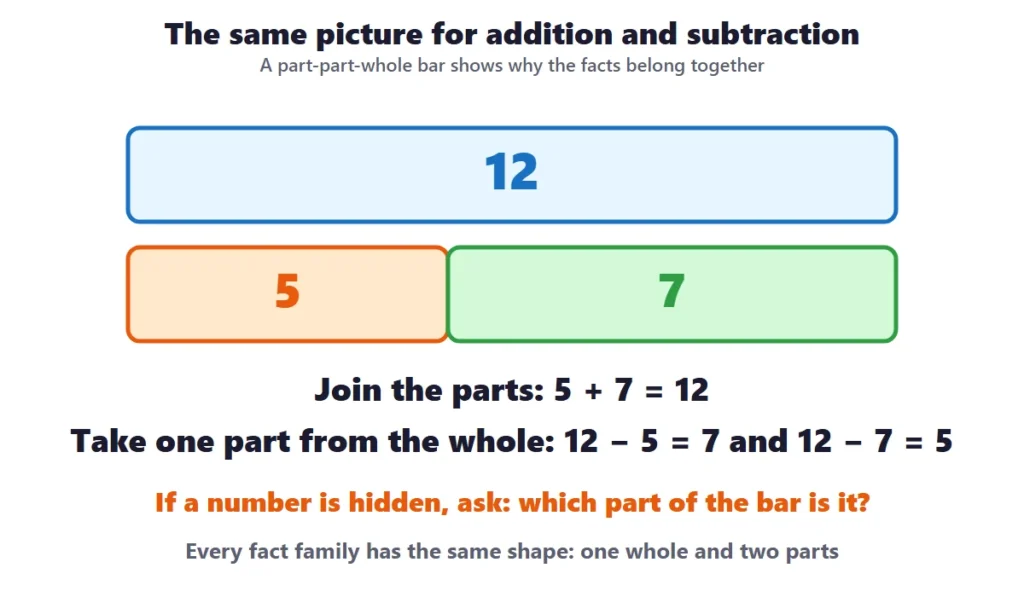
For children who need more support: use counters in two colors and a part-part-whole mat, and let the child slide the counters apart and together to see all four facts. Start with wholes up to 5, then up to 10. For missing numbers, cover one number with a cube and ask “which part of the mat is it?”.
For children who need more challenge: ask for all the families with a whole of 12 (there are six), for a missing number with the box in every place in one family, and for the number of facts in all the families with wholes up to 10 (90). Move on to missing numbers with 2-digit numbers, such as ☐ + 25 = 60.
How to tell that a child is ready to move on from fact families and missing numbers
Before moving on from fact families and missing numbers, check that the child can do all four of these things:
One bar, all the facts. 5, 7 and 12.
The child can name the whole and the parts in any three numbers that make a family.
The child writes all four facts of a family, or two for a double.
The child finds a missing number in any of the three places.
The child uses an addition fact to solve a subtraction with a box.
A 20-minute lesson on fact families and missing numbers
A short lesson is the best way to introduce fact families and missing numbers. This 20-minute plan can be used in a classroom, at a tutoring session or at home, and it uses the worksheets at the end:
Minutes
Activity
What to say or ask
0 to 4
Show 7 red and 8 blue counters, and ask how many in all
What is the whole? What are the parts?
4 to 9
Write 7 + 8 = 15 and ask for three more facts
Which number goes first in a subtraction?
9 to 14
Draw the triangle and write the four facts around it
Do all four facts use the same numbers?
14 to 18
Cover one number with a cube and find it, in each place
Which part of the triangle is it?
18 to 20
Start a worksheet and check one answer
What is the whole here?
Where fact families and missing numbers fits across the grades
No skill stands alone. This table shows what children learn before and after fact families and missing numbers, with the standard that goes with each step:
This page is the main page for fact families. The whole sequence is on the subtraction worksheets page.
Helping at home with fact families and missing numbers
Parents do not need to be experts to help with fact families and missing numbers. These suggestions work well, and each takes only a few minutes:
Use three numbers on cards, such as 4, 6 and 10, and ask for all the facts.
Ask “which one is the whole?” before every problem.
Cover a number in a fact with your finger and ask what is under it.
Use dominoes: the two sides are the parts and the total is the whole.
Praise a child who says a fact in a different order.
How to check progress in fact families and missing numbers
A teacher or parent can check progress in fact families and missing numbers with the answer key and a few questions. This table shows three common situations, what they mean and what to do next:
What you see
What it means
What to do next
The child writes only the two addition facts
Subtraction is not yet linked to addition
Point at the whole on the triangle and say it is the biggest number
Usually four: two addition facts and two subtraction facts. A family made from a double, such as 6, 6 and 12, has only two.
What grade learns fact families?
Grade 1. The Common Core standards ask children to understand subtraction as an unknown-addend problem (1.OA.B.4) and to find the unknown number in addition and subtraction equations (1.OA.D.8).
Are there multiplication fact families too?
Yes. Multiplication and division make fact families in the same way, such as 3 × 4 = 12 and 12 ÷ 4 = 3.
What are fact families and missing numbers?
A fact family is a group of addition and subtraction facts that use the same three numbers, such as 7 + 8 = 15, 8 + 7 = 15, 15 − 7 = 8 and 15 − 8 = 7. A missing number problem hides one of the numbers in a fact and asks the child to find it, using the rest of the family.
How many fact families are there within 20?
If the parts are at least 1, there are 100 fact families with a whole up to 20, and they give 380 addition and subtraction facts. Within 10 there are 25 families and 90 facts.
How long does it take to learn fact families and missing numbers?
Most children need about two weeks of short sessions for fact families and missing numbers, if they know their addition facts within 10. The sheets on this page go from triangles to missing numbers anywhere in a fact, so a child can practice for as long as they need.