Change the numbers, layout and number of problems, then download a new PDF with its answer key.
Subtraction within 10 means starting with 10 or fewer and taking some away, such as 8 − 3 = 5, and it is the first kind of subtraction that children meet. The 15 PDFs on this page go from crossed-out counters and ten frames to number lines, dominoes, dice and plain facts, with a riddle, bingo and story problems at the end, and every sheet has an answer key.
Quick answer: Subtraction within 10 means starting with 10 or fewer and taking some away, such as 9 – 4 = 5. This page has 15 free printable subtraction within 10 worksheets with answer keys for kindergarten and grade 1. Updated October 2026.
About these subtraction within 10 worksheets
Subtraction within 10 means starting with 10 or fewer and taking some away, such as 8 − 3 = 5. It is the first kind of subtraction children meet, usually in kindergarten, and the goal by the end of grade 1 is to know these facts quickly.
The worksheets on this page start with pictures and end with plain facts. On the counter and ten frame sheets some counters are already crossed out, so children can see what “take away” means before they work with numbers alone. Number lines show subtraction as hopping back, and dominoes and dice give quick practice with patterns children already know.
A good order to use them
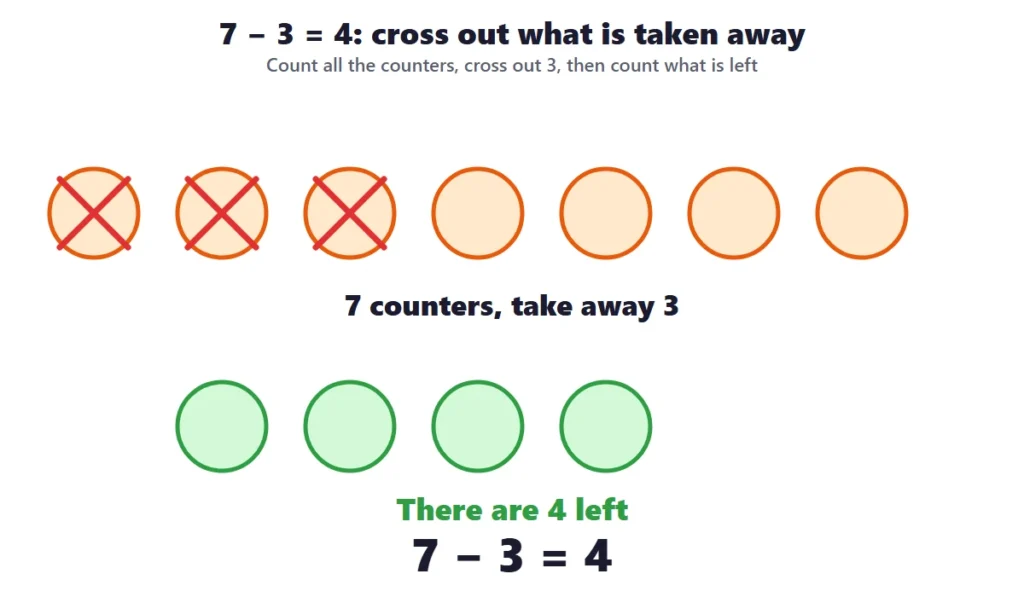
Cross-out counters and ten frames: count all, count what is crossed out, count what is left.
Dominoes and dice: take the smaller side away from the bigger side.
Number line: start on the first number and hop back.
Fact practice: vertical and horizontal facts, first untimed, then as a short daily warm-up.
Games: the caterpillar, color-by-difference pictures, riddle, match-up cards and bingo.
Story problems: children draw the story and write the number sentence.
Tips for teaching subtraction within 10
Act it out first: five crackers, eat two, how many are left?
Use the words “take away” and “minus” so children link the idea to the sign.
Show that subtraction undoes addition: 3 + 4 = 7, so 7 − 4 = 3. The fact family worksheets build this link.
Count back for small numbers (6 − 2: five, four) and count up when the numbers are close (9 − 7: eight, nine, so 2).
Subtraction within 10 worksheets: what is in the set
There are 15 subtraction within 10 worksheets on this page, and every one has an answer key except for any cut-out games. The sheets begin with pictures (counters, ten frames, dominoes and dice), move to number lines and plain facts, and end with games and story problems.
Worksheet
What children do
Standard
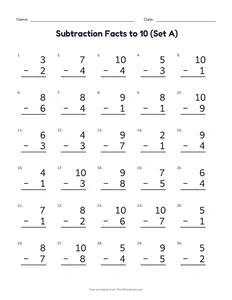
Subtraction Facts to 10 (Set A)
30 vertical subtraction facts starting at 10 or less.
K.OA.A.5
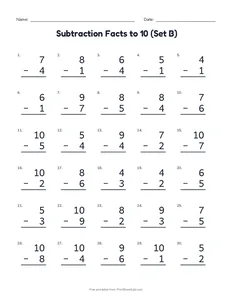
Subtraction Facts to 10 (Set B)
A second set of 30 facts within 10.
K.OA.A.5
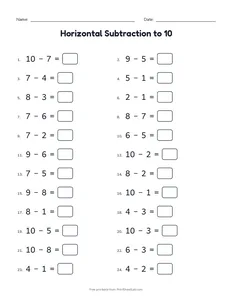
Horizontal Subtraction to 10
24 facts written across the page, like 9 − 4 = ☐.
K.OA.A.5
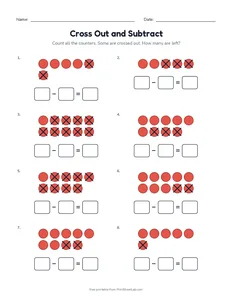
Cross Out and Subtract
Counters with some crossed out: count what is left and write the number sentence.
K.OA.A.5
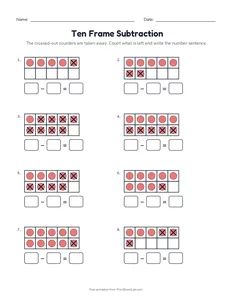
Ten Frame Subtraction
Counters in a ten frame with the take-away part crossed out.
K.OA.A.5
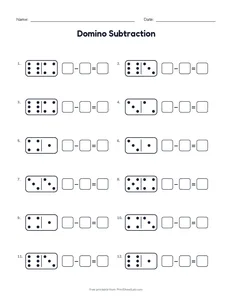
Domino Subtraction
Take the smaller side of each domino from the bigger side.
K.OA.A.5
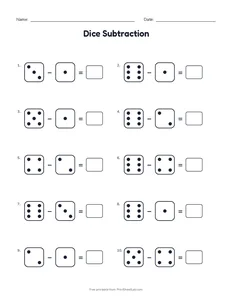
Dice Subtraction
Take the second die from the first and write the difference.
K.OA.A.5
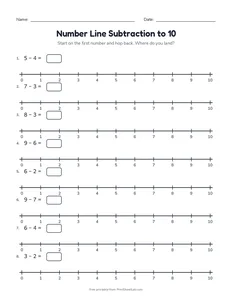
Number Line Subtraction to 10
Start on the first number and hop back on the number line.
K.OA.A.5
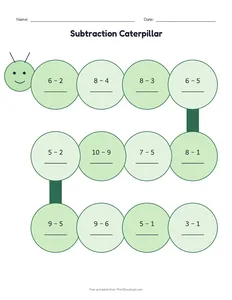
Subtraction Caterpillar
Solve 12 take-away facts along the caterpillar.
K.OA.A.5
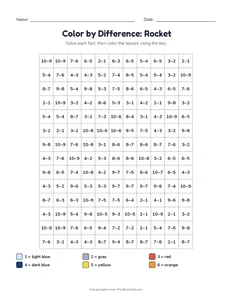
Color by Difference: Rocket
Solve each fact and color by the key to reveal a rocket.
K.OA.A.5
Color by Difference: Heart
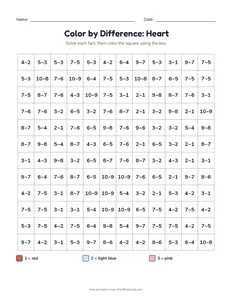
Solve each fact and color by the key to reveal a heart.
K.OA.A.5
Subtraction Riddle to 10
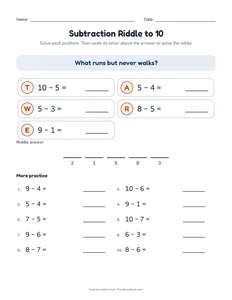
Solve the facts to decode the answer to a riddle.
K.OA.A.5
Subtraction Match-Up Cards
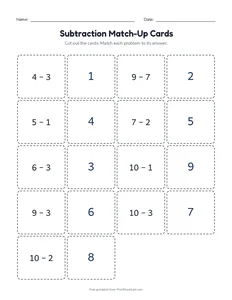
Cut out 18 cards and match each fact to its difference.
K.OA.A.5
Subtraction Bingo to 10
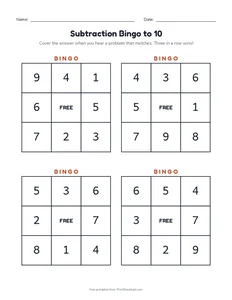
Eight bingo boards and calling cards within 10.
K.OA.A.5
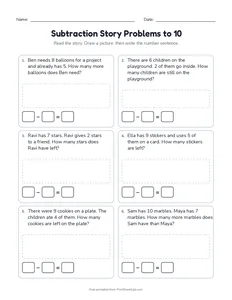
Subtraction Story Problems to 10
Six take-away and compare stories to draw and solve.
K.OA.A.5
Subtraction within 10 worksheets: all 66 facts
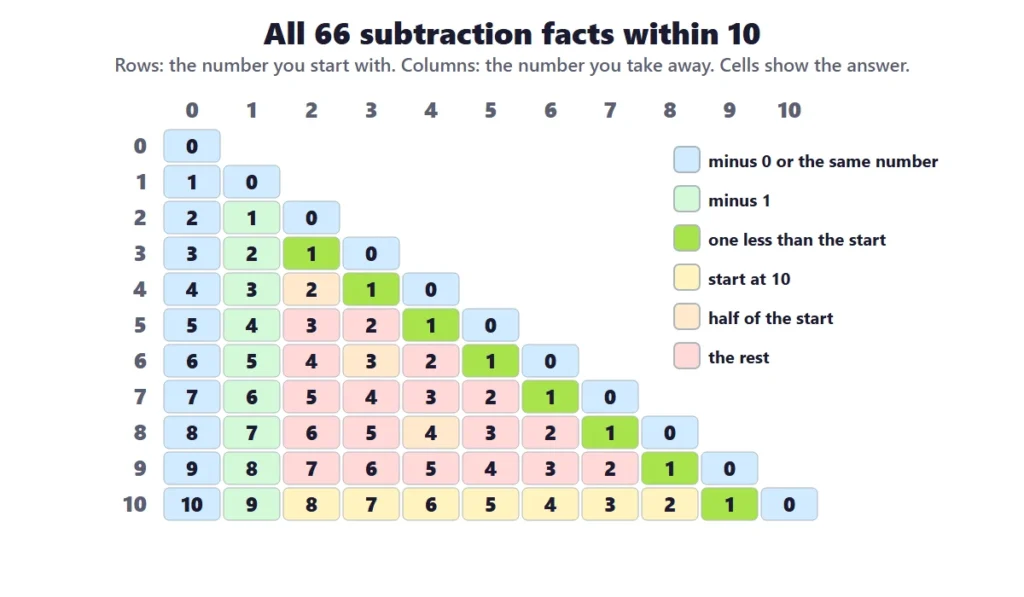
The subtraction within 10 worksheets cover every fact that starts at 10 or less and takes away a number that is not bigger than the start. There are 66 such facts, from 0 − 0 to 10 − 10. They are not all equally hard. Going down this list and stopping at the first strategy that fits, this table shows how many facts each strategy handles:
The first strategy that fits
Facts
Share of the 66
Examples
Take away 0, or take away the same number
11
17%
8 − 0 = 8, 6 − 6 = 0
Take away 1
9
14%
9 − 1 = 8
The answer is 1 (one less than the start)
8
12%
7 − 6 = 1
Start at 10 (not already counted)
7
11%
10 − 4 = 6, 10 − 7 = 3
Half of the start (a double)
3
5%
8 − 4 = 4, 6 − 3 = 3
The rest
18
27%
9 − 5 = 4, 8 − 3 = 5
All
66
100%
The picture above colors the whole grid by the same rule. Nearly a third of the facts, 11 of the 66, are taking away 0 or taking away the same number, and another 17 are taking away 1 or leaving 1. Only 18 facts, in the last row, need real work. A child who knows the first five rows, which is 48 facts, has only 18 left to practice.
Subtraction to 10 worksheets: counting back or counting up?
Children can solve the subtraction to 10 worksheets by counting back from the first number, or by counting up from the second number to the first. The answer is the number of hops either way. This table shows how many of the 66 facts can be solved in three hops or fewer in each way:
Strategy
Rule
Facts it solves in 3 hops or fewer
Share of the 66
Count back
the number taken away is 0, 1, 2 or 3
38
58%
Count up
the answer is 0, 1, 2 or 3
38
58%
Either of the two
both rules fit
16
24%
Count back or up
at least one rule fits
60
91%
Neither: use a ten frame, a double or a bond
the number taken away and the answer are both 4 or more
6
9%
Counting back or counting up solves 60 of the 66 facts in three hops or fewer, and only 6 facts need another way: 8 − 4, 9 − 4, 9 − 5, 10 − 4, 10 − 5 and 10 − 6. Those facts are a good use of the ten frame, a double (4 + 4 = 8) or a number bond to 10. The best choice depends on the size of the two numbers. This table shows six facts, with the number of hops for each way:
Fact
Hops counting back
Hops counting up
Quicker
Answer
7 − 3
3
4
count back
4
9 − 2
2
7
count back
7
10 − 6
6
4
count up
4
8 − 6
6
2
count up
2
9 − 7
7
2
count up
2
6 − 5
5
1
count up
1
For 9 − 7, counting back takes seven hops but counting up takes only two, so counting up is the better choice. The number line tool lets children try both. The rule to teach is simple: count back when the number taken away is small, and count up when the answer is small.
Kindergarten subtraction worksheets: how many facts is that?
Kindergarten subtraction worksheets are about meaning more than speed. The standard K.OA.A.5 asks children to fluently subtract within 5, which is 21 facts, and in grade 1 the standard 1.OA.C.6 asks them to be fluent within 10. This table shows how the number of facts grows:
Stage
Facts to know
New facts
Standard
Kindergarten: within 5
21
21
K.OA.A.5
Grade 1: within 10
66
45
1.OA.C.6
Grades 1 and 2: within 20 (answers 0 to 10)
121
55
1.OA.C.6 and 2.OA.B.2
Going from 5 to 10 more than triples the number of facts, from 21 to 66, so grade 1 children have 45 new facts to learn. The worksheets on this page start with pictures, so that children see what “take away” means before they work with numbers alone. Use the crossed-out counters and ten frames first, then the dominoes, dice and number lines, and use the plain fact sheets last.
Take away worksheets: dice and dominoes
Two of the take away worksheets use dice and dominoes: the child takes the smaller number from the bigger one and writes the difference. The differences are not equally likely. This table shows how often each difference comes up when two dice are rolled, and in a double-six domino set:
Difference
Two dice: ways out of 36
Chance
Double-six dominoes: tiles out of 28
Share
0
6
17%
7
25%
1
10
28%
6
21%
2
8
22%
5
18%
3
6
17%
4
14%
4
4
11%
3
11%
5
2
6%
2
7%
6
0
–
1
4%
Ten frame and number line. 10 − 6 = 4.
With two dice, a difference of 1 comes up in 10 of the 36 ways, about 28% of rolls, while a difference of 5 comes up only twice. A difference of 0 comes up in 6 ways, so about one roll in six is a double, and the answer is 0. In a double-six set there are 7 tiles with a difference of 0 (the doubles), 6 with a difference of 1 and only 1 with a difference of 6. Children can check this by sorting a set of dominoes by their difference.
Subtraction facts to 10: the link with addition
The subtraction facts to 10 are tied to the addition facts. Every subtraction from 10 is a number bond: 10 − 4 = 6 because 4 and 6 make 10. This table shows nine facts with their bonds, and the family each one belongs to:
Take away from 10
Answer
Same as the bond
Fact family
10 − 1
9
1 and 9 make 10
1 + 9 = 10
10 − 2
8
2 and 8 make 10
2 + 8 = 10
10 − 3
7
3 and 7 make 10
3 + 7 = 10
10 − 4
6
4 and 6 make 10
4 + 6 = 10
10 − 5
5
5 and 5 make 10
5 + 5 = 10
10 − 6
4
6 and 4 make 10
6 + 4 = 10
10 − 7
3
7 and 3 make 10
7 + 3 = 10
10 − 8
2
8 and 2 make 10
8 + 2 = 10
10 − 9
1
9 and 1 make 10
9 + 1 = 10
This is why the making 10 page and the fact families and missing numbers page are useful for subtraction. A child who knows that 4 + 6 = 10 also knows 10 − 4 = 6 and 10 − 6 = 4. The ten frame tool shows the same bonds with counters.
Common mistakes with subtraction within 10
Most mistakes come from counting rather than from the facts. This table shows five mistakes, what went wrong and the fix:
What the child writes or says
What went wrong
The fix
7 − 3 = 5
counts the starting number: “7, 6, 5”
say the first number, then count back three more: “6, 5, 4”
3 − 7 = 4
takes the smaller number from the bigger one
the number you start with comes first, and you cannot take 7 away from 3
6 − 6 = 6
thinks nothing is taken away
six take away six leaves none: 0
8 − 5 = 13
adds instead of subtracting
circle the minus sign and read it as “take away” or “minus”
9 − 0 = 0
thinks that taking away 0 leaves 0
take away nothing and all nine are left: 9
Subtraction within 10 word problems
Take-away stories are the first stories that children solve. Ask them to draw the story, to cross out what is taken away and to write the number sentence:
Word problem
Working
Answer
There are 8 birds on a wire and 3 fly away. How many are left?
8 − 3
5 birds
Ali has 10 stickers and gives 4 to a friend. How many does he have now?
10 − 4
6 stickers
A plate has 7 cookies. Mia eats 2. How many are left?
7 − 2
5 cookies
There are 9 red balloons and 6 blue balloons. How many more red balloons are there?
9 − 6
3 more
A box has 10 crayons and 3 are broken. How many are not broken?
10 − 3
7 crayons
There are 6 frogs on a log. 6 jump into the pond. How many are left?
6 − 6
0 frogs
Games and activities for subtraction within 10
Children learn subtraction within 10 best when they play with it. These games use things that are found at home or in a classroom:
Cross out the cookies: draw 9 cookies, eat 4, and write the number sentence
Snap the bond: children hold up fingers to show 10, fold some down, and say how many are up
Domino difference: each child turns over a domino and takes the smaller side from the bigger side
Dice difference: roll two dice and score the difference; the first to 20 wins
Color by difference: solve each fact and color by the key to reveal a rocket or a heart
Subtraction bingo: call a fact, and children mark its answer on their board
Extra support and extra challenge with subtraction within 10
For children who need more support: act out each fact with real objects, such as cubes or snacks, before using pictures or numbers. Use the ten frame sheets and say the whole story: “seven counters, three are crossed out, four are left”. Stay within 5 until the facts are quick, then go to 10. Do not use timed practice until the facts are secure.
For children who need more challenge: ask for all the subtraction facts with an answer of 3 (there are 8), for a missing number in 10 − ☐ = 4, and for the facts that can be solved neither by counting back nor by counting up in three hops (there are six). Move on to subtraction within 20.
How to tell that a child is ready to move on from subtraction within 10
Before moving on from subtraction within 10, check that the child can do all four of these things:
All 66 facts. Colored by strategy.
The child can act out and draw a take-away story.
The child knows the facts that take away 0, 1 or the same number without counting.
The child can count back or up to find a difference.
The child knows the number bonds to 10 and uses them to subtract from 10.
A short lesson is the best way to introduce subtraction within 10. This 20-minute plan can be used in a classroom, at a tutoring session or at home, and it uses the worksheets at the end:
Minutes
Activity
What to say or ask
0 to 3
Act out: 7 cubes, 3 are taken away
How many are left?
3 to 8
Draw 7 counters and cross out 3, and write the sentence
What does the minus sign mean?
8 to 12
Show the same fact on a number line, hopping back
Where do we start?
12 to 17
Play dice difference in pairs
Which is bigger, and by how much?
17 to 20
Start a worksheet and say one fact aloud
Can you tell me the story?
Where subtraction within 10 fits across the grades
No skill stands alone. This table shows what children learn before and after subtraction within 10, with the standard that goes with each step:
Grade
What children do
Standard or page
Kindergarten
Subtract within 5 fluently
K.OA.A.5, this page
Grade 1
Subtract within 10 fluently
1.OA.C.6, this page
Grade 1
Understand subtraction as an unknown-addend problem
This page is the first page of the subtraction sequence. The whole sequence is on the subtraction worksheets page.
Helping at home with subtraction within 10
Parents do not need to be experts to help with subtraction within 10. These suggestions work well, and each takes only a few minutes:
Use snacks: five crackers, eat two, how many are left?
Say “take away” and “minus” so children link the words to the sign.
Count the hops on a number line drawn with chalk outside.
Play “How many are hiding?” with 10 coins in two hands.
Keep sessions short, and stop while the child still enjoys them.
How to check progress in subtraction within 10
A teacher or parent can check progress in subtraction within 10 with the answer key and a few questions. This table shows three common situations, what they mean and what to do next:
Subtraction for kindergarten: worksheets and practice
This page is also searched as subtraction for kindergarten, subtraction kindergarten, a subtraction worksheet kindergarten, subtraction kindergarten worksheet pages, free subtraction worksheets for kindergarten and kindergarten subtraction worksheets pdf. All of these are the free PDFs above, with an answer key. Free printable subtraction worksheets for kindergarten and easy subtraction worksheets for kindergarten use pictures, so a child can cross out objects and count what is left. Subtraction worksheets for kindergarten pdf and subtraction worksheets kindergarten pdf downloads are free, with no sign-up.
Frequently asked questions
8 quick answers
What does subtraction within 10 mean?
It means subtracting when the starting number is 10 or less, for example 9 − 4 = 5. The answer is never below zero.
When do children learn subtraction within 10?
Kindergarten children take away within 10 using objects and drawings, and are expected to subtract within 5 fluently. In grade 1 they become fluent subtracting within 10.
Why are some counters crossed out?
The crossed-out counters are the ones taken away. Children count all the counters, then the ones left, and write the number sentence.
Do these worksheets have answer keys?
Yes. Every worksheet except the cut-out games has an answer key on the last page of the PDF.
How many subtraction facts are there within 10?
If the number taken away is not bigger than the number you start with, there are 66 subtraction facts within 10, from 0 − 0 to 10 − 10. There are 21 of them within 5.
Should children count back or count up?
Count back when the number taken away is small (0 to 3), and count up when the answer is small. For 9 − 7, counting up takes two hops and counting back takes seven.
How long does it take to learn subtraction within 10?
Most children need several weeks of short sessions for subtraction within 10, since there are 66 facts. The sheets on this page start with pictures and end with plain facts and games, so a child can practice for as long as they need.
Where can I download free kindergarten subtraction worksheets?
Open any worksheet in the gallery above, choose US Letter or A4, then print or save the PDF. They are free and each has an answer key.