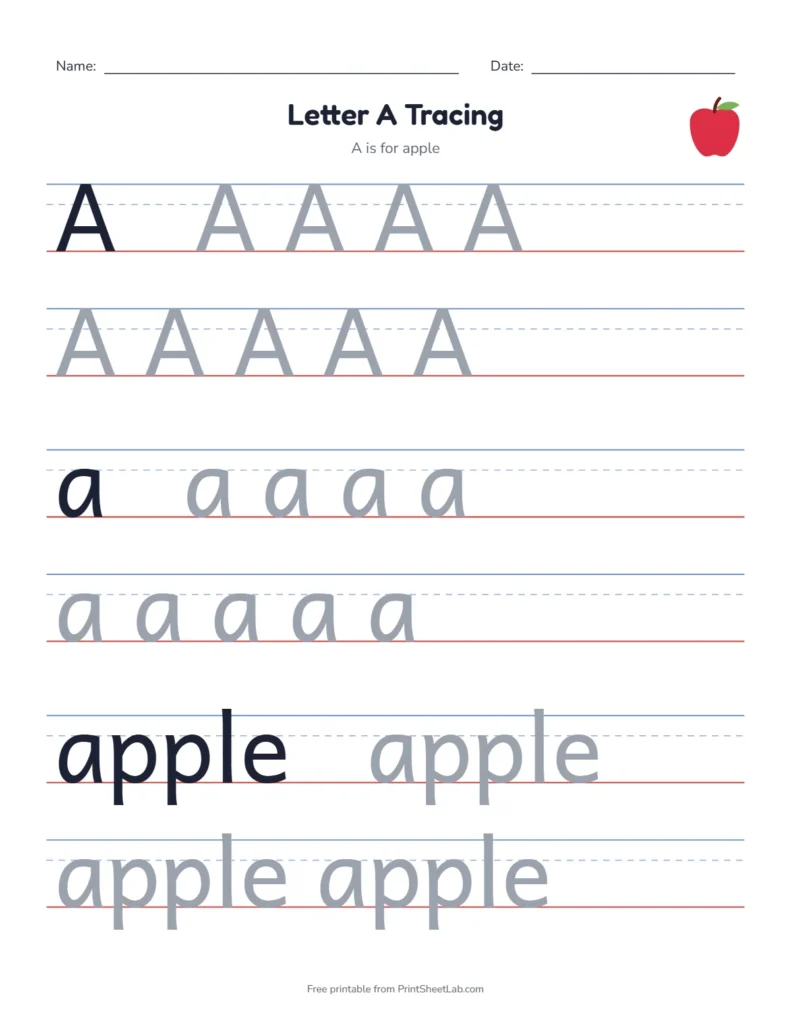
Letter tracing worksheets help children learn to write the alphabet by tracing gray letters on handwriting lines. Pick one letter or all 26 above: each page has uppercase and lowercase rows that start with a dark example and fade as they go, plus a word and a picture that start with the letter (A is for apple, with an apple in the corner). Print a single letter of the week or the whole alphabet tracing pack as one PDF, on US Letter or A4. These alphabet tracing worksheets turn tracing letters into a daily habit: one page, one letter, one picture.
New: after tracing letters, practice whole words with sight word worksheets and the spelling worksheet generator.
Quick answer: Letter tracing worksheets are printable pages where children trace gray letters on handwriting lines to learn how to form each one. Print a single letter, the full A to Z pack, only capitals or only small letters, free on US Letter or A4, with a word and a picture for every letter. Updated October 2026.
Ready-to-print letter tracing worksheets (PDF)
Print a single letter, the full A to Z pack, or only capitals or small letters. Press Customize to change the size, font or paper.
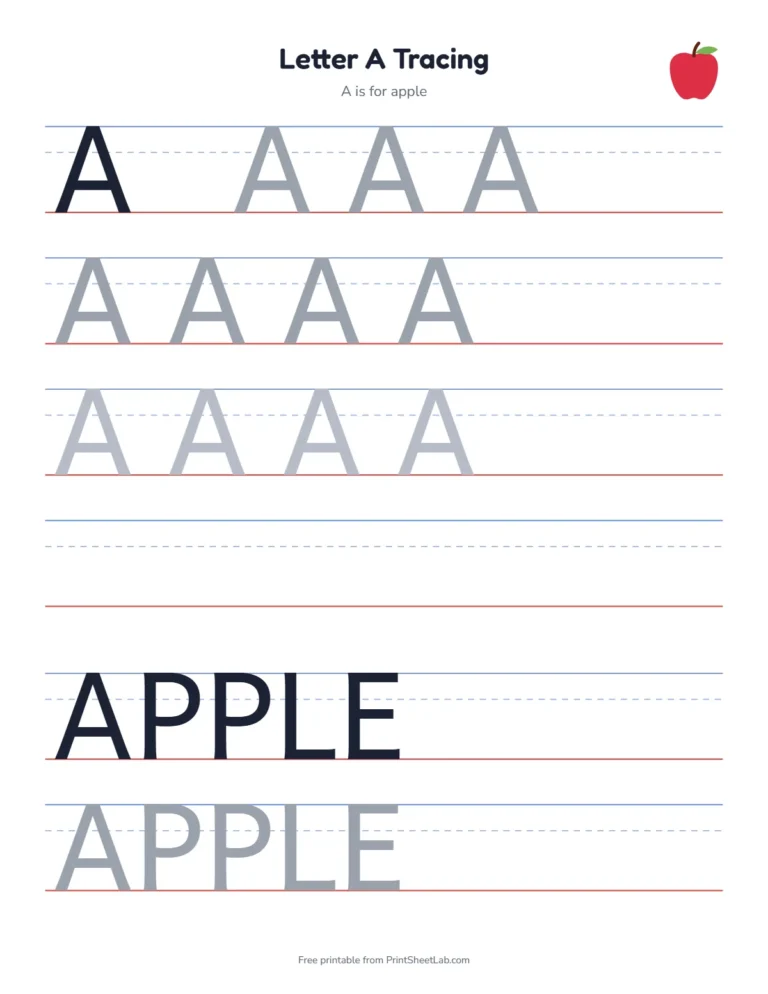
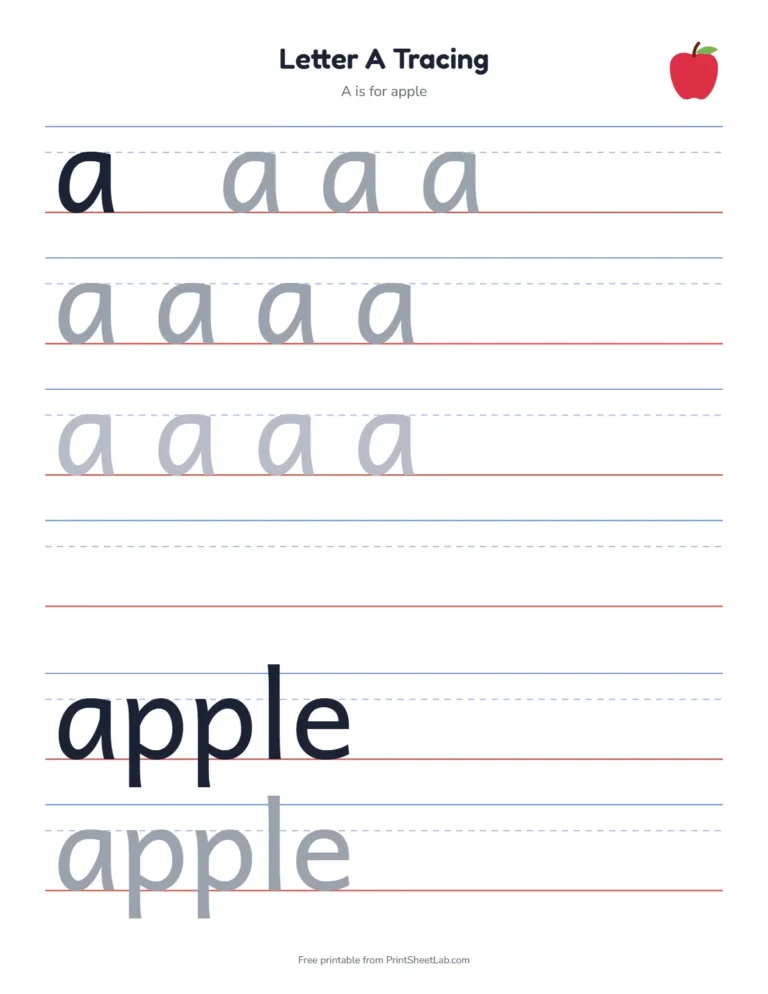
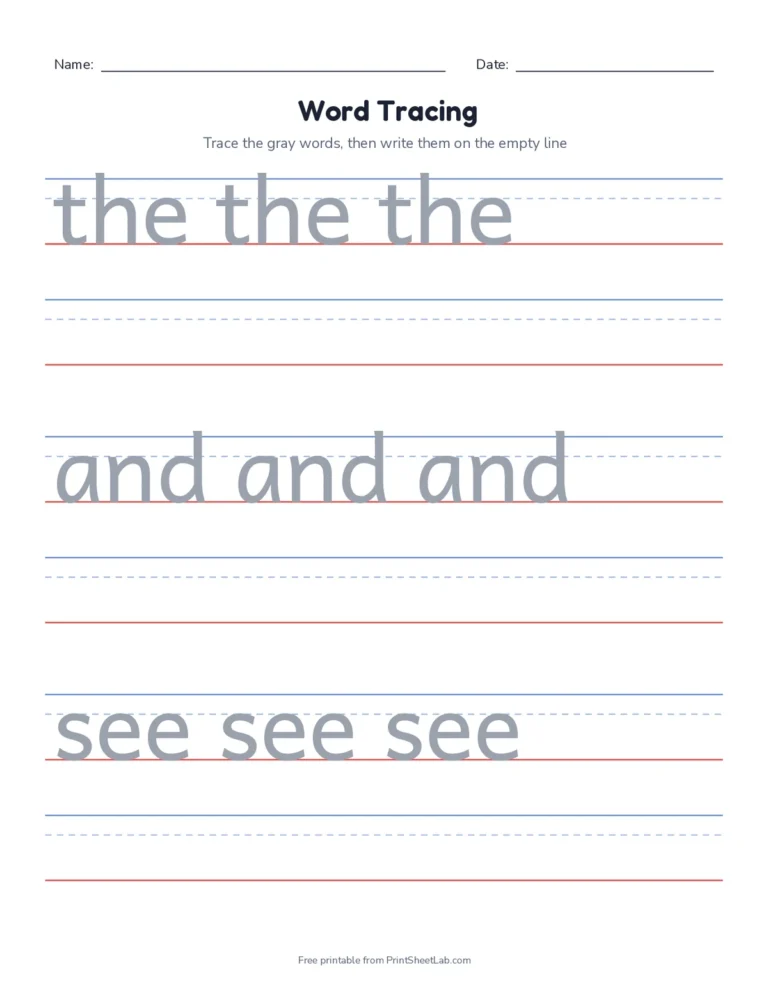
What is on each letter tracing page?
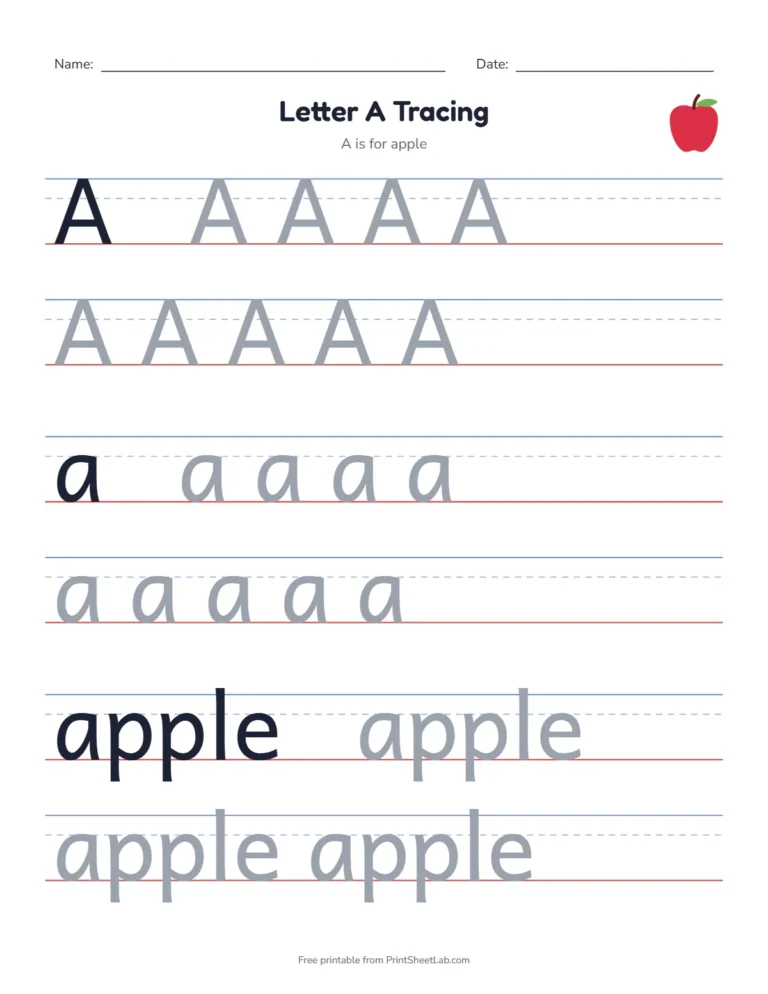
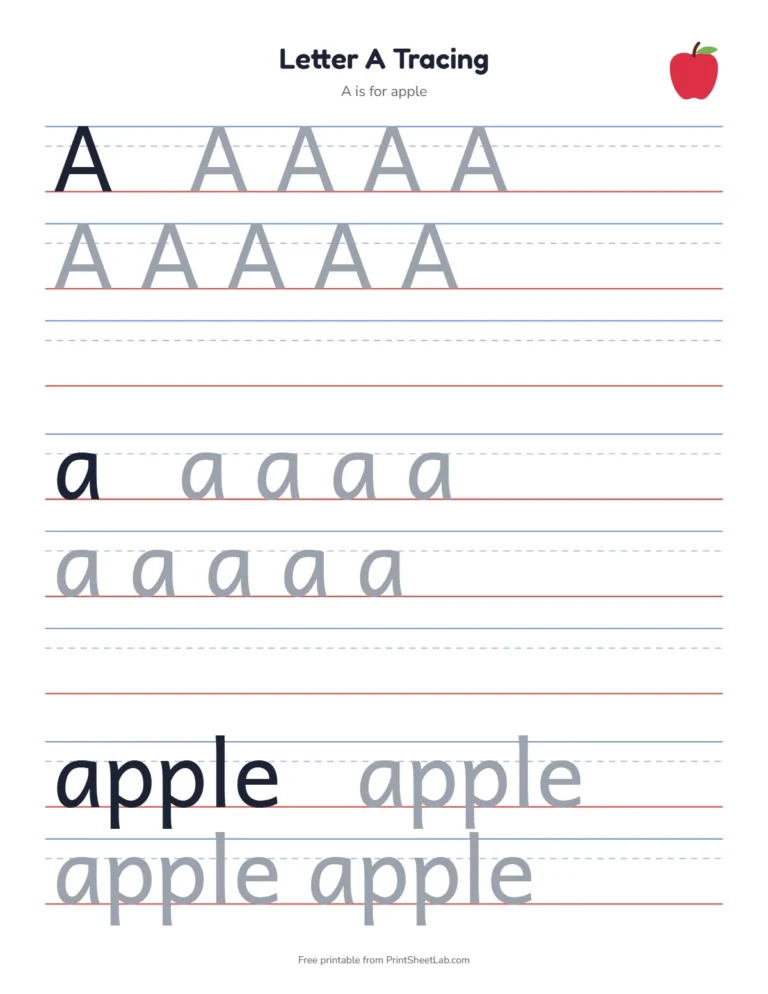
- Uppercase row: one dark capital to copy, then gray capitals to trace.
- Lowercase row: the same for the small letter.
- A word to trace: a simple word that starts with the letter, from apple to zebra, with a colorful picture of it in the top corner of the page.
- Handwriting lines: a blue top line, a dashed middle line and a red baseline, measured to fit the letters exactly.
Which order to teach the letters?
You do not have to go from A to Z. Many teachers start with letters that use similar strokes, so each new letter builds on the last:
- Straight lines: L, F, E, H, T, I.
- Curves: C, O, Q, G, S.
- Slants: V, W, X, Y, Z, A, K, N, M.
- Lowercase “c” letters: c, a, d, g, o, q, which all start with the same curve.
Others teach the letters in a child’s name first, because those are the letters they are most excited about.
Where does each letter start?
Good letter formation matters more than neat tracing. A child who learns to start every letter in the right place writes faster and more legibly later, and finds the move to joined-up or cursive writing much easier. These simple rules cover almost every print letter:
- Start at the top. Tall letters such as b, d, h, k, l and t begin at the top line. Small letters such as a, c, m, n and o begin at the dashed middle line.
- Pull down, not up. Straight lines are drawn from top to bottom, so L begins with a long line down before the short line across.
- Circle letters go counterclockwise. c, a, d, g, o and q all begin like a c: start just right of the top and curve to the left.
- Lift for crosses last. Draw the down stroke of t and f first, then cross it.
- Sit on the baseline. Every letter rests on the red line. Only the tails of g, j, p, q and y drop below it.
Watch the first few letters a child traces. If they start at the bottom or go round the wrong way, gently show the starting point with a dot before they try the next row. The history of penmanship shows how these top-down habits became the standard way handwriting is taught.
Tips for tracing letters
- Start at the top: nearly every letter begins at the top line or the dashed line.
- Say the sound: saying “a says /a/ as in apple” while tracing links the letter shape with its sound.
- One letter a day: a single page per day is enough for preschool and kindergarten.
- Use big letters first: choose Extra large for three and four year olds, then move down to Medium.
- Reuse the pages: put it in a clear plastic sleeve so kids can trace, wipe and try the letter again.
Traceable letters and alphabet letters to trace
Traceable letters are letters printed in light gray so that a child can write over them with a pencil. Each row on our pages starts with a dark model and gets lighter, so children copy first, then trace, then write alone. You will find this page searched as traceable letters, traceable alphabet letters, printable traceable letters, alphabet letters to trace, letters to trace and tracing alphabet letters. They are all the same pages: choose one letter or all 26 in the generator above, then download a PDF. Printable traceable letters work best in a large size for three and four year olds and a medium size for kindergarten.
Alphabet tracing sheets, pages and printables
Parents and teachers describe the same pages many ways: an alphabet tracing sheet, alphabet tracing sheets, alphabet tracing pages, alphabet tracing, tracing alphabet worksheets, tracing letters worksheets, tracing letters practice sheets and tracing letters printable. For an ABC tracing set, print the A to Z pack and the capital and small letter sheets together; ABC trace pages are also in the letter of the week packs on our alphabet worksheets page. Printable letter tracing worksheets and letter tracing printables here are free, with no account, and each page has room for the child to write the letter alone at the end of the row.
Letters by height: where does each letter start?
Every lowercase letter belongs to one of three groups, depending on where it starts and how far it goes. Counting them shows how few shapes there really are to learn:
| Group | Letters | How many | Where to start |
|---|---|---|---|
| Tall letters | b, d, f, h, k, l, t | 7 | Start at the top line |
| Small letters | a, c, e, i, m, n, o, r, s, u, v, w, x, z | 14 | Start at the dashed middle line |
| Tail letters | g, j, p, q, y | 5 | Start at the middle line, tail drops below the red baseline |
| Capitals | A to Z | 26 | All reach the top line |
That is 7 tall letters, 14 small letters and 5 tail letters, which together make the 26 letters of the alphabet. Teaching the groups, rather than the alphabet in order, helps children see why their letters should not all be the same size.
How long does it take to trace the whole alphabet?
The time depends on how many pages you do each week. Because one page is enough for a short session, the plan below finishes the alphabet in as little as six weeks:
| Pace | Letters | Time to finish A to Z |
|---|---|---|
| One letter a day | 1 page a day, 5 days a week | 6 weeks (26 school days) |
| Two letters a week | 2 pages a week | 13 weeks |
| Letter of the week | 1 letter a week with 4 or 5 activities | 26 weeks |
Frequently asked questions
14 quick answers
Are these alphabet tracing worksheets good for preschool?
Yes. Choose Extra large letters for three and four year olds. Our letter tracing worksheets start every row with a dark model, so children know exactly where to begin.
How long should a child spend tracing letters?
Five to ten minutes is plenty. One page of letter tracing worksheets a day, finished calmly, does more than a long session that ends in tired hands.
Are these letter tracing worksheets free?
Yes. Every letter and the full A to Z pack are free to print for home and classroom use, with no sign-up.
Can I print all 26 letters at once?
Yes. Choose All 26 letters in the generator and download one PDF with a page for every letter.
Should children learn uppercase or lowercase letters first?
Many preschools start with uppercase because the strokes are simpler, then add lowercase in kindergarten. Since most reading uses lowercase, some teachers practice both together, which is why each page includes both.
At what age should children trace letters?
Children often start tracing letters around age three or four, once they can hold a crayon and draw lines and circles. Writing letters independently usually comes in kindergarten.
What are the lines on handwriting paper?
The top line is where tall letters reach, the dashed middle line is where small letters reach, and every letter sits on the bottom line, called the baseline.
Which font is best for tracing letters?
A plain school print font with a simple a and g, like Andika, is closest to how handwriting is taught. OpenDyslexic and Lexend are easier for some children to read.
Do the letter tracing worksheets have pictures?
Yes. Each letter page has a word and a matching picture, from an apple for A to a zebra for Z, so children can say the sound, point to the picture and trace the word. You can turn the picture off in the generator if you prefer a plain page.
Can I make tracing worksheets for sight words or spelling words?
Yes. Choose Word list in the generator and type your words, one per line.
Can I print the letter tracing sheets on A4?
Yes. Pick Letter or A4 before you download and the pages are drawn for that paper.
Where can I download free traceable letters?
Open any card in the PDF section above, or use the generator to choose one letter or all 26. Choose US Letter or A4, then print or save the PDF. It is free and needs no account.
What is the difference between tracing letters and writing letters?
Tracing means writing over a gray letter, which guides the hand. Writing means making the letter alone. Each page here ends with an empty row, so children move from tracing to writing on the same sheet.
How many letter tracing pages should a child do a day?
One page a day is enough for most preschoolers and kindergartners, about five to ten minutes, with a break if hands tire.
More tracing practice
- Name tracing worksheet generator for your child’s own name.
- Number tracing worksheets from 0 to 30.
- Handwriting paper for free writing.
- Word search generator for letter and word recognition.
- Cursive writing worksheets for letters, words and names.