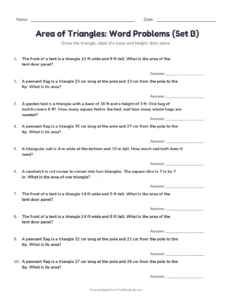
These area of a triangle worksheets practice one formula, A = base × height ÷ 2, from first examples to real problems. The printable sheets cover whole numbers, decimals, finding a missing base or height, right triangles, word problems and composite shapes, each with an answer key on the last page. The maker above writes new triangles whenever you need another set. Work through each area of a triangle worksheet from easy to hard.
Quick answer: The area of a triangle is half its base times its height: A = b × h ÷ 2. A triangle with a base of 10 cm and a height of 6 cm has an area of 30 cm2. This page has 9 free area of triangles worksheets (PDF) with answer keys for grade 6, plus a maker.
Area of a triangle worksheets: ready-to-print samples
A few of the ready PDFs on this page. The full list is under Ready-to-print worksheets, and the maker above makes new problems on demand.
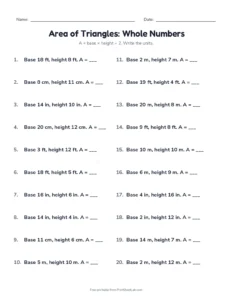
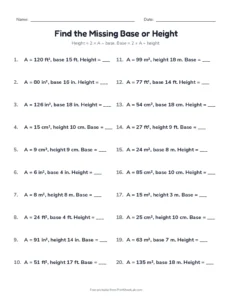
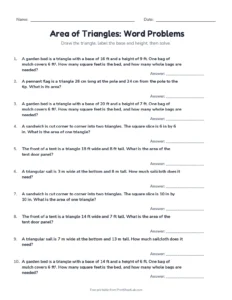
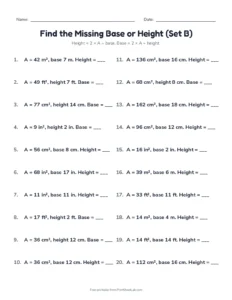
Whole numbersLevel 1 with a full answer key.PDFFind the missing base or heightLevel 3 with a full answer key.PDFWord problemsLevel 5 with a full answer key.PDFComposite shapesLevel 6 with a full answer key.PDF
Area of a triangle formula
A = ½ × base × height, which is the same as A = base × height ÷ 2. The base is any side of the triangle; the height is the straight-up distance from that side to the opposite corner, measured at a right angle. The answer is in square units, such as cm2 or in2.
Why the formula divides by 2
Draw a rectangle around any triangle so it shares the triangle’s base and height. The triangle fills exactly half of that rectangle, so its area is half of base × height. For a slanted triangle the same is true of the parallelogram it makes with a copy of itself turned around.
How to find the area of a triangle: worked examples
Multiply the base by the height, then halve the result. The answer is in square units:
Base
Height
Base × height
÷ 2 = area
10 cm
6 cm
60
30 cm2
7 in
4 in
28
14 in2
13 m
8 m
104
52 m2
9 ft
5 ft
45
22.5 ft2
4.5 cm
6 cm
27
13.5 cm2
12.4 m
3.5 m
43.4
21.7 m2
How to find the area of a triangle in 4 steps
Choose a side to be the base and measure it.
Find the height: the perpendicular distance from that base to the opposite corner.
Multiply the base by the height.
Divide by 2 and write square units.
Which side is the height?
The height is the straight-up distance from the base to the opposite corner. It always meets the base at a right angle.
Any side can be the base, as long as you use the height that goes with it.
In a right triangle, the two legs are the base and the height, so no extra line is needed.
In an obtuse triangle the height can fall outside the triangle. Extend the base with a dotted line to measure it.
Area of a right triangle
In a right triangle the two shorter sides (the legs) meet at a right angle, so one leg is the base and the other is the height. Multiply the legs and halve the result; the longest side, the hypotenuse, is not used. Level 4 of the maker practises exactly this:
Legs
Legs multiplied
Area
6 cm and 8 cm
48
24 cm2
5 in and 12 in
60
30 in2
9 m and 4 m
36
18 m2
If you know the hypotenuse but not both legs, find the missing leg first with the Pythagorean theorem.
Finding a missing base or height
Work the formula backwards: double the area, then divide by the side you know. Level 3 practices this:
Area
Known side
Double the area
÷ known side
Missing side
24 cm2
base 8 cm
48
48 ÷ 8
height = 6 cm
30 m2
height 5 m
60
60 ÷ 5
base = 12 m
45 in2
base 9 in
90
90 ÷ 9
height = 10 in
17.5 ft2
height 7 ft
35
35 ÷ 7
base = 5 ft
Composite shapes with triangles
Split the shape into rectangles and triangles, find each area, then add (or subtract a cut-out piece). For a simple house shape with a 10 ft by 6 ft wall and a roof 10 ft wide and 4 ft tall:
Part
Formula
Area
Rectangle wall
10 × 6
60 ft2
Triangle roof
10 × 4 ÷ 2
20 ft2
Whole house shape
60 + 20
80 ft2
Try ten practice problems
A warm-up across all six levels. Answers are in the right-hand column.
#
Problem
Answer
1
Base 12 cm, height 5 cm
30 cm2
2
Base 9 m, height 4 m
18 m2
3
Base 7 in, height 3 in
10.5 in2
4
Base 6.4 cm, height 5 cm
16 cm2
5
Right triangle with legs 8 ft and 15 ft
60 ft2
6
Area 36 m2, base 9 m. Find the height.
8 m
7
Area 21 in2, height 6 in. Find the base.
7 in
8
A sail 4 m wide and 9 m tall
18 m2
9
A 6 ft by 4 ft rectangle with a 6 ft wide, 3 ft tall triangle on top
33 ft2
10
Base 2 m, height 50 cm (answer in cm2)
5,000 cm2
Common mistakes with the area of a triangle
Mistake
Example
Fix
Forgetting to divide by 2
base 10, height 6: A = 60
A triangle is half a rectangle: 60 ÷ 2 = 30
Using a slanted side as the height
Multiplying the base by the long sloping side
The height must meet the base at a right angle
Leaving off square units
A = 30 cm
Area is measured in square units: 30 cm2
Mixing units
base 2 m, height 50 cm: A = 50
Convert first: 2 m = 200 cm, A = 200 × 50 ÷ 2 = 5,000 cm2
Dividing by 2 when finding a missing side
A = 24, base 8: height = 24 ÷ 8 = 3
Double the area first: 48 ÷ 8 = 6
Which area of a triangle worksheet should you start with?
Start with whole numbers, add decimals, then work backwards to missing sides. Levels 1, 3 and 5 have a Set B for a retest.
Find the area of right triangles, other triangles, special quadrilaterals and polygons by composing into rectangles or decomposing into triangles and other shapes, and use this in real-world problems
Start with the first area of a triangle worksheet, then move on to the harder sheets once the formula feels easy.
Frequently asked questions
6 quick answers
What is the formula for the area of a triangle?
A = base × height ÷ 2, often written A = ½bh. The height must be measured at a right angle to the base.
Why do you divide by 2?
A triangle is exactly half of a rectangle (or parallelogram) with the same base and height, so its area is half of base times height.
How do you find the height of a triangle from its area?
Double the area and divide by the base. For an area of 24 cm2 and a base of 8 cm, the height is 48 ÷ 8 = 6 cm.
What grade learns the area of a triangle?
Grade 6, in Common Core standard 6.G.A.1, which also covers composite shapes.
Are these area of a triangle worksheets free?
Yes. Open any sheet in the Ready-to-print list, choose US Letter or A4, and print or save the PDF. Each one has an answer key and no sign-up is needed.
Which area of triangles worksheet should my child start with?
Start with level 1, whole numbers, then add decimals at level 2 before working backwards to a missing base or height at level 3. Right triangles, word problems and composite shapes follow, and levels 1, 3 and 5 have a Set B for a retest.
We hope you're enjoying Print Sheet Lab! Need a different option, noticed something missing, or have an idea for a new tool or calculator?
Whether it's a small improvement, a technical issue or something customized for your business, we'd love to hear from you.
✓ Existing tool improvements and bug fixes – Free
✓ Custom calculators, tools and websites – Affordable development charges
We aim to respond within 24 hours.
How Can We Help You?
Tell us what you're looking for. Whether you need an improvement to an existing tool, want to report an issue, or have an idea for something new, we're here to help.
✓
Thank you for sharing your request!
We've successfully received your message. Our team will review it and aim to respond within 24 hours.
We'll contact you at your provided email address with an update.