Change the numbers, layout and number of problems, then download a new PDF with its answer key.
These frog life cycle worksheets give children four printable pages for the four stages of the life cycle of a frog: eggs, tadpole, froglet and frog. Children read a labeled diagram, label the stages from a word bank, cut and glue the pictures in order, and draw the cycle from memory. Every page has an answer key, and you can print in color or in black and white, on Letter or A4 paper.
Frog life cycle worksheets to print (PDF)
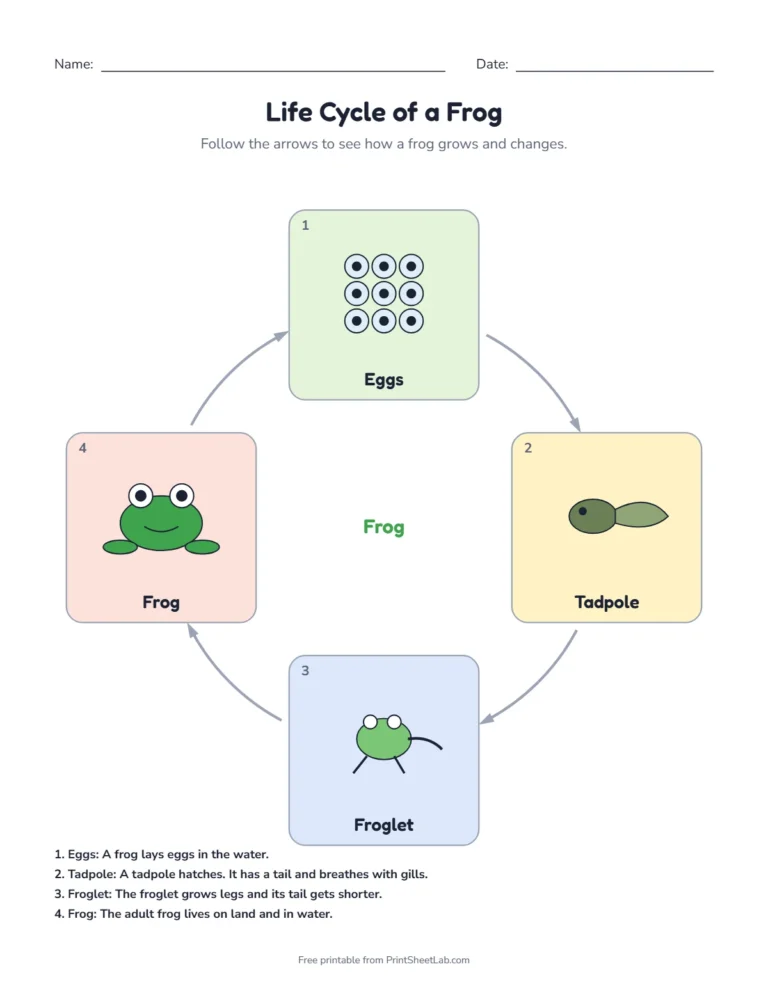
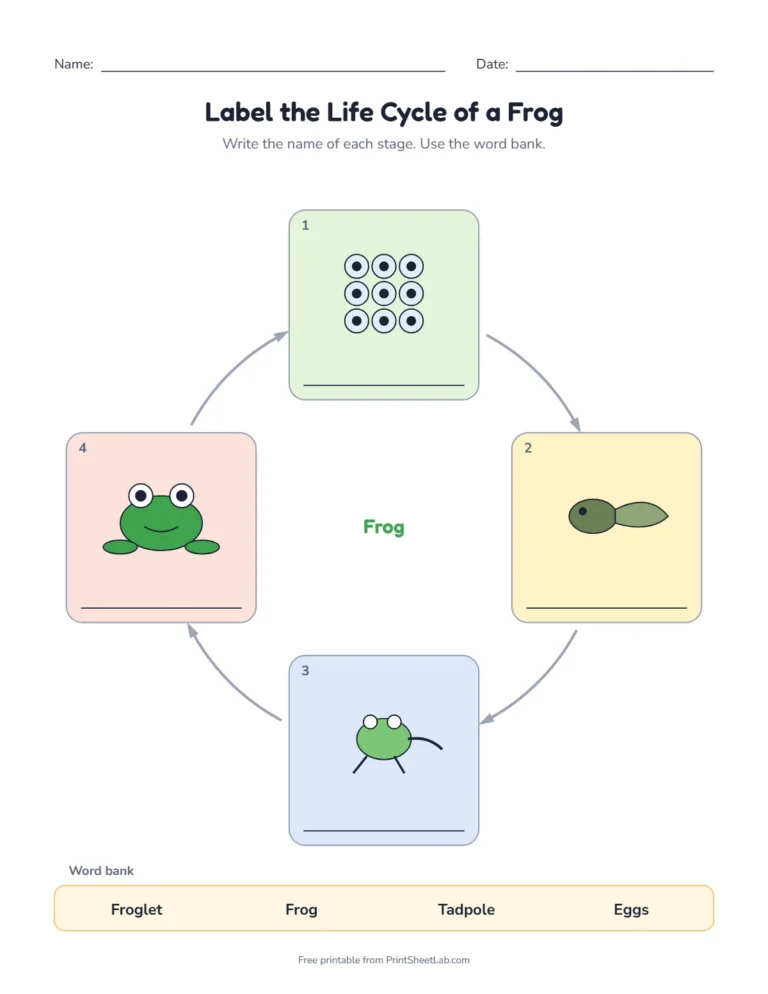
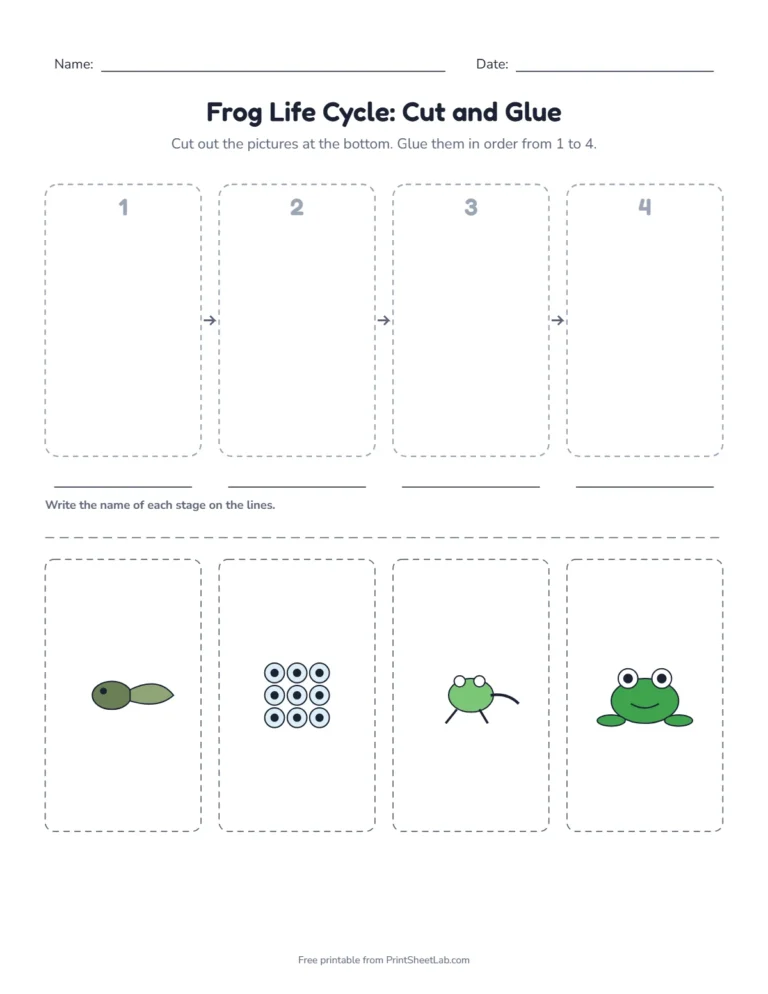
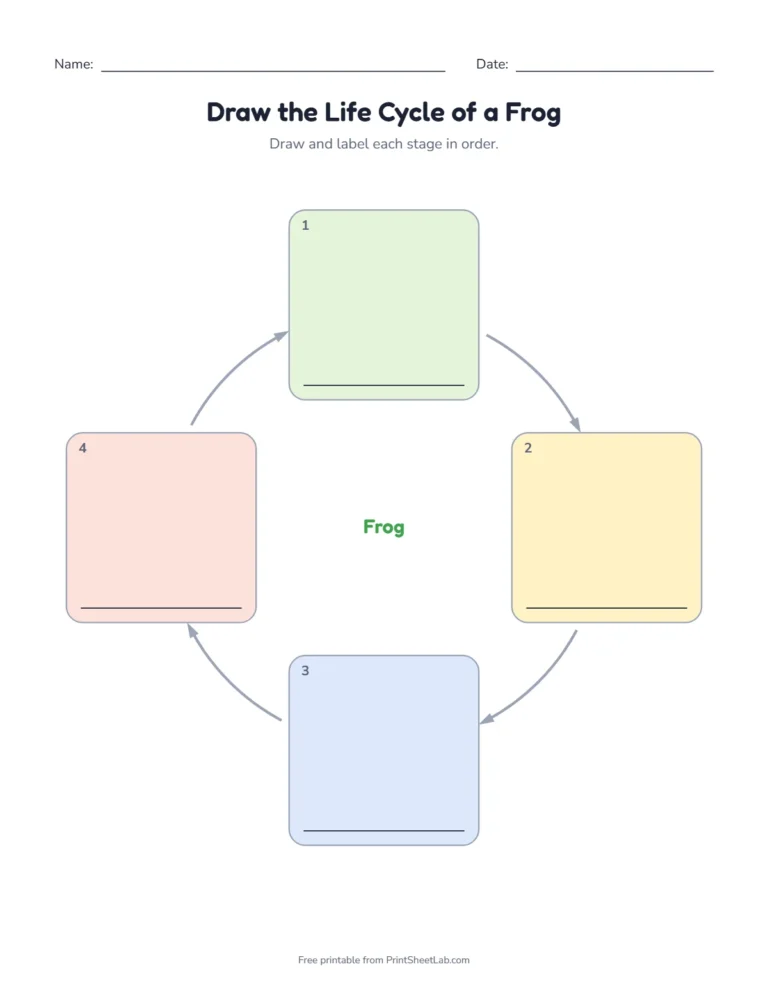
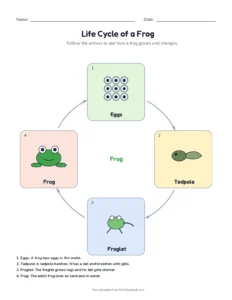
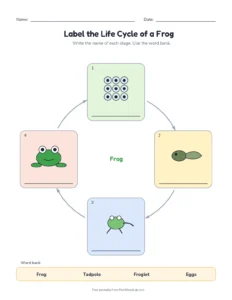
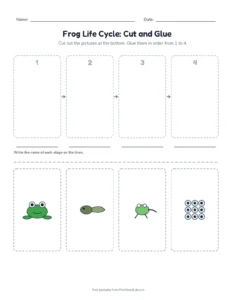
These four pages show what the generator prints for the frog life cycle worksheets: the labeled diagram, the label-it page with a word bank, the cut-and-glue page for putting the four stages in order, and the draw-it page with room for your own pictures. Click any picture for the PDF, or use the generator at the top of the page to choose a single page, switch to black and white, or print on A4 paper.
Life cycle diagramAll four stages, with a sentence each.PDFLabel the cycleWrite each stage from the word bank.PDFCut and gluePut the four stages in order.PDFDraw the cycleDraw and label it from memory.PDF
The life cycle of a frog, from eggs to adult
The frog life cycle has four stages, and children learn it best as a circle that goes round and round:
Eggs → Tadpole → Froglet → Frog.
A frog is an amphibian, and it goes through metamorphosis, a big change from a water animal with gills to an adult that breathes air. The times below are for the common frog of Europe, in a pond in spring. Other species can be much faster or slower.
Frog life cycle stages in order
Stage
What happens
How long
Key word
1. Eggs
The female lays a clump of jelly-covered eggs, called frogspawn, in shallow water. A common frog lays about 1,000 to 2,000 eggs.
About 2 to 3 weeks
frogspawn
2. Tadpole
A tiny tadpole hatches. It has a tail, breathes with gills and eats algae. Back legs appear first, then front legs.
About 12 to 16 weeks
gills
3. Froglet
The young frog has four legs and a short tail, which its body absorbs. Its gills close and it grows lungs.
A few weeks
lungs
4. Frog
The adult frog lives on land and in water, breathes through lungs and skin, and eats insects. It can breed at about three years old.
Adult at about 3 years
amphibian
Frog life cycle for kids: how a tadpole turns into a frog
A tadpole’s body is made for water: a long tail for swimming, gills for breathing and a mouth that scrapes algae. A frog’s body is made for both land and water: strong back legs for jumping, lungs and moist skin that can take in oxygen, and a long sticky tongue for catching insects. The change in between is called metamorphosis, and it follows a clear order:
The back legs grow first, then the front legs.
The gills are covered by skin and the lungs develop.
The mouth widens and the diet changes from plants to insects.
The tail shrinks as the body takes in its tissue; it does not simply drop off.
Frogs and toads compared
Feature
Frog
Toad
Skin
Smooth and moist
Dry and bumpy
Back legs
Long, for big jumps
Short, for walking and short hops
Eggs
A clump of spawn
Long strings of eggs
Home
Close to water
Often far from water, except to breed
Why so many eggs?
A female frog may lay a thousand eggs or more because most will not survive. Fish, birds, beetles and other pond animals eat the eggs and the tadpoles, and only a few of the thousands become adult frogs. It is a good way to talk with children about food chains and about why frogs need clean, safe ponds.
Frog life cycle printable: what is in the set
The generator at the top of the page makes five pages for the frog life cycle worksheets, and you can print all of them or choose one. Every page uses simple pictures that children can color, and all of them have a name and date line.
Page
What children do
Skills
Life cycle diagram
Read: all four stages with a picture and a sentence for each
Vocabulary and the order of the stages
Label the cycle
Write each stage name from the word bank (Eggs, Tadpole, Froglet, Frog)
Spelling and recall
Cut and glue
Cut out four pictures and glue them in the right order
Sequencing and fine motor skills
Draw the cycle
Draw each stage and label it from memory
Making a model of the cycle, with lines for writing
Answer key
A completed label page and sequence page for the teacher
Quick marking
Frog life cycle worksheet: how to use it in four steps
Choose the pages. In the generator, pick all four pages of the frog life cycle worksheets with the answer key, or one page at a time.
Print. Press Download PDF or Print, in color or in black and white, on Letter or A4 paper.
Teach the stages. Read the diagram together and say the stages in order: Eggs → Tadpole → Froglet → Frog.
Practice and check. Children label, cut and glue and draw, then check their work with the answer key.
Vocabulary for the frog life cycle worksheets
Teach these words before children start the frog life cycle worksheets, and use them again when you check the answers:
Word
What it means
amphibian
An animal that starts life in water and lives on land as an adult
frogspawn
The clump of jelly-covered frog eggs
tadpole
The young frog that lives in water and has gills and a tail
gills
Body parts that take oxygen from water
froglet
A young frog that still has part of its tail
metamorphosis
A big change in body shape from young to adult
lungs
Body parts that take oxygen from air
algae
Tiny water plants that tadpoles eat
Hands-on activities to go with the frog life cycle worksheets
Pond visit: look for frogspawn in spring, from the edge, and count how many clumps you can find without touching them.
Jelly experiment: put a spoonful of unflavored gelatin dessert in a cup of water and talk about what the jelly does for the eggs.
Leap measure: children jump like frogs and measure the distance of each leap with a ruler.
Compare with a butterfly: both change completely, but a butterfly has a chrysalis stage and a frog does not.
Sequence cards: cut the four pictures from the cut-and-glue page and shuffle them for a partner.
Wikipedia’s frog article describes frog biology, the life cycle and the thousands of species around the world.
Frog life cycle worksheets by grade
Grade
How to use the pages
Kindergarten and Grade 1
The diagram and the cut-and-glue page: name the four stages and put them in order
Grade 2
The label-it page with the word bank, plus a pond-visit drawing
Grade 3
The draw-it page used as a model, linked to NGSS 3-LS1-1: organisms have unique and diverse life cycles, with birth, growth, reproduction and death in common
Frog life cycle worksheets: frequently asked questions
How many stages are in the frog life cycle?
Four in most classroom versions: eggs, tadpole, froglet and adult frog. Some teachers split the tadpole into early and late stages.
How long does it take for a tadpole to become a frog?
For the common frog it takes about 12 to 16 weeks, and the frog is fully grown at about three years. Other species, such as bullfrogs, can take much longer as tadpoles.
Why does a tadpole have a tail and a frog does not?
The tail helps a tadpole swim. As the tadpole becomes a frog, its body absorbs the tail and uses the material to grow legs and organs.
Which grade learns about the frog life cycle?
Life cycles appear from kindergarten, and grade 3 develops models showing that organisms have unique and diverse life cycles with birth, growth, reproduction and death in common (NGSS 3-LS1-1).
Are these frog life cycle worksheets free?
Yes. Every page is free to print for home and classroom use, with no sign-up. Choose color or black and white, and Letter or A4 paper, before you press Download PDF.